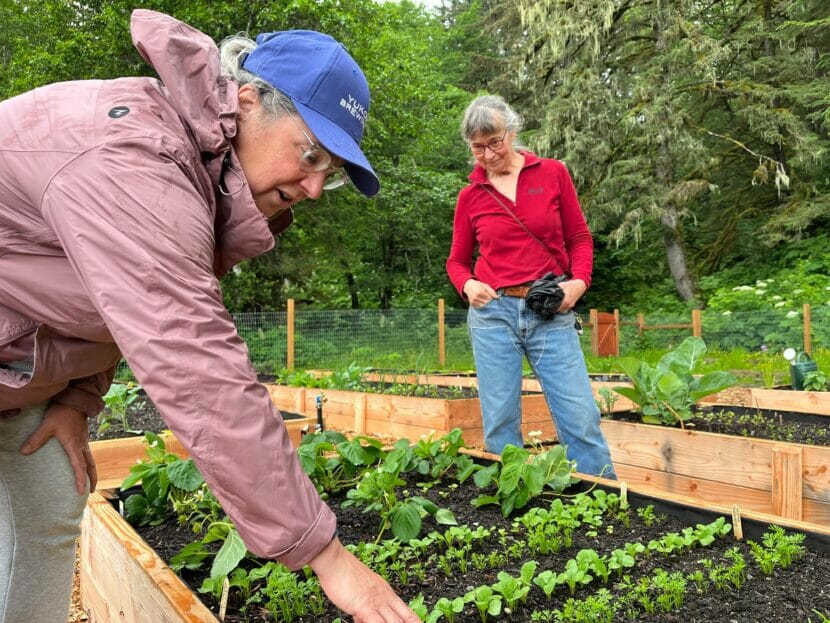
Lauren Smoker points out her vegetables at Thane Community Garden while Judy Sherburne looks on. June 29, 2023. (Photo by Yvonne Krumrey/KTOO)
Judy Sherburne says she’s often thinking about how people in Juneau get their food.
“I’ve heard predictions that if we did not have a barge for a week, we’d be pretty lean,” she said. “And a couple of weeks would be pretty serious.”
Sherburne organized the Thane Community Garden, which is in its first growing season. She wanted there to be a place for her neighbors to come together to plant in a sunny, flat community space.
The garden has about 40 beds. As of late June they are all in use, with new growth coming up. Sheep Creek rushes by in the background. Some beds have plastic hoops covering the veggies, others have shiny windmills to deter ravens.
Lauren Smoker helped get the project going. She has her own 20 foot by 4 foot bed.
“Lingít potatoes in one half of it,” she said. “And then I’ve got some strawberries, some radish, spinach, shallots and broccoli.”
Her chives are tall already. It’s Smoker’s first time growing vegetables, and she’s not the only beginner, Sherburne says.
“A lot of newbies here,” she said. “Not only new to gardening but new to getting to know their neighbors.”
She says she’s made new friends in the garden. And what they grow here will help put quality food on the table and lower their grocery bills. She says about 10% of the people who are growing plots this summer live on fixed incomes, which makes it harder to keep up with rising food costs.
“There are other people who don’t have jobs, that may be lower income,” she said.
While the plots aren’t large enough to live off, Sherburne says even a little bit of fresh organic food can make a difference in someone’s health. She gestures to a row of kale.
“It’s not going to make or break somebody that might be in that situation, but it could complement what they’re able to do with their income,” she said. “Having a fresh salad on the table every night is huge.”
Sherburne says she plans to start offering classes soon. She wants to teach people how to make the most of a garden plot in this climate, and what nutrients they can get from the different things they can grow.
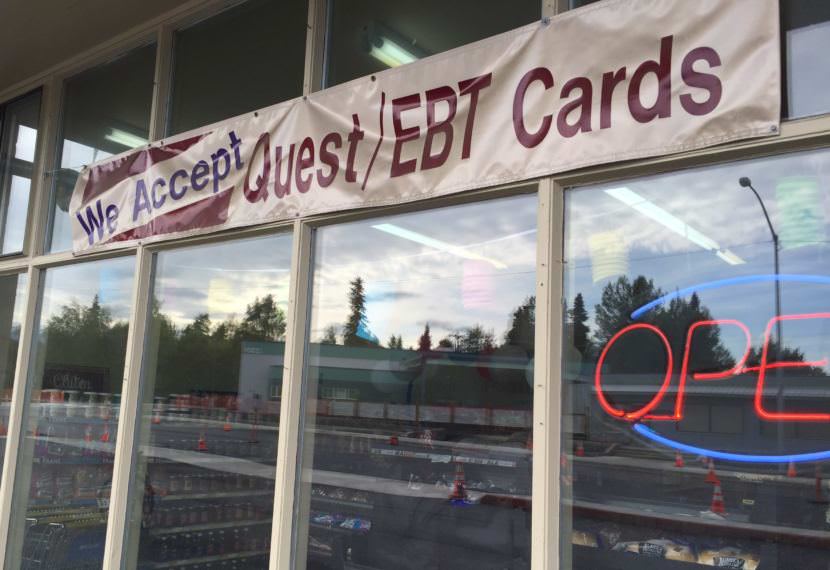
A sign outside of a store in midtown Anchorage announcing that they accept EBT Cards, the distribution method for SNAP benefits. (Photo by Anne Hillman/Alaska Public Media)
The division of state government that handles food stamps has made progress in eliminating the backlog of thousands of Alaskans waiting for aid, but it still has work to do.
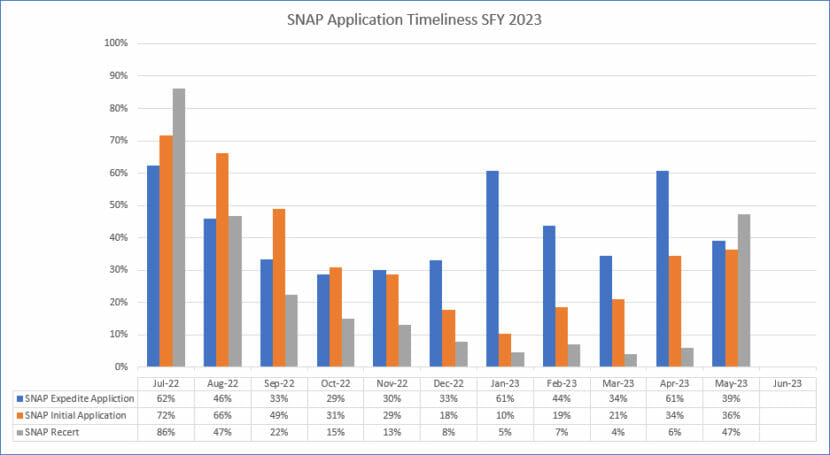
Families must have their income checked periodically in order to keep receiving food stamps. But sharp delays in those recertifications kept families waiting months for food aid. In March, only 4% were done on time. But the most recent Division of Public Assistance data shows a rebound — now nearly half of the recertifications are processed within a month.
That’s still a long way from the target, which is to get them all done within 30 days, but division Director Deb Etheridge said on Monday that it shows things are going in the right direction.
“Once we can get rid of those backlog numbers, then you start to see the real timeliness. As long as we have numbers in the backlog, you’re not going to see the actual timeliness,” she said.
In other words, things are still slow because the division is working against a deficit. Etheridge said that the division finished processing the part of its backlog that is recertifications — those accounted for most of the backlog that began to grip the state last fall and intensified through the winter and spring.
The backlog of new applicants is down also, to about 5,500 people and families. Of those, roughly 255 are expedited applications, which are supposed to be processed within 10 days. Applications qualify to be expedited for several reasons, including extreme financial need. Etheridge said she hopes her division can finish that expedited list within a couple of weeks.
State data shows that the division is processing less than half of those new food stamp applications on time, but Etheridge said that’s because the division was focused on clearing the waiting list of recertifications and expedited applications.
“You won’t see the improvement in timeliness in new applications or expedites on that chart, but you’ll see it in recertifications,” she said. “That’s all part of the strategy.”
Data and graph from the Alaska Department of Health.
Fewer people waiting
During the height of the backlog, people waiting more than a month for food stamps could enlist pro-bono help from Alaska Legal Services to ask for a hearing to get the state to process their applications. Demand for the service was so high early in the year that the group took on extra volunteer attorneys to help. Leigh Dickey, the group’s advocacy director, said the demand for their services has tapered, but it hasn’t disappeared.
“We are seeing fewer requests for help,” she said. “But we are still seeing clients who are experiencing delays at recertification. So I know the state has been saying that they’ve cleared the SNAP recertification backlog. And that’s not true based on our caseload.”
Dickey said the group has gotten requests for help with recertifications from April, May and June.
Etheridge said sometimes recertification applications do go into a backlog when the division is waiting on extra information. Or, she said, people waited too long to recertify and have to reapply, so the system counts them as a new application rather than a recertification — even if that applicant has received food stamps before. If there are any Alaskans waiting on a recertification, she said, she wants to hear about it: “We’ll process that application,” she said.
Solutions
The state is on track to have an online application for food stamps by December, according to Etheridge. It has been developed and reviewed and is currently in the testing process with the federal government. Most states use them. The benefits include less paperwork for clients, better applications for workers, and a reduced reliance on the mail, Etheridge said.
The division also has a new cohort of about 15 hires that should be in training soon, she said, some of whom were promoted from within the division.
“We’re not growing the number of staff as fast as I would like to see,” she said, but added that part of the reason growth is slow is those internal hires – so the state has to fill vacancies caused by the promotions – along with some turnover.
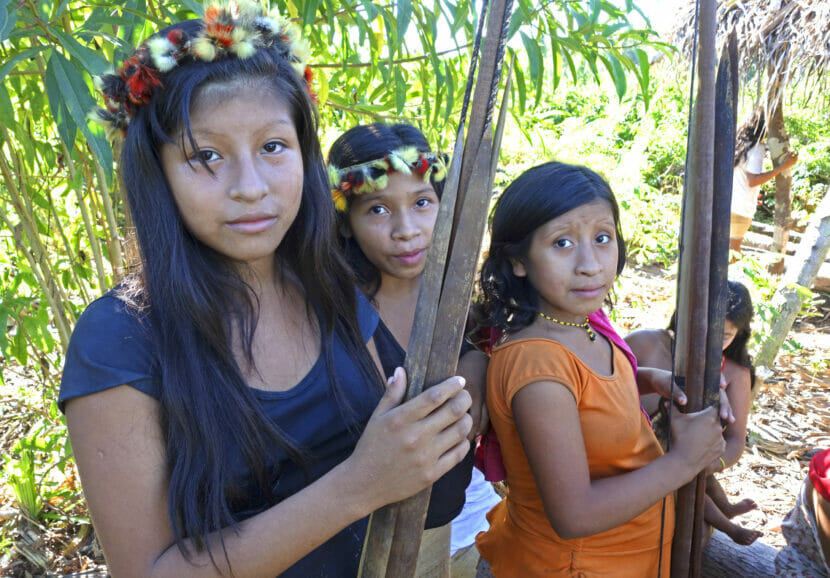
A group of young women from the Awa people in Brazil hold their bows and arrows as they return from a hunt. A new reexamination of ethnographic studies finds female hunters are common in hunter-gatherer societies. (Scott Wallace/Getty Images)
For decades, scientists have believed that early humans had a division of labor: Men generally did the hunting and women did the gathering. And this view hasn’t been limited to academics. It’s often been used to make the case that men and women today should stick to the supposedly “natural” roles that early human society reveals.
Now a new study suggests the vision of early men as the exclusive hunters is simply wrong – and that evidence that early women were also hunting has been there all along.
Specifically, the new research upends one of the key strands of evidence that scientists have relied on to infer what life was probably like during the period that started roughly 200,000 years ago, when homo sapiens first emerged as a species.
Direct evidence is limited because that phase ended about 9,000 years ago, as people slowly began to develop agriculture and settlements. But all over the world, there have been groups, often in remote areas of low- and middle-income countries, who still live a hunting and foraging life. So scholars look to them as a sort of window into humanity’s past. Anthropologists and other specialists have gained these groups’ permission to live alongside them and have produced detailed observational reports.
Until now, the general sense among scientists has been that these accounts overwhelmingly pointed to men mainly hunting and women mainly gathering, with only occasional exceptions, says Robert Kelly, professor of anthropology at the University of Wyoming and the author of influential books and articles on hunter-gatherer societies.
But Kelly says that the views he and others held of the typical gender divisions around hunting were based on anecdotal impressions of the reports they’d been reading, combined with the field work many had engaged in personally. “No one,” says Kelly, had done a systematic “tally” of what the observational reports said about women hunting.
Enter the researchers behind the new study: a team from University of Washington and Seattle Pacific University. “We decided to see what was actually out there” on hunting, says the lead researcher Cara Wall-Scheffler, a biological anthropologist.
A fresh look at old evidence
Wall-Scheffler and her collaborators combed through accounts from as far back as the 1800s through to present day. And rather than relying on summaries of those accounts – as scientists often do when analyzing large numbers of them – Wall-Scheffler notes “our goal was to go back to the original ethnographic reports of those populations and see what had actually been written about the hunting strategies.”
Their findings — published in the journal PLOS One this week — is that in 79% of the societies for which there is data, women were hunting.
Moreover, says Wall-Scheffler, this wasn’t just opportunistic killing of animals that the women happened upon. The vast majority of the time, she says, “the hunting was purposeful. Women had their own toolkit. They had favorite weapons. Grandmas were the best hunters of the village.”
In other words, “the majority of cultures for whom hunting is important train their girls and their women to make their tools and go hunting,” she says. Wall-Scheffler says she was expecting to find evidence of women hunting – but not to this extent. “That piece has just been really underappreciated,” she says, “even though it’s right there in literature.”
The implications of these results are potentially enormous, says Kimberly Hamlin, a professor of history at Miami University in Oxford, Ohio who specializes in ways that evolutionary science has figured in the wider culture.
“I think that next to the myth that God made a woman from man’s rib to be his helper, the myth that man is the hunter and woman is the gatherer is probably the second most enduring myth that naturalizes the inferiority of women,” says Hamlin.
It has fueled the idea, she says, that “men are supposed to be violent, they’re supposed to be aggressive – one of the core elements in the soup of toxic masculinity” used to excuse damaging male behaviors, including rape.
The popular narrative of man as the sole – or at least almost exclusive – hunter has also been used implicitly and even explicitly to argue for policies that prioritize men’s role as the “natural breadwinner” – and that also limit them to that role by, for instance, denying them paternity leave, adds Hamlin.
By the same token, she maintains, “this idea that somehow women are naturally preordained to be caretakers and maternal figures, whether they like it or not,” often underlies policies that effectively “force motherhood on women” – including policies that restrict access to abortion and contraception.
So the new study’s findings are “thrilling,” concludes Hamlin. “It’s really going to encourage us to call into question a lot of these ideas about what men and women are supposedly naturally like.”
For scientists, a shifting narrative about hunters
As to how consequential the study’s findings are for science, scholars say they add to a body of evidence that has been building for years.
Kelly says that notwithstanding the endurance of stereotypes around early human hunting in popular culture, scientists had already moved to a more nuanced picture.
As far back as the mid-1960s, says Kelly, scientists were coalescing around evidence that most of the diet in hunter-gatherer societies has come from plant food gathered by women. “People were saying, ‘We should call them ‘gatherer-hunters’ to emphasize that.’ ”
By the 1980s, adds Kelly, many more women had entered the field of anthropology. Compared to their male predecessors, these women scientists were often able to gain more access to women in foraging societies. The result was a slew of new descriptions of women’s activities – including more accounts of women hunting.
So Kelly’s initial reaction to Wall-Scheffler’s study is that, while its organization and tabulation of the data is “genuinely new and useful,” when it comes to the picture it paints of the hunting practices of women, “there wasn’t anything that struck me as eye-opening. I sort of knew all of this.”
Yet one finding did stick out to Kelly. He says that the current consensus view holds that even when women do some hunting, they engage in a very different form of hunting than the kind done by men.
“The general pattern is that men intentionally go out to hunt large game,” says Kelly. “And women intentionally go out to gather plant food and also intentionally or opportunistically will hunt the smaller, more reliably-gathered game” – meaning animals like lizards and rabbits.
By contrast, the new study found that in a third of societies for which there is data, the women hunt large game. In other words, they do go after the kind of big mammals associated with the stereotype of male hunters.
“I would consider that something new,” Kelly concedes, adding “I’d really like to go look at those ethnographies” that were the source.
Vivek Venkataraman of the University of Calgary is another anthropologist expressing doubts.
He notes that Wall-Scheffler and her colleagues had to limit themselves to societies for which there were explicit accounts of not just hunting practices, but precisely who was doing the hunting. The result is that the study is based on observations of 63 groups.
“But of course there are several hundred foraging societies,” says Venkataraman. “We need to know what’s going on there before we can draw any sweeping conclusions.”
Key clues that were overlooked
Randy Haas disagrees with the critics of the study. An anthropologist at Wayne State University, Haas notes that the societies Wall-Scheffler’s study analyzes are well distributed across the globe. Furthermore, says Haas, “more data is not always better. My sense is that [the evidence used in the study] is a well-structured, high quality sample that is actually more likely to yield a reliable result than a larger sample of lower quality observations.”
What’s more, Haas says, his own experience illustrates how the “near universal” view of men as the sole big-game-hunters may be warping researchers’ ability to recognize data to the contrary. In addition to creating blind spots in the understanding of modern hunter-gatherer societies, Hass says it also appears to have led scientists to overlook key clues from the other main source of evidence on early humans: ancient burial sites and the human remains and artifacts found there.
In 2018 Haas was part of a team in Peru that found a 9,000-year-old person buried with an unusually large number of hunting tools. “We all just assumed this individual was a male,” he recalls. “Everybody is sitting around, saying things like, ‘Wow! This is amazing. He must have been a great hunter, a great warrior. Maybe he was a chief!’ ”
Haas didn’t even think to question the person’s gender until about a week later, when a colleague who specialized in analyzing bone structure arrived and delivered a bombshell assessment: The remains seemed to be female.
The team then used a technology newly available to the field. Scraping the enamel from the teeth found in the grave, they found proteins that confirmed it unequivocally: This apparent master hunter was female.
Stunned, Haas and his collaborators decided to review the records of similar finds across the Americas over the previous 70 years. In 27 gravesites of individuals found with hunting tools, they found 11 cases in which the person was female.
They ran a statistical analysis that finds that this ratio is associated with the probability that between 30-to-50% of individuals buried with hunting tools in ancient American gravesites are female. In other words, says Haas, “Large mammal hunting during this time in the Americas was a gender neutral activity, or at least nearly so.”
Why did this take so long?
Why hadn’t these findings commanded the world’s attention sooner?
Haas says in one of the excavation records he and his collaborators re-analyzed – the 11,000-year-old remains of a female found in the 1970s with a pointy stone tip laid under her head – the scientists who had originally uncovered the grave had effectively ignored their own discovery.
Says Haas, “They had written something to the effect of, ‘Had this [pointy stone] been associated with a male we would have assumed this to be a hunting weapon. But given its association with a female, its use as a kitchen tool would make more sense.” Haas and his co-authors decided it should be reclassified as a hunting tool.
Yet what’s even more notable, says Haas, is that in all but one other case, his team did not need to revise the conclusions of the original excavators: Those scientists had already determined that the individuals they’d found were females buried with hunting weapons. Just as with the findings in Wall-Scheffler’s study, the archaeological evidence had been available the whole time – hiding in plain sight.
“Everybody had just taken this man-the-hunter hypothesis for granted. So no one really decided to evaluate it,” says Haas. “It wasn’t really a question on a lot of people’s minds.”
But Cara Wall-Scheffler had seen Haas’s findings, and they were precisely what prompted her to launch her review of the modern-day accounts.
Wall-Scheffler says the episode offers a reminder of why it’s so important to ensure the scientific community includes people of diverse backgrounds.
“The preconceptions that we all have when we look at a data set really shape the outcome,” she says. “I’m really hoping that people take second looks at some of the data that they already have to see what new questions we can ask.”
Copyright 2023 NPR. To see more, visit https://www.npr.org.
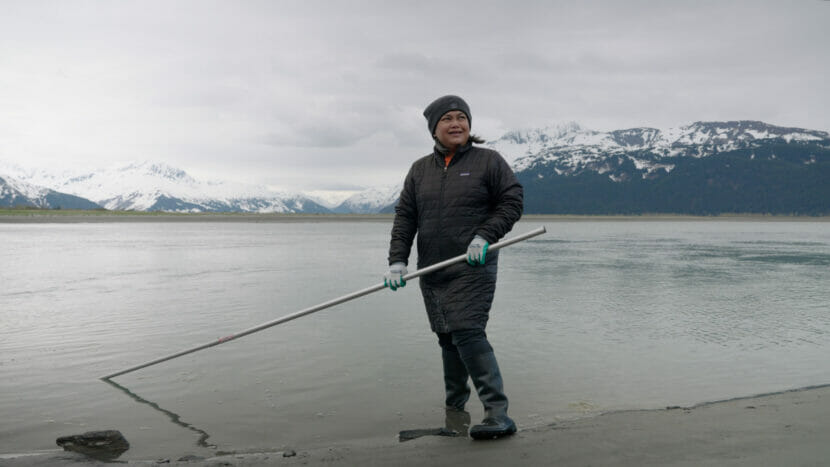
Ratdawan Haywood was the lone hooligan fisher in the Twentymile River area on the last day of May, trying her luck after being able to fill her five-gallon bucket several times the week prior. (Young Kim)
On the last day of May, Ratdawan Haywood tried her luck at the mouth of Twentymile River near Portage. She dipped her net into the grayish brown river, where it disappeared for a few moments before it emerged empty. Her blue Lowe’s bucket sat on the shoreside near her, empty as well.
“It’s slow this year,” she said. “People say last year was pretty good and this year is not as good. I heard people are catching them in Seward, but I don’t know where to go.”
Haywood had better luck the week prior, and was able to fill her bucket a couple of times.
Every year, dozens of Anchorage residents like Haywood venture to the southernmost edge of Anchorage’s municipal boundary to the mouth of Twentymile River, in hopes of filling their freezers and fryers with the slender, small silvery fish. For a brief season — the beginning of April to the end of May in salt water and June 15 in freshwater — they can scoop hooligan fish out of the water with long nets. The hooligans’ arrival is the kick off to the long-awaited summer season for many families who turn the fishing trip and the subsequent fresh fish fry into celebratory events that center on family, friends and the sharing of food.
“I think the move is to take what you think you can eat, and then share with everyone else, because it seems like everyone has a use for it,” said Randy Guintu who grew up in Anchorage and fished often with his family.
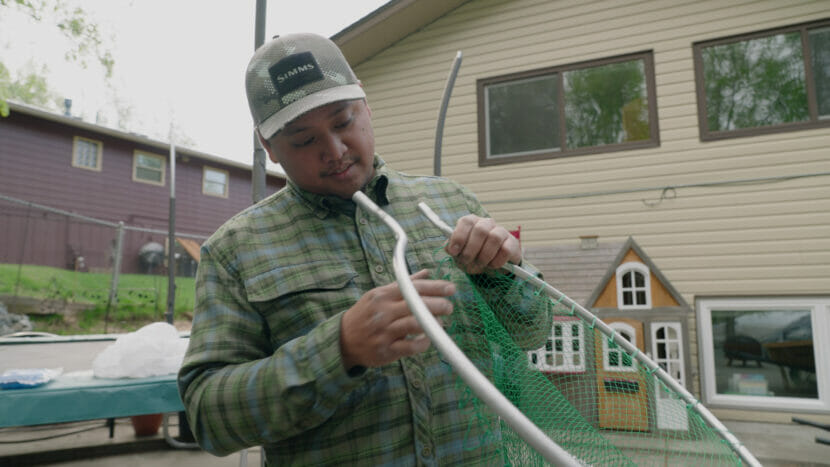
Randy Guintu removes the old net from his dip net frame. He remembers growing up and going to Seward, Willow or Twentymile and hooligan being one of the first fish that young children are able to catch for themselves. (Young Kim)
Haywood also spent a lot of time fishing with her family. She said she took her children to catch hooligan every year, and would fry and bake the little fish for her family to eat. But then her children grew up, and her recent trip to the river was her first in about a decade. She wanted to get out of the house, she said, and still likes to fry the hooligan, but she’s been more experimental with the fish she caught the week before — trying them in Thai soups like tom yum.
“It was last week, I actually told my mom I wanted to make tom yum soup,” she said. “Sometimes people think the fish is small and the meat is squishy so some people don’t like them because it’s a lot of oil.”
Hooligan, also known as ooligan, smelt, candlefish and eulachon, are extremely oily – up to 20% of the fish is fat. The small fish is considered to be a keystone species for the West Coast. A multitude of marine and land animals rely on hooligan for food in the spring months, and the fish is prized by Indigenous people in the Northwest for its oil, medicinal and food values. Before the gold rush, trails like the famous Chilkoot Trail were used by Indigenous people to trade ooligan oil. These trails were sometimes called “grease trails.”
Ooligan oil is a staple in Ruthie Constantine’s home. She moved to Anchorage in 2009 from Metlakatla, a Tsimshian community near Ketchikan in Southeast Alaska. She grew up eating hooligan and its oil — which is made by fermenting large batches of the fish before rendering the oil into different grades. Constantine said they get ooligan grease from Canada, where her tribe is originally from.
Despite growing up eating hooligan, Constantine only tried fishing for it when she first moved to Anchorage.
“It was a different experience to see and try,” she said. “My husband’s aunt took us out and wanted us to try. After that we were hooked.”
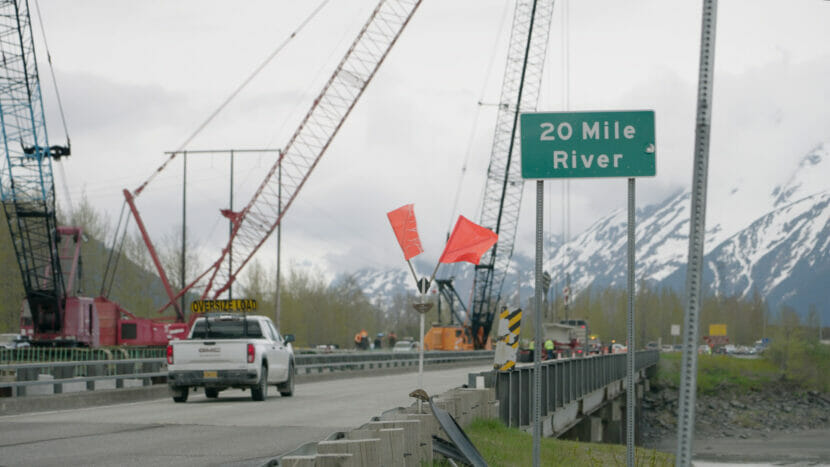
Road construction takes place near the bridge by Twentymile River, a popular destination for hooligan fishing in May. (Young Kim)
Constantine and her family often fish for friends and family who live back home in Metlakatla. When they visit, they bring two 50-pound freezer boxes on the plane with them. Then, starting with her grandma’s house, they go around the community with gallon bags full of fish for whoever wants or needs them.
“To bring them home feels – I don’t know how to describe it – it’s like a piece of joy just being able to share something that everyone loves to have at home,” she said. “It’s nice to provide for them and be able to give, and to be able to share with everybody.”
Constantine, as well as her friend’s and family back home, like to fry the fish whole with flour and seasoning or smoke them using traditional methods her grandmother taught them.
“Depending on who we’re having our Native food dinners with, sometimes the older people like a small bit added to their berries,” she said.
Guintu and his family also grew up frying the hooligan fish whole. Guintu works in the survey field and has commercial fished in Cook Inlet.
“I feel like hooligan is one of the first fishes young children are able to fish for,” he said. “I kind of remember growing up and being dragged down to Seward, and we would go to Willow or Twentymile. It’s kind of something that I’ve done for my family, being like one of the only adult children from my generation that actually likes to go out and fish.”
He tries to go annually with his family and friends, but hasn’t been able to go the last few years. But, family friends have made sure he doesn’t go without hooligan to eat – which they all typically like floured, seasoned and fried fresh and whole.
When he does fish, Guintu said, he likes to share his catch with his aunts or grandma. Their method is to take the biggest sized hooligan, butterfly and marinate it in garlic, soy sauce, brown sugar, vinegar, MSG, Sprite or Coke and liquid smoke, before baking them at a low temperature to create a smoked effect. Then, they’d fry the fish.
“It’s like a potato chip,” he said. “You just eat everything, it’s crunchy. But that takes a lot of time. The move was to bring them to grandma’s house because she made them the best. I think that’s probably pretty typical with most Filipino families. There’s a party, just fry and go really.”
He said the flesh of the fish is white, delicate and oily and not “super fishy” in taste. Most recipes from any culture calling for milkfish or mackerel could easily translate to using hooligan, he said.
“I feel like there’s a lot of cultures that have really made it popular, and really have a good way of preparing them,” he said. “Usually it’s a lot of ethnic cultures like the Hmong or the Hawaiians or the Koreans. I’m really intrigued to see what the Greeks or some of the other Europeans are doing with them. I think it’s a pretty cool resource to have.”
Like Haywood, whose bucket was empty Wednesday afternoon, Guintu said he’s been “kind of concerned about some of the returns” he’s seen.
“It just used to be – when we were kids, we went down to Nash Road and we’d be like five years old, you’d bring a spaghetti strainer and you can scoop them out of the creek,” he said, referencing Seward.
Whether it’s fishing or hunting, Guintu said, he likes providing for his family and others.
“I felt like it was something we did traditionally and I wanted to keep that tradition strong with the next generation,” he said. “I think it’s a pretty important personal use and subsistence fishery for all Alaskan residents.”
Catching the fish has become a tradition for many. For Haywood, who came to the river to try her luck after a decade hiatus from the fishery, it’s a tradition she’s picking back up.
“From now on, I’m going to try and come out every year and catch it for the season,” she said.
This reporting is supported in part by a grant from the Alaska Humanities Forum and the National Endowment for the Humanities, a federal agency. Any views, findings, conclusions or recommendations expressed in this report do not necessarily represent those of the National Endowment for the Humanities.”
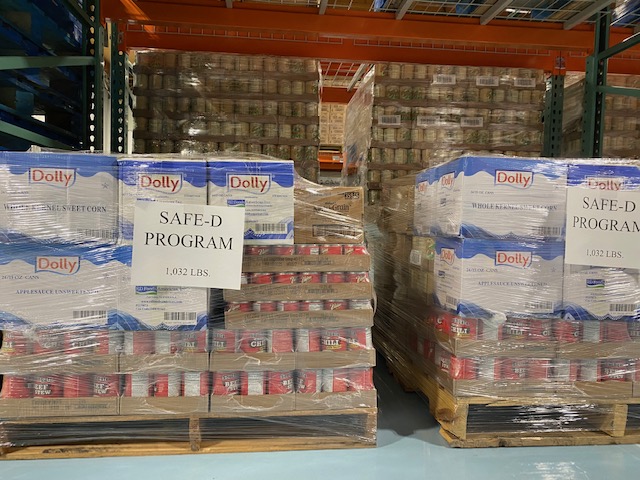
Bulk food purchased with the $1.68 million Gov. Mike Dunleavy put towards supporting food banks is staged for delivery in Food Bank of Alaska’s Anchorage warehouse on April 21, 2023. (Photo by Claire Stremple/Alaska Beacon)
Rep. Genevieve Mina, D-Anchorage, introduced a bill at the end of the last legislative session that is aimed at streamlining applications for the Supplemental Nutrition Assistance Program, formerly known as food stamps. It would ease requirements to get benefits which could also have the effect of reducing the administrative burden that contributed to a backlog in the state’s Division of Public Assistance.
Specifically, the bill would implement “broad-based categorical eligibility,” which means that people who already qualify for other kinds of benefits could be automatically eligible for SNAP.
“I think that broad-based categorical eligibility is a great approach to address a lot of the structural issues in the SNAP program in the long term,” Mina said. “It’s not going to be a fix for the current backlog that we’re facing. But even if we are able to remove one component of the application process, which is the asset test, I think that also will help folks at DPA and our eligibility techs be able to approve applications on a more streamlined basis.”
Alaska is one of only a handful of states that doesn’t already use broad-based categorical eligibility for food benefits. The state’s Department of Health could have implemented it and considered doing so in 2019 and recently in 2023, according to Mina.
Deb Etheridge, who oversees benefit programs as the director of the Division of Public Assistance, said the division is “neutral” on whether or not to implement the new eligibility system. The division will wait for the will of the governor and Legislature, she said.
“Broad-based categorical eligibility has been evaluated by our division,” she said.
The division is making progress on reducing the number of Alaskans waiting an unlawfully long time for food stamps, but is not sufficiently staffed to keep current with benefits applications. In an effort to get Alaskans benefits more quickly, the division began renewing food stamps applications without all the usual verifications this year — on a limited-term basis and with permission from the federal government.
Mina said the proposed policy change could increase retention in the Division of Public Assistance by reducing the caseload burden on each individual employee. She said the current backlog underlines the importance of retaining staff.
“We’ve seen how big of an impact was made a couple of years ago when those positions were cut,” she said; the Dunleavy administration cut more than 100 jobs from the division in 2021. “Knowing how valuable those employees are goes a long way in preventing massive situations like the SNAP backlog that we are working through right now.”
Mina said the bill also addresses the “benefits cliff,” which refers to the sudden decrease in public benefits that can come as a result of even a small increase in earnings, by increasing the eligibility threshold to 200% of the federal poverty line from 130% of the federal poverty line.
“This would incentivize people to have modest savings that they can’t really do in the SNAP program,” Mina said. “We’re also incentivizing Alaskans to be more self-sufficient by allowing them to have savings without getting kicked off the program. I think that also helps our workforce and our economy.”
Eggs are on display at a Sprouts grocery store on April 12 in San Rafael, Calif. (Justin Sullivan/Getty Images)
Egg prices soared in recent months, driving up grocery bills for many Americans, but buyers can see the sunny side now that the cost of a dozen eggs is dropping in stores across the country.
The spike in egg prices was caused by a number of factors, including an avian flu outbreak that affected tens of millions of birds across the country.
But the bird flu outbreak has eased, inflation has loosened its grip on the economy, and whipping up an omelet has suddenly become more affordable.
It’s a far cry from the wholesale price of $5 for a dozen eggs in many places across the country earlier this year, according to department figures.
The most recent data from the Bureau of Labor Statistics estimated that the average consumers would pay for a dozen eggs in April was around $3.27, the lowest it had been since September.
Phil Lempert, editor of the website SupermarketGuru.com, said that not only have egg prices fallen, but stores are no longer running out of the protein-rich commodity, as they had been in recent months.
“The good news is, if you go into a grocery store, you’re going to see eggs. versus just a couple months ago when you weren’t going to see eggs,” Lempert told NPR, “and if you were, they were $5, $6, $7 a dozen.”
Likely the main reason egg prices are coming back down is that the poultry industry is recovering from the bird flu outbreak.
According to the Centers for Disease Control and Prevention, more than 58 million birds have been affected by highly pathogenic avian influenza (HPAI) in the most recent outbreak, including commercial poultry as well as backyard chickens.
Lempert said it takes months for newly born hens, unaffected by the highly contagious and lethal bird flu, to be able to lay eggs that can then be sold to consumers.
Grocery prices can also be tied to inflation, which remained high in April but decreased slightly. Consumer prices increased 4.9% over the same period a year ago, but they dipped compared to prior months.
Egg prices may not fully return to previous levels anytime soon though, Lempert said, since egg producers will want to make up for lost earnings and other supply chain issues, such as labor shortages and trucking industry woes.
Copyright 2023 NPR. To see more, visit https://www.npr.org.
Close
Update notification options
Subscribe to notifications
Subscribe
Get notifications about news related to the topics you care about. You can unsubscribe anytime.

9(MDEwMjQ0ODM1MDEzNDk4MTEzNjU3NTRhYg004))

9(MDEwMjQ0ODM1MDEzNDk4MTEzNjU3NTRhYg004))