
This is not the milk in Haines. This milk expired long ago. (Rachel Waldholz/Alaska Public Media)
A Haines grocery store has more milk than it knows what to do with. An ordering error led to the store receiving many times its usual supply.
Sarah Swinton owns Olerud’s grocery store on Main street. This week, there was a glitch in her milk order.
“When I ordered from Dairy Gold, it was in the individual units, so I proceeded to order that way,” she said. “But UNFI wanted it in the cases. So, long story short, normally I get in a pallet of milk, and I got eight pallets of milk.”
That comes out to over 700 gallons of milk, including ten thousand eight-ounce containers.
Swinton says the supplier will not help her deal with the error.
“They were apologetic,” she said. “Apologetic doesn’t pay for my freight or my cost of goods.”
She now has to sell the milk as fast as she can, at a loss.
“I don’t think I want to freeze milk in my store and then try to sell it to my customers after the expiration date, so I’m trying my best to move what I can out of the store,” she said.
Swinton says she thought of making milkshakes but doesn’t have enough staff. She says now would be a good time for customers to make pudding.
“Just stop on by Olerud’s and please grab a gallon of milk,” she said. “It’s a pretty good markdown.”
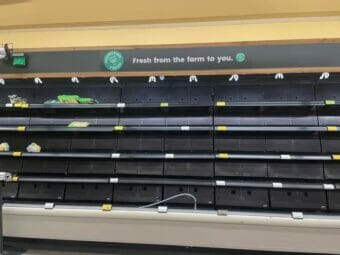
Safeway’s produce section was nearly cleaned out after rough weather delayed food shipments to the island; March 4, 2023. (Kirsten Dobroth/KMXT)
Grocery store shelves in Kodiak were bare this weekend after rough weather delayed food deliveries to the island. An emergency cargo flight filled with provisions landed in Kodiak Sunday morning to help fill the gap.
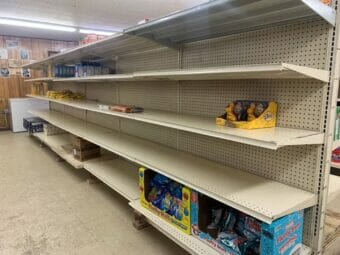
Kodiak depends on barges to bring in everything from milk and meat to cereal and bread. The last barge delivery was nearly two weeks ago, on Feb. 22.
Safeway on Mill Bay Road is the only large grocery store on the island. And store management expected a resupply stop ahead of this past weekend. But snowstorms and gusty weather, including hurricane-force winds, scuttled those plans.
“In my entire career, I’ve never seen two successive bypasses,” said Mike Murray, the store director of Kodiak’s Safeway.
He said with the exception of some nonperishable goods, the store had been nearly cleaned out by this weekend.
“Frozen foods was catastrophic,” said Murray. “I have just a few bags of frozen vegetables and pizzas, etc. And then on into the dairy aisle where we ran out of milk, virtually all milk products, eggs, cheese, probably 85% of our yogurt, and 70% of our juice products.”
The store’s produce shelves were also nearly empty. The bread aisle took a big hit. So did the meat department. Several restaurant owners also posted in a popular community Facebook page that they were running low on supplies.
Management from Safeway and shipping company Matson chartered a military transport plane to fly in an emergency food delivery on Sunday morning. Kodiak-based Advantage Air Freight helped unload supplies once they landed.
Murray said they were able to source some provisions from the grocery chain’s Anchorage warehouses, but it took a boots-on-the-ground effort to get other products back to the island.
“Whatever milk or meat products we got was a handful of people in Anchorage going from store to store picking up what they could, what those stores could spare so that we could fill that airplane out,” he said.
Murray said it’s only a fraction of what they needed, and shelves were almost bare again Sunday night. The next barge was scheduled to arrive in Kodiak on Monday evening.
The store in Stebbins is struggling to keep food and other supplies in stock. Photographed Feb. 23, 2023. (Photo by Daisy Katcheak)
It’s been nearly six months since the Alaska Division of Public Assistance first began to fall behind on processing federal food stamp applications, leaving thousands of Alaskans still waiting for benefits to arrive now.
In rural Alaska, where food costs can be astronomical and food banks or pantries are rare, residents are experiencing particularly dire consequences from the unprecedented backlog, advocates say.

While Alaskans all over the state have been struggling as a result of the delays, officials with the Food Bank of Alaska said they have been contacted by people in multiple villages in rural Alaska — particularly in Western and Northwest Alaska — asking for assistance with an urgency that reflected the lack of a safety net in many of these communities.
Stories are emerging of people digging to the bottom of their freezers for scarce game, relying on friends and neighbors to fill empty shelves, and even in some rare cases requiring hospitalization for malnutrition.
“People are literally starving,” Ron Meehan, Food Bank of Alaska’s policy and advocacy manager, said this week.
“They’re calling and saying ‘We have nothing,’” Meehan said, referring to the handful of communities where people have reached out for help. “But the reality is that there are probably far more than that experiencing this, they just don’t know how to reach us.”
Volunteer Andrea Stein stocked shelves in the agency shopping room at the Food Bank of Alaska off Viking Drive in Anchorage on Thursday, Feb. 23, 2023. (Bill Roth / ADN)
Food Bank staff said they are able to deliver food to struggling food pantries in some communities, but are limited by dwindling resources, rising food costs and fewer donations even as more people need help due to Alaska’s delays processing applications in the federal Supplemental Nutrition Assistance Program, or SNAP.
“So many of our food banks and food pantries simply do not have the capacity to meet this need,” Meehan said.
Food Bank of Alaska policy and advocacy manager Ron Meehan inside their food warehouse on Viking Drive in Anchorage. Photographed on Thursday, Feb. 23, 2023. (Bill Roth / ADN)
‘My community is suffering’
In Stebbins, a Western Alaska village where nearly all residents qualify for food stamps and few have gotten them, three elders have needed to be hospitalized for malnutrition, said city administratorDaisy Lockwood Katcheak.
The community, located roughly 120 miles southeast of Nome and home to more than 600 people, has suffered multiple devastating events in a short span of time, which Katcheak said have compounded on each other in combination with the SNAP delays.
The sole store in Stebbins burned early Tuesday morning, Nov. 29, 2022. (Photo by Linda Greta Camillus)
A historic storm battered much of Western Alaska in September including Stebbins, and severely flooded many homes. Then in November, the community’s only store burned down.
“We make-shifted a little store that’s been cut down to a third, and only sells shelf-stable foods,” Katcheak said Thursday. “On top of that, there’s such a delay with the food stamps, so my people are further being impacted by that.”
The store in Stebbins is struggling to keep food and other supplies in stock. The cart is for produce, which has not been seen for a while. Photographed Feb. 23, 2023. (Photo by Daisy Katcheak)
In recent months, Stebbins officials have had to rely on food donations from the Red Cross, the Food Bank of Alaska and the Alaska Native Tribal Health Consortium to keep residents fed.
“I just requested more food for our community because our people are not receiving the nutritional value,” she said. “My elderly and my children are being impacted. My community is suffering.”
The last bone
In Kivalina, 72-year-old Becky Norton struggled for months to feed her family of nine. There are no food banks or pantries in this largely Iñupiat village on a barrier island along the Chukchi Sea.
Norton’s family typically receives around $1,800 a month in SNAP benefits for her family that includes her three young grandchildren, she said.
Norton filled out her recertification application in November, and by January, still hadn’t heard anything back from the state’s Division of Public Assistance regarding the status of her application.
While Norton waited for her SNAP benefit application to be approved, she said she searched through her freezer for any caribou remnants from past hunts — a once plentiful but now scarce food source for her family with the decline of local herds.
“I found in the bottom of my freezer a single leg bone, enough to make soup,” she said.
Meanwhile, Norton said, she waited on benefits and budgeted carefully to keep the family’s monthly Social Security payments from running out. She knew that if she became truly desperate, she could post in a local Facebook group to ask for assistance from her neighbors.
“We are a caring community,” she said. “So if we know that someone is struggling, people will make little care packages. Not much, but to help them get by.”
Norton finally got help expediting her application from Alaska Legal Services. Within a few days, SNAP funds were deposited in her account.
Her sister, who applied for benefits around the same time she did, still hasn’t received any word from the state about the application she submitted over four months ago.
Norton herself is still waiting on her state application for energy assistance, one of several programs also experiencing delays. She applied for that in September, before the cold arrived. Last week, she got an electric bill for $423.
Significant delays continue
The extent of the food stamp application processing problem first surfaced in late December when multiple Alaska news outlets reported on major delays within the public assistance division, which processes the applications.
Thousands of Alaskans already been waiting months to receive SNAP benefits reported spending hours on hold with the state’s virtual call center only to be told there was nothing to be done to speed up the process. Many calling about food stamps are also experiencing delays for other types of public assistance, including senior benefits, Medicaid — and heating assistance.
State officials attributed the public assistance processing delays to a staff shortage, a cyberattack that disrupted online services for months, and an influx of recertification applications in early fall when an emergency pandemic-era program expired in September. The program made it easier for Alaskans to receive maximum benefits without annual recertifications. It ended with the state’s emergency declaration, which wound down in July.
Since December, the director of the Division of Public Assistance has been replaced, and 10 Alaskans have filed a lawsuit alleging that the delays were a violation of federal law.
Last month, Heidi Hedberg, the state health department’s commissioner-designee, said the department was hiring workers via an emergency contract to focus solely on food stamps and Medicaid as a way to get the agency back up to speed.
Since November, the department has hired 71 new staff members “in various stages of training,” department spokeswoman Sonya Senkowsky said in an email this week.
But as March approaches, the backlog still hasn’t been cleared. In an email this week, Hedberg said the state is still processing SNAP applications received in October. And on the front lines, advocates at the Food Bank say the majority of their clients still aren’t getting benefits in a timely way.
Staff with the Food Bank of Alaska this week, however, said they’re still working with clients whose applications are marked as received in September with no action taken since.
“We’re continuing to see significant delays in processing,” said Magen James, the organization’s SNAP coordinator.
‘Nothing we can do’
As the backlog stretches on, Food Bank of Alaska staff describe staffers exhausted after months of dealing with people going hungry around the state with limited access to food resources.
“The secondary trauma of dealing with people that are starving every single day has been taking such a toll on my staff,” James said.
Douglas Carothers moves a pallet of perishable donations to the refrigerator at the Food Bank of Alaska on Viking Drive in Anchorage on Thursday, Feb. 23, 2023. (Bill Roth / ADN)
The organization is struggling to keep up with the demand, Food Bank officials say. Even in places on the road system, like Soldotna, residents dealing not only with delayed benefits but inflation say the high price of fuel has made it difficult or impossible to drive into town to visit a food pantry, according to Greg Meyer, with the Food Bank in that community.
The organization has been driving out to smaller communities to distribute food in response but the demand hasn’t let up, and resources are limited:Meyer said the food bank there has gone through about 75% of its stored food since September, and has seen nearly a 50% increase in the number of families seeking food assistance each day.
The impact of rising food and fuel costs on top of delayed federal benefits has been particularly hard on elders and single parents, said Carey Atchak, food security coordinator for Bethel Community Services Foundation.
Atchak, who helps manage the city’s food pantry, said it’s been nearly impossible to keep up with the demand.
“I purchase about $1,000 worth of products on Monday, and by Wednesday, everything has been depleted,” she said.
The charity sector is not set up to replace federal benefits — Meehan said that SNAP benefits typically provide more than 10 times as much food as is typically distributed by food banks. Over the last year, the Food Bank of Alaska also experienced a drop in the amount of food it has been able to provide, he said.
In places far from a food bank or pantry, like the Yukon River community of Mountain Village, staff said they feel a sense of helplessness.
“We’ve seen a significant increase in the amount of clients from Mountain Village specifically asking about their SNAP benefits, and they’re still not getting approved, and then asking for food, and there’s no food bank or pantry or anything in that region,” James said. “And unfortunately, I had to tell people that they’re going to have to wait. There was nothing that we can do.”
Alannah Johnson in her “incubation room” where she prepares new batches of fungi to sell through her business, New Earth Fungi. (Photo courtesy of Alannah Johnson)
Alannah Johnson fell in love with the fungi of Juneau’s rainforest nearly a decade ago.
Now, she’s selling delicious mushrooms from her gourmet and medicinal mushroom farm, New Earth Fungi.
On a snowy day at the Brotherhood Bridge Trail, Alannah Johnson recalls the lush green of summertime.
“This whole entire area would just be like, covered with moss. And it kind of reminds me of a little fairyland,” she said.
As her boots crunch along the trail, she stays vigilant, peeking around trees.
“Under a branch or like the space in the bottom of a tree. There’s usually mushrooms in there,” she says.
In the February cold, there are only conks, a woody, bitter shelf mushroom. But Johnson says the forest is abundant with edible mushrooms during the rest of the year. Plump white puff balls as the summer begins, the golden-yellow “chicken of the woods” later in the season, and trumpet-shaped winter chanterelles as summer turns to fall.
Johnson has a passion for microbiology, and a sharp eye for the tiny details of mushroom identification. Subtle differences in colors, shapes and even the spores of fungi help her to tell them apart. And her drive to find them keeps her in tune with the forest.
“I just love the challenge of looking for mushrooms and like paying really close attention to detail,” she said.
Mushroom enthusiast and owner of New Earth Fungi Alannah Johnson uses a device to record the sounds of mushroom “music”. (Photo by Andrés Javier Camacho/KTOO)
She says mushrooms have helped her feel more connected to nature and the food she eats. And those values are the core of her business New Earth Fungi.
Mushrooms have always been a hobby for Johnson. Growing up in California, she started by cultivating shiitakes on logs. But the hobby grew to a full-on passion after she transferred to the University of Alaska Southeast during her sophomore year.
She was taken by the diversity of Southeast’s forests, where she made frequent trips for “mushroom forays,” gathering mushrooms to identify, study and eat. As the founder of the UAS mycology club, she started inviting others to join her.
“I put up some fliers announcing my first foray. And I was really shocked at how many people showed up. I think the first group was about 35 people,” she said. “I didn’t realize that there are other people who were also super passionate about learning about fungi.”
Now, Johnson regularly leads forays for tourists and locals alike. Equipped with wicker baskets and a stack of field guides, she works to demystify fungi as food.
Johnson always knew she wanted to share her passion for mushrooms with others, but she didn’t know how until the pandemic hit. She was doing a post-grad stint as a Peace Corps volunteer in the Caribbean.
“And all Peace Corps from all around the world were evacuated back to the U.S.,” she said. “So I was just like, I don’t know what I’m gonna do. I felt depressed about the whole situation. And then I was like this is the time to start my mushroom business.”
Johnson had no experience as an entrepreneur, but she knew there was a demand for locally-sourced mushrooms. So she started by cultivating them in her home. Her first batch was oyster mushrooms, a popular fluted fungi known for its mild savory flavor.
“They’re pretty easy for me to grow. And a lot of people are familiar with them,” she said. “So I started like, okay, what do people want to eat?”
Soon, she wanted to add new flavors and textures to local palettes with the lion’s mane mushroom, a shaggy white fungus.
“They see it in the grocery store, they’re like, what is that weird thing, and it’s like got little, like, tentacles,” she said. “But then I tell them how to cook it. And now it’s become more popular. And I tell them what the medicinal benefits are. And they’re just in love with it,” she said.
Slowly, Johnson started to introduce new varieties and new mushroom products, like medicinal mushroom tonics. She now cultivates eight varieties. They grow out of large plastic bags that line the white metal shelves of her fruiting room, which she operates out of her home.
A combination of education and cultivation form the foundation of New Earth Fungi. Johnson refined her business plan at the Path to Prosperity three-day business boot camp, an annual business development competition hosted by Spruce Root, a nonprofit focused on community development.
Johnson at the “Path to Prosperity” awards ceremony in January. She stands beside fellow winner Rebecca Kameika of Costa Brava Bakery & Pâtisserie in Haines (Photo courtesy of Alannah Johnson)
She pitched New Earth Fungi, alongside 12 other small business finalists. A team of independent judges selected Johnson as one of two recipients of a $25,000 small business grant.
Johnson said the news came as a great relief.
“When I got off the phone I just broke down,” she said. “I just started crying because I feel like I’ve put so much work, time and energy into all of this and sometimes it can feel like there’s definitely days where I’m like, why am I doing this?”
She says it’s been exciting to see her mushrooms out in the community. They’re sold at grocery stores like Juneau Natural and Rainbow Foods. Some restaurants like Red Spruce, Black Moon Coven and Zerelda’s make dishes centered around them. And individuals who buy them or gather them on mushroom forays will tag her on social media to show off their mushroom dishes.
But she’s been struggling to keep up with growing demand. Cultivating mushrooms at a commercial scale demands sterile conditions to keep mold and undesirable fungi at bay. Johnson says that’s been really hard to do while operating out of her house.
She says she plans to use the prize money to invest in mushroom sterilizing equipment, and maybe a larger commercial space. And plans to hire some help too.
“I think that would be wonderful to hire some people who are really passionate about cultivating mushrooms and participating in mushroom education,” she said.
And most importantly, she believes that improving the cultivation process will free up more time for educational events, where she hopes to forge stronger connections with the land and local food.
“It’s just such a relaxing but healing thing to just be connected and know what things are around you, to have to have a greater appreciation and respect for food, wild food, food that we grow,” she said. “And I feel so connected to this place through mushrooms. It makes me feel warm and fuzzy inside.”
Kyrstin Arellano holds up her finished vegan macaron shells, made with chickpea water instead of egg whites. Jan. 9, 2023. (Izzy Ross/KDLG)
On a frosty morning in mid-January, Kyrstin Arellano worked in her kitchen on the outskirts of Dillingham. About three dozen perfectly round bright blue blobs rested patiently on a baking sheet.
“I’ve got some vegan macaron shells here,” she said. “They look good so far, and when I was mixing, they felt regular. So I’m really hopeful.”
The national egg shortage has forced everyone to use fewer eggs, and bakers like Arellano are rising to the challenge — just in time for Valentine’s Day.
Arellano is a home baker. That is, she bakes from her house for Bristol Bayking, a business she started last year. Along with signature and custom cakes, Arellano experiments with local ingredients like cranberries, salmonberries and fireweed.
“I mostly make macarons,” she said. Macarons are small French desserts made of two delicate meringue shells that sandwich a filling of jam, curd, ganache or cream. “They’re for sure my most popular, and my favorite thing to make. I also make cakes and cupcakes to order, for birthdays and stuff. But I really enjoy making the macarons.”
Bright blue macaron shells rest on baking sheets before going into the oven. This is a critical step in the baking process – if they don’t develop a tacky “skin” they will erupt in the oven. Jan. 9, 2023. (Izzy Ross/KDLG)
Egg-based desserts in an egg shortage
Macaron shells are normally made by whipping together egg whites, almond flour, and powdered and granulated sugar and piping the batter in rounds onto a tray. But how do you make an egg-based dessert without using eggs?
Arellano uses aquafaba — chickpea water she gets from a can of grocery-store chickpeas, whipping it up into soft peaks just like egg whites.
“Macaron shells don’t actually have a lot in them,” she said.
Arellano is no stranger to staples being out of stock.
“We go through this all the time,” she said. “Last year, powdered sugar and butter were hard to find. Sometimes milk is hard to find.”
Kyrstin Arellano rotates a batch of blue macaron shells in her oven. (Izzy Ross/KDLG)
Baking in the bush
Like many others, Arellano began baking after the COVID-19 pandemic started three years ago. In rural Alaska, that takes a certain innovative flair. Arellano has honed her ability to find substitute ingredients, like using vinegar and baking soda as a raising agent. And when she can’t find buttermilk at the store, she makes it herself, combining a cup of milk with a tablespoon of vinegar.
“You mix it together and let it curdle a bit, ‘cause that’s all buttermilk is: acidic milk,” she said.
Arellano has three fridges at home, so she’s been able to stock up some eggs. But she’s had to cut back, which means trying new recipes and better understanding why eggs are used in baking. They can provide structure, leavening and flavor.
“Depending on your recipe, the egg might provide moisture, in which case you can substitute with something like yogurt or applesauce to get that moisture,” she said. “You get to be a little more resourceful baking in the bush, because what can you do?”
When Arellano first started her business, she shipped most of her cakes out to villages like Togiak, New Stuyahok and Manokotak.
“I really appreciate them,” she said of customers in other communities. “I’m also getting a feel for the big birthday months in Dillingham.”
Arellano has also sent birthday cakes out on fishing boats in the summer. She said her client base is loyal; she does monthly pre-sales, and her flash sale batches regularly sell out.
Kyrstin Arellano packages egg-based macarons while she waits for the vegan shells to cool. (Izzy Ross/KDLG)
Rest, then bake
The first batch of macarons went into the oven for a total of 18 minutes while the second batch rested on the baking sheet. They need anywhere from 30 minutes to an hour before baking to develop a skin, which protects them from the heat.
“If I put them in before they’ve developed the skin, they’re going to – it’s called ‘volcano’ – they literally pop up like a volcano in the middle and crater and are just horrible,” she said. “So, really important to let them sit and develop that skin.”
Arellano opened the oven door and turned the tray around, ensuring that the shells are evenly baked.
“When they first come out of the oven, before they have any filling, they’re hollow,” she said, tapping on a finished shell, which emits a delicate, hollow sound. “And so when you fill them, the moisture allows the shell to expand inside and get soft.”
When the shells came out, they had swelled slightly and developed small ruffled edges, called “feet.” But none erupted — each was still perfectly round, like rows of blueberry emojis.
The produce section at Foodland IGA in Juneau. (Photo by Tasha Elizarde/KTOO)
After a months-long wait, thousands of Alaskans have gotten their food stamps. But thousands more are still waiting.
MaryRuth Moore of Soldotna reapplied for herself and her four children in October. Since then, she’s been watering down crock pot meals to stretch the food she has.
“I feel like I’ve kind of become a scientist in the kitchen, and trying to make things go further,” she said. “So what this boils down to is less vegetables, less fruits — and especially the fresh ones.”
Waits for food stamps stretched out to months following a flood of 8,000 renewal applications in August, after the state’s pandemic health emergency lapsed. State officials say the Division of Public Assistance is working through the backlog faster now, but eligibility workers — staff who process paperwork for benefits like food stamps and Medicaid — say they were told to cut corners to do that. And even Alaskans who have now gotten their benefits say that the months they went without have left them with debt and fears for the future.
Moore says she, too, has been relying on credit cards to get through. She says she worries about how she’ll pay them off, and knows thousands of other people are going through the same thing.
“It’s a very powerless feeling to know that the situation you’re in is so dependent, and there’s no one to reach out to,” she said. “There doesn’t seem to be any accountability.”
Moore connected with Alaska Legal Services and filed a case last week. The state’s largest provider of civil aid is Alaskans’ main recourse — the ombudsman’s office was also a resource for those who sought overdue food stamps, but say they are no longer legally allowed to help after a group of Alaskans filed a class action lawsuit against the state last month.
Alaska Legal Services Advocacy Director Leigh Dickey said that last January, the group processed just a handful of complaints. This month they’re working on 200 cases related to food stamps, and they’re taking on more pro bono lawyers to help handle the workload. She said they file 20 to 30 new cases a day, and it’s not slowing down.
“It’s just booming,” she said. “It hasn’t tapered at all.”
“There may be some sanctions”
At legislative briefings in late January, Department of Health Commissioner Heidi Hedberg blamed the departments’ difficulties clearing the backlog on legacy technology and the effects of a cyberattack on the department in May of 2021. She said the department was pursuing solutions.
Hedberg and other leadership told state legislators that there has been renewed productivity in the Division of Public Assistance. Deputy Commissioner Emily Ricci said “the number of recertifications being processed daily increased substantially last week, which is positive.”
Ricci, who described the delays as unacceptable, said the department had finished issuing food stamps to people who applied in September and was working on October.
But two eligibility workers — who say chronic understaffing is behind the slowdowns — told KTOO that their division’s leadership overstated the progress to the committee.
The eligibility workers did agree that they have been working faster — but they say it’s because leadership directed them to skip mandatory federal processing requirements.
“When I don’t verify anything you tell me, of course I can get your documents processed faster,” one eligibility worker said. KTOO is not using their name because they fear they could lose their job for speaking out.
Staff say they’ve been instructed to approve or deny cases without verifying information like employment and income with anyone except the applicant. Eligibility workers say federal guidelines require they verify with people like landlords and bosses to make sure information is accurate.
Skipping verification has risks, both to recipients and to the state. If people get larger benefits than they should, they’ll have to reimburse the government later.
“We’re taking all measures that we can to expedite this food stamp recertification process,” she said. “We are talking with our federal partners and engaged with them. And they’re aware of steps that we’re taking. And there may be some sanctions, perhaps, but it’s nothing that we’re doing without full awareness and transparency.”
Etheridge, who has been on the job for four weeks, says she took on the role now because she believes in the programs and the staff.
She spent 30 years working in public service before taking on the role. She’s worked in the division, and she’s even been an eligibility worker before.
She described the backlog as an “all hands on deck” situation.
“We’re working very hard,” she said. “We don’t want this to be happening.”
She said with support from the commissioner and the governor, they’re making strides on the solutions that Hedberg set out for the Legislature.
The commissioner didn’t cite understaffing as a root cause in her briefing to the legislature, but the department recently made 53 hires — mostly new roles, Etheridge said, but also to replace staff attrition.
The department also signed a contract with a group that will find contract workers to answer phones so that highly trained staff can focus on recertifications. And she says two current employees are working on IT solutions while the department looks for contractors to update technology that they say is behind the slowdown.
Etheridge also said security contracts to keep employees safe in their offices should be in place by the end of the month.
But she says her larger goal is to build a department that won’t experience this kind of backlog again.
“I really want to leverage technology to make things easier for people who are applying for assistance,” she said. “Ideally, it’s one-touch processing for all applications, which means that individuals who are applying for benefits can call or they can apply online, and they can get immediate feedback.”
Meanwhile, a lawsuit
Saima Akhtar is the lead attorney for the class action lawsuit ten Alaskans filed against the state. She’s litigated cases like this for about a decade, where citizens sue the state not for money but for the federal benefits they’re due.
She says food stamp programs nationwide are struggling to process benefits on time. And she has insight into the solutions the state is proposing.
“Assuming that technology is the problem and the fix is sometimes part of the issue. In my own experience, in other places, it is never the whole issue,” she said.
“A 30-day processing standard has been the standard in the SNAP regulations, actually, for years and years. And so that was the standard when many of these older computers were the norm, or were the expected technology.”
She said some of the methods the state is using to work through the backlog are effective, like waiving the need for time-consuming personal interviews. But she says that’s a short term fix — the federal waiver will expire after a year.
“The interview will come back in the future,” she said. “So there will have to be sufficient staff to conduct the interviews and maintain the caseload at the end of that time period. This is not a function that can be carried out by computers. It is a mandatory piece in the application process.”
“Why didn’t they plan for it?”
Natalie Richards of Soldotna got her benefits in January after five months of waiting. But she says the experience has left her with credit card debt and nagging fear that it will happen again.
“It’s really frightening to live that way,” she said. “Thinking that your basic needs of food and shelter aren’t going to be met.”
She said she’s grateful the state paid her benefits for all the months she was waiting, but she doesn’t feel like the trial is over. She says she’s using the money sparingly, just in case something like this happens again. And she doesn’t understand why services for the most vulnerable Alaskans are letting them down.
“Everybody deserves to eat,” Richards said. “Why is there such a delay now? I mean, they knew that the pandemic COVID stuff was going to end. Why didn’t they plan for it?”
She said people deserve better from state leadership.
“They still go home and eat their dinner, you know?” she said. “What about the people they were responsible to look out for?”
Close
Update notification options
Subscribe to notifications
Subscribe
Get notifications about news related to the topics you care about. You can unsubscribe anytime.