Food

As state grapples with food stamp backlog, an Anchorage middle school steps up to feed families

Community partners with Wendler Middle School donated food to help families impacted by a large backlog of state food stamp applications. (Wesley Early/Alaska Public Media)

In a Wendler Middle School classroom that is normally reserved for lunch detention, Kailey Otten walked through an assortment of food laid out on multiple desks.

“I would say a lot of canned vegetables, and spaghetti sauce and noodles is probably the thing we’ve gotten the most of,” said Otten, a social work intern at the Anchorage school. “Lots of mac and cheese.”

Otten, along with Wendler teachers and staff, have collected the donated food to give to students and their families. They’re trying to fill a serious need as the state continues to flail under a massive backlog of food stamp applications.

Their effort started a few weeks ago, Otten said, when a child told his teacher that his family was having trouble getting food.

“Through that initial disclosure, we kind of realized that this was a much bigger issue that was facing families,” she said. “And it was directly related to the struggles at the state level with SNAP benefits for families.”

The issues with the state’s Supplemental Nutrition Assistance Program, or SNAP, were first flagged in late December, when public radio station KTOO in Juneau highlighted a months-long backlog of thousands of food stamp applications.

Reasons for the backlog have been varied, with high-level officials blaming cyber attacks and a large influx of paperwork stemming from the pandemic. Meanwhile, state workers say chronic understaffing and workforce cuts have plagued the public assistance system for years.

The state official in charge of the program resigned, and the state faces a lawsuit that claims the state subjected thousands of families to ongoing hunger. Gov. Mike Dunleavy addressed the backlog in an appearance on Talk of Alaska last week.

“It’s an awful thing,” Dunleavy said. “We all admit that. And on behalf of Alaska, I apologize to the folks that are impacted because this is an important issue.

Wendler Middle School principal Marcus Wilson. (Wesley Early/Alaska Public Media)

When Wendler principal Marcus Wilson found out about one student’s family struggling to get food, he decided to send out a message to all Wendler families to see if it was a bigger issue.

“I would say within the first five minutes, we had probably about 15-18 responses back, that quick,” Wilson said.

Otten said, in total, roughly four dozen families have reached out saying they were impacted by the state’s backlog.

She wanted to help, so she reached out to Clear Water Church, a school community partner.

“I reached out to them and said, ‘Hey, would you be interested in collecting some food for some families because we know that a lot of kids are hungry right now,’” Otten said. “And ended up getting a really large donation, and we’ve gotten a couple follow-up donations, and have had a really positive response from families.”

Families impacted by the delay in state benefits can pick up the food from the school or, in some cases, school staff brought the food directly to homes. Wilson said, when he made the deliveries, he learned about families’ various struggles.

“One family was just dealing with COVID with the whole family at home, and weren’t able to go out and buy groceries because everybody was pretty sick,” he said. “Another family, the main breadwinner in the home was injured, so they were really hurting.”

Wilson said he understands that for some families, it’s not easy to ask for help, and they’ve been so gracious and thankful for the food.

Kailey Otten, a social work intern at Wendler Middle School, prepares food for families. Otten is working toward her master’s degree at the neighboring University of Alaska Anchorage. (Wesley Early/Alaska Public Media)

Otten agreed that the feedback has been positive, but said the school’s food drive is not a sustainable solution to families’ hunger. The real solution should come from the state.

“We shouldn’t need to be collecting food for families,” she said. “This shouldn’t be an issue that’s happening.”

State health officials did not respond to questions about the current SNAP backlog for this story. However, they said in late January that they’d caught up on backlogs through October.

In his Talk of Alaska appearance, Dunleavy said he thinks the problem could be solved by updating the state software that handles the application requests as well as by hiring enough staff.

“We just have to make sure that going forward we have the personnel in place to make sure that this doesn’t happen again,” the governor said.

While families wait on benefits to go through, Otten said, she’s grateful for how the community has stepped up in the wake of the state’s failure.

“As much as it has been heartbreaking to see how many families have been impacted, it’s also been really heartwarming to see the way that community has just stepped up and immediately responded to a request,” Otten said.

For families whose kids don’t go to Wendler, officials say they should try to get in contact with their school’s community partners.

Dora Wilson is community outreach manager for the IBEW Local 1547 union, a community partner with Wendler that provided gift cards to aid with the food drive. She’s also a member of the Anchorage School Board.

“The school community is really good about connecting them to resources, whether they have resources on hand or they have resources that are accessible to their families,” she said. “So I think they should always use their school as a resource to get that information.”

There are additional options in Anchorage for families experiencing food insecurity, including the Food Bank of Alaska and Bean’s Cafe.

Correction: An earlier version of this story incorrectly said that Dora Wilson was not related to Marcus Wilson. They are married.
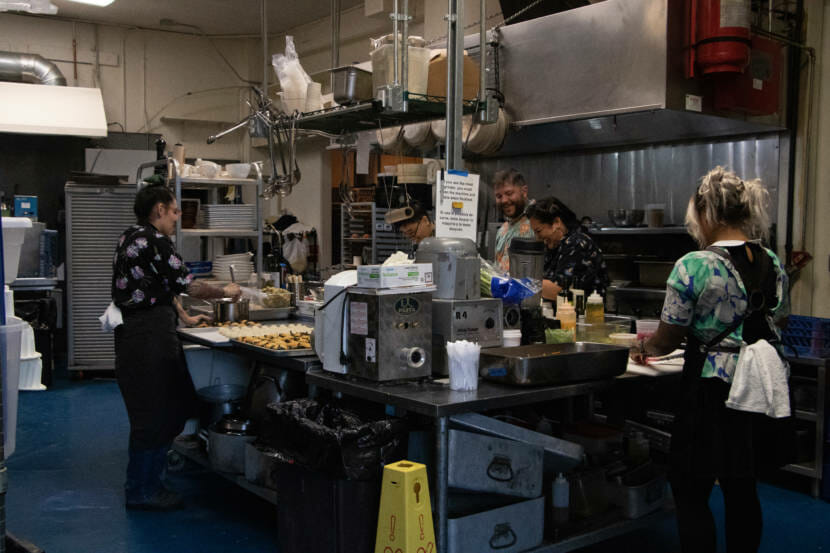

Three Alaska chefs, restaurateur nominated for James Beard awards

Claudette Zepeda, Rachel Barril, Beau Schooler, Amara Enciso and Aims Villanueva-Alf cook in the kitchen of In Bocca Al Lupo for their event "Dinner with Friends: Womxn of Power edition" on June 26. (Photo by Lyndsey Brollini/KTOO)
Claudette Zepeda, Rachel Barril, Beau Schooler, Amara Enciso and Aims Villanueva-Alf cook in the kitchen of In Bocca al Lupo for their event “Dinner with Friends: Womxn of Power edition” on June 26, 2021. (Photo by Lyndsey Brollini/KTOO)

Three Alaska chefs and one restaurant owner have been nominated for James Beard Awards, considered a top honor in the food world.

Laile Fairbairn of Locally Grown Restaurants was named as a semifinalist for restaurateur of the year for the outstanding restaurateur award in a field that includes other nominees from across the United States.

Fairbairn is the longtime co-owner of popular Anchorage restaurants Snow City Cafe, South Restaurant + Coffeehouse and Spenard Roadhouse. She couldn’t immediately be reached Wednesday afternoon.

Nathan Bentley of Anchorage’s Altura Bistro was nominated in the best chef of the Pacific Northwest region category.

“We’re so honored,” said Bentley, who was also a semi-finalist last year. “It’s motivating.”

Beau Schooler of In Bocca Al Lupo in Juneau, previously nominated several times, and Rene Trafton of Sitka restaurant Beak were nominated in the same category.

Trafton learned about her place on the James Beard nomination list from a restaurant supply store representative. She’d been emailing him about purchasing a new commercial refrigerator, and he congratulated her, she said.

It was still a little surreal: On Wednesday afternoon, the first-time nominee was busy in the kitchen, heating salmon chowder for dinner and pickling carrots. It was the first time, to her knowledge, that a Sitka restaurant had been nominated.

“I guess it’s real!” she said.

Trafton moved to Sitka a decade ago after working in Michelin-starred restaurant in New York. She opened Beak, which shares a historic building with the local public radio station, in 2017.

The food is focused on Sitka’s fresh seafood and Alaska-sourced ingredients and uses a no-tipping model in which higher menu prices allow Trafton to pay her employees what she says is a more livable wage than many restaurants.

One of Trafton’s favorite dishes on the Beak menu is rockfish — an underrated fish Alaskans appreciate, she thinks — topped with her version of an “everything” bagel seasoning and topped with a briny pickled vegetable salad featuring bull kelp.

The James Beard winners will be announced March 29.

This story originally appeared in the Anchorage Daily News and is republished here with permission.

Lawsuit says Alaska Department of Health exposed thousands to hunger risk by not giving food aid

A sign outside of a store in midtown Anchorage announcing that they accept EBT Cards, the distribution method for SNAP benefits. (Photo by Hillman/Alaska Public Media)
A sign outside of a store in midtown Anchorage announcing that they accept EBT Cards, the distribution method for SNAP benefits (Photo by Anne Hillman/Alaska Public Media)

Ten Alaskans are suing the state, saying it failed to provide food stamps within the time frames required by federal law. The complaint was filed Friday in Superior Court in Anchorage against Alaska Health Commissioner Heidi Hedberg. The lawsuit said that in her role as commissioner of a department that failed to provide needed services, Hedberg “has subjected thousands of Alaskans to ongoing hunger and continues to do so.”

Some families have waited four months to receive Supplemental Nutrition Assistance Program (SNAP) benefits, also known as food stamps, the complaint alleged. In the absence of these benefits, people have sought other means to get food or make food last longer.

“We’ve got people who are relying on family members. We’ve got people who are relying on food pantries. We’ve got people who are eating less so they can feed their kids, trying to juggle their bills and decide whether they’re going to pay for their heat or their groceries,” said Saima Akhtar, senior attorney at the National Center for Law and Economic Justice, one of the firms representing the plaintiffs in this lawsuit.

“People are taking as many different avenues as they can to take care of their families and eat right now, and it shouldn’t be that hard,” Akhtar said.

The complaint asserted the delay is due to the “immense delays and chaos of the Alaska Department of Health,” and pointed to the unresolved “massive backlog of unprocessed SNAP cases that has left thousands of Alaskans without critical food assistance in the coldest months of the year.”

While 10 Alaskans are named in the class action suit — residents from Anchorage, Marshall, Petersburg, Wasilla, Bethel, Palmer, Nome and Delta Junction — they represent thousands of other Alaskans who are facing the same issue.

Under federal law, the Department of Health must provide ongoing SNAP benefits to eligible applicants no later than 30 days after the date of application. Households that qualify for expedited processing are required to get their benefits within seven days of the application being filed. Some families have been waiting months, the complaint said.

The lawsuit asked the court to find that the Alaska Department of Health has violated the federal SNAP Act and violated due process clauses of the federal and state constitutions. The suit wants the court to order the Department of Health to process people’s SNAP applications and recertifications within the timeframe required by federal law, to allow people to apply and seek benefits on the first day they contact the agency, and to ensure that there are adequate language interpretation services and translations of documents for those who need it.

Essentially, Akhtar said, the injunctive relief is asking the state to “do the things that they are legally obligated to in operating the program within the federal guidelines.”

The plaintiffs are not seeking monetary damages.

“They want to get fed,” Akhtar said. “And they also have the opportunity to try and influence the system so that this is not happening again, so that their siblings and their children and communities aren’t going hungry, too.”

In an email on Friday, a spokesperson for the Department of Health said, “The Commissioner and DOH cannot comment on the complaint or the lawsuit because we have not seen the complaint or been served in the lawsuit.” The spokesperson didn’t immediately answer other questions regarding the backlog or its cause, or availability of language translation services for SNAP applications and forms.

Chair of the Senate Health and Social Services Committee Sen. David Wilson, R-Wasilla, said his committee will hear from the Department of Health about the food stamp application backlog during its meeting on Tuesday, Jan. 24.

It’s a huge issue, he said: “We’re talking about, you know, people’s sustenance… It’s a health safety issue.”

“We want to know, basically, what can we do in the Legislature to help you fix this problem and how fast can it be fixed and resolved? And those are the issues that I want to focus on,” Wilson said.

This story originally appeared in the Alaska Beacon and is republished here with permission.

State offers help with high feed prices, but some farmers are pushing for an Alaska grain reserve

""
Delta-area farmer Bryce Wrigley shows the tightly clustered seeds atop a ripe barley stalk. (Erin McKinstry/Edible Alaska)

The state is offering financial help to Alaska farmers who are struggling to pay high prices for livestock feed that’s in short supply after last year’s poor harvest. But some farmers say setting up a grain reserve would be a better way to help them recover in lean years.

The state has launched two new programs to help farmers pay for livestock feed. Prices are about double last year’s because spring planting was delayed by last winter’s heavy snowfall and fall-harvest crop yields were low due to early frosts and other unseasonable weather.

“It was tough,” says local UAF Cooperative Extension Service agent Phil Kaspari. “We had those high input costs, poor returns, and a number of people are in survival mode.”

Kaspari said in an interview Monday that higher prices for feed, fuel and fertilizer have driven some producers to cut back on their livestock.

“The last thing that we wanted to see happen is people having to cull down their herds,” he said, “but in fact that’s what a number of these people have had to do.”

Alaska Farm Bureau President Scott Mugrage says the problem affects many farmers around the state.

“It’s not just people are paying a high cost for feed,” he said. “We’re going to run out of grain in the state of Alaska.”

Mugrage grows hay and other feed for the 600 head of cattle at his farm near Delta Junction. And he says producers appreciate the help the state is offering through its Food Security Cost Assistance Program. A state Agriculture Division spokesperson says about 70 farmers have applied for payouts from the program, with requests ranging from about a thousand dollars to nearly $150,000.

But, Mugrage said, “I’m just not sure that this type of assistance is what was needed to carry us through.”

He says another new program announced by the state last week, however — the Alaska Barley Transportation Support Grant Program — is more likely to help, even though the window to apply for a grant closed on Monday.

“I thought they’d be better off with offsetting some transportation costs with imported feeds, because that’s what we don’t have,” he said. “We don’t have grains.”

Mugrage says he was disappointed that the state didn’t follow through on what he and others believe is the best solution to protect livestock producers during lean years: reviving plans to establish a grain reserve.

“This is exactly the type of year that proves we need this reserve to be established,” he said. “It’s like a savings account. That grain’s always going to be there, it can be released during a time of drought or disaster, and then could be right back re-apportioned after the drought. ”

Mike Schultz, another Delta area farmer, agrees.

“It is a good idea, for several reasons,” he said in an interview Monday. “One is over the course of several years, that grain reserve would get built up and be the cushion that we need in the event of another poor production year.”

Mike Schultz raises barley and other crops on the 6,000 acres he farms with his brother, Scott. He’s also serves as board chair of the Delta-based Alaska Farmers Co-op, which built grain elevators and a fertilizer plant with state funding back in the 1980s. The organization ran into financial problems and declared bankruptcy in 1993, and deeded those assets to the state. Then in 2015, the state leased it back to the co-op for 25 years at a cost of a dollar a year. Schultz says it would be the perfect place to set up a grain reserve.

“It would really benefit the livestock producers throughout the state,” he said, “because they would then know there’s an adequate supply of feed for their animals.”

Both Mugrage and Kaspari agree. And they’d had hoped the state would move ahead on setting up a grain reserve after Gov. Mike Dunleavy talked about it in June at Nenana’s annual Agriculture Day event. An Agriculture Division spokesperson said last week that state officials are still considering a grain reserve, but decided to move ahead on the other programs in an effort to get help to farmers this year.

Homer man works to feed people who’ve fled their homes in Ukraine

A man in a baseball cap studies a large donut-shaped piece of metal
Lucas Wilcox assembles a tent frame in Lviv, Ukraine on Oct. 4, 2022. (Courtesy Lucas Wilcox)

Last spring, when many Ukrainians were leaving the country, Lucas Wilcox was on his way in. Russia had invaded eastern Ukraine two months earlier. It was mid-April and the 40-year-old Homer resident was on a train traveling from Poland to the western Ukrainian city of Lviv. Wilcox was traveling into the country with a mission: to build large, off-grid kitchens to feed people who had fled their homes.

What Wilcox didn’t know at the time was Lviv would be hit by its largest missile strike yet that night.

“The conductor comes through and whispers something urgently to each one of the cars,” Wilcox said. “Everybody turns off the lights and closes the blinds and sits quietly. And then all of a sudden, it is absolutely pitch black and completely silent.

For two hours, Wilcox and the other passengers remained quiet in the dark, before the train reached the Lviv station.

It was Wilcox’s first time in Ukraine, and he didn’t know anyone and didn’t speak the language.

While, depending on your perspective, it may seem brave or foolish to be traveling into a war-zone, this is kind of what Wilcox does.

His non-profit organization, Altruist Relief Kitchen, or ARK, works with displaced people, from refugees in Tijuana to Syrians in Lesvos and Texans after Hurricane Harvey.

The idea for the organization came to Wilcox more than a decade ago while he was a student at Kachemak Bay Campus in Homer. ARK’s goal, Wilcox said, is to provide large amounts of food and supplies in off-grid areas that might not have access to fuel or running water during hard times, and to be adaptable to a variety of scenarios. He began developing the concept while witnessing tumultuous events happening worldwide.

“The financial crisis and the Arab Spring and Occupy [Wall Street] all happened during that time,” he said. “I really focused my attention on making an aid organization that would be able to respond to many different kinds of events.”

Wilcox said another one of his goals is to make the organization, as he described it, “radically transparent.” He said he’s skeptical of how other aid organizations may use their funding, and he wanted to change the model. He posts all of ARK’s receipts on its website, and the organization recently received 501(c)(3) non-profit status.

Now ARK has grown to a handful of dedicated volunteers who work across the United States. Wilcox said his current role in the organization is mostly to help engineer and build structures versatile enough to be mobile, yet big enough to accommodate large groups of people.

The field kitchen he helped set up in Ukraine, for example, looks like a giant tent. The structure is over 1,300 square feet — large enough to fit a school bus inside.

Many of the materials used to build the structure were salvaged, Wilcox added.

“The tent is made out of recycled drilling equipment, the stoves are made out of recycled steel barrels, the pots are made out of stainless steel kegs,” he said.

What wasn’t able to be salvaged was purchased in or around Lviv, and the building of the structure was mostly handled by Ukrainians who fled the war or live in affected regions. Wilcox said they are paid a “survival wage” of around $25 a day. The goal, according to Wilcox, is to bring and keep money in the area.

“The whole thing is manufactured in Ukraine with local materials,” he said. “All of the money that we’re spending on this project is going completely to Ukraine.”

Inside ARK’s tent in Lviv, six wood stoves meet in the middle at one large stack, which serves as both a heat source and a means of cooking. He said the kitchen can make 75 to 100 gallons of food at one time, or 30,000 to 50,000 meals a month.

The kitchen, which Wilcox said is the first of many, is situated on the grounds of a Catholic church which is being used to temporarily house people who have fled their homes. Although missiles can be heard in many of Wilcox’s self-produced videos, he said the site of the kitchen is relatively safe.

“Even though there is a bit of an incessant rain of missiles on the country, they’re really targeting infrastructure, primarily energy, and now healthcare infrastructure, bridges and rail stations and things like that,” Wilcox said. “But there’s a reasonably low likelihood of a stray missile hitting just a church on the outskirts of a city.”

Wilcox’s visa expired in October so he’s currently in Homer, but he plans to head back to Ukraine later this month. He said this winter, his work is more important than ever.

“It’s a country of 40 million people. And something like 10 million of them now are either internally displaced or leaving the country,” Wilcox said. “That number is certainly going to grow through the winter as the energy infrastructure is continuously taken out.”

Wilcox said the ARK kitchen will begin serving meals in Ukraine “any day now.”

Bird flu in Washington cracks Alaska’s egg supply chain

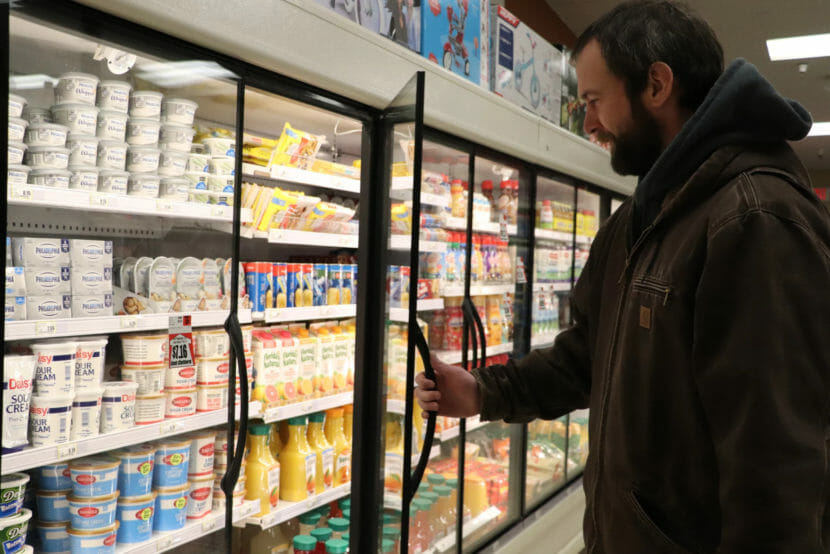
A bearded man holds a door open in the refrigerator section of a grocery store
Michael Yingst looks for eggs at the AC grocery store in Dillingham on Tuesday. (Izzy Ross/KDLG)

On a recent, snowy afternoon in Dillingham, Michael Yingst scanned the dairy section at the AC grocery store.

“I came here to look for eggs,” he said. “Tomorrow is my birthday and I was hoping to make some banana cream pie. But it looks like we’re going to be out of luck for a while.”

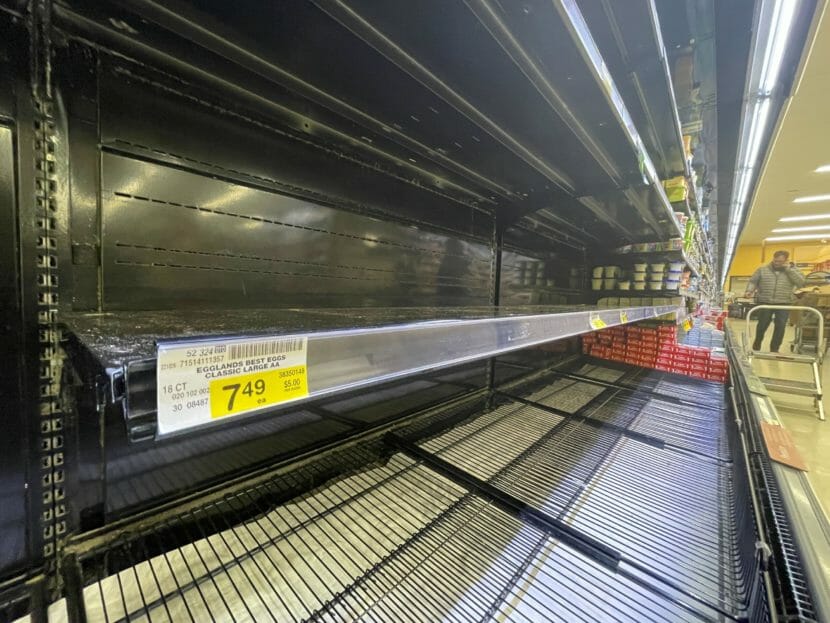
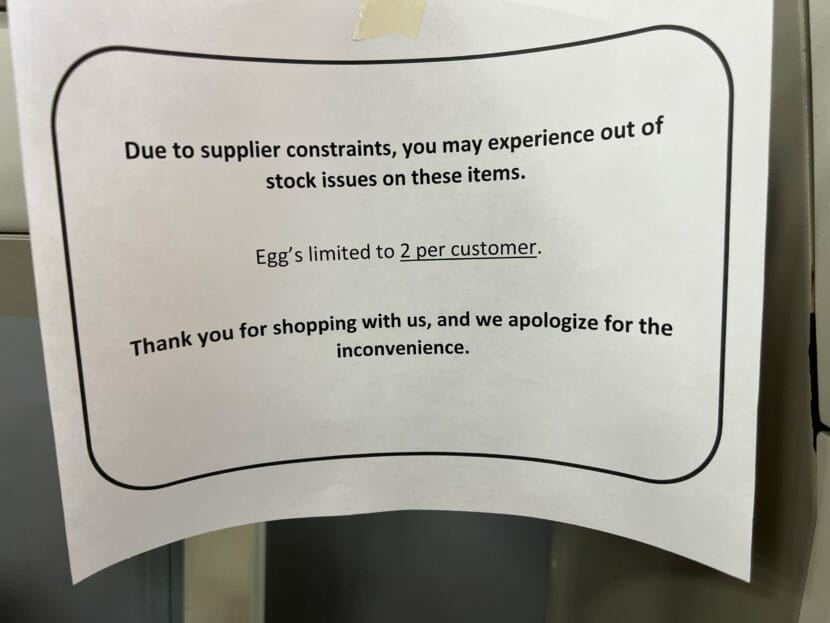
Like Yingst, people across Alaska are running into egg shortages. Many are posting photos on social media of empty shelves and trying to crowdsource where they can buy eggs. Even large grocery chains like Fred Meyer are limiting how many cartons of eggs people can buy. Meanwhile, prices are spiking. Rural areas are getting hit especially hard, because many only have one or two grocery stores, which leaves them with fewer options. And the shortages aren’t expected to let up any time soon.

“It’s not good news in any way,” said Kyle Hill, the president of the Alaska Commercial Co. “It’s really farm-dependent.”

Looking down along empty refrigerated shelves in a grocery store
Empty egg shelves at a Kodiak grocery store on Tuesday. (Brian Venua/KMXT)

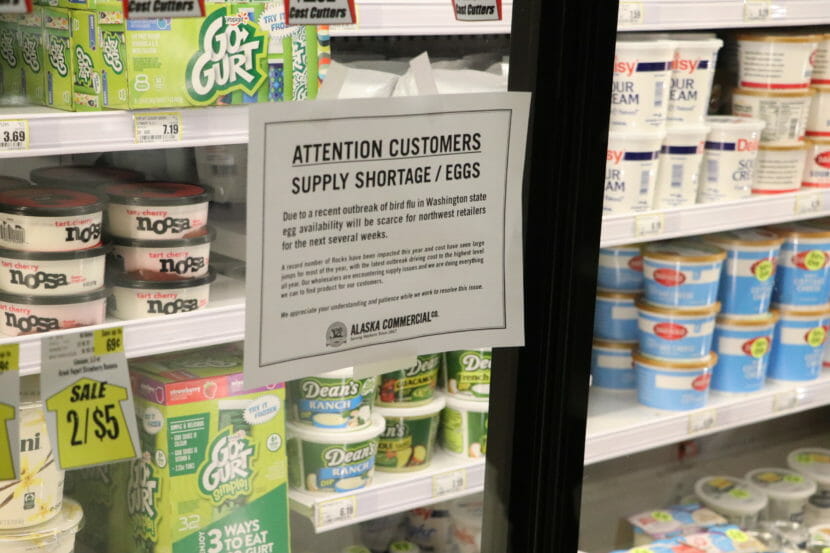
The Alaska Commercial Co., or AC, has 35 stores in the state and calls itself the “largest retailer in rural Alaska.” It gets most of its eggs from Washington state, and one of those providers, Oakdell Farms, was recently hit hard by the bird flu.

“They’ve had to unfortunately deal with over a million birds that have had avian flu in that farm,” Hill said. “So there’s huge supply issues, in the sense that we’re struggling to get any eggs at all.”

When they can get eggs, it’s just a trickle. Hill said AC is telling its suppliers that rural communities don’t have a lot of options when it comes to groceries. If AC doesn’t have eggs, that means an entire community might not have eggs, which then becomes a food security issue. But Hill said it’s tough, because AC is competing with large, national chains.

“They are trying to leverage their national scale and their national distribution to get eggs from elsewhere,” he said. “But, you know, when it comes down to it, there’s only so many eggs out there.”

A sign on a shelf saying customers can only by two cartons of eggs each.
A sign at the checkout at a Fred Meyer grocery store in Anchorage on Tuesday. (Tegan Hanlon/Alaska Public Media)

Hill said pressuring suppliers only goes so far. It’s a supply and demand issue, and all retailers are pushing their suppliers.

“It is a fight, because every retailer is making their case to the same suppliers,” he said. “And then this isn’t even just a Pacific Northwest issue. Down in Texas over the holidays a friend said that they saw eggs at $9 a dozen, because they have a farm down there that’s having avian flu issues. So it’s really farm-dependent.”

Prices aren’t going to be any cheaper in rural Alaska. And when supplies run low, costs go up.

At the front of the Dillingham AC store this week, Sarah Nanalook waited for fellow shoppers. She had traveled with them about 30 miles over the tundra on snowmachines from their hometown of Manokotak to Dillingham to go shopping.

“We only have one small trading store which is owned by Manokotak Native Limited. There’s no other store,” she said.

A sign on a glass refrigerator door telling customers there is a shortage of eggs
A sign informing AC’s customers in Dillingham that eggs will be in short supply in the coming weeks. (Izzy Ross/KDLG)

She said she has watched the price of eggs skyrocket.

“For Christmas I had to buy two dozen for, I mean, almost $20,” she said.

A smaller group of Alaskans, like Alicia Swan, are leaning on their backyard flocks of chickens. Alicia Swan perused the dairy aisle, but not for eggs. That’s because she and her family own chickens.

“Out of 17 birds we’re averaging six to nine eggs a day,” she said. “That’s pretty good.”

But it’s not easy to keep chickens in rural Alaska, particularly in the winter, when chickens tend to produce fewer eggs.

“It can be complicated getting feed here,” she said. “Especially during the winter, you have to continually give them water because it freezes, keep them warm. We give them extra light to keep them laying eggs. They kind of have a vacation during the winter.”

And what about Michael Yingst and his birthday banana cream pie? He’s trying to come up with a new plan.

“Researching egg substitutes and see if there’s anything else I can use as a replacement for eggs,” he said. “But they’re kind of irreplaceable when it comes to a lot of things. So hopefully we’ll figure that out.”

Dillingham’s other grocery store, Bigfoot, is also out of eggs, but hopes to get a delivery early next week. Meanwhile, AC expects a shipment to stores throughout the state by the end of next week, but anticipates the egg shortage will last for at least a couple months.

Site notifications
Update notification options
Subscribe to notifications