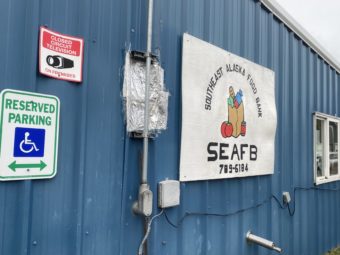
Southeast Alaska Food Bank in Juneau. November 15, 2022. (Photo by Claire Stremple/KTOO)
Ken Garrison looked through a shopping cart piled high with all kinds of bread — long baguettes, herbed loaves, sliced. He was at the start of a buffet of food-laden carts in front of the Southeast Alaska Food Bank warehouse, where he picks up food twice a week for some elderly friends who don’t have cars.
He selected one white and one whole wheat, then grabbed some celery and a bag of kale salad.
“I like that they get good produce here, from Costco and through other stores in town,” he said. “They get a pretty good variety.”
Garrison is part of a long but fast-moving line. The pandemic more than doubled the food bank’s patrons. And they say they need the service as much as ever — inflation means their food dollars don’t go as far as they used to.
Claudia Criss and a friend select some dairy products at Southeast Alaska Food Bank in Juneau. November 15, 2022. (Photo by Claire Stremple/KTOO)
“We’re all squeezed with fixed income,” said Claudia Criss, who is 71-years old.
She was looking for dairy, vegetables, bread and maybe some protein.
“I think it’s a needed service,” she said. “I really appreciate being able to get it.”
Criss used to go to the Helping Hands food pantry, but she switched over when she learned they were shutting down.
Chris Schapp, who has run the food bank for the last three years, says demand is higher than ever.
“We noticed with Helping Hands closing down, we were up about 35 to 40 people more than we’ve been averaging — almost 300 [people a week],” he said.
Chris Schapp moves food from the warehouse to the parking lot for a Tuesday food pantry. November 15, 2022. (Photo by Claire Stremple/KTOO)
When he started, the food bank would serve up to 90 people a week.
“Over the last two years with COVID, it’s been between 225 to 275 a week,” he said.
He says inflation is likely a factor now.
Southeast Alaska Food Bank is hosting its annual food drive this Saturday. Last year, Juneau donated more than 20,000 pounds of food. Schapp says he’s hoping for even more this year, to match the need.
“It’s busy,” Schapp said. “But we’ll take care of everybody we need to. Just make it happen.”
The annual Caring is Sharing Food Drive will take place on Saturday, November 19, from 8 a.m. to 6 p.m. at Foodland and Superbear IGA stores in Juneau.

Averaging almost six feet tall, they’re the second tallest bird in the world, only after ostriches. They weigh more than 100 pounds, and they can’t fly.
But, like more conventional chickens and turkeys, they’re also considered poultry. They’re harvested for meat, leather and oil. And as of this summer, they’re considered legal livestock in the state of Alaska, thanks to an Anchor Point man named Pike Ainsworth.
Ainsworth was inspired to raise emus in Alaska after learning about emu farmers in Maine and British Columbia. He ordered some eggs and managed to hatch one.
“It was really neat,” he said. “ It grows so fast. It’s a really cool little creature.”
Then, he discovered emus weren’t on the Clean List — a register of livestock allowed in the state without a permit. He started working to get emus on that list in 2019.
But it wasn’t so easy. Ainsworth said he encountered resistance from the Board of Game, the authority that greenlights what animals go on the Clean List. Board of Game Executive Director Kristy Tibbles said the board only addresses the Clean List every three years, and they weren’t set to do so until 2021. That meeting was ultimately delayed until the spring of 2022 because of the COVID-19 pandemic.
Ainsworth submitted an agenda change request to bring his proposal before the board earlier, but it was denied. Tibbles said it did not meet the board’s criteria for an out-of-cycle request.
Finally, in March of this year, Ainsworth was able to make his case before the board. At the meeting, he testified about the condition of food security in Alaska.
“Food security is an extremely serious issue, especially now during wartime and COVID-19, stores have been consistently out of food, the price of meat has skyrocketed, making red meat unattainable to most Alaskans,” he said. “I have a proposal. I’d like to add emu to the Clean List.”
He told the board emu meat is more nutritious than beef, that it is eaten by extreme athletes as fuel and that the birds put less of a strain on the land than other livestock. He also said emus require little feed and water and grow quickly.
“Emu can be hatched from an egg and be ready to market in six months,” he said.
Ryan Scott, an assistant director at the Alaska Department of Fish and Game, said the board needed time to review Ainsworth’s proposal because birds often carry a slew of diseases. However, they looked into it, and he said there didn’t appear to be any issues.
“We would anticipate very little impact on Alaska’s indigenous species,” he told the board at its deliberation on Ainsworth’s proposal, three days after his testimony. The state veterinarian didn’t have any concerns, either. Scott noted that emus are not under any threat of becoming endangered.
The proposal passed unanimously, and went into effect July 1.
Since then, Ainsworth said he’s had several farmers thank him for getting emus on the Clean List, allowing them to raise their birds without fear of retribution. He said on top of the health and food security benefits, emus just make great pets.“They’re really a bonding animal, almost like a dog,” Ainsworth said. “They’re so loving, they’re not dangerous creatures.”
Ainsworth currently has two emus and plans on getting more. He also designed a geodesic dome to house his birds without heat in the winter, made of concrete with air bubbles that provides insulation. He shares that design, and his knowledge about raising emu, with others who are interested.
The Midtown Mall in Anchorage. (Photo by Zachariah Hughes/Alaska Public Media)
Two Democratic Alaska lawmakers are urging the Federal Trade Commission to block a proposed merger between grocery giants Kroger and Albertsons.
Reps. Ivy Spohnholz and Zack Fields co-chair the Alaska House Committee on Labor & Commerce. On Oct. 31 they sent a letter to FTC Chair Lina Khan requesting the intervention.
In Anchorage, the two primary grocery chains are Carrs and Fred Meyer, which are owned by Albertsons and Kroger, respectively.
Fields says those stores are also the main competitors in Alaska’s next four biggest cities.
“And these stores are today, the major competitors in Kenai, (Kenai-Soldotna), in Wasilla (Wasilla and Palmer), in Fairbanks, in Juneau, and in Anchorage. So in the five largest population centers in the state,” Fields said.
The parent companies announced their intent to merge back on Oct. 14, stating the buyout would lead to an enhanced customer experience, increased wages and lower prices.
But Fields does not buy that argument. Alaskans already pay some of the highest grocery prices in the country, and Fields worries the merger would send prices significantly higher. He says mergers like these generally result in price spikes.
“That would be the first time in human history that reduced competition has lowered prices,” Fields said. “I don’t think this company is going to suspend the laws of economics and common sense. To the contrary, they would be closing stores, reducing consumer choice, and of course, because there’s no longer meaningful competition, raising prices.”
Carrs and Fred Meyer are two of Alaska’s leading employers, and Fields says a merger would also hurt their thousands of workers in the state by taking away bargaining power, leading to lower wages and benefits.
He hasn’t yet heard back from the FTC, but Fields says he has confidence in chair Lina Khan, who has been skeptical of corporate consolidation and its impacts on consumers.
Kroger and Albertsons did not respond to requests for comment for this story.
Fred Jackson (center) waits outside Helping Hands with his son, Louis, on Friday, Nov. 4, 2022. (Photo by Claire Stremple/KTOO)
One of Juneau’s oldest food pantries is slated to close at the end of the month.
Helping Hands is a nonprofit that’s been around for almost four decades. Volunteers collect food from local stores and distribute it two nights a week to anyone who needs it. Now it doesn’t have enough cash — or volunteers — to stay open.
On a cold Friday evening, several dozen people waited at Switzer Village Mobile Park Rec Center for the food bank’s doors to open. Many of them were regulars.
“I’ve been going here for many years now,” said Fred Jackson, who waited with his son. “It’s sad to hear. It’s gotten us through some very tough times.”
His grandkids visit on the weekend, so tonight he’s looking for special snacks.
Pam Bearden is chatting with a friend further up the line. She says she loves that supermarkets donate food that’s past its “sell by” date but is still good to eat.
“It helps all of us kind of stretch a buck because it’s really hard for a lot of folks right now, so I’m grateful,” she said. “This is a big deal. I mean, years ago all this good food got thrown out in the garbage.”
Inside the rec hall it’s warm and bright. The walls are lined with shelves of bread. A cooler full of yogurt hums. Shopping carts loaded with meat, soda pop and huge cans of baked beans are ready for guests.
“It’s pretty sad because it’s a great organization to volunteer for,” said Sierra Gorbutt. She started volunteering here three years ago. Now she’s one of the only volunteers left, but even she is leaving soon — to take on a full-time job.
Sierra Gorbutt and Kevin Fortwengler are the two remaining Helping Hands volunteers. Pictured on Nov. 4, 2022. (Photo by Claire Stremple/KTOO)
“We would still probably be standing strong, but with the corona [virus pandemic] — it ate up all the savings to keep this place running,” she said.
Helping Hands usually holds fundraisers throughout the year, but the pandemic shut down those revenue streams.
Gorbutt says everything they can’t give away will go to the dump. She points to a shopping basket loaded with kibble — it’s the last of the dog food.
Karen Fortwengler is the director of Helping Hands. She took over leadership after her mother stepped down from the role about a year ago.
“Trust me, it’s not been an easy decision,” she said. She was emotional thinking about the closure. “I’ve been struggling for months to keep this place afloat. And the money’s gotten down there so low that I can’t do it anymore.”
To stay open, she says she’d need about $30,000 that she just doesn’t have. And she said even if she did, she doesn’t have the volunteers to staff it any longer.
Two more volunteers slip through the doors before Helping Hands opens for the evening. One of them is Crystal Johnson from the Lions Club. She comes in every Friday to help out.
Sierra Gorbutt says the soda pop and canned food are typically gone by the end of the evening. Helping Hands estimates it serves about 100 guests each night. (Photo by Claire Stremple/KTOO)
“This is actually my favorite day of the week, I tell everybody,” Johnson said. “Because I get to come down here and meet people and just get to say ‘hi’ and have that chance to do something nice that makes somebody say, ‘Ooh, I kind of matter.’”
People start filing in when the doors open at 5:30 p.m. Bread, chips and canned foods move from the shelves to shopping bags as the room fills with people and the line outside shrinks.
Helping Hands is now open only on Fridays due to the volunteer staff shortage. It will close for good on Nov. 25.
The Southeast Alaska Food Bank will still be open on Tuesday and Thursday afternoons. They also have a list of other local food pantries on their website.
Participants in the three-day unit II deer summit walk around Harris River to view thinning techniques on Oct. 15. (Photo by Raegan Miller/KRBD).
On Prince of Wales Island, an important food source is disappearing. For years, populations of Sitka black-tail deer have slumped, leaving residents without a staple source of protein.
A three-day summit held in Craig last month prompted lengthy discussions about the problem. Scientists have a few theories about why deer populations have declined.
On a Saturday afternoon, and 30-odd biologists, residents and local leaders walked along the looping Harris River trail, 20 or so miles east of Craig, the biggest town on Prince of Wales Island.
The 2022 Unit II Deer Summit was a three-day event that packed the Craig Tribal Hall with representatives from wildlife agencies and conservation groups, as well as interested locals who wanted to share their opinions.
The summit was organized by a steering committee made up of Alaska residents like Dennis Nickerson from the Prince of Wales Tribal Conservation District, Ross Dorendorf and Tessa Hasbrouck from the Alaska Department of Fish and Game, and representatives from the Natural Resources Conservation Service, the University of Alaska Fairbanks, and the Southeast Alaska Conservation Council.
It was more than two years in the making, and officially kicked off on Oct. 13, ending Oct. 15.
Attendees mingle during the summit at the Craig Tribal Hall. (Photo by Raegan Miller/KRBD).
The Harris River walk capped the summit. It was meant to drive home the theories presented for why the island’s deer population is plummeting – such as poor habitat management and a legacy of clear-cut logging.
When loggers cut down a section of old growth Sitka spruce, hemlock and cedar in the Tongass National Forest, there’s no need to replant — trees grow back on their own.
And while that sounds like a good thing, it can wreak havoc on the food web.
U.S Forest Service Wildlife Technician Ray Slayton stopped to take in the sights. He pointed to a stand of trees packed tightly together. It’s all natural regeneration from a clear cut in 1960. He pointed to the forest floor, lined with dead leaves, sticks, moss and dirt.
“What you see is there’s no forage for deer at all,” he said.
It’s what scientists call an “even-aged forest.” When trees all start growing at the same time, they create a dense canopy that prevents light from reaching the ferns and berry bushes that black-tail deer love to snack on. And because the trees grow close together, they end up long and spindly — not the massive, thick, tight-grained trunks that make old growth lumber so highly valued.
One big way to address the problem is by cutting down some immature trees to open up the canopy. It’s called thinning.
Mike Sheets, from the U.S. Forest Service, explained on the walk that half the trail has been thinned in various ways. Some stands were cut in a kind of herringbone pattern, while others were thinned near the top or the bottom. This was all done to try and encourage more foraging opportunities and open up travel corridors for deer.
Habitat loss is one of the major theories for why deer have been disappearing from the island.
Back at the Craig Tribal Hall, biologist John Schoen from the Alaska Department of Fish and Game told summit attendees that old growth forests are a key habitat for deer. He says old growth keeps too much snow from accumulating on the ground and provides plenty of food beneath the trees.
But second growth is another story – without management, there’s little to feed deer.
Jim Baichtal is the regional coordinator for the Mule Deer Foundation. He said forest managers need to prioritize habitat restoration.
“What we need most now is a commitment for radical large-scale restoration … that focuses on fixing the right places,” he said.
He said strict management of young growth is essential. He said managers should use radar to determine where trees need to be thinned. And he said that the Forest Service should figure out how to make thinning an attractive business proposition for loggers.
“We need to write prescriptions for stem exclusion phase young growth that will remain wind firm and create meaningful, accessible forage for the near future. We need to develop these prescriptions knowing that multiple entries may be needed through time to continue creating forage. We need to have a market for the logs produced by these prescriptions and plan for utilization of the biomass created to allow access through the stands,” read a slide from Baichtal’s presentation at the summit.
But habitat loss isn’t the only theory. A number of factors are thought to be at play — including the management of predators.
As one attendee put it, “… Wolves and weather and habitat and hunting, that sums up a lot of it.”
Ecology professor Sophie Gilbert presented data that showed it could be due to how aggressively black bears prey on fawns. In one study, Gilbert said her research shows that black bears will kill 50% of fawns sometime within their first two weeks of life. Gilbert says does are known to keep twin fawns apart from each other, so if one is eaten, the other still has a chance at survival.
“Black bear just dominate neonatal mortality,” Gilbert said.
Gilbert also said that harsh winters — known as killing winters — can quickly cull a deer population. She said there hasn’t been a killing winter since 1976. But some attendees worried climate change could cause problems.
“So basically, if there’s not snow, everybody can usually make it to the fall or the spring, but if there’s snow, a bunch of fawns are going to die,” Gilbert said.
One of the most popular theories among Prince of Wales Island residents is that wolves are behind the drop in deer numbers.
Craig’s mayor, Tim O’Connor, said wolves need to be thinned out. State wildlife officials estimate that somewhere between 100 and 200 wolves live on the island. But O’Connor said that’s a substantial undercount — he said based on what local hunters bring back, the real number is somewhere around 700 or 800.
Ross Dorendorf is the state’s Department of Fish and Game area biologist. He explained Prince of Wales Island’s wolves prey primarily on deer — it’s more than half their diet.
He said deer can be a safer option for a hungry wolf than taking on a goat or a moose.
“There’s different challenges for a wolf, in going after these critters,” Dorendorf explained. “A moose is a lot bigger and requires a certain skill set to not be killed yourself, when you’re trying to eat that animal. They can stomp you, they’re pretty dangerous. And then other challenges for (hunting) a mountain goat might be really steep terrain and running after it, (the wolf) falls off a cliff. That’s not very good.”
A graph from Ross Dorendorf’s presentation showing the breakout of a wolf’s diet. (Courtesy of Jess Forster and Mandy Park).
But he said there’s more to study to understand what role wolves play in the declining deer population.
The meeting wasn’t meant to end with a plan to fix the problem. Organizers pitched it as a place to voice concerns and opinions and learn more about the issue. Some attendees suggested cutting back on old growth logging. Others suggested thinning out predators and cutting deer bag limits.
But one thing is clear: there are no easy answers.
Raegan Miller is a Report for America corps member for KRBD. Your donation to match our RFA grant helps keep her writing stories like this one. Please consider making a tax-deductible contribution at KRBD.org/donate.
Tasha Elizarde, KTOO’s community reporting fellow, with interview guests Rachel Barril, Lionel Udippa, and Aims Villanueva-Alf on Juneau Afternoon Friday, Oct. 21, 2022, at the KTOO studio in Juneau. (Photo by Sheli DeLaney/KTOO)
October is Filipino American History Month. An event over the weekend in Juneau will celebrate Filipino food with several local chefs.
“So all of my memories, there’s always food associated with them,” said chef Rachel Barril. “Filipino food is the cornerstone of Filipino culture. It’s how we gather for family celebrations, funerals, that kind of thing.”
Barril works at In Bocca Al Lupo in Juneau, which is known for its wood fired pizza. But Barril makes sure there’s always a Filipino take.
“I take the traditional dishes and apply more modern techniques that I’ve learned. I like fermentation. Recently I learned to make miso out of peanuts and I used it in a kare kare dish. It’s like a peanut curry, usually served over oxtail,” she said.
October is the time to consider the contributions of Filipinos to U.S. history because the first Filipinos landed in what is now the United States in October of 1587.
“So, Filipinos have been in America for 435 years. And that’s 33 years before the pilgrims landed,” said chef Aims Villanueva-Alf, who owns Black Moon Coven in Juneau. “I never knew that.”
Villanueva-Alf is from Juneau, but the rich and long history of Filipinos in Alaska specifically is something she’s only recently started to embrace since moving back from the Lower 48.
“I don’t feel like fully let myself really nourish myself in my culture and my heritage until I was out of Juneau,” she said.
Lionel Udippa from Red Spruce and Abby Laforce Barnett from Zerelda’s Bistro will also be bringing food for the event hosted at the Filipino Community, Inc. hall downtown. And they’ll join in a panel discussion, followed by a screening of Ulam, a documentary about Filipino food, sponsored by Friends of the Juneau Public Libraries.
This story is part of KTOO’s participation in the America Amplified initiative to use community engagement to inform and strengthen our journalism. America Amplified is a public media initiative funded by the Corporation for Public Broadcasting.
America Amplified
KTOO is amplifying the voices of Filipinos in Alaska. We want to hear from you. What stories would you like to share or learn more about?
Close
Update notification options
Subscribe to notifications
Subscribe
Get notifications about news related to the topics you care about. You can unsubscribe anytime.