Food

From frozen pizzas to toilet paper, Alaska stores deal with erratic shortages

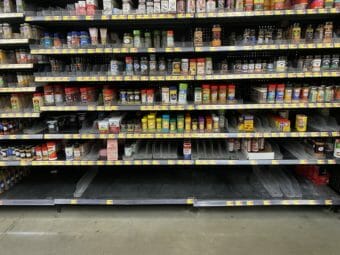
Grocery store shelves with numerous spices missing and no salt at all
The spice aisle at a Kenai grocery store, where salt — meant to line the bottom shelf — is fully out of stock. (Photo by Riley Board/KDLL)

It’s hard to walk into a grocery store these days without thinking about the buzz-phrase “supply-chain problems.” The common sight of scattered empty shelves is the product of global supply systems that were shattered by the pandemic, and even more recently by the war in Ukraine.

Reported national shortages include meat, canned goodscoffee and wine. On the Kenai Peninsula, many grocers agree that it’s hard to predict which items will be unavailable during any given week.

“One week it’s like Jimmy Dean sausage, the next week it’s paper products. It’s just been so random lately,” said Jim Kolb, the marketing director at Alaska-based chain Three Bears.

He said the shortages come in strange waves — one week it will be tampons and pads, and the next, frozen pizzas.

“Honestly, that’s what it’s like. We don’t know. Ammo used to be a big problem, it’s not anymore,” he said.

Lately, it hasn’t been too bad. The only products Kolb said he’s missing at the moment are frozen items.

The erratic shortages hit small grocery stores even harder. At Cooper Landing Grocery and Hardware, owner Wayne Mitchell said 25% of everything he orders just never shows up.

That’s particularly true for items that come from overseas, like souvenirs.

“It runs the whole gamut, from cigarettes to candy to souvenirs to anything. Almost anything. I’m taking a chance on what I order,” Mitchell said.

Souvenirs are especially important at the Cooper Landing store, which serves a lot of tourists in the summer.

Mitchell said the store has basic items available most of the time, but placing orders has become difficult and inconsistent.

Last year, he said, he only had to go through one vendor to get items. But with a lack of supplies, he’s had to diversify. Now, he has to go through three or four different vendors to get what he needs. That’s made purchasing for the store a major time commitment.

“I’m working on orders almost constantly trying to get stuff in here. So it’s been a challenge,” he said.

Those challenges resonate with Jenny Bushnell, the Kenai manager of the small chain Save U More. She said the seasoning liquid smoke and toilet paper are recent culprits.

She also said product shortages are accompanied by sky-high shipping rates.

“Say a pallet costs me a thousand dollars. To get it up here I would pay 20% of that, so it would cost me $1,200 to get that stuff up here. Now if the palette costs $1,000 it’s 40% added on so it’s $1,400 to get the pallet here,” Bushnell said.

She said that doesn’t even account for the cost of putting the product on a barge — which has to first make its way to Anchorage, then down to the store on Kalifornsky Beach Road.

For Bushnell, that means she’s paying higher costs for those products and changing up Save U More’s traditional offerings.

Save U More, like the store in Cooper Landing, is serving a primarily tourist customer base this summer. Bushnell said she struggles to meet the needs of customers who are only in town for a short while. By the time she’s able to bring in the missing products tourists are asking for, they’ve already gone back home.

But shortages aren’t hitting every grocery store the same way.

Jim Kolb of Three Bears said that besides a week without frozen items here or paper products there, Three Bears has, in general, been able to keep its nine Alaska stores well supplied. He attributes this to a strong buying staff and a willingness to seek out a variety of alternative vendors, something that larger chains might be likely to do.

Alaskans are rethinking their spending habits as record inflation hits the state

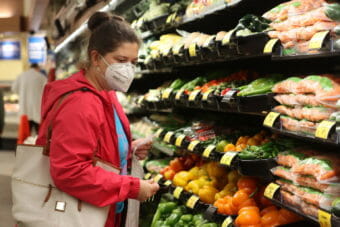
A woman shopping in the produce aisle of a grocery store
Natasha Price looks for sale produce at Carrs in South Anchorage on Thursday, July 14, 2022. (Photo by Kavitha George/AKPM)

On a grocery run to Carrs in South Anchorage, Natasha Price examined her options for ketchup.

“My husband is very particular with his ketchup, being from Pittsburgh, so he wants Heinz,” she said. “So this is where I really get into it these days.”

She bent down and compared the price per ounce of a bottle of Heinz and a bottle of generic ketchup. The conclusion: the Heinz was more than twice as expensive.

“That’s a huge difference,” she said. “So I’m sorry but my husband is not going to get his preferred ketchup today. We’re getting the regular stuff.”

This kind of calculus is new for Price. But with record inflation driving up the price of basics, it’s her norm now.

The U.S. Bureau of Labor Statistics measured Anchorage and Mat-Su consumer prices up more than 12% from a year ago. It’s one of the highest jumps in the nation.

Price is a florist with a part-time marketing job. Her husband works for the state, and they have a ten-year-old son. She said her family’s income has increased enough to keep costs covered, but she’s still approaching spending with caution.

As she made her way through the aisles, Price checked the sale meat section for a deal on pork — no luck, though — and said no to chicken breasts at $4.29 a pound.

She said she’ll keep some things on her list until she finds them at a better price somewhere else. If they’re dry goods, she might even order them on Amazon.

But others, like artichokes or fresh berries, she’s completely written off her list.

“Grapes have gone up a lot, too. Red grapes are my favorite fruit, and it has to be like a special occasion for grapes. Sort of sad,” she said.

An Alaska Public Media survey on inflation showed Price is not alone in her efforts to rethink her spending. Many Alaskans said they are paying more attention to sales, buying less meat and expensive produce, and stocking up on bulk items from Costco or Amazon. Others are sticking to generic brands or relying on food pantries more often.

Respondents also said they are more cognizant of their driving habits amid rising gas prices, combining errands, cutting out road trips and biking more often.

According to the federal data reported last week, the average cost of groceries in Anchorage and the Mat-Su is up more than 10% from a year ago. Energy prices are up more than 30%, largely driven by the spike in gasoline, which is up more than 60%.

“Another one that has a big weight was housing,” said veteran state labor economist Neal Fried. “That was up by 6.6%. You have to go back to 1982 to find that kind of over the year increase.”

Fried has watched inflation tick steadily upward this year. But he was taken aback by the June inflation numbers for the Anchorage area.

“The last numbers that came out in April were 7.5%, compared to April a year ago, and then boom, 12.4%. I mean, that’s pretty eye popping,” Fried said.

After a brief period of deflation toward the start of the COVID-19 pandemic, inflation has taken hold of the nation’s economy. There are many reasons for this. Pandemic-related supply chain disruptions and labor shortages have forced up the price of goods. Demand for goods and energy is also bouncing back and driving up prices, said Fried.

Market uncertainty due to the Russian invasion of Ukraine is also still at play, said Fried. Oil prices have dipped slightly in the last few weeks, but they remain high.

Meanwhile, Fried said wages are going up nationwide, but not enough to match the rate of inflation.

The federal inflation numbers don’t include rural Alaska. And Fried said without the data it’s difficult to say whether inflation is even worse in rural areas, where the cost of living has always been much higher. But rural respondents to our survey on inflation say brutal cost hikes are making it harder to afford basic necessities.

Susan Tessier, who lives in Kotzebue, said despite uncertain salmon returns she’s trying to stock up on subsistence fish.

“Last year, I just kind of blew off the herring fishing. But this year we went out and got a bunch of herring, and we’re getting our net ready for salmon. And we’re gonna try to jar and put away some salmon and just try to keep our freezers full to combat the prices,” Tessier said.

She added that she noticed people trying to stock up amid rumors that the town’s next barge delivery would come with higher priced gasoline and supplies.

“People are just kind of scrambling. I mean, when you go to the gas pumps now, it’s like there’s a long line of people filling up drums of gas. And at the store, it seems like people are buying extra,” Tessier said.

At the South Anchorage Carrs, Natasha Price finished checking out. She scanned her receipt to make sure all the discounts went through.

“Seven items, that was $28.22. So that’s not too terrible.”

But that doesn’t count the time and energy spent scrutinizing each product to make sure it fit her budget.

Fried said despite the Fed raising interest rates, he doesn’t expect inflation to let up for the rest of this year. He said he’s not making predictions for 2023.

Adelyn Baxter contributed to this report.

Juneau Assembly pivots to opinion poll on how to implement tax break on food sales

Sarah Young checks out at Foodland IGA in Juneau, Alaska. (Photo by Jeremy Hsieh/KTOO)

Ballots in Juneau’s local election this fall won’t have questions about a proposed sales tax break on groceries. There’s been months of discussion on the topic at Juneau Assembly meetings. Now, the Assembly wants to finish the debate with a public opinion poll instead of asking voters directly on the ballot.

At the beginning of June, the Assembly was leaning toward asking advisory questions on the ballot. The questions would have paired the tax break with different options for new taxes to recoup most of the cost to the city.

The Assembly wants to know if voters would still want the tax break if it also meant one of these things would happen: raising the year-round sales tax rate to 5.5%, raising the sales tax rate seasonally to 6%, or raising property tax rates so most property owners would pay about 9.5% more.

But by the end of June, most Assembly members had become concerned about how those non-binding questions would look alongside separate, tax-related questions that will be on the ballot and are binding.

“These ballot questions I think would be super — just, confusing,” Deputy Mayor Maria Gladziszewski said in a committee meeting on June 27. “And then if the sales tax things pass, then we’d have to do it again, and people would have to vote on it twice, and then they’d be like, ‘Didn’t I vote on this last time?’”

The city charter doesn’t allow the Assembly to change the sales tax rate, so voters would have to approve it with another ballot question in another election.

There was also concern that including the advisory questions could confuse voters about three other ballot questions in the works that deal with funding major city projects. That includes funding to build a new City Hall.

“Man, I really had my heart set on removing sales tax with this Assembly,” said Assembly member Wade Bryson. “But I’m afraid if we try to squeeze it into this ballot, this October’s ballot, that it could have more harm than good.”

Gladziszewski suggested an alternative.

“So I’m wondering if we could achieve our same objectives by just hiring a firm to do a statistically valid survey,” Gladziszewski said.

Most of the other Assembly members were amenable.

A measure to commit up to $40,000 for the survey is set for public hearing and final vote at the Assembly’s next regular meeting on Aug. 1.

The timing for the survey hasn’t been decided. City Manager Rorie Watt told the Assembly he wants to avoid election season.

Universal free school meal program going away for about half of Alaska’s schools

Schoolchildren with trays getting a cafeteria meal
Children pick up their school lunches. Starting this fall, access to free school meals is going away for about half the schools in Alaska that participate in the federal school meal program. (Photo by Amanda Mills/Centers for Disease Control and Prevention)

During the pandemic, public schools were able to provide free meals to all students, regardless of income, due to federal waivers. Starting this fall, that access is going away for about half the schools in Alaska that participate in the federal school meal program.

Families attending these schools will return to pre-pandemic ways of getting school meals — apply for free or reduced price meals based on income level, or pay for them.

Jo Dawson, program manager for child nutrition programs at the Alaska Department of Education and Early Development, said the transition will be difficult.

“I don’t want to undersell this. It’s going to be difficult because families who had traditionally applied are not used to applying and some won’t apply. They won’t ask for assistance,” Dawson said.

She said school sites that have traditionally charged for meals saw participation increase during the pandemic.

“Those school sites are definitely concerned at what this transition back to charging for school meals will do to their participation,” Dawson said. “You know, not only to the revenue, but for the students. Do they have the means to access those healthy meals that they have been participating in in the last two years? So it’s certainly a concern.”

Dawson said some students won’t have access to free meals because their families won’t apply or they don’t meet the income threshold. Serving all meals free to all students works well, she said, because it takes barriers away from participation.

“When all of the students partake in the school meals, it’s no longer thought of as a program that someone needs; it’s a program that someone gets. Students don’t want to be identified as needing that meal,” Dawson said.

To ease families through the transition back to pre-pandemic days, schools in the Matanuska-Susitna Borough School District impacted by this change are keeping the costs of meals at the same rates.

“We were very intentional in not increasing our meal prices for this coming year,” said Katherine Gardner, Mat-Su school district associate superintendent who oversees its food service operations.

For elementary schools, breakfast costs about $2.25 and lunch $3.75. At the middle and high schools, breakfast costs $2.75 and lunch $4.75 — the same as pre-pandemic rates.

“We’re very mindful of the increased costs that we’ll have in purchasing goods, purchasing food and supplies. But we also recognize that the lower we can keep those prices, the more access students have to those meals,” Gardner said.

Gardner said the district plans to ramp up its communication to families about the changes to the school meal program as the school year approaches.

“It’s really important that they fill out that free and reduced application. We would encourage all of our families to take a look at the application and fill it out. Some people may not think they qualify, but they do. That free and reduced application and status not only helps with access to meals, but it helps for additional support for student programs,” Gardner said.

About half the schools in Alaska will continue to serve free meals to all

About half the schools in Alaska that participate in the national school meal program, including a quarter of the schools in the Mat-Su school district, will not see any difference in their school meal program this coming school year. They’ll continue to serve all meals free to all students through the federal Community Eligibility Provision program, which includes schools where at least 40% of students are eligible based on income or other factors.

“Nothing will change in our district,” said Amanda West, food service director for Lower Kuskokwim School District, regarding student access to free meals.

The district serves about 4,000 students in 28 schools. Most students participate in the school meal program, West said. What will change is how the food is served, “We’re no longer packing it to-go for families. We’ll be serving it in the cafeterias. We’re just going back to what we were doing before, serving kids regular meals.”

Ripple effect of free school meals going away

The benefits linked to a universal free school lunch program – food security and academic performance – will likely be impacted when it goes away, said Mary Kopriva, health economist at the Institute of Social and Economic Research at the University of Alaska Anchorage.

“Families are already facing increased food insecurity because of increased prices. Taking away these universal free lunches just exacerbates that,” Kopriva said.

Kopriva said a working research paper that recently came out suggests that taking away universal free lunch may make inflation worse. The paper showed that universal school lunch programs actually helped to reduce grocery prices for everybody by reducing people’s grocery expenditures.

“Stores respond to that reduced demand by reducing prices. So if we see universal lunch programs going away then we will see that increased demand to grocery stores, which could actually heighten inflation for all as well. So we could see this actually exacerbate inflation too potentially, which then again, would have these ripple down effects of increased food insecurity,” Kopriva said.

Another possible impact of free school meals going away, Kopriva said, is families buying lower quality food.

“Households who are getting these universal school lunches are spending less on groceries overall. And they’re also able to increase the quality of the food that they’re getting a little bit, so they’re mainly having healthier options. So, it’s possible that we could see some effects on overall health in that dimension as well.”

Despite federal warning, Alaska alcohol board says distilleries can keep selling kegged cocktails

""
Tap handles shows a variety of kegged Denali Spirits cocktails on Thursday, July 7, 2022 in Talkeetna. (Photo courtesy Sassan Mossanen)

Alaska’s state alcohol regulator is declining to stop distilleries from selling kegs of premixed cocktails despite a warning by federal regulators, who have concluded that the process is illegal.

Last week, the Alaska Alcohol Control Board rescinded an advisory notice that had cautioned distilleries against selling kegs to bars and other places with alcohol licenses. The board also voted unanimously to create a working group to consider the topic further.

“In the meantime, I’m not going to go after a guy who has been doing something, allegedly lawfully, for (four) years under our nose,” said Joan Wilson, director of the Alaska Alcohol and Marijuana Control Office.

Sassan Mossanen is the CEO of Denali Brewing and Spirits in Talkeetna and has been selling cocktails by the keg for four years.

State law forbids distilleries from selling a keg to an individual — Alaska has strict limits on serving sizes — but there are no state laws that forbid a distillery from selling a keg to a bar or restaurant that has a liquor license.

In April, following a question from a Denali Spirits sales agent, AMCO began investigating whether federal regulations might bar the practice.

Alcohol sales practices are controlled by the Alcohol and Tobacco Tax and Trade Bureau, a section of the U.S. Department of the Treasury.

The bureau has a section of regulations called “standards of fill,” which dictate the size of bottles that a distillery, winery or brewery can sell.

“It sounds like the activity you described would not be allowed by federal regulations,” a TTB investigator told AMCO’s lead enforcement officer, after he asked about keg sales.

After that message, AMCO sent a warning notice.

“The thought at that time was, ‘Of course, we’re going to enforce the TTB standards,’ and we sent out an advisory to people to let them know that,” Wilson said.

Tom Hogue, a spokesperson for the Tax and Trade Bureau, confirmed the regulations.

“In terms of making a premixed product, like a margarita, or piña colada, somebody who’s properly permitted as a distiller can go ahead and produce a product like that, as long as it’s properly labeled and everything else. The thing is, they’ll have to remove it from their premises in a container that meets one of the standards of fill requirements. There are certain container sizes that are allowable, and the largest container size that they could use would be 1.8 liters,” he said. That equals a half-gallon.

Most cocktail kegs are one-sixth of a barrel, or just over 5 gallons.

Mossanen and Lee Ellis, board president of the Brewers Guild of Alaska, testified in front of the alcohol board in late June, urging the five-member body to disregard the federal guidance and continue keg sales.

“For us, this is a very, very big deal. There are significant financial consequences,” Mossanen said.

Ellis’ employer, Midnight Sun Brewing in Anchorage, also holds a distillery license.

“I would say we have already lost business opportunities because of (the uncertainty),” Ellis told the alcohol board.

Nationally, and within Alaska, the trend in alcohol sales has been toward “premiumization” — smaller volumes of higher-quality alcohol instead of bigger amounts of cheap products.

Alcoholic and nonalcoholic cocktails represent a larger part of the alcohol industry than they did a few years ago, and so-called “ready to drink” cocktails, which don’t require a bartender’s intervention, are a particularly fast-growing niche.

Mossanen said it’s common for distilleries to sell cocktails as a way to demonstrate to bartenders and the public how their liquor can be used.

Denali Spirits and many other distilleries in the state sell ready-to-drink cocktails by the can, but selling by the keg is more efficient and allows Mossanen’s company to better compete with other kinds of alcohol, he said.

He acknowledged the federal regulation but said that because Alaska doesn’t have a similar state law, it’s unenforceable. He compared the situation to the way Alaska handles marijuana, which is federally illegal but legal within the state.

Mossanen also noted that the Tax and Trade Bureau is considering whether to eliminate its “standards of fill” regulations.

In February, the Treasury Department released a report saying in part that those regulations are “no longer necessary” to ensure tax compliance, and a rulemaking process underway now could eliminate the idea of regulated container sizes in favor of a minimum size and a maximum size.

Even if adopted, the current wording of that proposal appears to fall short of allowing kegs.

At AMCO, Wilson said one of her primary concerns is to maintain fairness, and if there’s no clear state law, she will follow the direction of the alcohol board.

“I implement the board’s will. I’m not always going to wait, but we’ve got someone selling a product — we believe lawfully — and not getting our attention for (four) years. And I’ve also got an entire industry of breweries supporting his interpretation of this. And I’ve got a board asking for additional advice on it,” Wilson said.

“I’m not going to start enforcing until those pieces come together.”

As state COVID emergency ends, tens of thousands of Alaskans will see reduced food stamp benefits

""
Shelves at a small Anchorage-area grocery store on Wednesday, Jan. 5, 2022. (Photo by Emily Mesner/ADN)

Tens of thousands of Alaskans will lose access to expanded food stamp benefits in September after the state ends its public health emergency in July.

The end of certain additional benefits under the federal Supplemental Nutrition Assistance Program comes as food aid groups say need is reaching previous pandemic highs while prices are soaring. Plus, other pandemic-era benefits, like the child tax credit and rental assistance, are expiring too, said Cara Durr, director of public engagement at the Food Bank of Alaska.

“We know families are struggling and they are turning to services,” Durr said. “So this is really coming in the middle of what is kind of a perfect storm.”

The SNAP Emergency Allotment program, which has been in place throughout the pandemic, is set to end in Alaska after August. It will mean the loss of at least $95 in benefits per month for the 56,000 households in Alaska that receive food stamps. But some families could be losing hundreds of dollars more each month, at a time when roughly 13% of Alaskans are receiving benefits from SNAP.

The additional benefits will cease because the state of Alaska opted to end its public health emergency in July. For the money to be sent, both a federal and state-level order need to be in place.

A state spokesman said the emergency declaration was specific to COVID-19, and was not related to today’s economic challenges. The order was initially a way to respond to the pandemic, but is no longer needed since the private sector is providing much of that response now, he said.

The emergency allotment program gives people already receiving SNAP benefits the maximum amount for their household each month, Durr said. Benefits are calculated based on someone’s income and expenses, which means someone with more income would usually get lower benefits.

But under the emergency allotments, a single person in Anchorage who might normally receive the minimum of $26 per month could receive the maximum amount of benefits for their household, which is $322 per month, she said.

People who were already receiving their maximum benefit were able to receive an additional $95 each month beginning in July 2021 under the emergency allotment, Durr said.

“It’s been a really important boost for households,” she said.

SNAP benefits are available to some low-income families and come on debit cards issued to recipients so they can purchase food. While the benefits may not fully cover a month’s worth of food for families, they’re still an important resource, Durr said.

All told, some 97,000 Alaskans, among 56,000 households, were receiving SNAP benefits in April and are set to lose some amount of benefits come September.

That’s around 17,000 more people who received the benefit compared to January 2020, and is a number that’s been steadily rising since January 2021, according to data from the state’s health department.

At a press conference earlier this month, Shawnda O’Brien, director of the Division of Public Assistance, told reporters that the department will give notice to people receiving the additional money that the benefit will end.

According to a spokesperson for the U.S. Department of Agriculture, 16 states around the country have ended their emergency or disaster declarations while another four have said they will end theirs. States can extend the emergency SNAP benefits by a month after their emergency declarations end — which Alaska opted to do in order to send the benefits out through August once the order ends in July. The benefits will also extend a month after the federal emergency ends, according to the USDA.

For the states continuing their public health emergencies, the federal Department of Health and Human Services has said it will give a 60-day notice of when it plans to end the federal public health emergency, which by late June, it had not yet done — meaning the earliest the emergency could end would be late August, and the benefits for those states would continue through September.

The end of the emergency allotments will be “devastating” for people who rely on SNAP, predicted Heather Parker. She is a supervising attorney in Southeast Alaska with Alaska Legal Services, a nonprofit that provides free civil legal services to low-income Alaskans.

Parker said local food banks can be a stopgap measure for those who need food. She’s also told clients that to qualify for the maximum amount of food stamp benefits, they should make sure the Division of Public Assistance is aware of all expenses. But all in all, she said, there’s not a great safety net for people.

Leigh Dickey, advocacy director for Alaska Legal Services, noted that the federal dollars to pay the benefit still exist.

“By DHSS ending the state emergency, they’re basically just ending Alaskans’ access to the federal money earlier than they need to, which does seem cruel right now,” Dickey said.

An earlier disaster declaration that had been in place since March 2020 expired in February 2021, after Gov. Mike Dunleavy said the Legislature was the body that should renew it and it failed to do so. The current public health emergency set to end in July has been in place since May 2021.

In an emailed response, health department spokesman Clinton Bennett said that the emergency order was only possible under limited authorities given to the state’s health commissioner by the Legislature to help with the pandemic response.

The state public health emergency “is specific to COVID-19 and has nothing to do with the current economic situation,” Bennett wrote. “The tools provided for the COVID-19 response are no longer required, so it is appropriate to end the State Public Health Emergency Order.”

This story was originally published by the Anchorage Daily News and is republished here with permission.

Site notifications
Update notification options
Subscribe to notifications