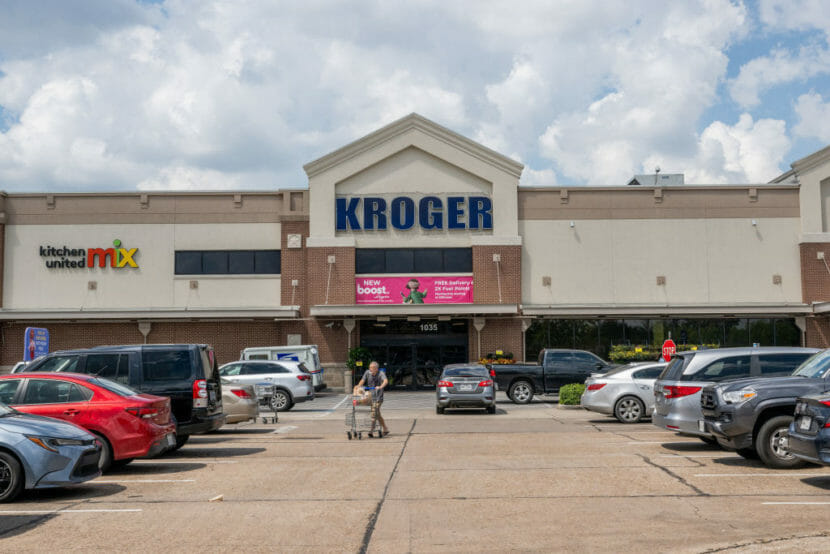
A customer exits a Kroger grocery store on Sept. 9 in Houston. (Photo by Brandon Bell/Getty Images)
Kroger plans to buy Albertsons in a deal valued at $24.6 billion, a merger that would combine the two largest grocery-store chains in the U.S., the companies said on Friday.
The deal is likely to draw intense scrutiny from federal regulators and critics as it would form a new supermarket colossus at a time of soaring food costs. Grocery prices jumped 13% in September compared to a year ago.
Kroger is the largest supermarket operator in the U.S., with 420,000 employees and more than 2,700 stores, including Ralphs, Harris Teeter, Fred Meyer, and King Soopers. Albertsons is the country’s second-largest supermarket company, with 290,000 employees and almost 2,300 stores, including Safeway and Vons.
The two overlap in several markets, largely in the western part of the country. Their tie-up would involve spinning off up to 375 stores into a separate company, the companies said.
In the Friday announcement, Kroger said it would “reinvest approximately half a billion dollars of cost savings from synergies to reduce prices for customers” and invest $1 billion to raise wages and benefits for workers.
For both companies, Walmart is a key competitor, as a nationwide big-box giant that sells more groceries than Kroger and Albertsons combined. The two also face competitions from Costco as well as Amazon, with its online delivery reach, and lately, dollar stores, the fastest-growing segment of U.S. retail.
Antitrust regulators in the Biden administration have advocated for changes in the government’s approach to mergers, and they have pushed back against megadeals, citing outsize impact on competition and consumer prices.
Kroger and Albertsons are “going to get a much closer look than earlier transactions received in this sector,” said William Kovacic, former lawyer and chair at the Federal Trade Commission. “They’re going to face a great deal more skepticism about the potential benefits of the consolidation,”
But the federal competition regulators have also recently lost in litigation over some attempts to block mergers, said Kovacic, who’s now a law professor at George Washington University.
“So there’s likely to be a difficult passage through the review by the FTC,” he said.” It does not mean that the FTC is absolutely destined to prevail if it decides to go to court and challenge the deal.”
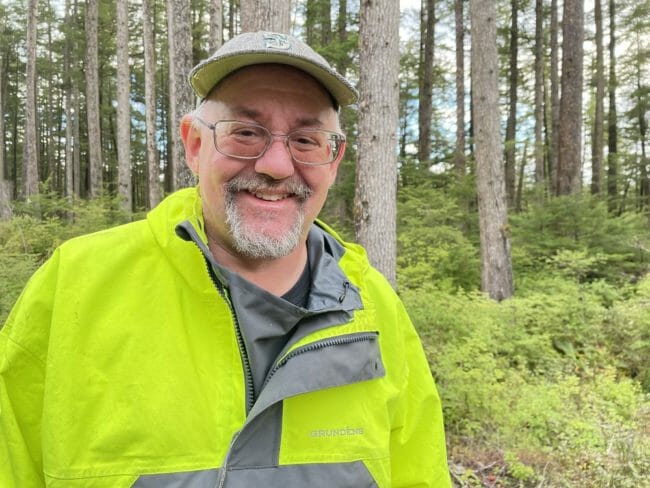
Dave Gregovich, Wildlife Habitat Analyst for ADF&G and local mushroom enthusiast (photo by Sheli DeLaney/KTOO)
Dave Gregovich, Wildlife Habitat Analyst for the Department of Fish and Game, is a mushroom enthusiast on the hunt for winter chanterelles. He starts the search in a forest near the North Douglas highway, and looks for areas with hemlock trees and blueberries.
“It’s not a super specialized mushroom,” Gregovich said. “In most places where you have old growth forest, you have at least a few winter chanterelles.”
Edible mushrooms found in Southeast Alaska can be foraged throughout the fall and into early winter, but winter chanterelles have very distinct characteristics that make them especially easy to identify, especially for beginners.
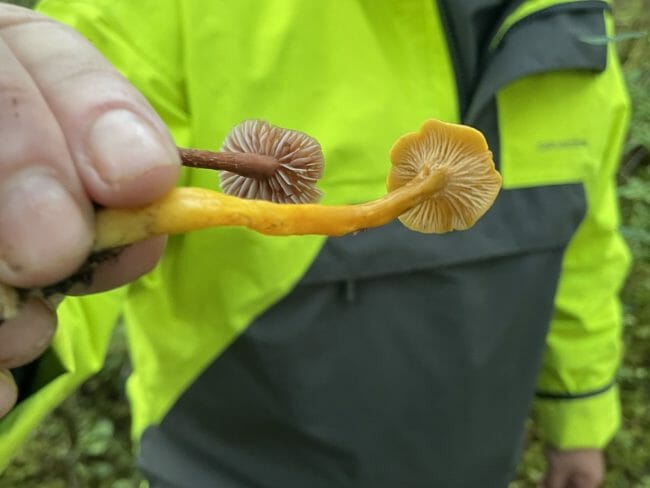
Winter chanterelles (right) have ridges under the cap, rather than the sharp gills found on other mushroom species (left) (photo by Sheli DeLaney/KTOO)
“A lot of mushrooms have these really sharp blade-like gills on the underside of the cap. But winter chanterelles have these kind of ridges on the bottom of the cap.” Gregovich said. “And they are shaped like a funnel. They’ve got a hole in the top, and it funnels down to a hollow stem.”
Winter chanterelles are small, so it takes quite a few for a meal. And their texture can be pretty wet when you bring them home. But they are really good to eat, Gregovich said.
Winter chanterelles have a funnel-shaped cap, with a hole in the center and hollow stem (photo by Sheli DeLaney/KTOO)
“What I like to do is put them under a fan for an hour or so, no heat,” he said. “And the other thing you can do is you can dry-sauté them. Before you add any oil or butter, put them in the pan just dry and let some of the water kind of evaporate from the mushrooms.”
In the temperate rainforest of Southeast Alaska, mushrooms almost always have plenty of moisture and good growing conditions in their environment.
“But one thing that is the case, you really don’t see most of these mushrooms until kind of the start of August, mid-August, and then they really start to pop.” Gregovich said. “A couple of species, including the winter chanterelle, can be around in November or even December.”
There are hundreds of species of mushrooms around Juneau. But Gregovich advises the average forager stick to the four that are easiest to identify: winter chanterelles, golden chanterelles, porcinis (aka King boletes), and chicken-of-the-woods.
“So you can just stick with those four kinds, and you can get out and find something that’s easy to identify and good to eat,” he said.
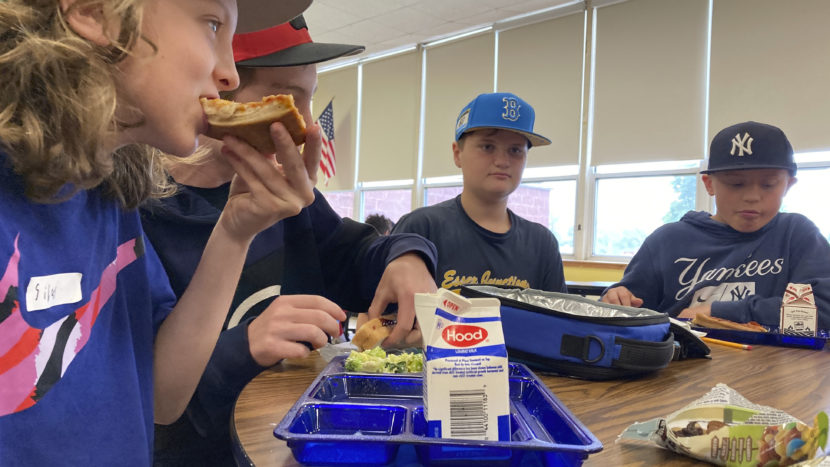
Students eat lunch at Albert D. Lawton Intermediate School in Essex Junction, Vt., on June 9. The pandemic-era federal aid that made school meals available for free to all public school students — regardless of family income levels — is ending, raising fears about the effects in the upcoming school year for families already struggling with rising food and fuel costs. (Photo by Lisa Rathke/AP)
BOISE, Idaho — Lunchtime on the first day of school at Mountain View Elementary earlier this month brought the familiar bustle of students scurrying to find their assigned table in the cafeteria while administrators checked trays and lunch bags to make sure everyone had something to eat.
Many brought their own sack lunches this school year, because unlike the last two, not every child is eligible for free meals provided by the school.
During the pandemic, schools were able to provide meals for free to kids regardless of income as a part of COVID-19 assistance passed by Congress to reduce food insecurity. This meant that nationally, an estimated 10 million kids who would have previously paid for school meals were able to get them free. But Congress did not agree to provide universal free lunches for a third school year.
About 30% of the student population here qualifies for free or reduced lunch, mirroring data from the whole Boise School District system. But the other 70% are now responsible for paying their own way for breakfast and lunch.
“The biggest challenge is going to be on the children,” said Christy Smith, supervisor of the Food and Nutrition Services at the Boise School District. “Regardless of income, there are children who are hungry because children face obstacles to accessing nourishing food at home and those are the kids that are going to suffer the most.”
Nationwide, families across all income levels are feeling the strain of high food, gas, housing and utility costs. And Congress’ decision to not extend a pandemic benefit that provided free meals to all students regardless of need will soon hit the pocketbooks of parents and provide new challenges for schools still grappling to return to normal.
“We are not on the edge, but our grocery budget could not afford $7.50 a day [for her kids’ school lunches] five days a week,” said Vanessa Gamma, a mother of three attending Mountain View. “It would just be not something that even not on the edge we could afford.”
School meal prices challenge parents and educators
The Boise School District, like others across the country, is preparing to raise the prices of meals in its elementary schools by 10 cents this academic year in order to combat rising food and labor costs.
“Our families in Boise can’t afford even a modest price increase,” Smith said. “Boise’s become a very expensive place to live and even 10 cents sounds modest, but that’s a lot of money to families who can’t pay their bills right now and don’t qualify for free or reduced-price meals.”
Across the country, school meals can cost parents upwards of $5 per meal.
In nearby West Ada — Idaho’s largest school district, where only 14% of the student population fully qualifies for free and reduced-price meals — prices will increase by 30 cents.
Shannon McCarthy Beasley, West Ada’s school nutrition supervisor, is on a mission to get as many kids as possible to buy the schools’ hot, fresh and, most importantly she says, nutritious, meals.
“I have this challenge of convincing families my meals are better. My meals are better than what you can pack,” said McCarthy Beasley. “And I am up for that challenge.”
Advocates like McCarthy Beasley say school meals are often some of the healthiest that many students have access to because of the nutrition requirements behind every dish served. In order to streamline the process, West Ada has created a QR code families can scan and use to fill out the applications to see if they qualify for free or reduced-price meals. But that final bill is still a challenge.
“A mom and dad making $15 an hour with a family of three — they don’t qualify,” McCarthy Beasley said.
The challenges to pivot back to a pre-pandemic system are felt across the country as schools work to reach all parents, hire additional staff members to collect meal money in lunch lines and prepare to return to tracking the finances of each child.
“As much as we all would like to go back to normal into a pre-COVID world, we’re just not there,” said Lisa Davis, senior vice president of Share Our Strength’s No Kid Hungry campaign. “Staffing shortages are impacting school nutrition departments across the country and the supply chain continues to be a mess. Food price inflation is increasing significantly, and so school meal programs continue to have to continue to face a lot of challenges and juggle a lot of different dynamics.”
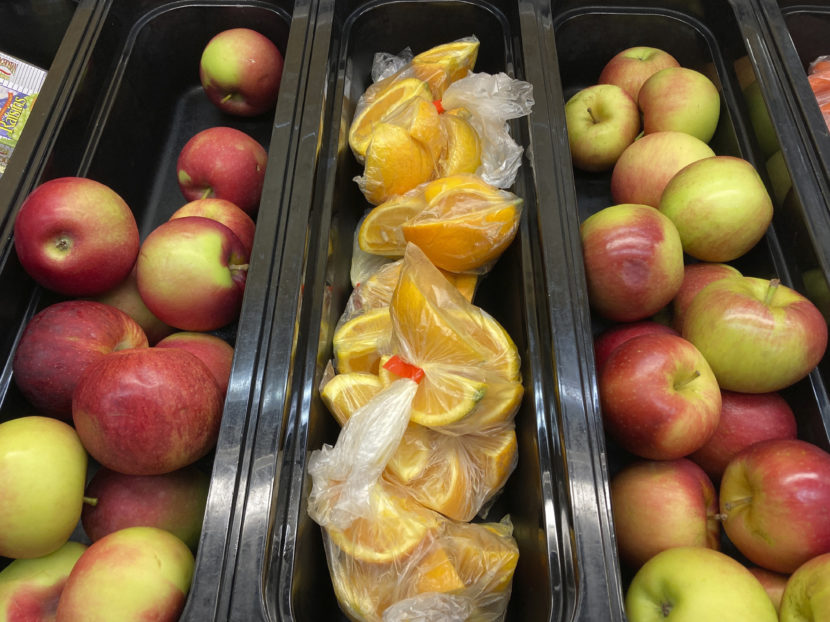
Apples and orange slices rest in trays for student lunch at Albert D. Lawton Intermediate School in Essex Junction, Vt., on June 9, 2022. (Photo by Lisa Rathke/AP)
Federal rules add to the challenges
When Congress created the ability for schools to give universal free meals, it did so by allowing the Agriculture Department, the federal agency that governs what and how is served at school, to waive certain federal requirements. Lawmakers waived requirements for schools to provide free lunch based on need, nutrition requirements for the food served and requirements that meals needed to be served in congregate settings, like cafeterias.
All of those waivers were set to expire on June 30.
Two of them were recently extended. But Senate Republicans balked at the cost of providing universal free meals for another year, and as part of the final compromise, Democrats agreed to drop it from the package.
This means all schools will go back to requiring that families pay the full price for each meal if they do not qualify for free or reduced-price meals.
In order to qualify, families must meet income requirements that are the same across the country. For the 2022-2023 school year a family of four must make less than $51,338 to qualify for reduced-price meals and $36,075 to qualify for free meals.
But each school district sets its own school meal prices, and those can significantly vary, as can the cost of living — not just within states but from state to state, which the income requirements don’t account for.
“I’ve already received an unprecedented number of requests from families to reconsider their denial for meal benefits after they submitted an application,” said Smith of the Boise School District. “And of course, that’s not something that we have control over. It is heart-wrenching.”
In Colorado, some schools are raising their meal prices by 50 cents. For families with multiple kids, it adds up.
Sarah Kremmerling is a mother of two in Boulder, Colo., and her family has qualified for free lunches on and off over the years. For both kids, her monthly bill could total upwards of $200 if they were to eat at school every day.
“I fill out the application every year, but the only time I’ve been able to qualify for them is usually when I’m working like almost less than part-time — like I really can’t be working at all to qualify for them,” Kremmerling said. “I just think that’s kind of crazy when you look at, like, the price of living.”
Mary Rochelle, who works as the program, events and grant coordinator at the Food Services Department of the Boulder Valley School District, said her district is scrambling to hire employees to help students purchase the meals as opposed to just being able to hand them a tray for food.
Lawmakers waited until just days before all the waivers expired on June 30 to pass the bill that extended some waivers but left free school meals out. Congressional delay in extending, or not extending, pandemic school meal waivers also hindered schools’ ability to plan.
“There was a lot of talk and a lot of hope that the universal meals would be extended and we weren’t really sure how much we should tell parents free meals are definitely ending because we felt like we weren’t given a clear answer until June and our school year ends the end of May,” Rochelle said.
The universal school meal debate resumes
Even before the pandemic, progressives, food and nutrition advocates were pushing for a universal school meal system that would offer school meals to students regardless of income. Advocates said the existing system of having three categories of pricing results in burdensome application processes, stigmatizes students who receive free meals and can cause families to carry lunch debt.
“We also have seen kids who were eligible for free school meals kind of slipped through the cracks and not get certified either because they were missed in direct certification or there were literacy or language barriers to the school meal application,” said Crystal FitzSimons, director of school and out of school time programs at the Food Research and Action Center.
Some states have taken their own action. California, Maine, Massachusetts, Nevada and Vermont have passed legislation or rules to allow all students in their states to receive free meals this upcoming school year. Others have legislation pending in statehouses.
“There’s a lot of innovation happening in communities and at the state level. I think where the conversation gets stuck is at the federal level,” said Davis. “And a big part of that is because the discussions again are all around price tags and offsets through that very narrow lens.”
“Congress never intended to provide universal free breakfast and lunches to all K-12 students regardless of need,” said Rep. Virginia Foxx, R-N.Y., during a floor speech debating the waiver extensions in June. She favored the bill because the free meals would be extended by only one year, not longer. “By returning these programs back to normal we can return our responsibility to taxpayers and the principle that aid should be targeted and temporary.”
Many education, hunger and nutrition groups have asked the White House to recommend that Congress implement universal school meals as a part of the broader list of recommendations expected to come out of the conference on hunger, nutrition and health next month. But until then, schools will need to adjust for the foreseeable future — whether or not they or families are ready.
Copyright 2022 NPR. To see more, visit https://www.npr.org.
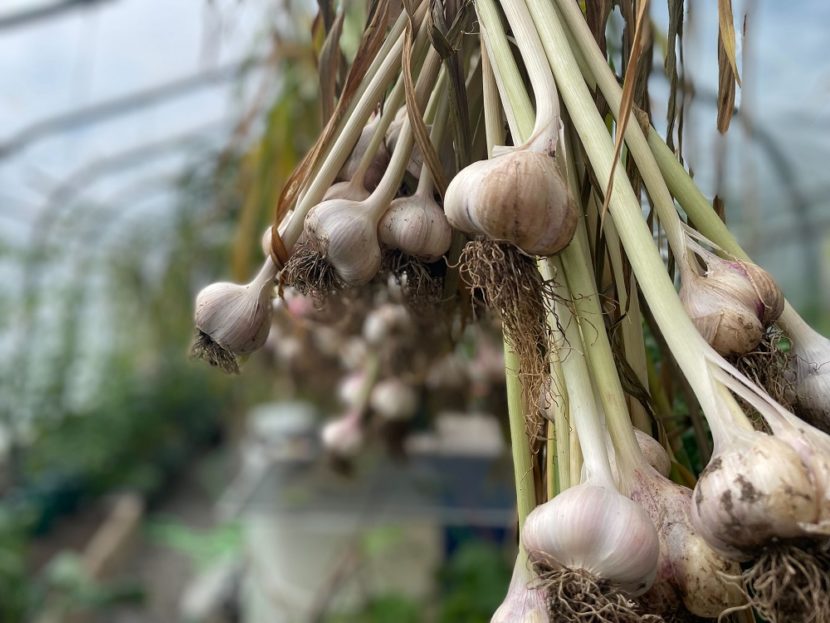
Hardneck garlic bulbs hanging up to cure inside a greenhouse (Photo by Sheli DeLaney/KTOO)
After garlic is harvested, it can be cured by hanging in a warm, dry place with good air circulation for a few weeks.
Master gardener Ed Buyarski says that he has garlic hanging in his greenhouses, his furnace room and his garage.
“In fact, last week I bought a dehumidifier to go in my garage underneath the garlic, and I’m emptying it twice a day.” Buyarksi says. “So I’m hoping that it will dry it better so it keeps better.”
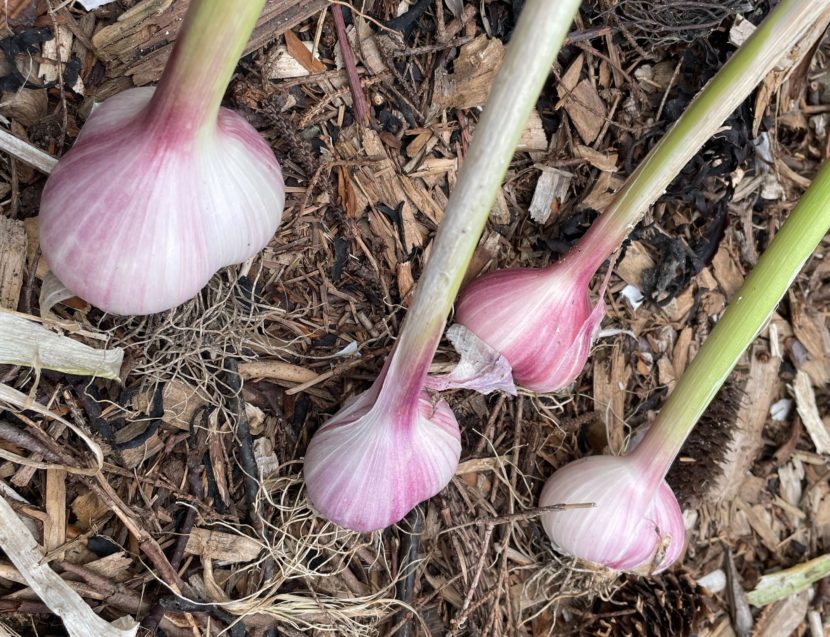
Some of the garlic has been set aside to be eaten fresh rather than preserved. They show signs of the fungus disease botrytis. Buyarski recommends keeping them separate from unaffected garlic plants and giving them a quick rinse in a 10% bleach solution.
Garlic bulbs with the tell-tale pink streaks of botrytis should be eaten fresh rather than preserved (Photo by Sheli DeLaney/KTOO)
“We’ll eat them, friends will eat them. But we will not use that for the replanting later on in late September and October.”
A couple of days of air-drying is all that’s needed to preserve garden herbs, too, such as the oregano Buyarski grows in his greenhouse.
“Dry it just on cookie sheets in the open. I don’t bother to put it in a dehydrator.” he recommends. “Because if you heat it then you lose some of the volatile oils.”
Buyarski has even experimented with drying garlic leaves.
“That was quite a failure, that was in a dehydrator,” he says. “Made the house smell wonderful. But the next morning when we went to taste the dried crunchy garlic leaves, there was no flavor left.”
For other herbs that lose flavor when dried, like basil and chives, or are too tender for the drying process, Buyarski suggests freezing them in a baggie or even in ice cubes.
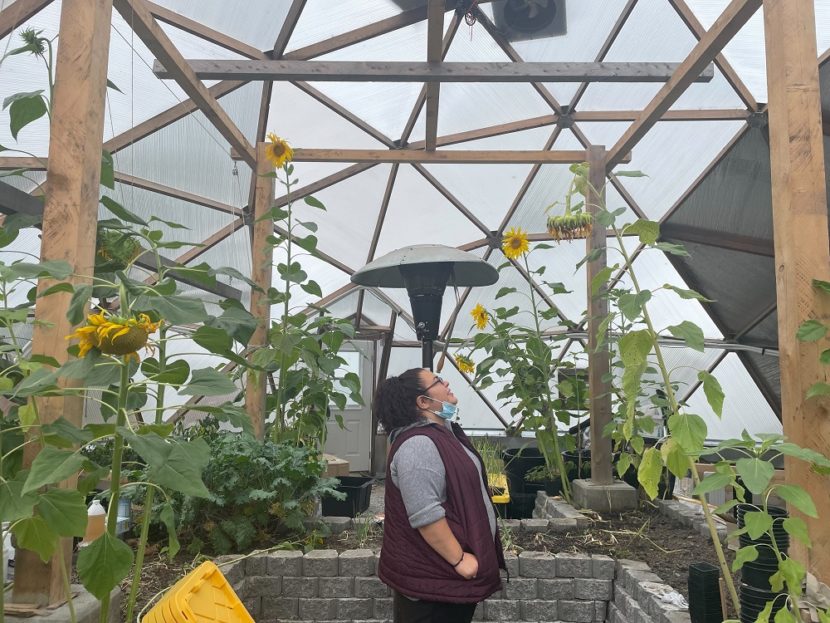
Master Gardener Lindsey Pierce is surrounded by sunflowers as she looks up at the top of the dome in Táayi Hít, the “Garden House” at Central Council of the Tlingit and Haida Indian Tribes of Alaska. (Photo by Sheli DeLaney/KTOO)
A year after completion, the greenhouse built by Central Council of the Tlingit and Haida Indian Tribes of Alaska has produced its share of successes and setbacks.
“The name is Taay Hít, which means ‘garden house’ in Lingít,” says Lindsey Pierce, master gardener and environmental specialist at Tlingit and Haida.
Also referred to as “the dome” because of its shape, the structure was assembled from a kit by local contractors last July. This year marks the second growing season for the greenhouse.
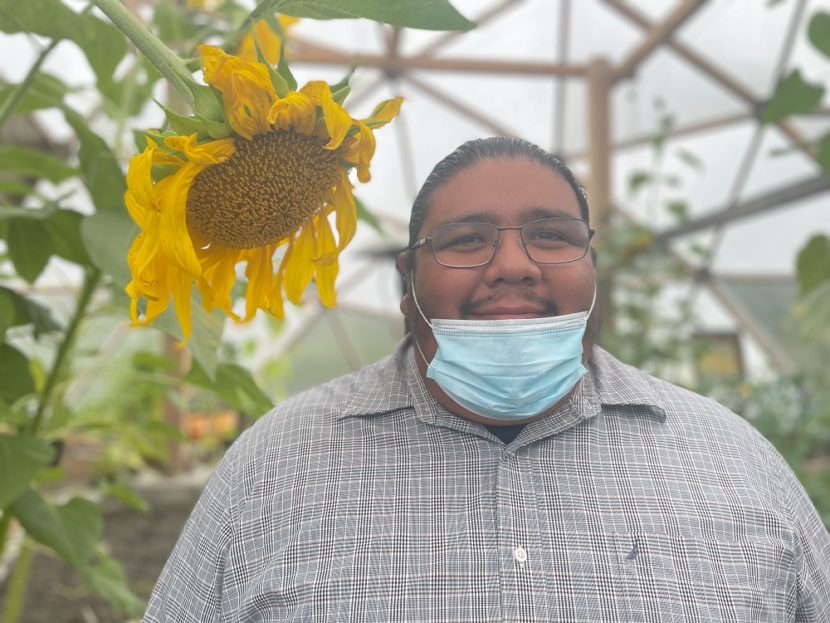
Cer Scott, also a master gardener and environmental specialist, said he was new to indoor gardening and overwhelmed at first. For him, one of the first challenges was deciding what to grow.
Cer Scott, Master Gardener and Environmental Specialist at Central Council of the Tlingit and Haida Indian Tribes of Alaska .(Photo by Sheli DeLaney/KTOO)
“We’re trying to decide, you know, should we grow things that are not as accessible at our stores?” Scott said. “Or should we grow things that people that are more, you know, wanted in the region, like cultural traditional foods. So we kind of did a mixture of both.”
One of the successes from this season included multiple crops of Swiss chard.
“We had several harvests and made a nice big lunch for the staff,” Scott said.
A lot of it also went to Smokehouse Catering, the tribe’s event company, who use produce from the dome in the meals they serve.
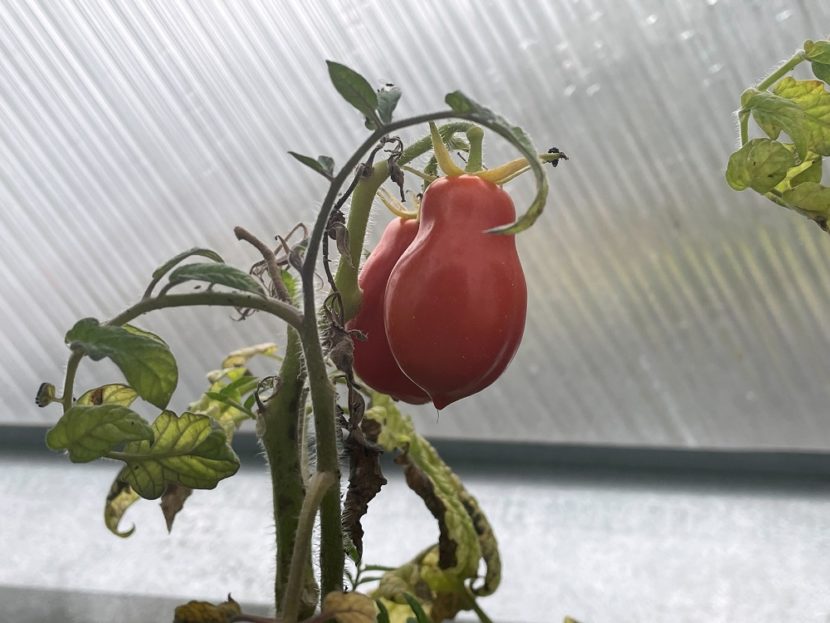
Tomatoes also did well, but basil was an especially big hit.
“It’s one of those things that it’s right next to the door, so when you walk in you get a waft of some fresh basil,” Scott said.
Ripe beefsteak tomato on the vine under the dome at Táayi Hít. (Photo by Sheli DeLaney/KTOO)
They had a few setbacks however, like pests and heat.
“We did have some cabbage here but we lost that unfortunately to some of the aphids,” Scott explains. “Aphids took over those so we just ended up pulling them to kind of help combat that.”
And a long stretch of hot weather earlier in the summer threw off the timing of their broccoli.
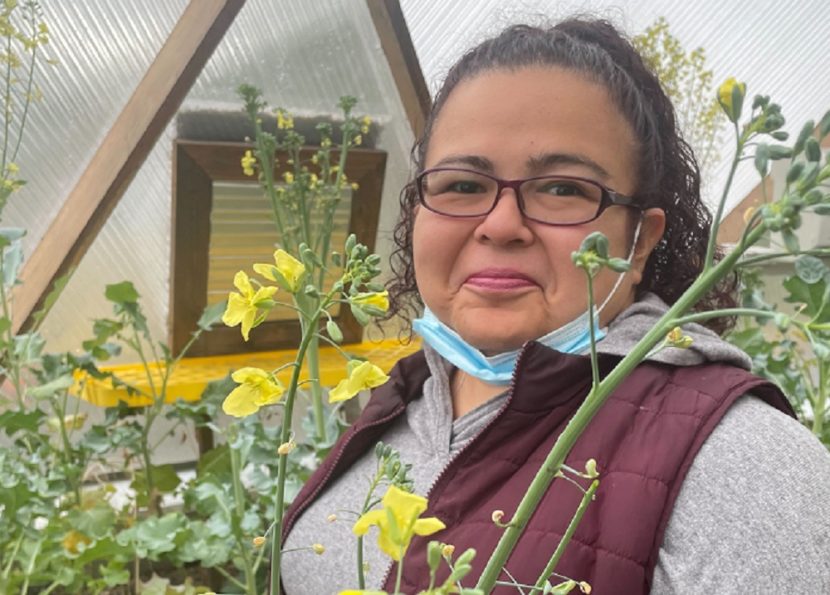
“While we were still trying to figure out the environment inside the greenhouse, as far as climate control, our broccoli ended up bolting. And flowering.” Scott explained. “It’s just their life cycle.”
“You can eat the flowers though,” Pierce added.
Lindsey Pierce, Master Gardener and Environmental Specialist at Central Council of the Tlingit and Haida Indian Tribes of Alaska, holds out edible broccoli flowers from a plant that bolted. (Photo by Sheli DeLaney/KTOO)
Scott and Pierce both completed the Alaska Master Gardener Program, and they agree that they have learned a lot in just two growing seasons under the dome.
“Last July is when it started. And it’s just been a ride ever since.” says Pierce.
Garden Talk
Correction: An earlier version of this story misspelled Taay Hít, the name of the greenhouse.
The bulk carrier M/V Razoni leaves Ukraine’s port of Odesa on Monday. (Photo by Oleksandr Gimanov/AFP via Getty Images)
ODESA, Ukraine – A cargo ship loaded with 26,000 tons of Ukrainian corn left the country’s largest port Monday for the first time since Russia’s invasion on Feb. 24.
The milestone comes after the United Nations and Turkey signed agreements with Russia and Ukraine on July 22 to re-open Ukraine’s Black Sea ports and resume exports of grain, cooking oil and fertilizer. The U.N. had pushed for a deal to address a growing global food shortage.
Ukraine’s Infrastructure Minister Oleksandr Kubrakov filmed the ship, the Sierra Leone-flagged Razoni, as it departed and declared the U.N. deal “a great success for providing global food security.” He wrote on Facebook that Ukrainian ports would be working at full capacity in a few weeks.
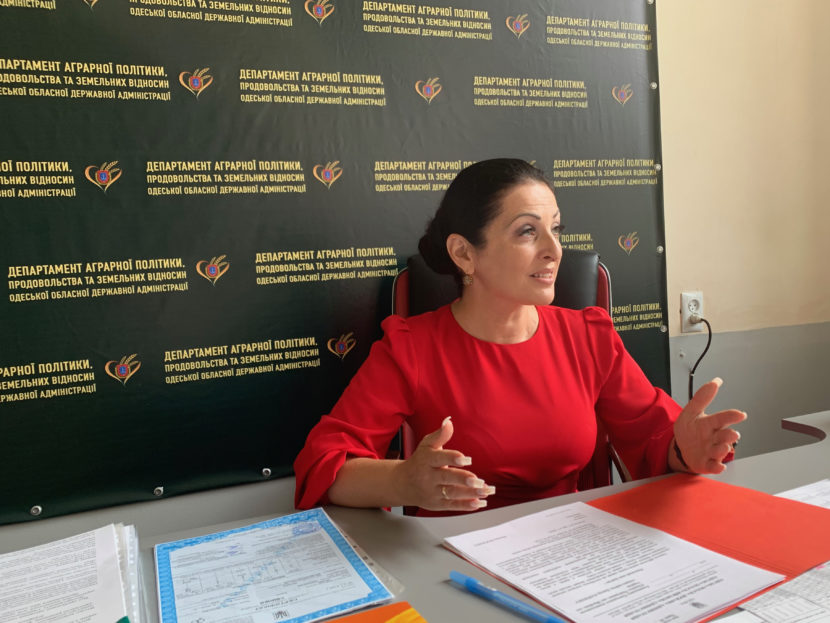
Alla Stoyanova, Odesa’s agriculture chief, says Ukraine’s agricultural exports are even more important for its economy as a result of the war. (Photo by Joanna Kakissis/NPR)
Kremlin spokesperson Dmitry Peskov also noted the ship’s departure, calling it “very positive.” Russia signed a separate agreement with Turkey so it could export its grain and fertilizer, which remain grounded because of Western sanctions on banking and transportation.
The Ukrainians need this deal to work to keep their economy from falling apart.
“Ukraine used to earn 45 percent of its general income from the agriculture sector,” Alla Stoyanova, the Odesa region’s agriculture chief, told NPR. “Since the Russian invasion, practically every other sector has crumbled. So agricultural exports are now our money, our economy, our life.”
Russia’s war has cut off Ukrainian grain exports and exacerbated a global food crisis. (Photo by Joanna Kakissis/NPR)
Keeping up the pace of exports is crucial. Farmers continue to work during the war, sometimes donning helmets and bulletproof vests while working in their fields. They are running out of space to store crops. They can’t afford to plant next year’s crop.
Viacheslav Nevmerzhytskiy, who farms wheat and sunflowers near the port of Pivdennyi, not far from Odesa, says he worries that the Russians might even bomb the ships carrying Ukrainian products — and then try to pin it on Ukraine.
“I don’t see this shipping corridor lasting into the new year unless there are big security guarantees,” he says, like NATO guarding the ports.
Farmer Viacheslav Nevmerzhytskiy says he has doubts about how long the shipping corridor will last. (Photo by Joanna Kakissis/NPR)
Russia has repeatedly shelled the Odesa port and region since the grain export deals were signed. The Ukrainian military, meanwhile, is using specialists to remove undersea mines near the ship corridors.
Security is already tight at Ukrainian ports, which are now run by the military.
Dmytro Barinov, deputy head of Ukraine’s Seaport Authority, says at least 68 vessels have been stuck in the country’s Black Sea ports since the Russian invasion. About half are loaded with grain.
“Some of them continue to load,” he says. “They’re waiting (for) these corridors to work, and they can go out, perhaps in a kind of caravan on the sea.”
Hanna Palamarenko and Pavel Zilinskiy contributed reporting from Odesa.
Copyright 2022 NPR. To see more, visit https://www.npr.org.
Close
Update notification options
Subscribe to notifications
Subscribe
Get notifications about news related to the topics you care about. You can unsubscribe anytime.

9(MDEwMjQ0ODM1MDEzNDk4MTEzNjU3NTRhYg004))

9(MDEwMjQ0ODM1MDEzNDk4MTEzNjU3NTRhYg004))


9(MDEwMjQ0ODM1MDEzNDk4MTEzNjU3NTRhYg004))