Food

Sitka’s drinking water places second at national taste championship

A glass of water on a window sill
A glass of the second best tasting water in the country. (Photo by Katherine Rose/KCAW)

Sitka’s tap water, locally sourced from Blue Lake, won second place last week at the American Water Works Association taste test competition.

Water One, an independent public water utility that serves Johnson County, Kansas, took first. Water One also won the people’s choice award. Sitka didn’t enter that contest because it would have required shipping more water to Texas.

Sioux Falls, South Dakota, finished third.

Environmental Superintendent Shilo Williams says Sitka was one of 26 finalists from the United States and Canada. To enter, competitors must first win their state or regional contests, and can’t have any drinking water violations on their record from the previous year.

Sitka qualified for the national competition after winning Alaska’s title.
The contest took place at the AWWA national water industry conference in San Antonio, Texas. Williams shipped two one-liter glass bottles of Sitka water to the conference in a cooler, but her hopes were nearly dashed in a shipping disaster.

“While I was there, I received an email from the contest coordinator that said our bottles had come broken,” Williams says. “So we were really bummed out about that. And I thought that was the end of it and that we wouldn’t have a chance.”

But the next day, Williams received word that only one of the bottles had broken, and they were back in the game.

People standing around a table that has vessels of water on it
Water judges judging water on June 14 in San Antonio. (Photo courtesy of Shilo Williams)

Three judges from the water industry tasted all 26 contestants samples.

“They certainly were taking their time, smelling and tasting the water, and they were marking down their notes,” Williams says.

The judges then narrowed it down to five finalists for a second round of sampling.

Williams says it’s the first time they’ve entered the competition, and she believes it’s the first time an Alaska utility has placed in the event.

“I’m really excited about it. But you know, it really has really nothing to do with me. It’s all about our great source water,” Williams says. “Blue Lake is a pristine water source. So we’re really lucky to have blue lake as our source water. I mean, it’s fantastic water just on its own. We provide very minimal treatment, low chemical addition.”

Williams says she’s thankful for the dedication of city staff that ensure safe water is delivered to Sitkans.

There’s a nationwide Sriracha shortage, and climate change may be to blame

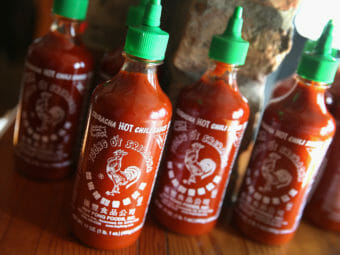
The impact of the Sriracha shortage is starting to be felt. (Photo by Scott Olson/Getty Images)

Sorry, Sriracha fans, your favorite hot sauce is running out nationwide.

The company that makes Sriracha, Huy Fong Foods, wrote in an email to customers in late April that it will have to stop making the sauce for the next few months due to “severe weather conditions affecting the quality of chili peppers.”

The spicy sauce has something of a cult following, and so when the news filtered through, some fans took to social media to express their dismay and post about panic buying (with varying degrees of irony.)

Grocery stores in some parts of the country have already started running low on stock, and restaurant owners have been facing higher prices.

Michael Csau, co-owner of the restaurant Pho Viet in Washington D.C., has been paying much more in recent weeks for his Sriracha orders.

“Usually when I bought one case, it was roughly around $30 to $32. Now it’s up to $50, almost double the price. If it keeps going up, we cannot afford it,” Csau said.

If the price gets much higher, Csau said he would probably have to switch to a different brand.

“But people, they are used to the taste right now. So when they taste it, they’ll know right away,” he said.

Michael Csau says he may have no choice but to move away from Sriracha. (Photo by Ashish Valentine/NPR)

Florence Lee, who was at Csau’s restaurant waiting for a bowl of pho, summed up her thoughts on a Sriracha swap-out: “A little bummed out.”

“Because this is where I’m like, you have to have the Hoisin sauce and the Sriracha, together!” she said.

Other food could be affected too

The shortage is due to a failed chili pepper harvest in northern Mexico, where all of the chilies used in Sriracha come from, according to National Autonomous University of Mexico’s Guillermo Murray Tortarolo, who studies climate and ecosystems.

“Sriracha is actually made from a very special type of pepper that only grows in the southern U.S. and northern Mexico,” Murray Tortarolo said. “These red jalapeños are only grown during the first four months of the year, and they need very controlled conditions, particularly constant irrigation.”

Irrigation, of course, requires lots of water, but northern Mexico is in its second year of a drought.

“The already difficult conditions were pushed over the limit by two consecutive La Niña events. And the dry season has not only been intense, but also remarkably long,” Murray Tortarolo said.

As a result, the spring chili harvest was almost nonexistent this year. Murray Tortarolo thinks it’s very likely that climate change is a factor, although it requires further study to confirm.

He said that if the drought continued, it was likely that prices for other foods from the region like avocados, tomatoes and meat would rise as well.

This is the view of La Boca dam in Santiago, Mexico in March. The lack of rain has reduced the dam capacity to 10%, the lowest in the last 40 years. (Photo by Julio Cesar Aguilar/AFP via Getty Images)

On top of these conditions, the entire region that includes the southwestern U.S. and northern Mexico is suffering a “megadrought.” And it’s also connected to climate change.

“This has been the driest 22 years in the last 1,200 years,” UCLA hydroclimatologist Park Williams said. Williams recently led a study of the megadrought, published in Nature Climate Change.

He said the megadrought conditions drying up water reservoirs in the U.S. made it harder for Mexico to deal with its water shortages.

“We share some of the same climate, but we also share some of the same water,” Williams said. “So over the last 23 years as we’ve seen our largest reservoirs get drained, this puts Mexico and Mexican agriculture at a risk of being even more water limited than it would be already.”

It’s hard to say climate change caused the drought, Williams said, but it’s certainly made it worse. His research estimates that about 40% of the drought can be attributed to human-caused climate change.

Still, Williams said we can make a huge difference by limiting how bad climate change gets.

“Limiting global warming to below 2 degree Celsius puts us in a much better situation than if we let global warming go to 3 degrees or 4 degrees Celsius.”

So keeping Sriracha hot may depend on keeping the planet cool.

Copyright 2022 NPR. To see more, visit https://www.npr.org.

Abbott’s baby formula plant is reopening in a step that could soon ease the shortage

A photo of a factory
The Abbott manufacturing facility in Sturgis, Mich., is reopening, allowing supplies of baby formula to head to consumers starting later this month, the company said Saturday. (Photo by Jeff Kowalsky/AFP via Getty Images)

Abbott says it’s restarting the production of infant formula at its Sturgis, Michigan, plant in a step that could ease a nationwide formula shortage in the coming weeks.

The facility was forced to close in February after a bacterial contamination was found in the company’s formula products. Several babies were sickened and two died after consuming formula made at the plant.
The closure intensified ongoing supply shortages of baby formula in the U.S. To help alleviate the scarcity, the Biden administration has been importing formula from abroad in recent weeks.

Abbott’s specialty formula EleCare will be available to consumers beginning on or about June 20, the company says. EleCare is formulated for infants with allergies to cow milk.

Abbott, one of the largest of the few formula makers in the U.S., was cleared to restart production the Michigan facility after meeting initial FDA requirements.

“We understand the urgent need for formula and our top priority is getting high-quality, safe formula into the hands of families across America,” Abbott said in a statement on Saturday.

“We will ramp production as quickly as we can while meeting all requirements,” the company added. “We’re committed to safety and quality and will do everything we can to re-earn the trust parents, caregivers and health care providers have placed in us for 130 years.”

The Food and Drug Administration has been working “around-the-clock” to alleviate the supply shortages, an agency spokesperson said in a statement to NPR. The FDA expects the resumption of production at the Michigan plant “will mean more and more infant formula is either on the way to or already on store shelves moving forward,” the spokesperson added.

Copyright 2022 NPR. To see more, visit https://www.npr.org.

Food aid groups in Alaska say need is approaching early pandemic levels as relief money ends and prices rise

Two people in a warehouse filled with boxed and canned food
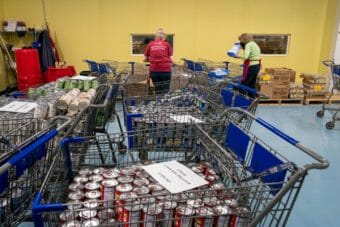
Volunteers Jill Smythe, left, and Lois Grey sort food for the agency shopping area on May 18 at the Food Bank of Alaska in Anchorage. The agency shopping area is where partner agencies can get food to distribute through their own programs. (Photo by Loren Holmes/ADN)

More and more Alaskans need help with food as prices spike at the gas pump and on grocery shelves, while pandemic relief dollars dry up, local providers say.
“Most of our partners are saying they’re seeing the need really ramp up in the last one to two months,” said Cara Durr, chief of advocacy and public policy at the Food Bank of Alaska, which distributes food to some 150 agencies statewide.

Agencies are now seeing demand approach what it reached in the early months of the pandemic, when providers saw a roughly 75% increase — which at the time reflected record-breaking levels of need, Durr said.

The Food Bank of Alaska operates a series of mobile food pantries, and the number of households served at each has been trending upward lately, Durr said.

While the food bank doesn’t yet have numbers for May 2022, the number of households served at the pantries went from 1,926 in February to 3,738 in April. In April 2020, they served around 3,400 households, before reaching a high for that year in October with over 4,700 households served.

Cara Durr, chief of advocacy and public policy, gives a tour of the new Food Bank of Alaska building on May 18 in Anchorage. (Photo by Loren Holmes/ADN)

“It’s easy to feel like, ‘Well, things are back to normal, and there’s tons of jobs available,’ ” Durr said. “But for people that lost wages, and maybe were struggling already, it takes a while to dig out of that hole.”

Irene Brooks is a community worker at the Copper River Native Association Food Bank, the only food bank in the greater Copper River Basin, serving clients from Eureka to McCarthy. Brooks said the number of clients right now is the highest it has ever been.

People are telling her that while they’ve never used food banks in the past, prices are so high they can’t afford to feed their families.

“I’ve literally had people tell me that if it wasn’t for food banks, they and their families would have gotten hungry,” she said.

Groceries up 10% as rental assistance ends

Several factors may be contributing to this increase in demand for help with food right now.

Over the past year, the price of groceries rose 10.8% while the prices for meat poultry, fish, and eggs increased 14.3% — the biggest yearlong increase since 1979, according to the U.S. Bureau of Labor Statistics.

Inflation is significant right now, said Neal Fried, an economist with the state. But Fried said that may not be the primary reason people’s incomes are strained. Pandemic relief money, including rental assistance, is running out right now too, and that could be an even more significant contributor to that strain, Fried said.

“The transfer payments that come from government, of all varieties, have been dropping off significantly and have probably a disproportionate impact on lower-income households,” Fried said.

People receiving food tell those working at Lutheran Social Services that their dollars just aren’t going far enough at the store right now, said Alan Budahl, executive director there.

Plus, many have high utility costs and are facing shutoffs. He said he receives some 20 to 30 calls a day for rental assistance.

“I tell them, ‘Well, use your money to keep your utilities on and pay the rent, and it’s easier for us to feed you,’ ” he said.

Durr with the Food Bank of Alaska said the level of need at food pantries makes sense, given prices people are paying for things like fuel right now. Food is a relatively easy resource to get help with, as opposed to something like getting rental assistance, which is more challenging, she said.

Often when people’s budgets are strapped, food is something they can get ahold of, and the last thing they give up when getting back on their feet.

“They could come to a food pantry and get a week’s worth of food,” Durr said. “That’s a big help in the budget.”

‘The exact same numbers as fall 2020′

Last fall, demand slowed, said Greg Meyer, director at the Kenai Peninsula Food Bank in Soldotna. But recently, it increased, he said.

The food bank serves several remote areas where need is especially high right now. And not only are food prices high, the cost of fuel has risen, too, which makes coming to pick up the food challenging as well, he said.

At the same time need is rising, Meyer said the organization doesn’t have the same ability to serve as it did earlier in the pandemic, after certain CARES Act programs lapsed. They have less food and variety than they did previously.

“Our numbers have gone up,” Meyer said. “But some of our programs that were in response to the pandemic have gone away, so our ability to provide as much has gone down.”

Boxes of food rest on pallets at the St. Francis House Food Pantry, operated by Catholic Social Services in Anchorage, on May 24. (Photo by Emily Mesner/ADN)

On a recent Tuesday, cars lined up to receive food from St. Francis House Food Pantry in East Anchorage. Robin Smith, a volunteer who was helping pack boxes of food to be given out, said they used to put together four pallets’ worth of boxes. Lately, she said, that number climbed to six and sometimes almost seven pallets.

“If you asked us three months ago, it would not look like this,” said Claire Lubke, who directs the food pantry, as she walked along the line of cars toward staff giving out boxes.

In the first week of May, they served 400 households. By mid-May, they served 430. By the third week of the month, that number had risen to 480 households. They used to see some 70 households come through each day the pantry was open. Now it’s up to 120.

Lubke said that demand at their food pantry was most intense during the fall of 2020 after people were out of work, COVID-19 relief money hadn’t kicked in, and people had used up their reserves. That’s when the numbers peaked.

“We are now up to the exact same numbers as fall 2020,” she said.

Claire Lubke, St. Francis House Food Pantry program director, left, talks with Tricia Teasley, chief communication and development officer, while waiting for volunteers to arrive to work on garden starters for their clients at Catholic Social Services in Anchorage. (Photo by Emily Mesner/ADN)

This story was originally published by the Anchorage Daily News and is republished here with permission.

Alaska parents look desperately for baby formula as nationwide shortage persists

A sign telling customers they can buy no more than 4 packages of baby formula at once
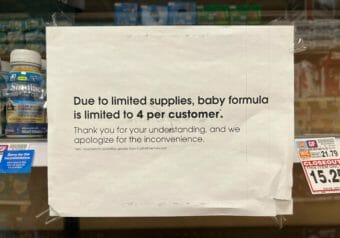
Many stores are limiting the number of baby formula containers each customer can buy. At a Fred Meyer in Anchorage, customers are limited to four. Photographed Monday, May 23, 2022. (Photo by Tegan Hanlon/Alaska Public Media)

In January, Lottie Connelly got a call from her babysitter. They were out of formula, and her 10-month-old baby girl, Sloane, was hungry. On her way home from work, Connelly stopped by her local grocery store in Homer. She was looking for the formula she knows Sloane likes most: Enfamil Enspire.

“They did not have her kind in, so I bought the same brand just different, and she would not drink it,” Connelly said.

She got in her car and started driving to Soldotna, about an hour and a half north of Homer. She checked Fred Meyer, Walgreens and Walmart. No luck.

“So I panicked, obviously, because there was no food on the Peninsula,” she said. “I had to drive all the way to Anchorage at 10 o’ clock at night to see if I could find her formula. When I got there, I went to every grocery store I could and bought a couple from each store.”

She bought six containers on that first trip to Anchorage. That was enough to feed Sloane for about a month. Since then, she’s been driving to Anchorage twice a month in search of formula.

Connelly isn’t alone. In one Anchorage-based Facebook group, dozens of shoppers share photos of store shelves so others can see where baby formula is in stock. A formula exchange page created by a mother in Kodiak now has more than 15,000 members. Staff in the mother-and-baby unit at Providence Children’s Hospital in Anchorage say they’re out of formula samples. Another page, called Human Milk for Human Babies Alaska, has nearly 2,000 members — a mix of donors and moms looking for milk.

How has the nationwide baby formula shortage affected you in Juneau?

Let us know

Parents across the state and country have been facing an infant formula shortage since February, when the country’s largest formula manufacturer, Abbott, recalled products made at its plant in Michigan after four children became sick with bacterial infections. Two of them died.

Because there are so few infant formula manufacturers in the U.S., that recall had a ripple effect as parents bought other brands. Ongoing supply chain issues related to the pandemic have also played a role. Some stores are limiting the number of containers customers can purchase at once.

Mostly empty store shelves in the baby formula section
Shelves of baby formula at a Fred Meyer grocery store in Anchorage are mostly empty amid a nationwide shortage. (Photo by Tegan Hanlon/Alaska Public Media)

Dr. Monique Child, an outpatient pediatrician in Anchorage, said her patients are having to adapt. Like many other pediatricians, she’s started giving away the formula samples that manufacturers send to her office.

“Last week, maybe a week and half ago, was really when the shortage seemed to hit the shelves in Alaska,” she said. “I started to have moms that were calling somewhat desperately afraid they couldn’t find formula for their babies.”

Child has worked with moms and babies to figure out what kinds of changes they can tolerate. One option for older babies is to try out a new type of formula. That can cause diarrhea or vomiting that usually clears up in about two weeks, Child said. Gradually introducing small amounts of the new formula can help, according to the American Academy of Pediatrics.

Child said it’s important to work closely with a pediatrician during a formula switch to ensure that it’s happening safely.

“It’s just like you or me — if we suddenly changed the bulk of our diet, our GI system takes a moment to get caught up to the change,” Child said.

Adding extra water to formula, making homemade formula or switching to goat milk or plant-based milk are not recommended by pediatricians. Older babies may be able to switch to cow’s milk, which generally happens after a baby turns one.

“One of my moms called, and they were four days away from their one year old birthday, and I’m like, ‘You might be fine switching to milk,’ and fortunately that baby was,” Child said.

Younger babies don’t have as many options.

“I worry about those babies kind of in the middle — for whatever reason we stopped breastfeeding at birth, we’re now 6 months old, we’re not old enough to really switch to cow’s milk, we’re pretty established on formula,” Child said.

A woman might not breastfeed for a variety of reasons. A mom might be returning to work and unable to breastfeed. Mothers of premature babies often rely on milk donations at the hospital, but Child said only about 10% of mothers produce enough milk to donate extra.

When Connelly couldn’t produce enough milk to feed Sloane shortly after her birth, a friend gave her extra breast milk. Connelly said there’s been pressure, especially online, for Anchorage moms to do the same thing during the formula shortage.

“People are like, ‘Why don’t you just donate breast milk?’ They don’t have to do that,” Connelly said. “It’s out of the kindness of their hearts that moms even do that.”

Child encourages all of the mothers she sees to breastfeed if they can. But she agrees no one should be pressured or forced to.

“We’re in a time in history where bodily autonomy is something we need to think about,” she said.

Connelly tries to help out fellow moms when she can. In one local Facebook group, Homer residents ask if anyone in town needs something picked up in Anchorage. Next month, Connelly plans to drive to Anchorage and get formula for other parents. Between gas prices and hotel room costs, she knows not all families can afford the trip.

“It’s a big community thing,” she said. “If we’re already going, we’re going to try to help.”

National efforts to alleviate the shortage are underway. In an op-ed in The Washington Post, Abbott’s CEO said he expects to reopen the Michigan plant by the first week in June, and that it’s increasing production at its facilities in Ohio and Ireland. Alaska Sen. Lisa Murkowski co-sponsored the Access to Baby Formula Act. Last week, President Biden invoked the Defense Production Act and required suppliers to prioritize getting baby formula ingredients to manufacturers. In many states, including Alaska, recipients of WIC — the Special Supplemental Nutrition Program for Women, Infants, and Children — can temporarily use their WIC cards to buy a wider range of brands. And over the weekend, a shipment of formula arrived in the U.S. from Germany.

As for Connelly in Homer, she recently ordered formula from a company based in Holland. In the meantime, she and other moms are keeping an eye on Facebook and helping each other out when they can.


Baby formula in Juneau

How has the nationwide baby formula shortage affected you in Juneau? Reach out to KTOO’s Claire Stremple to share your story.

With food prices climbing, the U.N. is warning of crippling global shortages

""
A Combine harvesting machine reaps wheat in a field of the Hula valley near the town of Kiryat Shmona in the north of Israel on May 22, 2022. Wheat prices have soared in recent months, driven by the war in Ukraine and a crippling heat wave in India. (Photo by Jalaa Marey/AFP via Getty Images)

Fears of a global food crisis are growing due to the shock of the war in Ukraine, climate change and rising inflation.

Kristalina Georgieva, the International Monetary Fund managing director, told the World Economic Forum in Davos, Switzerland on Monday that “the anxiety about access to food at a reasonable price globally is hitting the roof” as food prices continue “to go up up up”.

Last week, United Nations Secretary-General António Guterres warned of “the specter of a global food shortage in the coming months” without urgent international action.

The U.N. estimates that in the past year, global food prices have risen by almost one third, fertilizer by more than half and oil prices by almost two thirds.

According to U.N. figures, the number of severely food-insecure people has doubled in the past two years, from 135 million pre-pandemic to 276 million today. Now, more than half a million people are experiencing famine conditions, according to the U.N., an increase of more than 500% since 2016.

In Ethiopia, Somalia and Kenya, the number of people facing extreme hunger has more than doubled since last year, from roughly 10 million to more than 23 million today, according to the report. Across the three countries, the report notes, one person is likely dying every 48 seconds from acute hunger-related causes stemming from armed conflict, COVID-19, climate change and inflationary pressures worsened by the war in Ukraine.

In India, a devastating heatwave has upset the nation’s wheat harvest, driving up prices around the world for the staple commodity. Earlier this month, as temperatures in the capital of Delhi hovered near 120 degrees Fahrenheit, the government announced a ban on wheat exports. The announcement helped push wheat prices to record levels.

Wheat prices were already hit hard by the war in Ukraine. Ukraine and Russia are some of the world’s biggest wheat producers, combining to produce around 25% of global supply. Global wheat prices surged in the wake of Russia’s invasion of Ukraine. They had already risen an estimated 80% in just over a year before December 2021, according to the IMF.

International shocks have brought some countries into near breakdown. In Sri Lanka, rising inflation has led to a wholesale economic emergency, with extreme shortages of food, medicine and fuel.

Humanitarian agencies have warned that Afghanistan has been close to famine for months, while Lebanon has been in economic crisis for over a year.

In the U.S., consumer prices in April were up 8.3% from a year earlier, according to data from the Labor Department. Food costs were up 9.4%, with prices for things like meats, poultry, fish and eggs up 14.3% from the previous year. In March, around 65% of the 200 food banks in the Feeding America network, the nation’s largest food recovery organization, reported a greater demand for assistance month on month.

In China, prices of fresh vegetables are 24% higher than a year ago, according to data released from the country’s National Bureau of Statistics. China’s “zero COVID” policy has meant an economic slowdown, and added to inflation around the world and global supply chain issues.

The U.N.’s Guterres has urged a five step plan to help confront the challenges: increasing supplies of food and fertilizers; social protection systems within countries; more access to international finance; further government help for smallholder food producers; and better funding for humanitarian operations to reduce famine and hunger.

Copyright 2022 NPR. To see more, visit https://www.npr.org.
Site notifications
Update notification options
Subscribe to notifications