Food

Juneau staple J & J Deli and Asian Mart may shut down if owners can’t find a buyer

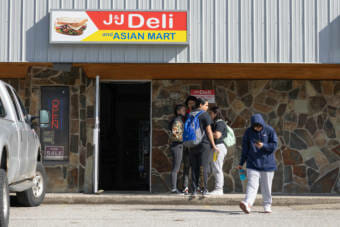
High school kids in Juneau, Alaska go to J & J Deli and Asian Mart during their lunch hour on April 4, 2022. (Photo by Lyndsey Brollini/KTOO)

A Juneau deli and Asian mart known for its sandwiches may be shutting down this year if the owners don’t find someone to take over the business.

Neil and Alma Doogan bought J & J Deli and Asian Mart from the original owners Jack and Jack in 2010, which is where the name J & J comes from. 

The business opened in 1978. Back then, J & J mostly carried sandwiches and a few snacks. It wasn’t until a few years after the Doogans took over that they started carrying Asian products. The deli is a staple among Juneau high school students.

High school kids line up inside J & J Deli and Asian Mart in Juneau, Alaska for lunch. (Photo by Lyndsey Brollini/KTOO)

During the high school lunch hour on a sunny day in Juneau, J & J was packed. At least 20 students from Juneau Douglas High School: Yadaa.at Kalé came into the small space and lined up to get snacks, Red Bull spritzers and, of course, sandwiches.

Sandra Bouvier is a junior at the high school and has been going to J & J since she was a freshman. Bouvier said that if the deli shuts down, kids might not eat as much.

“Just because it’s, you know, a really close walk from the high school and most high schoolers don’t drive yet so they’d either walk all the way to IGA or you know, not eat,” Bouvier said.  

Bouvier also thinks there really is something different about J & J sandwiches.

“I swear you can make these sandwiches at home, but they taste like 10 times better here, so it’s my favorite place to go for food,” she said.

And she has no idea why they taste so good because it’s still the same white bread and lunch meat you can buy on your own. Alma Doogan, who makes the sandwiches, has a pretty simple answer.

“Because we serve the best, I guess. Fresh every day,” she said.

The main reason the Doogans want to sell is because Alma has been struggling with health issues for the past couple of years, so it’s been hard to keep up with the business. 

Alma Doogan is usually the only one behind the counter. She does get some help during the lunch rush from her husband, son and son’s girlfriend. But that is usually for about an hour, and then she is running the shop by herself again. 

The pandemic also hit the business hard, Neil Doogan said. When COVID-19 first came to Juneau, they were barely making enough to pay the bills. 

Neil Doogan, right, co-owner of J & J Deli and Asian Mart, works during the lunch hour in Juneau, Alaska on April 4, 2022. (Photo by Lyndsey Brollini/KTOO)

“It was a ghost town down here,” Neil Doogan said. “We were open every day. We made a little money not much.”

Pandemic-related supply issues have made it harder to get what they need for the business, especially the Asian products that come from the Philippines and Taiwan. He said that some businesses they’d get products from are shut down for good, so they can’t carry them anymore.

Neil Doogan said he and his wife don’t care so much about whether a potential buyer wants to carry the Asian products or not.

“As long as they keep the sandwiches and stuff. Because that’s what made this place,” Neil Doogan said.

Alma Doogan said it is hard to imagine J & J not being around anymore. 

Alma Doogan, co-owner of J & J Deli and Asian Mart, makes sandwiches during the lunch hour in Juneau, Alaska on April 4, 2022. (Photo by Lyndsey Brollini/KTOO)

She said she has really enjoyed working at J & J and she’s stuck with it because of the customers. Sometimes people will come over just to say hi to her.

“My customer, it’s not just a customer,” Alma Doogan said. “They become my friend and family.”

Weeks after its roof collapsed, Delta Junction’s only grocery store has been torn down

An excavator beginning to demolish the front of a grocery store
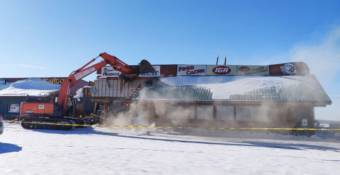
An excavator begins demolishing the IGA Food Cache building in Delta Junction Monday morning. (Photo courtesy of Tiki Levinson)

Workers tore down the building that housed Delta Junction’s only grocery story Monday, nearly three months after its roof collapsed under the weight of an extreme snow load. The owner plans to build a new store in the same location.
The old IGA Food Cache had been boarded-up since its roof partially collapsed on Dec. 26 after a heavy snow and rain storm. So when heavy equipment began demolishing the 50-year-old structure Monday morning, it caught locals like Lori Yates by surprise.

“Well, look at this! This is unbelievable!” she said as she watched the demolition.

By mid-afternoon, all that was left was a pile of rubble.

Store General Manager Jeff Lisac says that as soon it’s hauled away, work will begin on a new store.

“We’re definitely rebuilding,” he said in an interview at the site Monday. “We’re going to build a better store than we had. Everything will be brand new inside of it.”

That’s necessary because almost all of the inventory and equipment in store, including some new freezers they’d just installed, were too damaged to salvage.

“Couldn’t save anything in here,” he said, “so, the shelving, everything has to be replaced.”

Lisac says there’s no official dollar estimate of the damage yet. He says store owner Ed Larson is still working on insurance claims and other issues. They’ve also have had to work around supply-chain issues and the high cost of materials like the type of steel used for shelving.

Lisac says it’ll take a year for the new shelving to be delivered. So the new store will be set up with a more basic temporary system.

Meanwhile, Larson has been serving customers with a sort of mini-grocery set up in his liquor store next door. It’s pretty limited, but customers like Monica Gray say it helps fill the gap left by the loss of the town’s only grocery store.

“It’s nice to have stuff in the liquor store, but I mean, it’s not a grocery store,” she said.

Gray says it’s better than trying to buy staples from the two convenience stores in town, which run out of inventory pretty quickly these days.

“No milk, no eggs. You know, it’s like there’s usually a dozen eggs down at the gas station,” she said, adding, “because you don’t want to have to buy it at the gas station — until that’s the only place to get ’em!”

Gray says her family hasn’t had to deal with that because her dad is retired military and can shop at the commissary on Fort Greely. But most folks, like Peter Osipchuk, don’t have those privileges. So they’re driving a hundred miles to shop in Fairbanks.

“Right now, we more, go to Fairbanks (to) buy more food,” he said during a quick stop at the store.

Bruce Smith says he’s OK with buying his groceries at Larson’s liquor store.

“You can get a lot of stuff here — most of it, anyway,” he said.

Smith is a trucker, and he often picks up groceries after making a delivery. He says that’s better than driving the icy Richardson Highway to get to stores in traffic-congested Fairbanks.

“We’ll stop at Three Bears in Tok and get a lot of stuff instead of having to deal with Fairbanks and the nightmare road.”

Lisac says that if all goes well, the new IGA Food Cache may open in the fall.

Ravn partners with Food Bank of Alaska to bring monthly donations to St. Paul elders

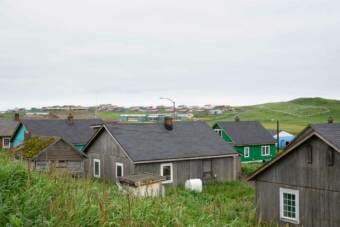
St. Paul in 2015. Ravn Alaska and Food Bank of Alaska work together to provide food for elders in the village. Ravn covers the freight costs for about 18-25 boxes of food each month. (Photo courtesy Ian Dickson)

Ravn Alaska has partnered with the Food Bank of Alaska to help provide meals to elders on St. Paul Island.

Andronik Hanson is the food bank coordinator for the Aleut Community of St. Paul Island — the local tribal government. He said shipping costs for food can get expensive on an island in the middle of the Bering Sea.

“The big thing they’re doing is donating freight to get the boxes,” Hanson said.

Ravn covers the freight costs for about 18-25 boxes of food per month, which has totaled more than 1,400 pounds since the program started in November, according to a Ravn press release.

The monthly deliveries are part of an effort to combat food insecurity in the region, said Rob McKinney, chief executive of the regional airline.

“We’re the primary carrier that serves that island,” McKinney said. “So we feel like we have a special obligation to make sure that we take care of that community.”

Ravn has covered freight costs for more than 600 meals to the island over the past few months.

McKinney said the deliveries to St. Paul will continue monthly and are the beginning of a larger project.

“Once we know what the needs are and what our capabilities are, we definitely want to look at other communities where we can expand that partnership,” he said.

The company is looking to add another De Havilland Dash 8 plane and increase its cargo capacity to supply more communities in rural Alaska with meals in the future, according to McKinney.

The first answer for food insecurity: data sovereignty

Native American Agriculture Fund’s CEO, Toni Stanger-McLaughlin (Colville). (Courtesy image)

For two years now, the COVID-19 pandemic has exacerbated almost every structural inequity in Indian Country. Food insecurity is high on that list.

Like other inequities, it’s an intergenerational product of dispossession and congressional underfunding — nothing new for Native communities. What is new, however, is the ability of Native organizations and sovereign nations to collectively study and understand the needs of the many communities facing the issue. The age of data sovereignty has (finally) arrived.

To that end, the Native American Agriculture Fund (NAAF) partnered with the Indigenous Food and Agricultural Initiative (INAI) and the Food Research and Action Center (FRAC) to produce a special report, Reimagining Hunger Responses in Times of Crisis, which was released in January.

According to the report, 48% of the more than 500 Native respondents surveyed across the country agreed that “sometimes or often during the pandemic the food their household bought just didn’t last, and they didn’t have money to get more.” Food security and access were especially low among Natives with young children or elders at home, people in fair to poor health and those whose employment was disrupted by the pandemic. “Native households experience food insecurity at shockingly higher rates than the general public and white households,” the report noted.

It also detailed how, throughout the pandemic, Natives overwhelmingly turned to their tribal governments and communities — as opposed to state or federal programs — for help. State and federal programs, like the Supplement Nutrition Assistance Program, or SNAP, don’t always mesh with the needs of rural reservations. A benefits card is useless if there’s no food store in your community. In response, tribes and communities came together and worked to get their people fed.

Understanding how and why will help pave the way for legislation that empowers tribes to provide for their own people, by using federal funding to build local agricultural infrastructure, for instance, instead of relying on assistance programs that don’t always work. HCN spoke with the Native American Agriculture Fund’s CEO, Toni Stanger-McLaughlin (Colville), to find out more.

This conversation has been edited for length and clarity.

High Country News: The big number from this report is that 48% of Native people surveyed experienced food insecurity during the pandemic. Was this a failure of infrastructure, like supply chain issues and trucks not getting to reservations?

Toni Stanger-McLaughlin: It was a perfect storm of all of those things during the height of the pandemic. Reservations are the rural of rural — they’re oftentimes so far removed from access to transportation, or any type of processing or storage plant, that they fully rely on those systems operating in a timely manner. When they don’t, it means that those communities go without.

HCN: According to this report, Natives changed where they got their food during the pandemic. They stopped going to farmers markets and community gardens because of social distancing and did more home gardening, foraging and collecting of seeds, as well as sharing food. But, surprisingly, they hunted and fished less. Do you know why?

TSM: A lot of the communities were on strict lockdown. You weren’t supposed to leave your home. Going on a couple years now, these communities are still reeling and still having to figure out what to do. We also saw a real big uptake in direct farm-to-family. You could buy a cow in your neighborhood, or in your community, where before you couldn’t. Those farmers were selling to stockyards, who were then selling to big processing plants. Your meat could go three states before it would return to your community. Instead, we saw more direct sales. And the federal government allowed that. It hasn’t happened at that scale in a long time.

HCN: The gap in food security seems to have most impacted medium-income households as opposed to the poorest households. Is that correct?

TSM: Yeah. … When we receive this data, and we look at the income level of the respondents, that doesn’t correlate to the requirements to participate in some of the food assistance programs that exist in the federal government, and then trickle down to state and tribal governments. So, for instance, to qualify for what used to be called the food stamp program, SNAP, or WIC (the Special Supplemental Nutrition Program for Women, Infants, and Children) or free school meals, all those programs are income-contingent. And they get continued servicing.

For those that could qualify, income-wise, those programs weren’t obstructed in a way that the general food access (was) — getting a food distribution box versus going to a grocery store where everything is gone, everyone has purchased the goods from that grocery store. We saw it with toilet paper, but we saw it with food, too. There was a huge shortage of meat, or the meat was so expensive that it disabled people from being able to get the full nutritional value of each of their meals. They had to pick and choose. Those are, in our respondents in our survey, largely the ones that identified as being food insecure and lacking nutrition.

HCN: FRAC — the Food Research and Action Center — talks about opportunities to address food insecurity with the Build Back Better plan, or through Congress. But your organization seems more focused on tribal efforts, saying that instead of increasing benefits, the federal government should increase support and empowerment of tribal governments. Why is that distinction important?

TSM: Well, unfortunately, we have to do both. When we saw in the report that people were turning to their tribal governments, not their state governments, for assistance, it’s just another indication of the ability of tribes to administer those program dollars and keep an alignment with the requirements and mandates that come from receiving federal funding.

IFAI — the Indigenous Food and Ag Initiative — and FRAC and NAAF came together to provide the data that will help educate Congress when they’re making decisions about food implementation and agricultural production across the country, in particular Indian Country.

HCN: Why is self-sufficiency so much more effective?

TSM: Because they intimately know their neighbors. They know culturally how their communities function. And they know how to get to their membership in the best possible manner. So, in one community, it might be working through mobile slaughter (units). In another community, it might be distribution of food boxes. In another community that’s not so far removed from a town or city, it might be working with food banks. And so those community members, the tribal governing authority — they know that better than an outside entity, better than a state entity.

A lot of our tribes have economic arms of their tribal government that have some type of food- or agricultural-based business. They utilize those businesses to get that food to their community members. And that’s the model we want to see. Those producers within those communities can sell their food locally. It reduces transportation and storage costs, it reduces or works toward eliminating issues that you would see in long transportation. In the end, they will save money, because these communities will have additional dollars, so the value of their dollar will remain stronger, won’t be chipped away by having to go through multiple states or processing plants or transportation companies. And again, if we have natural disasters, we have a pandemic, then the communities can stand up and serve their citizens, as opposed to waiting for Washington, D.C., or even the state capital to try to get to them.

If you look at eastern Washington, the Yakama Nation and the Colville Confederated Tribes, collectively, we have close to 10 million acres. The export industry in cherries and apples alone is in the billions — and yet our tribes are not billionaires. So there’s an opportunity there to pivot and diversify away from, say, gaming, and work towards making agriculture not only a food-security issue, but an economic development opportunity.

HCN: Are you optimistic that Congress is going to take this data into account and begin to more deeply or meaningfully empower tribal communities to support themselves through their own agricultural infrastructure?

TSM: We hope so. Our overall vision document is, through this regional agricultural infrastructure, about standing up everything that these communities or regions will need in order to feed themselves. That’s grain elevators, it’s rail transportation, it’s kitchens and processing plants. But it’s also marketing, packaging and distribution. And so having access to all of those in a regionalized manner will unburden the individual tribe or individual farmer or producer from having to stand up that infrastructure themselves. it would all be done in a regenerative, climate smart manner. And again, reducing the amount of transportation, all of those things moving towards helping the environment and helping these rural tribal communities at the same time. We’re asking tribes to reach out and engage with us if they’re applying for federal funding, to use our work as a model of how we can all come together and actually leverage private and federal funding and expand and unify our mission, which is to feed our communities, but do so in a manner that supports those community members and not necessarily a corporation.

This is just the beginning. We’re going to continue to do more data-related research. For the first time, we’re going to take ownership of our data, and also the messaging and how that data is going to be interpreted. A lot of this generation has benefited from the work of our ancestors. And we’re in a place where a lot of tribal communities are working toward large scale, either cultural development, gaming, you name it, government contracting. These tribes are moving into spaces they’ve never been before, they’re able to support their communities better. We have higher rates of participation in higher education and vocational education. And we want to continue that upward trajectory and supply the celebration of our traditional ecological knowledge. So this is just an opportunity. And it’s our first step going after and providing this type of data.

And we’re not just working with tribal entities; we’re working across the spectrum. We’re working with other large-scale agricultural industry groups, and nonprofits and federal agencies. And our hope is that we can do some focus work, to stand up agricultural infrastructure in rural communities and show the world that it can work and that these communities can have ownership over their food and food security.

This story was originally published by High Country News and is republished here with permission.

An Anchorage restaurant operator says the pandemic is still hitting the industry hard

Photo portrait of a man standing behind a bar
Jack Lewis operates Firetap Alehouse, along with several other restaurants in Anchorage. (Photo by Matt Faubion/Alaska Public Media)

Restaurants are going on two years of income uncertainty and staffing challenges due to COVID-19. Jack Lewis works as an operating partner for several restaurants and chains in Anchorage including Firetap Alehouse and a Krispy Kreme.

He told Alaska Public Media’s Kavitha George that the pandemic is still causing daily headaches in his industry.

Listen here:

This transcript was lightly edited for clarity.

Jack Lewis: People think it’s over, but yeah, it’s not with omicron. You think because of the vaccinations we would be on the downhill run here. But in actuality, the restaurants are getting hit hard again.

There’s a lot of confusion out there. Is it safe to go out? Is it not safe? Even if people have been vaccinated, they’re hesitant about going out. They’re not concerned about being hospitalized, but now they just don’t need to. So here we go, again, where the restaurants get hit hard again. So we are definitely not out of the woods yet by any means. And the workforce continues to be tight as we look for people.

Kavitha George: What does hit hard look like? Is it lowered sales, staff out sick?

Jack Lewis: It’s every area, it’s up and down. Sometimes you think you’re out of the woods, you have a big weekend, and then the following weekend, your sales are way off. You can have a big Tuesday, and then just sit there with an empty dining room on a Wednesday. So it’s all over the place.

The labor market, we are extremely short. My peers in the industry are extremely short. And it’s every area — it’s management, it’s food servers, line cooks, kitchen managers, every area has been affected.

Kavitha George: Have you opted to raise wages to attract workers?

Jack Lewis: I mean, wages are way up there. Probably well over 10% more than we were paying [pre-pandemic]. Close to 20% in some areas. Some you pass on to the consumer and you hope you don’t get pushback because we are paying people better. Minimum wage, I think, is pretty much non-existent in my operation and probably most of my peers up here. We’re paying the highest wages we’ve ever paid in the industry to keep people working, and paying overtime all over the place with the [worker] shortages.

Kavitha George: With the staff that you do have, have you had issues with one person testing positive, then everybody has to test and you have to shut down while you’re waiting?

Jack Lewis:  Right. You know, we’re still in a very challenging period here. Because if someone calls in, says “I’ve been exposed to somebody that tested positive,” now we have to wait and see whether they tested positive. And then if they do, we have to notify everyone that we’ve had a positive case. We usually don’t even open until we’ve been assured that everyone has tested negative or has zero symptoms.

And the public gets mixed messages. If you’re closed for a day, even though it could be 100% safe, the public wonders “Wow, well they shut down for that day.” So I think the public is still very confused, should they go out to restaurants or should they not? And we need them in the dining rooms. Because we’re certainly not going to make a living off of takeout and third party carriers, that’s for sure.

Kavitha George: How many times have you had to shut down for a day or even just cut back hours?

Jack Lewis: During the heat of COVID, I shut down several operations for over a week. I shut down Burger Fi for a week, Peanut Farm was shut down for over a week, Firetap Ale House shut down for over a week, Krispy Kreme shut down many days. And you know, your overhead carries on. And it’s an even worse effect because your people aren’t working … for those that couldn’t come into work because we weren’t open, they lost their income. So it was a real domino effect when we had to shut down.

Now we’re in omicron, I would say we’re shut down for like days at a time, or maybe we don’t do lunch hour, or maybe skip a day on a Monday just to play it safe. So we’re sort of going day by day. I wake up in the morning, as head of operations, and I’m fearful to look at my phone.

These are very difficult decisions, because I’m trying to do everything right. And my peers are trying to do everything right. And yet, people need to make a living and they’re trying to get to work.

Kavitha George: What would help you at this point? More relief money, more access to testing?

Jack Lewis: Well, we certainly need some more relief money. There’s no doubt about it. We’re not out of the woods yet. A lot of us don’t have the holding power, should we get hit again.

And then, information to the public, clear information. What are the odds of getting sick in a restaurant? I think they’re slim now, if you’ve been vaccinated. I think the more information out to the public, the better the restaurants will do. I still think there’s a lot of confusion by the general public, which I think is keeping them out of the dining rooms.

Barge rate hikes add to rising grocery costs in Wrangell

A stack of shipping containers
Shipping containers in Wrangell. (Photo by Sage Smiley/KSTK)

Barge rates have gone up in the new year across Southeast Alaska. But the rising cost of hauling goods into coastal communities isn’t the only reason a trip to the grocery store might be more expensive.

Alaska Marine Lines, one of the largest barge companies supplying Southeast, increased its general rate by 4.8% on Jan. 30. And freight costs will go up again next week when a fuel surcharge increase takes effect on Feb. 6.

Sitka’s Samson Tug & Barge, the other half of Southeast Alaska’s freight barge duopoly, mirrored Lynden’s rate increase. Samson, AML and a smaller tug company, Boyer Towing work together to serve Southeast communities in the Wrangell area.

As an island community, Wrangell relies heavily on bringing in supplies on these private sector barges.

“The only thing that comes by airplane is the packaged salad,” said Jake Hale, the manager of City Market, one of two supermarkets in town. “Everything else is on the barge.”

When the price of freight goes up, Hale says, so does the price of pretty much everything at his Wrangell grocery store.

“A gallon of milk weighs eight pounds,” Hale said. “So if we ended up paying six cents more pound for freight to get it up here, that’s 48 cents, that has to get added on to that gallon of milk.”

And price hikes are coming.

“We’re looking at record increases,” Hale said. “Not only are we looking at increased prices from the manufacturers and the wholesalers, shippers, but the fuel prices are huge. And when they go up, everything goes up.”

Hale says that depending on the products, he’s expecting 5-8% price increases on grocery store items this year.

“That’s probably the highest I’ve seen it in my career,” he said. He’s worked for more than three decades in grocery retail, and just shy of three years in Wrangell.

As a member of the industry group the National Grocery Association, Hale says he sees rising prices as an answer to a multifaceted problem.

“This is like the perfect storm,” he said, referring to supply chain issues nationwide, including for basic packaging materials like aluminum or cardboard. And packaging and processing plants have experienced shutdowns due to COVID-19.

“Basically every stop from the creation of the product to when it gets sold in the store costs more,” Hale said. “And there’s not much we can do about it.”

Companies have raised wages to attract workers and truckers in a tight labor market.

“Last year, I went four months without getting a single application,” Hale said.

City Market bumped up pay as well, which is a cost that gets passed on to the consumer. All that is on top of increases to barge freight and fuel surcharges setting in after the new year.

Wrangell’s local government has been monitoring barge rates because it’s a major driver in the cost-of-living. A rate study commissioned by the borough found Wrangell’s rates have risen an average of 4.5% every year, so the recent general rate increase of 4.8% from Lynden and Samson isn’t without precedent.

As for fuel costs, a spokesperson for Lynden, AML’s parent company in Seattle, says the fuel surcharges are tied to rising fuel prices. In fact, according to AML’s fuel surcharge rate sheet published with the Wrangell freight rate study, the company’s fuel surcharges have been artificially low for almost two years — as low as 6%.

Barge rates in Alaska are monitored by the Surface Transportation Board, which oversees the cost of shipping freight between communities. But the federal agency doesn’t intervene in freight pricing unless there’s a complaint. The state of Alaska’s Attorney General has, in years past, investigated the barge companies’ arrangement.

There’s always a cost of shipping added to a product, Hale adds. Whether it’s by truck, plane or boat.

“Barging product is not perfect,” Hale said. “But it is so much better than the alternatives I’ve used in the past.”

It’s one part of the price of living in a relatively remote part of Alaska.

Site notifications
Update notification options
Subscribe to notifications