Food

Metlakatla takes fishing rights dispute to federal appeals court

""
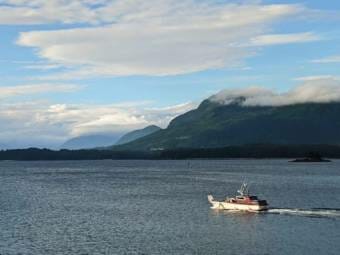
The 32-foot gillnetter F/V Deja Vu sails on Aug. 3, 2020 near Metlakatla. (Courtesy of Johon Atkinson)

Alaska’s sole Native reservation has taken a fishing dispute with state authorities to a federal appeals court. Metlakatla Indian Community is asking the U.S. Circuit Court of Appeals for the 9th Circuit to rule that Metlakatla’s tribal members don’t need state permits to fish in their traditional waters.

Congress created the Annette Islands Reserve in the late 19th century as a self-sustaining home for the people of Metlakatla.

Now, the Metlakatla Indian Community tribal government argues the 1891 law also gives its modern-day members unfettered rights to commercially fish around Ketchikan and Prince of Wales Island.
Its tribal members are the only people authorized to fish within 3,000 feet of the reserve’s shores. But in other parts of the southern panhandle, the same rules apply to them as anyone else. And the tribe took the Dunleavy administration to court last year to force the issue.

But a federal judge dismissed Metlakatla’s case. That brings us to Monday’s oral arguments.

“The district court erred in three main ways that are interrelated,” said Metlakatla’s attorney, Julie Weis, addressing the 9th Circuit in California.

She said established precedent and longstanding principles of Indian law provide a legal basis for Metlakatla’s interpretation of the 1891 law creating the reserve: namely, that Metlakatla’s tribal members have a right to fish the southern panhandle.

The problem for Metlakatla’s case is that the 1891 law doesn’t explicitly mention fishing. The 101-word statute says only that the reservation was set aside “for the use of the Metlakahtla Indians.”

But Weis cited a 1996 9th Circuit opinion that found that when reservations are created by fiat — as opposed to by a negotiated treaty — important rights and privileges are often left out of the text.

“The court indicated that we should look at the circumstances of the reservation’s creation and the history of the people for whom the reservation was created,” Weis said.

And she said Metlakatla’s fishermen had long harvested in waters within a day’s travel from their home. She said that was proof enough that they did not believe they were bound by the reserve’s waters extending out 3,000-feet.

“The facts alleged in the community’s complaint and the inferences drawn therefrom demonstrated that an Indian in Southeast Alaska more than a century ago could not have conceived of an invisible line around the reserve beyond which it could not fish,” Weis said.

Weis argued that the U.S. Supreme Court had recognized the importance of fishing to Metlakatla’s citizens more than a century ago.

“The court stated, Congress must be held to have known that without the food yield of the sea, these Indians could not survive there being a little or no agricultural land on the islands, or for that matter, in all southeastern Alaska,” she said.

That 1918 Alaska Pacific Fisheries case upheld Metlakatla members’ exclusive right to fish in waters near Annette Island. But Weis said the tribe was not a party to the case back then, so they weren’t able to argue for the wider interpretation they’re seeking in 2021.

Weis asked the three-judge panel to reverse a lower court judge’s dismissal and instruct the District Court to define Metlakatla’s fishing rights off the reservation.

But the state’s attorney fired back that Metlakatla’s demands would give their tribal citizens an unfair advantage over other Alaskans. Alaska Assistant Attorney General Laura Wolff said Alaskans have to follow uniform fishing rules and regulations.

“They’re not asking just to share fishing,” she said. “They’re asking for a priority.”

She emphasized that the 1891 law doesn’t say anything about fishing, and the Congressional Record doesn’t indicate that was ever a consideration.

“And these facts don’t add up to the legal conclusion that the act created an off-reservation right when the act is completely silent,” she said.

Wolff argued that the state’s fishing permit system, which in most cases only allows a limited number of vessels to commercially fish in state waters, was the state’s primary method to prevent overfishing. Wolff argued that allowing otherwise would undermine that.

“Opening up the limited entry program would derail the conservation purposes,” she said.

Judge William Fletcher, part of the three-judge panel, seemed to question that last point.

“It may derail this particular program, but I don’t think it would disable the state from regulating for purposes of conservation,” the judge said.

He said prior cases had held that tribal fishing rights are subject to state regulations aimed at conserving fisheries. Metlakatla’s attorney agreed.

A ruling is expected next year.

Sitka Tribe’s shellfish lab honored for safeguarding traditional foods

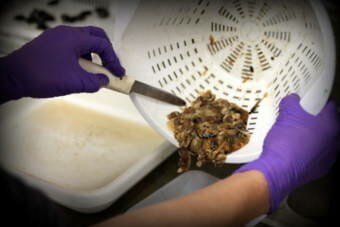
A pair of purple-gloved hands using a small knife to push shellfish meat out of a while colander
Sitka Tribe of Alaska fisheries biologist Jen Hamblen empties blue mussel meat into a blender in 2016. (Emily Russell/KCAW)

For millennia, people in Southeast Alaska have relied on the sea for sustenance. But what happens when traditional foods could be deadly? That question was behind the founding of Sitka Tribe of Alaska’s Environmental Research Lab in 2016. The lab tests shellfish from 17 Southeast communities as well as tribes on Kodiak Island.

The state tests commercial shellfish for toxins. But Sitka Tribe Resource Protection Director Jeff Feldpausch says subsistence harvesters are left to fend for themselves.

“They don’t do any public testing or certifying any beaches in Alaska, like you see in Washington and other Lower 48 states,” he said.

Feldpausch says the state’s official message is simply not to eat the clams and mussels on the beach because of the risk of toxins.

“We just figured, you know, that’s not that’s not acceptable response,” Feldpausch said. “We started down this road with, I think, 15 other tribes in Southeast as far as looking at ways to address safe access to shellfish resources.”

Paralytic shellfish poisoning, or PSP, is caused by toxic algae blooms. Filter feeding shellfish like clams and mussels store the algae’s biotoxin in their tissues, which can prove fatal when ingested.

PSP has always existed in Southeast. Harvesters could once rely on ancestral knowledge alone to be safe, but climate change has made PSP more frequent and harder to predict without testing.

“You know, a lot of the old harvesters used to say you only harvests shellfish in a month with ‘r’ in it,  and we’re starting to find out that that’s not necessarily the case right now, ” Feldpausch said. “It’s just, with climate change, we’re seeing a higher frequency of PSP or biotoxin levels that can cause death.”

It was spring of 2016 when Sitka Tribe of Alaska took a risk and opened its research lab, the first of its kind in Southeast Alaska. In November, the lab was recognized by Harvard’s Honoring Nations program in the 2021 American Indian Governance awards. Out of the 70 different programs that applied, Sitka Tribe was one of the top six.

Feldpausch says that tribal sovereignty is at the heart of the lab’s mission.

“Unfortunately, statehood and the Alaska Native Claims Settlement Act separated tribes and tribal citizens from the land and the resources to where the point that tribes really don’t have much more input, or much more leverage on how those resources are managed than any other entity or individual within the state,” he says. “So basically, it’s given the tribes the ability to act to exert sovereignty over some of the resources.”

For those who use the lab’s services, it’s about more than just subsistence. Yakutat Tlingit Tribe’s environmental director Jennifer Hanlon says the initiative is part of a greater struggle for cultural preservation.

“This data — it’s really important to inform harvesters of the current levels, if there’s any concern related to when and where to harvest shellfish,” Hanlon said. “Because that is such an important subsistence food for us that nourishes our people and our communities, on so many levels. Not just nutritional, but also fostering that relationship to our ancestral lands and waters.”

Feldspauch says the tribe’s shellfish testing program is still expanding and now includes training for tribal citizens.

“We’re actually testing for two other biotoxins that are produced by harmful algal blooms. So we’re expanding our testing range,” he said. “We’re also testing subsistence resources for total mercury. And beyond that, we’ve, outside of the lab, we’ve actually grown to training tribal citizens or other tribes to do shellfish biomass surveys.”

Sitka Tribe offers free shellfish testing for Sitka residents and is continually monitoring Starrigavan Beach, with new data out every two weeks, year-round. For more information on the lab and their services, you can visit their website.

Dunleavy administration loses lawsuit over Kake subsistence hunt

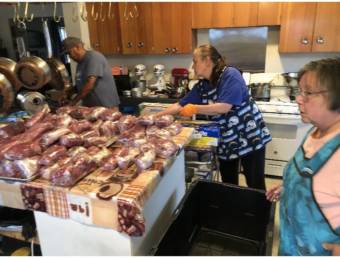
Kake residents and Elders process moose meat to be distributed to the community
Kake residents and elders process moose meat to be distributed to the community (Courtesy of the Organized Village of Kake)

A federal judge has rejected the Dunleavy administration’s legal challenge to a special rural subsistence hunt that was authorized by federal authorities during the early months of the COVID-19 pandemic. The Southeast tribal government in Kake had organized the deer and moose harvest out of concerns about food security during the early months of the pandemic.

About a year and a half ago, fresh groceries in the community of Kake were in short supply. It was the early weeks of the COVID-19 pandemic, and meat, dairy and other perishables weren’t showing up on the barge as nationwide hoarding caused shortages of basics like toilet paper, flour and other staples.

And workers key to the nation’s food web were getting sick.

Our meat supply kind of got pretty low because of the virus hitting the meatpacking plants in the Lower 48,” Organized Village of Kake’s tribal president, Joel Jackson, told CoastAlaska.

The normal hunting season doesn’t begin till the fall, and it was too early for the salmon run in the Kupreanof Island community of a few hundred people.

But there are plenty of deer and moose in the dense forests, so Jackson went looking for permission to organize a community hunt — first to the state agency that oversees wildlife.

I went to the (Alaska Department of) Fish and Game, first of all, and they absolutely said, ‘No, that’s not going to happen,’” Jackson recalled.

Special 60-day hunt opened by federal agencies

In the end, the Federal Subsistence Board authorized a special hunt for the community of Kake in June. Two bull moose and five bucks were reportedly harvested, with the meat distributed to the community.

But then Republican Gov. Mike Dunleavy’s administration filed a lawsuit claiming there was no food security risk. It raised a number of procedural objections to allowing the special hunt.

There’s long been tension between state and federal authorities over subsistence rights. And the state’s position was that the special hunt was exclusionary and an example of federal overreach.

But federal Judge Sharon Gleason rejected the state’s request for a restraining order against the Federal Subsistence Board. She also rejected the state’s objections over the board’s excluding urban hunters harvesting moose in an area of the Interior, which the subsistence board had ruled was needed for public safety. That had been a second part to the state lawsuit.

In a 49-page order issued Dec. 3, she rejected all the state’s legal arguments.

Indigenous legal firm celebrates sovereignty win

The Native American Rights Fund, which offered legal aid to Kake’s tribe, welcomed the ruling.

“The Organized Village of Kake, like many Alaska Native communities, relies on subsistence hunting to ensure food security for its tribal citizens,” NARF staff attorney Matthew Newman wrote in a statement, saying the federal authorities did well to work with a Native community like Kake anxious about its food security.

“It was ridiculous of the state to suggest anything otherwise, and the court made the right decision when it held that the board acted within its authority,” the attorney’s statement added.

And Jackson, the tribe’s president, says it was a victory for tribal sovereignty in a crisis situation.

“I hate the word ‘subsistence’ because that’s Western world,” Jackson said. “But we practice our way of life here in the villages … If worse comes to worst, and somebody tries to limit us when we’re in dire need of something, I’m not going to sit back and wait for their decision — that’s not going to happen.”

Alaska Attorney General’s office considers appeal

A spokesman for the Department of Law released a short statement accusing the judge of ignoring the Alaska National Interest Lands Conservation Act — known as ANICLA — which proscribes subsistence rights on federal lands in Alaska.

“This ruling today is entirely contradictory to ANILCA, which was intended to protect the rights of all hunters on federal lands in Alaska and retain the state’s management authority with a subsistence preference only when necessary to restrict harvest,” wrote agency spokesperson Aaron Sadler.

“The state maintains the Federal Subsistence Board overstepped its authority — in part in illegal, secret meetings at that — including by restricting hunting in Units 13A and B and by authorizing an emergency hunt in Kake last year in spite of no food shortages,” the communications director added.

He said the state was considering an appeal.

Canada taps into strategic reserves to deal with massive shortage…of maple syrup

Quebec produces nearly 70% of the world’s maple syrup, with the US being its biggest client for the sweet stuff. However, this year producers weren’t able to keep up with worldwide demand, which jumped 21%, according to Bloomberg. (AP Photo/Robert F. Bukaty, File)

While high gas prices have pushed President Joe Biden to tap into the U.S.’s strategic oil reserves, America’s neighbor to the north is also dealing with a shortage of another so-called “liquid gold”.

The Canadian group Quebec Maple Syrup Producers recently announced it was releasing about 50 million pounds of its strategic maple syrup reserves — about half of the total stockpile.
Quebec produces nearly 70% of the world’s maple syrup, with the U.S. being its biggest client for the sweet stuff. However, this year producers weren’t able to keep up with worldwide demand, which jumped 21%, according to Bloomberg.

Maple syrup is made from the sap from maple trees, which is traditionally harvested by installing a metal tap into the tree’s trunk. Modern sap harvesting typically involves a system of plastic tubing and vacuums to collect the sap from multiple trees to a central location where it can be refined into syrup.

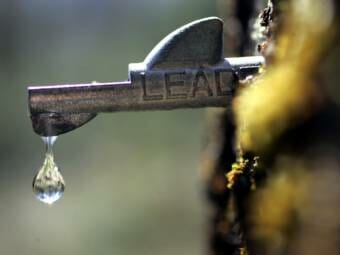
A drop of fresh sap falls from a tap in a maple tree.
A drop of fresh sap falls from a tap in a maple tree March 28, 2006 in Bowdoin, Maine. (Photo by Joe Raedle/Getty Images)

This is a seasonal process though, as maple sap can only be harvested in specific weather conditions. So, this year’s short and warm spring resulted in an uncharacteristically low yield for producers.

“That’s why the reserve is made, to never miss maple syrup. And we won’t miss maple syrup!” said Helene Normandin, the Quebec Maple Syrup Producers’ communications director.

While it’s hard to predict what next year’s crop will look like, Normandin said they were already planning for the future.

“What we can figure at this moment is maybe the season here in Quebec will start a bit earlier in February, instead of March, and end earlier also,” she said.

This is not the first time Quebec’s maple syrup reserve has made headlines. In 2012, more than 3,000 tons of maple syrup were stolen from the stockpile over the course of months. The value of the heist was estimated at nearly $19 million Canadian dollars.

The Quebec Maple Syrup Producers will be tapping 7 million more trees in the near future to replenish their reserves and to make sure they can meet demand next year.

So go ahead and top off those pancakes and waffles with the Canadian liquid gold this holiday weekend.

Copyright 2021 NPR. To see more, visit https://www.npr.org.

‘Turkey shoot’ raises funds for raising farm animals and awareness about where our food comes from

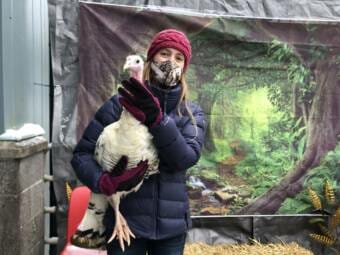
Juneau Douglas High School student Ashlynn King poses with Penny, a turkey she raised as part of the school’s IGNITE program. Penny was part of a photo shoot fundraiser for the program on November 20, 2021. (Jennifer Pemberton/KTOO)

Over the weekend, students in a career and technical program at Juneau Douglas High School: Yadaa.at Kalé held a “turkey shoot” fundraiser.

The set featured a hay bale and a lush scenic backdrop with foliage that looked more like Costa Rica than Southeast Alaska. And waiting for someone to sidle up next to her and smile was a beautiful flightless bird named Penny.

Penny is white with flecks of black at the tip of each feather.

“Like a snowy owl,” said my four-year-old son, who was seeing a turkey for the first time.

Penny is a royal palm turkey, an ornamental breed, but he’s exactly right that her plumage looks like a snowy owl.

Donations for the privilege of posing with Penny go to a program called IGNITE, which introduces students to career and technical programs at the high school.

“We’re kind of a weird club. I won’t say we’re underfunded,” said club member Gabe Hansen, who’s a junior at the high school. “We just spend a lot on feeding birds and rabbits.”

Hence the fundraiser.

Juneau is not known as an agricultural hotbed, but in addition to raising animals, students work on construction projects. They made a goat barn and a swinging door for the school’s library. They also learn how to manage money and people.

“You got to get all the people down here to feed the animals when it’s their time, otherwise animals don’t get fed, which isn’t really good for them,” Hansen said.

“We also emphasize getting girls — women — into this … without the toxic environment of our trade classes,” said Eva Sturm, a senior.

“I have this issue with southeast Alaska because there’s not enough agriculture and kids are freaked out by things they eat every day,” said Caplan Anderson, the students’ advisor. “So, it’s exciting to see some kids who are ready to snuggle a turkey.”

A family of four set up on the hay bale. Penny nestled right in with them, looking like part of the family.  Anderson told them it was okay to take off their masks, so you could really see their smiles.

“A lot of what we do is show people animals they might not see on a regular basis,” said Ashlynn King. She’s Penny’s handler and is actually raising the turkey at home.

All eyes were on the exotic bird, but right then a great blue heron flew right over.

“More people have seen herons than turkeys,” said Hansen. “It’s wild.”

That is certainly the case with my son, who had seen hundreds of bald eagles at once but had never seen a turkey before.

“I thought the turkey was going to be a turkey you eat,” he said on the walk home. “I thought it would be like meat that had eyes and a mouth.”

So now, in addition to venison and salmon, at least he knows where turkey meat comes from, thanks to Penny and the IGNITE students.

Document paints bleak picture of plan to bring Sitka black-tailed deer to Mat-Su

Sitka black-tailed deer
A Sitka black-tailed deer (Heather Bryant / KTOO)

Recently, Anchorage Daily News reporter Zachariah Hughes wrote a story about a proposal by Governor Mike Dunleavy to provide additional hunting opportunities in the Mat-Su by bringing in Sitka black-tailed deer. A state document obtained by ADN points out a number of potential issues with that plan.

KTNA’s Phillip Manning spoke with Zachariah Hughes about the story.

Listen Here:

This transcript has been edited lightly for length and clarity.

Zachariah Hughes: So it’s pretty common for the Alaska Department of Fish and Game to transplant animals. Currently, there’s a proposal to move Sitka black tailed deer into areas of the madness consistent valleys. And staff biologists wrote up a scoping document outlining, you know, what that might look like and some of the potential problems that it might bring. And I should say, there have been plenty of successful transplants all over the state, and Sitka black tailed deer are some of the earliest translocated species in the state. A lot of the places that they appear now like Prince William Sound, and Kodiak, those were transplanted colonies.

Phillip Manning: So the idea here is to establish a large enough stable population that they could be hunted by Alaskans for food. What does Fish and Game have to say about the feasibility of that?

Zachariah Hughes: This scoping document from the state — which initially the Department of Fish and Game would not release through a public records request — we obtained, and it painted a pretty bleak picture of the prospects for relocating deer there.

Phillip Manning: When I read your article, one of the first things that occurred to me is how much colder parts of the Mat-Su can be than Southeast where these deer originate.

Zachariah Hughes: Yeah, and that’s actually one of the big topics of discussion in the scoping document among the biologists. Deer do survive in Alaska, certainly, and in some pretty cold places. But a lot of the factors that allow them to survive in colder years are kind of absent from that area of the Matanuska-Susitna Valley. The cold really is the biggest problem, along with the snow. In Kodiak, they’ve been observed eating kelp off the beach, which helps to keep them from starving. There’s one sort of dry line in the scoping document that I thought was kind of funny, which is there is no kelp in the Matanuska and Susitna Valleys — or very little of it.

Phillip Manning: So I should clarify to where exactly in the Mat-Su is this potential relocation being looked at?

Zachariah Hughes: Mostly areas around Palmer and Wasilla: the Knik area. The Palmer Hay Flats were considered but mostly the lower part of the borough.

Phillip Manning: Okay, so you’ve laid out some of the concerns that the biologists had for why the deer population might not be able to be established. But there’s also some pretty strong implications in there that even if it were to be established successfully, that there could be some potential problems associated with that. Can you go into that a little bit?

Zachariah Hughes: Yeah, one of the interesting things about this report is it paints not just a pretty bleak picture of what the deer survival prospects are. But it then paints a very, in some ways, even bleaker picture, should they survive and thrive. The new problems that would be created — and some of those are minor nuisances, like deer eating flowers and gardens out of people’s private property. Some of them are pretty major — the potential for roadkill. Deer, like moose, are most active around dawn and dusk, which makes it really hard to see them on the road. This is an area where already there’s around 300 moose vs. vehicle collisions a year. And then the potential for deer to be vectors for parasite and disease transmission.

Phillip Manning: One of the other things that you pointed out in the article was the potential for competition between imported deer and the current moose population for browse.

Zachariah Hughes: There’s plenty of forage out throughout the Valley. It’s a very verdant and productive landscape, but it’s particularly in heavy snow years when you know, snow is burying willows, shrubs, alders, sources of forage for ungulates, it gets very scarce and the the suggestion in the report is not that deer wouldn’t do well, nine months out of the year, it’s that there’s, you know, those three winter months through November, December through about February.

Phillip Manning: So we should mention one other thing that you bring up in the article, is that this is still a very early stages document. And there’s not — the wheels haven’t really started moving all that much on actually trying to do something like this.

Zachariah Hughes: Yes, the scoping document, as one policy advisor told me and as quoted in the story — this is very, very, very early in the process. So this is could easily just be a 13-page document that lives on a shelf and collects dust somewhere. I thought it was interesting. I thought it was a novel proposal. The other thing that interested me about this is if it’s the start of a public process, then the public ought to know about it.

Site notifications
Update notification options
Subscribe to notifications