KTNA is our partner station in Talkeetna. KTOO collaborates with partners across the state to cover important news and to share stories with our audiences.

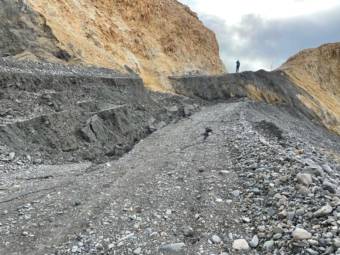
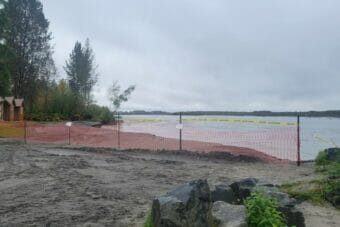
Erosion near the end of Main Street on Sept. 11, 2023. (Phillip Manning/KTNA)
The Matanuska-Susitna Borough has declared a local disaster for Talkeetna after high water caused rapid erosion in the community.
According to a statement by the borough Tuesday morning, the disaster declaration allows access to emergency funding as well as support from state and federal agencies. It also allows for emergency response plans to be carried out.
Downtown Talkeetna lies at the confluence of the Susitna, Chulitna and Talkeetna rivers. Multiple days of heavy rain resulted in high water throughout the Northern Susitna Valley earlier this month.
That high water event destroyed over 300 feet of the rock revetment near the end of Talkeetna’s Main Street, meant to stabilize and protect the riverbank from erosion. In less than a day, the riverbank was eroded back more than 60 feet, threatening some cabins near the river.
Last Friday, the borough authorized transporting 900 tons of rock to the end of Main Street to stage for future repairs. Staff from the borough’s public works department and the U.S. Army Corps of Engineers have visited the site multiple times since last week.
According to borough spokesman Stefan Hinman, the public works department and the Army Corps of Engineers are working on both immediate protective measures and long-term repairs.
The aftermath of an explosion that destroyed Talkeetna Tako on Main Street in the early morning hours of Aug. 29, 2023. (Phillip Manning/KTNA)
A taco truck exploded early Tuesday morning in Talkeetna. The blast damaged nearby buildings and could be heard miles away.
At around 4:30 a.m., Talkeetna Tako, a food truck that has called Main Street home for years, exploded, sending debris dozens of yards away. Windows in surrounding businesses were shattered, and items on shelves were thrown to the floor. The door of the trailer was found across the street on the roof of another food truck near the beer garden of the Fairview Inn. The Fairview had many of its front-facing windows shattered.
Immediately behind Talkeetna Tako is a residence owned by the Sheldon family. Reportedly, the home suffered significant damage. The Sheldons were not home at the time. Part of the roof of the truck landed in the Sheldons’ back yard.
Many of the front-facing windows of the Fairview Inn were broken in the explosion that destroyed Talkeetna Tako early on Aug. 29, 2023. (Phillip Manning/KTNA)
Talkeetna Fire Chief Eric Chappel says a propane leak with an unknown ignition source caused the blast.
Cleanup began shortly after the explosion. By 9:00 a.m., almost all of the debris and glass had been cleared from the street. In addition to Talkeetna Tako’s owners, multiple locals turned up to help clear the debris.
No one was injured in the explosion. Talkeetna Tako’s owner, John Krattinger, says the business is insured.
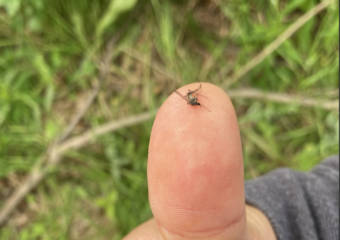
An Anchorage mosquito that did not survive the process of natural selection. (Nat Herz/Alaska’s Public Media)
As a recent transplant to Talkeetna, KTNA reporter Nell Salzman found herself shocked and annoyed by the swarms of mosquitoes. So she called up entomologist Derek Sikes at the University of Alaska Fairbanks to learn more about them.
“Mosquitoes could be considered to be these very fancy machines for turning blood into more mosquitoes,” he said.
The purpose of mosquitoes is to make more mosquitoes. And they’re really good at it.
There are 30 mosquito species in Alaska. There are 20 in Interior Alaska, though in any one place you won’t see more than ten. Most are in the Aedes genus.
“They are faster flying, much more numerous, far quicker to bite,” Sikes said.
They winter as eggs in water. The eggs hatch in the spring, and then the larvae feed in the water, pupate and emerge as adults in May.
Then have two things in mind: they want to mate, then feed. All mosquitoes that drink blood are female. Males, alternatively, feed off nectar.
“But the females only get the blood to make eggs, in order to provide food for their offspring,” Sikes said.
Carbon dioxide stimulates the female to start host-seeking. They buzz around our heads because that’s where we expel the most CO2. All summer, they’re busy biting.
“Once we start getting below freezing temperatures at nighttime, which happens sometime in September usually, then the mosquitoes start disappearing,” Sikes said.
This explains why the ends of most Alaskan summers are mosquito-free.
Sikes says populations of mosquito species are shifting.
“This one that’s moving north, this is the species Culex tarsalis. It’s moving north probably because of warming temperatures. And so we do expect, globally, species to expand their ranges northward, and so we could start seeing disease transmission in areas that don’t have it right now,” he said.
Culex tarsalis transmits diseases like norovirus. Sikes would not be surprised if, by the end of this century, it became thoroughly established in places like Alaska.
But in the long term, warming trends could lead to a decrease in mosquito populations. Sikes says that permafrost in northern Alaska is shrinking. Permafrost keeps water from evaporating and helps maintain breeding grounds.
“There is going to be less standing water, and that will probably affect the mosquito populations,” he said. “I mean, if we fast-forward 200 years, 300 years in the future and there’s no permafrost in Alaska, I imagine there will be a lot fewer mosquitoes.”
Sikes says it’s hard to predict whether there will be a lot of mosquitos in a given summer, but there are four big factors in play: “Water, temperature, predators and competitors.”
A bad mosquito year happens when all those variables line up in the mosquitoes’ favor.
But Sikes says entomologists haven’t been able to find strong patterns between rainfall and mosquito abundance. There is the general rule that a wetter year leads to more mosquitoes, but there are exceptions.
“Mosquito abundance can be higher after a drought year,” he said.
A recent study found that drought will empty out a lot of temporary water bodies, killing other insects — the mosquitoes’ predators and competitors.
“The year following, when the rain fills up those water bodies, the mosquitoes are able to colonize them and breed in a mostly predator-free environment. So their populations can get huge,” he said.
Which means that this summer’s drought doesn’t bode well for next year’s mosquito season.
Sikes says this is why spraying for mosquitoes isn’t a good idea. It’s similar to the “drought-year” effect. It kills all their competitors and predators.
I asked Sikes about a mosquito-specific insecticide. What if we could get rid of just the mosquitoes?
“Mosquitoes transmit so many diseases among wildlife and drink so much blood that,” Sikes said. “It would probably be for the net benefit of humanity, even if there were some small ecological consequences.”
Sikes says it probably wouldn’t be a major problem if mosquitoes disappeared completely.
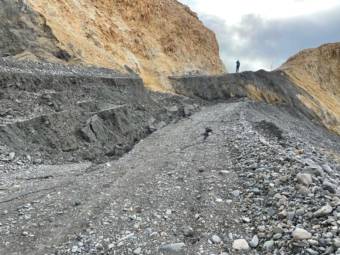
A Sept. 16, 2021 photo of the eastern side of the Pretty Rocks landslide. The displacement of approximately 14 vertical feet occurred over two weeks following the end of maintenance and road use on Sept. 2, 2021. (NPS Photo)
The National Park Service is moving forward with a plan to fix a part of the road in Denali National Park and Preserve that has been made impassable by an accelerating landslide.
The plan, which was approved earlier this week, involves building a bridge across the Pretty Rocks landslide, more than forty miles along the Park Road. Twenty-five million dollars in funding for the project comes from the federal infrastructure bill that passed late last year.
Time lapse of the Pretty Rocks slump, from July 21 to August 25, 2021. In this time, the road displacement was about 21 feet. (NPS Geology Team)
The Pretty Rocks landslide has caused increased road maintenance issues and safety concerns in recent years. The landslide has been speeding up, meaning the methods that worked to keep the road passable in the past are no longer working.
Construction on the project is expected to begin this year, and the National Park Service says the work will be done on an accelerated timeline. Until that work is complete, the western parts of Denali National Park will not be accessible by road.
Visitors this summer will still be able to see part of the park via the road, however. Denali National Park plans to keep the first forty-three miles of the road open.
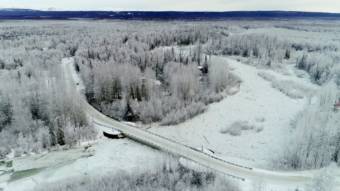
Deneki Bridge across Willow Creek surrounded by ice Dec. 22, 2019. (Photo by Stefan Hinman/Matanuska-Susitna Borough)
A bill to move the state capital to the Northern Susitna Valley was introduced on Wednesday.
House Bill 311 is sponsored by Reps. Christopher Kurka and David Eastman, both Republicans who represent Wasilla in the Matanuska-Susitna Borough. Willow is also in the Mat-Su, north of Anchorage.
In addition to a provision that crosses out Juneau and replaces it with Willow in state statute, the bill would also repeal existing requirements for moving the capital. Currently, voters must approve moving the capital as well as approve spending the funds necessary to do so. In addition, current state statute requires that any move of the capital be narrowed down to a short list of possible sites by a commission. That new site must then be approved by voters.
This is not the first time moving the capital from Juneau to Willow has been considered. In 1974, Alaska voters approved a measure to move the capital out of Southeast and onto the road system. In 1976, Alaskans voted for Willow as the new capital over Larson Lake and Mount Yenlo.
In 1982, though, a ballot initiative to pay for that move failed. The cost of moving the capital was estimated at more than 2.8 billion dollars in 1982, more than eight billion dollars today.
House Bill 311 received four committee referrals, giving it an uphill journey to make it to the House floor for a final vote.
Correction: Due to an editing error, an earlier version of this story incorrectly described the areas Reps. Christopher Kurka and David Eastman represent in the state Legislature. They represent Wasilla.
The Pretty Rocks landslide on Sept. 16, 2021. The displacement of approximately 14 vertical feet seen below the person standing on the stable road surface (for scale) occurred over two weeks following the cessation of maintenance and road use on September 2, 2021. (NPS photo)
Twenty-five million dollars have been set aside for repair work to address landslide issues with the Park Road in Denali National Park and Preserve.
An area known as Pretty Rocks, about forty-five miles in on the Park Road, has seen an accelerating landslide in recent years. By last summer, shifting earth was causing the road to move more than half an inch per day.
Park officials have tried to keep up with maintaining the road. In 2019, there were a few short-term closures for maintenance. In 2020, the road was able to stay open all season. But in 2020, the deteriorating situation led the National Park Service to close the road in late August for the remainder of the season.
Last fall, the Park Service set up a page detailing the issues at Pretty Rocks. That page says climate change is a likely contributor to the current problems, and continued use of the Park Road west of Pretty Rocks would require new, more expensive methods.
Now the National Park Service is looking at building a bridge over the landslide.
On Thursday, U.S. Secretary of the Interior Deb Haaland announced that $25 million from the recently passed bipartisan infrastructure bill will be used to make the needed changes. All three members of Alaska’s congressional delegation applauded the funds being dedicated to Denali National Park.
Before bridge construction can begin, the project must go through an environmental assessment process. That assessment allows for a public comment period, which is open until Feb. 13.
Close
Update notification options
Subscribe to notifications
Subscribe
Get notifications about news related to the topics you care about. You can unsubscribe anytime.