KTNA is our partner station in Talkeetna. KTOO collaborates with partners across the state to cover important news and to share stories with our audiences.
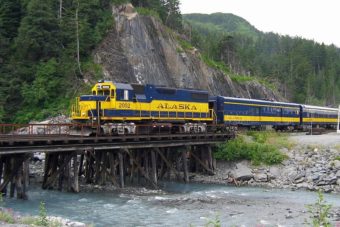
The Alaska Railroad passenger train in Whittier, Alaska. (Photo by Ron Reiring/Wikimedia Commons)
The Alaska Railroad is planning to run more passenger trains this summer than in 2020, but not as many as in recent, pre-pandemic years.
The railroad announced its new schedule on Thursday. Tim Sullivan, the railroad’s director of external affairs, says the new plan will mean twice as many Denali Star trains as last summer. The Denali Star goes all the way to Fairbanks.
“As opposed to four trains a week, we’re going to be moving eight trains a week, which means we’ll be going one direction–either northbound or southbound between Anchorage and Fairbanks–every day, and we’ll be moving two trains on Sundays, one northbound and one southbound.”
Sullivan says the railroad built the schedule with the needs of communities like Talkeetna, which rely in part on train passengers for seasonal tourism, in mind.
In addition to helping drive the economic engine for the larger communities, the Alaska Railroad still provides the easiest means of resupply for many area residents up the tracks, via the Hurricane Turn flagstop service. Sullivan says that service will be tied to the Denali Star again this year.
“Just like we did last year, the Hurricane Turn will be run in conjunction with the Denali Star, so we’ll have one direction service six days a week, and on Sunday it’ll go both directions,” Sullivan said.
While there will be two-way service for the Hurricane Turn train on Sundays, Sullivan clarifies that it is not technically round-trip service because the train will go all the way to Fairbanks and then another train will come south.
Sullivan says the Alaska Railroad continues to monitor conditions with the pandemic as well as anticipated travel demand this summer, and that the current schedule could change if needed.
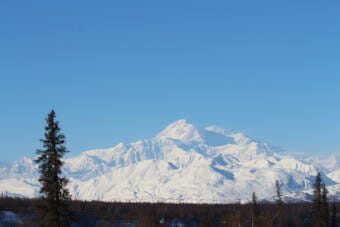
Denali in Feb. 2021 (Lex Treinen/Alaska Public Media)
For the first time in seventy years, nobody climbed Denali last year. The season was canceled due to COVID-19. Now the climbing season is returning, along with its boost to businesses in the Northern Susitna Valley.
Maureen Gualtieri, a public information officer for Denali National Park and Preserve, said the National Park Service is going into this climbing season with more information about COVID-19 than last year.
“We have better information on transmission, on prevention … We have better treatments, we’ve got more testing, more access to PPE for ourselves and our climbers, and of course, the potential game-changer of vaccines becoming more prevalent,” she said.
On average, the National Park Service expects around 1,200 climbers per year to attempt to summit Denali. The number is expected to be smaller this year, and Gualtieri said the distribution of where climbers are coming from is also expected to change.
“We would expect — and have seen — a decline in foreign registrations. That said, we expect a bit of an uptick in domestic climbers.”
Part of that anticipated increase in domestic climbers comes from Americans who might otherwise consider traveling abroad for mountaineering trips. With the fluid nature of travel restrictions, it’s likely to be easier to come to Alaska than to travel to another country.
Many of the climbers who come to Denali each year do so with a guide service. Alaska Mountaineering School in Talkeetna took a big hit last year when expeditions to the highest peak in North America were taken off the menu.
This year, the company is looking forward to resuming their Denali trips, but taking extra precautions. Caitlin Palmer, a managing partner at AMS, said COVID-19 prevention measures begin before climbers even come to Alaska.
“We had — already had — at AMS an internal rule/guideline for everybody that’s coming in: Have a negative COVID test seventy-two hours before their flight to Alaska,” she said.
In high-elevation environments, a respiratory disease has the potential to be particularly dangerous. Even under normal circumstances, conditions like high-altitude pulmonary edemas are a real concern for climbers and guides. Palmer said a few days in Talkeetna before a guided trip and a rapid test before departure gives extra time to make sure a climber has not contracted COVID-19.
“Those climbers come a few days ahead of time … to Talkeetna just for jet lag, do to some prep … with us at headquarters. So there will be a few days that they’re off their flight and in Talkeetna,” she said.
In addition to climber safety, keeping guides and mountaineering rangers safe is also a priority for Talkeetna’s mountaineering community. One way to do that is through vaccination. Mountaineering rangers are medical first-responders, which puts them high on the priority list to receive a vaccine. The National Park Service intends to limit the number of volunteers accompanying ranger patrols and largely limit them to medical professionals who also get early vaccine access.
Palmer hopes mountain guides may also be able to get higher-priority vaccinations for COVID-19.
“All the guides from all the different guide services get called upon by the rangers to help with rescues,” she said.
For climbers, rangers and guides, the commercial airliner to Alaska isn’t the only flight they’ll take. Air taxis in Talkeetna provide the main means of transportation to and from Denali’s base camp.
Courtney Schaeffer, the office manager for Talkeetna Air Taxi, said the business is following strict guidelines to protect staff and passengers including regular disinfecting, social distancing where possible, and requiring masks.
“Their whole experience with us is masked, from their check-in process in the office to their safety briefing to their actual flight,” she said.
Despite all the precautions, some climbers may develop COVID-19 symptoms on Denali. Caitlin Palmer said if that happens with one of Alaska Mountaineering School’s groups, the procedure is much like for any other serious respiratory issue.
“If you have some signs and symptoms that indicate [COVID-19], then descent is the option,” she said.
Despite the concern, most guides and park officials are optimistic for climbing season this year, which could mark the beginning of a return to normal for businesses and residents in the Talkeetna area.
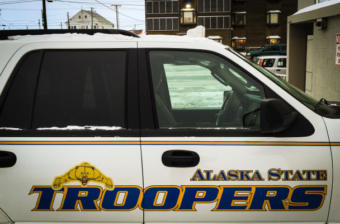
An Alaska State Trooper cruiser. (Matthew Smith/KNOM)
Updated Post — Dec. 1, 2020 4:30 PM
A Mat-Su teenager has been charged with killing his aunt and three cousins in Palmer and Wasilla Monday.
On Tuesday afternoon, 18-year-old Malachi Maxon was charged with multiple counts of first-degree murder, as well as one count of attempted murder and trying to escape from law enforcement.
Alaska State Troopers responded to the first shooting shortly after 3:00 a.m. on Monday. A Trooper affidavit says 18-year-old Cody Roehl, Maxon’s cousin, had been shot at a home near Wasilla, but was still alive when Troopers arrived. The affidavit says Maxon was at the home earlier in the evening, and that there had been no verbal or physical altercations while he was there. Roehl was taken to the hospital, where he died of his injuries.
A white Jeep Liberty and a Glock pistol were reported missing from the scene of the shooting, and video surveillance of the home shows the jeep leaving a few minutes after 3:00 a.m.
According to the affidavit, Troopers discovered that Maxon was under pre-trial electronic monitoring for a domestic violence charge. He had been released from jail a week prior to the shootings. Troopers determined Maxon was at a residence on North Valley Way in Palmer just after 3:30 am. Around that same time, Palmer Police Department received multiple calls reporting gunshots in the area.
While searching the home in Palmer, law enforcement officers found that three more people had been shot. Maxon’s aunt, 43-year-old Kimora Buster, as well as his cousins, 7-year-old Ellison Buster and 10-year-old Sienna Buster died from their injuries. A third child was also at the home, but was uninjured. Troopers say evidence at the scene indicates Maxon attempted to shoot the third child, but was unsuccessful.
Troopers, along with Wasilla and Anchorage Police later stopped Maxon on the Glenn Highway, and he was arrested without incident. While being transported, the Trooper affidavit states Maxon attempted to escape by running to nearby trees. The affidavit says Maxon attempted to pull a Trooper’s gun from its holster, but was unsuccessful. Maxon was restrained and taken to the Mat-Su Pretrial Facility.
Original Post — Nov. 30, 2020
Alaska State Troopers have arrested a suspect in the shooting deaths of four family members, including two children, in the Mat-Su Borough.
The suspect has yet to be identified, but Troopers said in a report Monday afternoon that he is male and is related to all four victims.
The first shooting reportedly occurred shortly after 3:00 am in Knik-Fairview near Wasilla. After receiving a report of gunshots, Troopers found Cody Roehl, 18, dead at the scene. Others present at the home gave a description of the shooter and his vehicle, a white Jeep Patriot.
Just over half an hour later, Palmer Police received a report of a disturbance and gunshots at a residence on North Valley Way. Police investigated and found the remains of Kimora Buster, 43, Ellison Buster, 7, and Sienna Buster, 10, at the scene. One unidentified child in the home was uninjured.
Just after 4:00 am, Troopers pulled over a white Jeep Patriot on the Glenn Highway that matched the description from the first shooting. They arrested the driver without incident.
In Monday afternoon’s update, Troopers said the suspect will be identified once formal charges are filed.
This story has been updated.
Close
Update notification options
Subscribe to notifications
Subscribe
Get notifications about news related to the topics you care about. You can unsubscribe anytime.