KTNA is our partner station in Talkeetna. KTOO collaborates with partners across the state to cover important news and to share stories with our audiences.
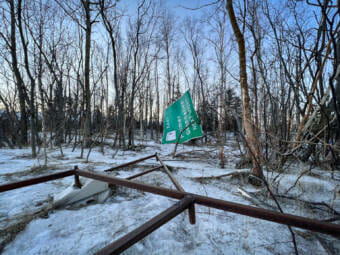
High winds in Palmer blew over an exit sign off the Glenn Highway. Colony Middle School in Palmer suffered significant damage to its roof. (Matthew Faubion/Alaska Public Media)
Schools in the Mat-Su suffered significant damage from the New Year’s windstorm and associated power outages.
All schools in the Matanuska-Susitna District are back in session this week following the multi-day windstorm that ripped through the area last week. But according to Superintendent Dr. Randy Trani, multiple schools in the lower valley incurred major damage — mostly in the form of broken windows, frozen pipes and damaged roofs.
Trani says fire suppression systems were also hit hard, and some schools experienced significant flooding. To help with the extensive repairs, the borough even went outside the school system for help.
“Our facilities folks have been, and still are, working around the clock. Over the weekend we employed twelve plumbers to try to get things up and running. We have one plumber on staff, so a twelve-fold increase,” he said. “There is a lot of damage in a lot of different places.”
On Jan. 3, Gov. Mike Dunleavy officially declared the Mat-Su Borough a disaster area. That designation will open avenues for state assistance to help the school district pay for repairs that insurance doesn’t cover.
Colony Middle School in Palmer and Wasilla Middle School are suspected to have suffered significant roof damage, though the extent of that damage is still unknown. Continued high winds have prevented the district from fully assessing the situation.
According to Trani, the northern schools in the district did not suffer any material damage.
Recently, Anchorage Daily News reporter Zachariah Hughes wrote a story about a proposal by Governor Mike Dunleavy to provide additional hunting opportunities in the Mat-Su by bringing in Sitka black-tailed deer. A state document obtained by ADN points out a number of potential issues with that plan.
KTNA’s Phillip Manning spoke with Zachariah Hughes about the story.
Listen Here:
This transcript has been edited lightly for length and clarity.
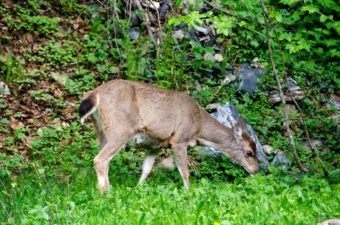
Zachariah Hughes: So it’s pretty common for the Alaska Department of Fish and Game to transplant animals. Currently, there’s a proposal to move Sitka black tailed deer into areas of the madness consistent valleys. And staff biologists wrote up a scoping document outlining, you know, what that might look like and some of the potential problems that it might bring. And I should say, there have been plenty of successful transplants all over the state, and Sitka black tailed deer are some of the earliest translocated species in the state. A lot of the places that they appear now like Prince William Sound, and Kodiak, those were transplanted colonies.
Phillip Manning: So the idea here is to establish a large enough stable population that they could be hunted by Alaskans for food. What does Fish and Game have to say about the feasibility of that?
Zachariah Hughes: This scoping document from the state — which initially the Department of Fish and Game would not release through a public records request — we obtained, and it painted a pretty bleak picture of the prospects for relocating deer there.
Phillip Manning: When I read your article, one of the first things that occurred to me is how much colder parts of the Mat-Su can be than Southeast where these deer originate.
Zachariah Hughes: Yeah, and that’s actually one of the big topics of discussion in the scoping document among the biologists. Deer do survive in Alaska, certainly, and in some pretty cold places. But a lot of the factors that allow them to survive in colder years are kind of absent from that area of the Matanuska-Susitna Valley. The cold really is the biggest problem, along with the snow. In Kodiak, they’ve been observed eating kelp off the beach, which helps to keep them from starving. There’s one sort of dry line in the scoping document that I thought was kind of funny, which is there is no kelp in the Matanuska and Susitna Valleys — or very little of it.
Phillip Manning: So I should clarify to where exactly in the Mat-Su is this potential relocation being looked at?
Zachariah Hughes: Mostly areas around Palmer and Wasilla: the Knik area. The Palmer Hay Flats were considered but mostly the lower part of the borough.
Phillip Manning: Okay, so you’ve laid out some of the concerns that the biologists had for why the deer population might not be able to be established. But there’s also some pretty strong implications in there that even if it were to be established successfully, that there could be some potential problems associated with that. Can you go into that a little bit?
Zachariah Hughes: Yeah, one of the interesting things about this report is it paints not just a pretty bleak picture of what the deer survival prospects are. But it then paints a very, in some ways, even bleaker picture, should they survive and thrive. The new problems that would be created — and some of those are minor nuisances, like deer eating flowers and gardens out of people’s private property. Some of them are pretty major — the potential for roadkill. Deer, like moose, are most active around dawn and dusk, which makes it really hard to see them on the road. This is an area where already there’s around 300 moose vs. vehicle collisions a year. And then the potential for deer to be vectors for parasite and disease transmission.
Phillip Manning: One of the other things that you pointed out in the article was the potential for competition between imported deer and the current moose population for browse.
Zachariah Hughes: There’s plenty of forage out throughout the Valley. It’s a very verdant and productive landscape, but it’s particularly in heavy snow years when you know, snow is burying willows, shrubs, alders, sources of forage for ungulates, it gets very scarce and the the suggestion in the report is not that deer wouldn’t do well, nine months out of the year, it’s that there’s, you know, those three winter months through November, December through about February.
Phillip Manning: So we should mention one other thing that you bring up in the article, is that this is still a very early stages document. And there’s not — the wheels haven’t really started moving all that much on actually trying to do something like this.
Zachariah Hughes: Yes, the scoping document, as one policy advisor told me and as quoted in the story — this is very, very, very early in the process. So this is could easily just be a 13-page document that lives on a shelf and collects dust somewhere. I thought it was interesting. I thought it was a novel proposal. The other thing that interested me about this is if it’s the start of a public process, then the public ought to know about it.
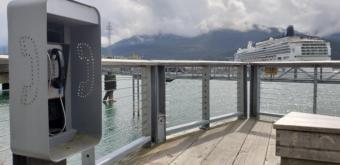
A public phone in Juneau on Aug. 15, 2019. (Jeremy Hsieh/KTOO)
Lately, many Alaskans have been hearing this message before their phone calls go through:
Please be aware that mandatory ten-digit dialing begins Oct. 24. From that date on, you will be required by FCC directive to use an area code when dialing, even for local calls.
The reason for the change is over a year old but is just now coming into effect.
Last June, the Federal Communication Commission adopted an order to designate 988 as an abbreviated dialing method for the National Suicide Prevention Lifeline. That means any area code that uses 988 as a prefix for dialing — the prefix is the first three digits of a seven-digit phone number — will have to switch to dialing the area code as well.
Multiple three-digit codes already exist, like 911, 511, and 411. But unlike 988, those codes were not already in use as prefixes in Alaska.
In addition to manually dialing area codes, people may need to change settings on devices like telemedicine monitors, fire alarms and voicemail services so they’ll keep working after the change on Oct. 24.
The Regulatory Commission of Alaska states on its website that no phone numbers will be changed because of the new rules, and what counts as a local versus long-distance call will remain the same.
The National Suicide Prevention Lifeline’s existing number of 1-800-273-TALK will continue to function after Oct. 24.
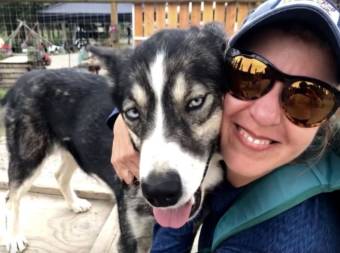
Emily LaPorte and Pika. (Courtesy of Emily LaPorte)
As a seasonal worker spending the summer at Denali National Park, Emily LaPorte says she’s found it difficult to have a pet. But after answering an advertisement to be a part-time companion to a sled dog, Emily says she’s found a new friend.
Denali National Park and Preserve is home to the only working sled dog kennel in the entire National Park Service. Dogs have played a key role in Denali since 1922, when the park’s kennel was first established.
Dogs are used in the winter to help haul supplies for building projects. They’re also used to help scientists with research projects. They help monitor wildlife and patrol for poachers.
But in the summer, when there’s no snow, the dogs still need training and exercise.
“I am a volunteer dog walker,” LaPorte says. “We have 26 Alaskan huskies, and in the summertime, because they’re not running the sleds, the Park Service has paired either NPS employees or people who live around the community with a particular dog.”
Emily’s dog is a two-year-old female named Pika. Emily describes how she takes Pika for walks along the road.
“It’s kind of like a skijor setup,” she says. “So it’s a padded, thick waistband that has a clip. And then the leash comes out from that, so it’s kind of a hands-free system. I don’t know what she’s like in action on the sled, but when we’re walking, she’s really well behaved, and she doesn’t pull.”
Emily explains that it’s not just exercise that she’s giving Pika.
“One of the big things is to bond with the dog,” she says. “They want one person to be paired up with a particular dog so that you get a relationship with that dog, and the dog gets to know you and is comfortable with you. Of course they would switch things out if it wasn’t a good match.”
Denali National Park has its own breeding program, and puppies are born right there at the kennel. According to the Park Service, the puppies run free beside the dog teams their first year, learning the routes and the terrain. They then learn to pull by skijoring.
When the dogs turn two, they begin to pull light loads until they are ready to take their place on one of the teams.
Next year the dog program will celebrate its centennial, marking 100 years of using dogs in the park.
Emily explains why the dogs are used for projects instead of more modern machinery.
“This stuff can be done with helicopters or airplanes or snow machines,” she says. “The park really has put a lot of effort into preserving and maintaining the wilderness culture of the park and wanting it to be done in a traditional way, in a way that is the least impactful on the environment.”
But dogs are also often more reliable than machines, when confronted with overflow or in temperatures of forty degrees below zero.
“That intuitiveness, that intelligence the dogs have, isn’t something that can be replaced by a snow machine,” LaPorte said. “Also to keep them out of danger, to let them know if there was a dangerous animal around, if there were cliffs and crevasses. I mean, all the things the dogs could sense that helped protect the mushers.”
Emily looks forward to her walks with Pika, and she’s pretty sure the feeling is mutual.
“I also brush my dog, so I think that she recognizes me. I’d like to think that she’s excited I’m coming,” she said.
Emily doesn’t know if she’ll be in Denali next summer. But if she is, she’s planning to participate in the dog program again.
“I would definitely do it again, and I would of course request Pika,” she said.
Although it’s easy to believe that technology is always the better way, Denali National Park is demonstrating that sometimes, what we did 100 years ago is still worth doing.
In 2020, COVID-19 shook up Talkeetna’s economy. Businesses shut down early in the year and saw only a partial reopening over the summer. This year, things may look like they’re getting back to normal — but it’s not at all business as usual.
The streets of Talkeetna have been full this summer. In a typical year, most visitors would arrive in Alaska on cruise ships or by traveling through Canada in an RV. But this year the cruise industry is a fraction of its normal size, and the Canadian border is still closed to tourists.
Still, Anita Golton of Flying Squirrel Bakery says business is even higher than before the pandemic.
“It’s very busy. I would say much busier that anybody expected,” she said. “I haven’t had time to really look at the numbers, but maybe 25% busier than two summers ago, before COVID.”
She’s noticed a difference in the clientele this year.
“Flying Squirrel is kind of geared toward independent travelers, and in a normal summer most of them would be on buses or coming off the train. This year everyone is an independent traveler. Maybe 90% of the travelers coming to Talkeetna are coming in a rental car,” she said.
Normally, an increase in customers would be great news. But Golton says there haven’t been enough workers to meet the increased demand. She says she’s not the only restaurant with this problem.
“I see all of the restaurants adapting and doing their best to make it work,” she said. “Most businesses have decided to close one day a week or open an hour later or some adaptation that makes it work for their business, so that the staff that they do have is healthy and happy and able to keep this going for another two months.”
The sign that welcomes visitors to Talkeetna. (Colleen Love/KTNA)
DeAnn Autrey, a local realtor, says the housing market has been brisk, too. But that’s not necessarily good news for local businesses and seasonal workers.
“Our listings here in Talkeetna are up 40%. Our sales are way up too. We are up 52% over last year,” she said. “I think a lot of people that were maybe living in Anchorage full time, and both husband and wife maybe working full time, have kind of re-evaluated their lives and they like what Talkeetna has to offer.”
And it’s not just folks from Anchorage buying Talkeetna homes.
“We’re definitely seeing an influx of out-of-state people moving up to Alaska,” Autrey said. “I currently have nine pending sales and out of those nine, three of them are from the lower forty-eight.”
According to Autrey, not all the buyers have plans to move in, which means fewer long-term rentals and fewer housing options for local workers.
“They’re looking for homes that they can Airbnb when they’re not using them,” she said. “Then when they want to come up and use them, they will just plot those dates for themselves.”
Sarah Stevens, director of Sunshine Station Childcare, says she’s having a hard time finding workers, too.
“It kind of went back to business as usual except that we don’t really have any employees,” she said.
Stevens says most of her staff left during the pandemic. She’s trying to juggle keeping the center open with limited staff.
“People need childcare, but I’m having to turn parents and kids away to stay in ratio because I can’t staff it,” she said.
The state mandates a minimum staff-to-child ratio, so without daycare workers, Stevens can only accept a limited number of children. But she also feels the lack of international workers is causing a ripple effect for people who need to fill positions.
“I definitely think we don’t have as many seasonal people as we normally do,” she said. “There aren’t any visas this year, and so the lodge is taking up a lot of the local people. And now everybody’s just trying to work seven jobs.”
The J-1 Visa is a cultural, international exchange program. Hotels and restaurants often participate by bringing in workers from other countries, providing temporary housing and employment.
In June 2020, former President Donald Trump placed restrictions on the J-1 program. Those restrictions expired on April 1st, but the program has been struggling to catch up and process the visas. On April 30th, the U.S. state department released a tier structure for prioritizing visa processing. The J-1 employment visa was in the bottom tier.
At Talkeetna restaurants, wait times for food are longer with smaller staffs. Golton says customers are responding with patience.
“I think a lot of people come from bigger cities where they’re used to waiting in line for things,” she said. “We’re used to something kind of different in Talkeetna, where lines seem out of the ordinary. But overall, people have been very, very patient and grateful that we’re open. And if you smile at them, they smile back.”
Tourist season will be winding down soon. It’s an open question whether the economic changes brought by the pandemic will last.
One thing that Talkeetna residents can count on is winter. Winter means time to rejuvenate and prepare for whatever might happen next.
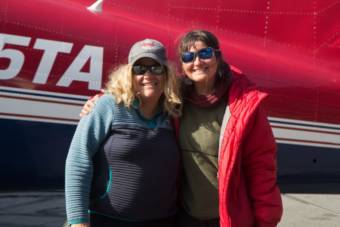
Lisa Roderick (l) and Gabby Faurot at Talkeetna State Airport. (Colleen Coulon Love/KTNA)
The Kahiltna base camp was disassembled last week, signaling the end of the 2021 climbing season on Denali.
Kahiltna is the name of the glacier where climbers begin and end their climbs. Teams are flown to the glacier by one of the local air services based in Talkeetna. There, climbers get checked into base camp by someone who, for three months, works and lives on the glacier.
This year, longtime base camp manager Lisa Roderick alternated managing the camp with new assistant Gabby Faurot. Faurot grew up around Denali, climbing and camping in the Alaska Range with her father, Chip.
Longtime base camp manager Lisa Roderick outside her tent in 2018. (Katie Writer/KTNA)
During the height of climbing season, base camp managers might have one hundred climbers at a time who are anxious to fly back to Talkeetna for a shower and a hot meal. During those weeks, keeping an orderly cue for flights out of the range is an important task for the base camp Manager.
“I kind of struggle with being assertive and this is a job that you have to be assertive,” Faurot said. “People came up and they’re in my face about wanting to leave, and I had to just lay it on the line. Like, ‘Hey, you can’t get out right now. No one’s going to fly in to pick you up because the weather’s bad.’”
She says she learned some tricks for curing climbers’ frustrations.
“One time I played frisbee with some people and that got them a little loosened up, they were a little bit happier, but the lemonade really does the trick. Just give them a glass of lemonade, sit down, ask them how their trip went,” she said.
Base camp is funded through the Air Association of Talkeetna. K2 Aviation and Talkeetna Air Taxi each collect a small fee from the clients they fly in to climb Denali. The air taxis then send that money to the Air Association, which pays the expenses for base camp.
Faurot described some of the tasks she performs on the glacier.
“I talk to the pilots, let them know what the weather is looking like, talk to the climbers, introduce them to base camp, gave them their gas, got them on their planes when they came back,” she said. “You have a record of all the people, their permit number, their team name, how much fuel they paid for, what kind of communication they have and their routes — and then their projected out date so we can kind of keep tabs on that.”
One of the most important aspects of the job is communicating the weather to the air taxis so they can fly climbers in and out of the range. Faurot finds she developed some pretty good forecasting skills.
“It’s all about patterns out there,” she said. “Especially with the fog, you would notice when the breaks would come in and when it would start to clear, and then I was able to pay more attention to the wind patterns, and if I felt a certain type of wind, I would know that hey, maybe it’s going to clear out in like fifteen minutes.”
As with any new job, sometimes it’s difficult to know what is most essential. And it’s crucial to have a good support system when you find you don’t have what you need.
“I need so much Chapstick,” Faurot said. “My lips get really dry out there. It’s so sunny. I had to have a plane fly a tube in at one point cause my lips started to split the first week, or the first two weeks I was out there. And the gals over at Spinach Bread would send me a burrito every once in a while and that was really, really nice.”
By early July, the snow on Denali softens and makes travel difficult for the mountaineers. Climbers typically aim to finish their expeditions before that happens. Faurot explains what drives the decision to pack up base camp for the season.
“It’s the deterioration of the glacier. Crevasses are starting to open up a lot more than they were in the beginning of the season. It’s not freezing as much overnight. That is not super conducive to safe glacier travel, because snow on top of crevasses is really soft so you don’t have strong enough ice bridges,” she said.
Right now, there aren’t many climbers left on the mountain. Since the teams carry “In-Reach” devices, the remaining climbers will be able to text the air services directly and may well be the lone clients on the Kahiltna Glacier awaiting pick-up when their plane arrives.
Faurot looks forward to returning next year. Despite the remoteness of her job, she came away with a deep reverence for the Alaska Range.
“There’s this poem, it’s about appreciating the mountainside versus the summit,” she said. “It’s not all about go, go, go, get to the top, that’s the only thing that matters. It’s about looking down at the ground, what you’re walking on, what you’re walking past, and you appreciate everything that it takes to get to the summit.”
And you can be sure some of that appreciation is held for people like Faurot, working from her office on the Kahiltna Glacier.
Close
Update notification options
Subscribe to notifications
Subscribe
Get notifications about news related to the topics you care about. You can unsubscribe anytime.