KTNA - Talkeetna

KTNA is our partner station in Talkeetna. KTOO collaborates with partners across the state to cover important news and to share stories with our audiences.
Park Service rangers describe troubling conduct as hundreds of climbers attempt Denali

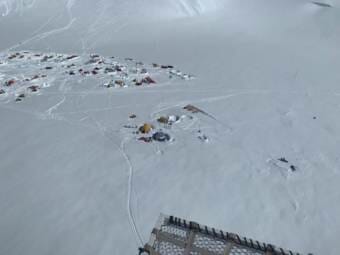
Aerial view of the 14,200-foot camp on Denali during on a routine helicopter resupply on Saturday, June 5, 2021. (NPS Photo/Joe Reichert)

Denali climbing season is back after being called off due to the pandemic last year, but it has come with a higher rate of accidents and medical issues on the mountain. In the first month of climbing season, there have been more search and rescue calls than in some entire years.

Park Service rangers identified a number of concerns in a blog post on the Denali National Park website titled “Troubling Trends.” In the post, they cite several problems including inadequate experience, attempting to summit too quickly, and not fully appreciating the difficulty of climbing Denali.

South District Ranger Tucker Chenoweth’s job involves overseeing ranger patrols, and he has years of experience in search and rescue. He said Denali, even along the popular West Buttress route, brings several unique challenges.

“The West Buttress is not easy,” Chenoweth said. “Technically it’s not hard, but then you factor in the remoteness, and you also factor in the altitude, then … the West Buttress becomes a serious endeavor.”

As of Wednesday, no fatalities had been reported on Denali, but there have been severe accidents, including a 1,000 foot fall high on the mountain that left Canadian climber Adam Rawski in critical condition. There have also been many reported cases of high-altitude pulmonary edema reported — fluid in the lungs — which can happen when climbers ascend too quickly.

Climbers ascend fixed lines on the headwall of the West Buttress route on Sunday, May 30, 2021. (NPS Photo/Erickson)

Chenoweth said the popularity of the West Buttress Route can make it easy to forget the remoteness of Denali. For a significant portion of this climbing season, there have been more than 400 people on the mountain at once. Even then, Chenoweth said the hundreds of people and mutual support that they can provide can suddenly vanish.

“All of a sudden that wilderness component where you’re the only team — or maybe it’s summit day and you’re really late in the evening and everyone else is already down below you. You’re so far out there at that point that the remoteness — it may be the first time you feel it,” he said.

Chenoweth said one thing that tends to lead to problems is when climbers form ad hoc climbing teams.

That can happen before a trip begins or if a climber’s partners have to turn back before making it to the summit. A common point to give up an attempt on Denali is at 14,000 feet. Chenoweth said forming a new team at that point poses additional challenges.

“Then people start looking for partners, but they don’t know them. They don’t know their technical skill. There’s no camaraderie, no teamwork. At that point, it feels like a summit-driven decision,” he said.

Chenoweth said some of the teams formed mid-expedition have met with unfortunate results, including serious injuries and fatalities in recent years.

Another trend that rangers said is a cause for concern is when climbers attempt the summit in one long push from 14,000 feet instead of resting at High Camp at 17,000 feet before a summit bid. Chenoweth said the impacts of that jump in elevation shouldn’t be underestimated.

A typical summit attempt involves leaving a lot of gear behind and moving light and fast to try to make it to the top and back in one day. If a group making a longer summit attempt encounters a problem, they may find themselves needing to rely on other teams for food or tent space.

There’s no guarantee that National Park Service rangers will be nearby or able to help when a group runs into trouble. In many cases, professional guides leading groups of paying clients step in to provide what help they can.

Caitlin Palmer, co-owner of Alaska Mountaineering School, a guide service based in Talkeetna, said her guides’ instinct is often to help whenever they can, but that can impact the group they are leading as well.

“A lot of our guides are sort of superhuman and can do some extraordinary things up there at high altitude,” she said. “But it does impact not only the patient’s life in a big way, but also the rescuers and the people the rescuers are responsible for their safety.”

Palmer said she was happy to see the National Park Service talk openly about the problems they’re seeing on Denali, and she hopes that climbers will follow the advice.

“A lot of it isn’t brand new, but it’s important for the Park Service to bring these incidences to light,” she said. “Hopefully these climbers who are not experienced enough yet will take some time to learn more skills and slow their pace down.”

As of Wednesday a bit more than a third of the expected attempts on Denali have been completed.

Colorado ski-mountaineer dies in Alaska Range crevasse fall

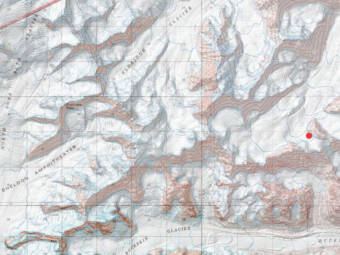
The red dot indicates the location of the fall. The summit of Denali is about 20 miles west. (NPS map)

A Colorado man has died in the Alaska Range after falling into a crevasse.

Mason Stansfield of Ouray, Colorado was ski-mountaineering with a partner when he fell into the crevasse on Monday afternoon. The pair were near the Eldridge Glacier, east of Denali.
Denali National Park spokesperson Maureen Gualtieri says the crevasse Stansfield fell into was relatively large.

“The ranger that was lowered down in the crevasse estimates he was down a hundred feet or so,” Gualtieri said. “That’s a deep, relatively wide crevasse.”

According to Gualtieri, Stansfield’s partner used a two-way satellite communication device to request help. A ranger team had been flying in the range earlier in the day, so they were already packed and ready to respond.

Gualtieri says satellite communication advancements in recent years have removed some of the guesswork from rescue operations.

“Back and forth communication about what’s going on, so we know what gear to bring. It also provides the exact location of where the accident took place, so there was no looking around,” she said.

Gualtieri says Stansfield had worked as a guide on Denali in the past, so he was familiar with glacier travel and the Alaska Range. He and his skiing partner were on a personal ten-day trip when the fall occurred.

Mason Stansfield was 28 years old. His body was recovered from the glacier Monday evening.

After last year’s cancellation, Denali’s base camp manager prepares for return of climbing season

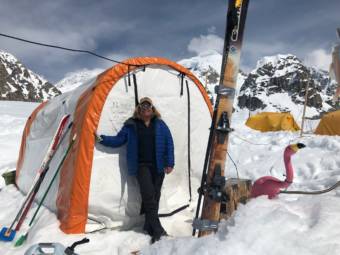
Lisa Roderick outside her tent at Denali Base Camp in 2018. (Katie Writer/KTNA)

It’s springtime in Talkeetna and while most of the town is preparing for summer, one local resident will be wearing her mittens and down clothing for a few more months.

April 2020 brought an unprecedented lockdown to most of the world.  Even the Kahiltna Glacier was silent, a remote wilderness spot where Denali Base Camp is located.  It’s a place where climbers begin their ascent of Denali.

Lisa Roderick is the manager of Denali Base Camp.  In a normal year, she spends mid-April through mid-July on the glacier, welcoming climbers and transmitting weather to pilots who shuttle climbers in and out of the camp with ski planes.

But last year, all climbing permits in Denali National Park were suspended. That meant Roderick stayed home.

“Last year, I was really shocked that climbing season was canceled, ‘cause I‘ve been going up there for 19, 20 years in a row,” she said. “But I ended up really enjoying the summer. I actually got a garden in.  My husband built me some raised beds and I grew lettuce and kale and I even tried to grow artichokes. But a moose ended up eating my one choke that I got.”

This year, the climbing season is on and Roderick will be flying into the Kahiltna Glacier on April 28.  She will set up her tent and it will be her home until early July, when snow conditions deteriorate, bringing an end to the climbing season on Denali.

But it’s not business as usual.  Roderick said there are some changes that climbers can expect when they land at Denali Base Camp.

“Couple things that might be different this year is, you know, we have to wear masks when we’re at Base Camp,” she said. “If you’re gathering around, you have to be masked up.  Of course, when you’re climbing and you’re roped up, you’re spaced out, so you won’t have to wear your mask as you’re climbing, but if you stop for a break and everybody gathers up together, then you’ll have to put your mask on.”

Although mitigations will be practiced on Denali, plans are also in place to identify and deal with possible COVID-19 infections.

“So, there’s always Park Service rangers stationed with me at base camp and they handle all the medical things.  They’re all medically trained; they’re all EMTs,” Roderick said. “If some climber starts showing symptoms of COVID, they’ll have some test kits up at 14,000 and then we’ll have some test kits at Base Camp.  They’ll be giving tests as they see necessary.  Hopefully, we’re not going to have to deal with that kind of stuff but you never know.”

Roderick and all the Denali National Park climbing rangers are fully vaccinated against COVID-19 so whatever the season brings, she said she feels prepared and ready.

“I’m definitely ready to get back up there for sure.  I’m starting to miss it a little bit. Hopefully, most of the people showing up will be vaccinated,” Roderick said.

State extends deadline to remove studded tires

Studded Tires
(Creative Commons photo by Ben McLeod)

Alaskans have two extra weeks before they have to take off their studded tires.

On Wednesday, the Alaska Department of Public Safety issued an emergency order extending the deadline in response to continued winter weather. Public Safety Commissioner Jim Cockrell cited continued icy conditions and sub-zero temperatures in parts of the state as the reason for the change.
“This extension provides drivers with an additional margin of safety on icy or snowy roads through breakup,” Cockrell said in a statement.

Areas south of latitude 60 — including Southeast Alaska — can keep their studded tires until May 1, while those living north of latitude 60 have until May 15 to change over.

Chalet guides help 5 ski to safety from planes stranded on Ruth Glacier

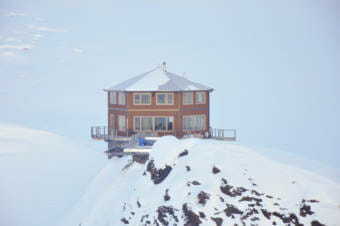
The Sheldon Chalet in the Don Sheldon Amphitheater. Guides from the Chalet provided assistance to five people stranded on the Ruth Glacier in early April 2021. (Phillip Manning/KTNA)
On Saturday, personnel from the Alaska Rescue Coordination Center, National Park Service and Alaska State Troopers received word of a group of five people who were stranded with their airplanes on the Ruth Glacier in the Alaska Range.
Maureen Gualtieri, public information officer for Denali National Park, says the five had already been on the glacier overnight when they called for help.
“They had, from my understanding, gone in for a day trip — flightseeing — in the [Alaska] Range on Friday, and weather came in quickly,” Gualtieri said. “They landed in the Ruth Gorge but were unable to safely take off due to weather.”
Gualtieri says the group was able to communicate via satellite phone to receive weather updates, but conditions didn’t improve on Saturday. With limited survival supplies, they called for help.
But the same weather that kept the stranded group on the glacier kept rescuers off it. Fortunately, the Sheldon Chalet was just a few miles away and keeps professional guides on staff. Gualtieri says they were able to ski out to the stranded aviators.
“They didn’t need to come too far, but they brought all the necessary skis, harnesses, ropes to guide these five individuals back to safety — back to food, warmth and water,” she said.
Robert Sheldon, whose family operates the chalet, says they were in contact with the stranded group before the official call for help went out. He says there were potential windows in the weather to allow the planes to take off and leave the Alaska Range, but none of them came to be.
The Sheldon Chalet’s guides packed two sleds with extra skis and gear and made their way to the planes over the course of about three hours. The group made it to safety by about 10:00 pm on Saturday. The stranded party was put up in the original Sheldon Mountain House, just behind the luxury chalet, until they were flown out on Monday.
Robert Sheldon says snow had already gathered nearly up to the wings of the three small planes by the end of the weekend, and that local aviation experts were being consulted on how to safely retrieve them once weather allowed.
Disclosure: Sheldon Chalet, which provided assistance to the stranded aviators, is a sponsor of KTNA’s “The Blue Tarp.”

Alaskans will soon need to dial 10 digits to make in-state calls

Later this year, Alaskans will need to dial the area code when making phone calls within the state.

Recently, some telecommunication companies — including Matanuska Telephone Association — notified users that seven-digit dialing will soon be a thing of the past.

According to the Regulatory Commission of Alaska, the reason for this change is a new federal act that will designate 988 as an abbreviated number to reach the National Suicide Prevention Lifeline.

To avoid potentially having to change any phone numbers, regions that have 988 as an active prefix will have to dial the area code to make phone calls.  That includes Alaska’s 907 area code.

The changes begin to take effect on April 24 but seven-digit dialing will still work until October.

In addition to phone calls, RCA said other devices may need to be updated, including medical monitors, fire or burglar alarms, voicemail and call forwarding services, and speed dialers.

The abbreviated number for the National Suicide Prevention Lifeline takes effect next summer.  Until then, the line can be reached at 1-800-273-8255.

Site notifications
Update notification options
Subscribe to notifications