Pumpkins stacked up at Tulleys farm in Crawley, England, on Friday. The U.S. celebrates National Pumpkin Day every Oct. 26. (Dan Kitwood/Getty Images)
Happy National Pumpkin Day! There’s no time like the present to stock up on decorative gourds, carve a spooky jack-o-lantern or sip on a PSL (… at least according to the pumpkin lobby, aka Big Pumpkin, not to be confused with the Charlie Brown special).
Pumpkin spice everything has been everywhere since — literally — August. Whether you love it or hate it, you can’t deny that it’s a staple of autumn in America.
To find out why, Morning Editionspoke with Jason Fischer, a professor of psychological and brain sciences at Johns Hopkins University. His team has been researching the science behind pumpkin spice’s appeal and found that it has a lot to do with how we associate smells and flavors with fall.
“Those associations, they form year after year, they also give us this sense of familiarity,” Fischer said. “And so when you start to smell the pumpkin spice things in the stores again it gives you a little feeling of nostalgia.”
And don’t underestimate the power of the warm fuzzies.
Pumpkin spice flavoring can be so evocative that it throws people off the scent of a very important fact: It doesn’t actually contain any pumpkin.

That aroma comes from things like nutmeg, cinnamon and allspice — which is why our brains can sometimes be tricked into mistaking pumpkin spice for apple pie.
“You can take those same spices and you can put different labels on them and make the experience kind of different, because you’re calling up different sets of associations as well,” Fischer said. “And, again, that’s your brain kind of filling in the gaps.”
The associations and labels attached to a smell can determine much of how we experience it, Fischer and his team found.
For instance, if someone is handed a pumpkin spice drink in a generic cup, they may recognize the smell but not quite be able to place it. But once they know what it is, they will perceive the taste and smell even more distinctly.
If you feel like testing out their theories, today’s a great day to cozy up with a mug of something pumpkin spicey. Or, as NPR’s Rachel Martin points out, “You could also just drink a regular cup of coffee, and light a candle that smells like pine.”
Owner of Southeast Dough Company, Andrew Jylkka reads a recipe out of “The Bread Bible” before testing out a new loaf. (Tash Kimmell/KCAW)
American food writer M.F.K. Fisher once wrote that the smell of good bread baking is “indescribable in its evocation of innocence and delight.” That may seem like high praise for what’s essentially the scent of yeast and sugar, but standing in the tangy, sweet aroma of Andrew Jylkka’s bread, Fisher’s words ring true.
For Southeast Dough Company’s Jylkka, baking bread is not just an occupation but a way of connecting, especially in an age when human connection has never been more tenuous.
“I’ve been transient for a lot of my 20s. I lived in a lot of different places. And that was always how I found folks was either through the food industry or just getting people together for food,” Jylkka said. “And I found that once I started doing the bread, that happened even quicker.”
When Jylkka came to Sitka last year at the height of the pandemic, he had no plan. He’d been working as a field guide in Wrangell for Alaska Crossings, but he needed a change. He didn’t know what to expect, but he knew bread, and he knew his way around a kitchen.
His first break came when local restaurant owner Rene Trafton hire him as kitchen staff at her restaurant, Beak. Trafton introduced him to the food scene in Sitka and even let him feature some of his own recipes on the menu.
“I was working for her and then also just starting to bake out of my home,” Jylkka said. “And then I would hand loaves to people and go “Hi, I’m Andrew, here’s a loaf of bread. And that’s kind of how it started. I had a lot of folks come up to me and say, ‘Oh, are you the bread guy?’”
Jylkka’s cornmeal, orange and cranberry loaf (Tash Kimmell/KCAW)
Jylkka talks about bread with reverence, about the way it’s nourished us through the ages. He loves his bread and the people he makes it for, but if you asked him several years ago if he’d be making it professionally, he probably would have said no.
“My friend gave me a sourdough starter. And I’ve been a cook all my life but was a terrible baker. But there was something about the sourdough starter — I really enjoyed it. I started making loaves, they all came out looking like frisbees,” Jylkka said.
He didn’t always have a baker’s touch, but he persevered.
“Oh, it was joyful to get, like, my first loaf that had good consistent rise on it hadn’t blown out the side and didn’t have any weird bulges or anything,” he said. “And of course that was then followed by the, ‘How do I recreate this? How do I do it consistently?’ And I mean, that’s been that’s been the journey of the whole time. I still feel like I am learning something every single week.”
When he finally did get that perfect loaf, it didn’t take long for people to catch on. Jylkka started giving his bread out to friends at first and then dropping his loaves off at local businesses.
“I didn’t have any intention to, like, sell bread. I still had another job. But a friend who owned a little shop there tricked me into giving her some loaves for a tasting. And then the next day came to me saying something like, I need 20 loaves a week now. And that’s how Southeast Dough Company started,” Jylkka said.
Today, Jylkka moves methodically around the kitchen on the Sheldon Jackson campus, juggling trays of cranberry orange loaves and English muffins with ease. But as easy as he makes it look, the process is arduous.
Jylkka checks the internal temperature of his seasonal cornmeal, orange and cranberry loaf — a recipe inspired by his mom’s baking. (Tash Kimmell/KCAW)
Sunday afternoons, he begins the baking process by refreshing his starter, affectionately named Audrey Two. After building up the starter, he leaves it overnight. On Monday mornings, Jylkka starts mixing and shaping his dough. After letting his loaves rise for a few more hours, he’ll finally start baking on Monday night.
Jylkka often delivers his bread directly to people’s homes, something he says can take upwards of four hours. But for Jylkka, it’s all part of being Sitka’s “Bread Guy.”
“During the pandemic, people really wanted some sort of interaction and something that made them feel cared for. And I think being able to deliver bread directly to folks throughout that achieved that goal,” Jylkka said. “People were often saying that that was like some of their only social interaction that they got, which was really touching.”
For Jylkka, making bread is as much about the ratio of flour to starter as it is the intention behind it. Starting a micro bakery in a new city in the middle of a pandemic only cemented his commitment to keep community and connection at the forefront of his business.
“I think it comes down to seeing the looks on people’s faces when they would get a fresh, warm loaf of bread,” he said. “There’s something about bread in general that touches people like in their heart, not just their stomach.”
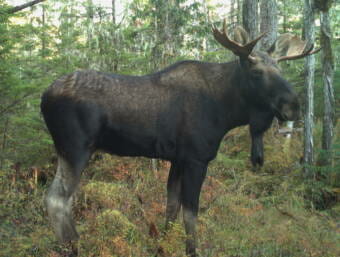
A bull moose photographed by an Alaska Department of Fish and Game game camera on Mitkof Island in 2018. (Courtesy of Dan Eacker/ADF&G)
Hunters have set a new record for the month-long moose season on the islands and mainland of central Southeast Alaska.
The season ended Friday, Oct. 15, and hunters reported killing 129 bulls around Wrangell, Kake and Petersburg. That’s two more than the previous record set in 2019.
Nearly half this year’s haul, or 61 moose, came from Kupreanof Island. Hunters reported 29 legal moose shot in the Kake area, along with another three that did not meet the state’s antler requirements. Outside of Kake, the remainder of Kupreanof produced another 26 legal bulls and three more illegals.
Nearby on Kuiu Island, hunters harvested 21. And harvest on the Stikine River near Wrangell came on strong in the late season with a total of 20 legal moose and one illegal.
Hunters also had success in mainland bays north of Petersburg. Farragut Bay had seven legal bulls and one illegal. Three were taken in Thomas Bay, three near Port Houghton and another one from elsewhere on the mainland.
There were also five shot on Wrangell Island, three legals and two illegals on Mitkof Island and one legal bull from Woewodski Island as well.
The 10 illegal moose are a little lower than average. It’s typically about 10% of the total, but this year is under 8%.
Hunters had until Wednesday, October 20 to report their kills to the Alaska Department of Fish and Game. Others who were unsuccessful or did not hunt have until Oct. 30 to turn in reports. Fish and Game issued 1,023 permits for the registration hunt this year, just short of the most recent five year average.
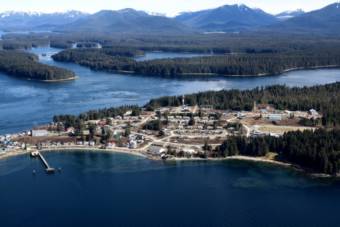
Aerial view of Angoon in 2017. The Southeast Alaska Subsistence Regional Advisory Council is recommending making lower Admiralty Island off-limits to sport hunters during deer season. (Emily Russell/KCAW)
Hunters in Juneau are pushing back on proposals that could restrict their deer hunting rights in parts of Southeast Alaska. The Southeast Alaska Subsistence Regional Advisory Council says its proposals are responding to food security concerns from villages.

Pelican deer hunter Terry Wirta testified this month to the regional subsistence council from the tiny hamlet on Chichagof Island. He says it’s been difficult for guys like him to fill his freezer.
“I don’t know, things seem to have slowed down around here, and all I hear nowadays is a lot a lot of hunters want to be coming here.” he told the council on Oct. 6. “I think the residents in Pelican should have the priority on hunting around here, I’ll tell you that much.”
He was supporting a proposal to restrict hunters coming from urban areas to hunt along Lisianski Inlet. It was one of a handful of proposals that would restrict deer hunting in areas popular with state-licensed hunters from bigger towns.
The strongest measure would be an outright closure of the southern portion of Admiralty Island to urban hunters, to give more opportunity to subsistence hunters living in nearby Angoon.
That’s where council member Albert Howard lives. He says hunters coming from Juneau have access to cheaper fuel to run their skiffs. And if they need affordable meat, there are supermarkets like Fred Meyer and Costco.
“If an Angoon resident fails at hunting, heh, I don’t know how else to say it. But they’re S-O-L,” he said last week. “And we’re people that don’t like to depend on anybody, and I don’t want to go ask anybody for help.”
These rules would apply to federal lands. Much of Southeast Alaska is in Tongass National Forest. And federal law gives priority to subsistence hunting for those living outside of the urban areas of Juneau and Ketchikan. Everywhere else in Southeast, from tiny Pelican to larger Sitka and Petersburg, is considered rural.
State and federal wildlife agencies opposed added restrictions on non-rural hunters. That’s because data shows the deer population appears healthy.
The federal Office of Subsistence Management also argued that many hunters originally from Southeast villages move to larger towns like Juneau or Anchorage. They’d be restricted when they come home to hunt with friends and family.
Juneau-based hunting group organizes opposition
More than 50 letters came in against the measures.
Territorial Sportsmen, a Juneau-based hunting and fishing organization, has lobbied hard against the proposals and encouraged its membership to chime in.
Ryan Beason is an accountant and commercial fisherman living in Juneau and the group’s president.
“We want to promote the rights to all hunters and Southeast and not limit each other,” he told CoastAlaska in an interview. “I think what these proposals are doing is creating conflict between user groups.”
The proposed restrictions on non-rural deer hunters were recommended by the council in amended form. They included urban hunters being allowed to hunt for bucks only with a reduced bag limit on areas of Chichagof Island near Hoonah and Pelican.
State tidelands would be exempt, meaning state-licensed hunters could still cruise the shorelines in their skiffs.
“The mean high-tide line is all state land,” Beason said. “So beach hunting would still be allowed.”
Regional Advisory Council Chair Don Hernandez, who lives on the northern tip of Prince of Wales Island, told CoastAlaska the council has been hearing from villagers concerned about rising costs of fuel and aging rural populations.
“There’s worry about the ability of people in these villages to get the food that they require add at a cost that they can afford,” he said.
He says he understands the wildlife agencies’ opposition. After all, on paper the deer herds are relatively healthy. But he says the regional advisory councils were set up to consider more than population surveys and the number of animals taken.
Final details of the recommendations approved earlier this month remain unclear but will be published in coming weeks after the minutes of the multi-day meeting are finalized.
That’s because the federal Office of Subsistence Management says the precise language won’t be available until a court reporter prepares a transcript of the meeting and minutes.
But those recommendations are not final. They’ll be forwarded to the Federal Subsistence Board, which in mid-April will consider whether to incorporate these in the federal hunting regulations as early as next year.
If they are adopted, it could limit deer hunting opportunities over large swathes of Southeast Alaska that had long been popular with sport hunters from larger towns.
Aims Villanueva-Alf works in her restaurant Black Moon Koven on August 5, 2021 in Juneau, Alaska. (Lyndsey Brollini/KTOO)
Juneau restaurant Black Moon Koven opened up this spring very elusively and mostly through word of mouth. Its dark, moody ambiance has drawn a cult following.
Walking in, there is a lot to take in. There are large murals painted in the shop featuring eyes, skulls and mushrooms — art by local artist Jollene Chup. Other art and decorations in the restaurant include spiderweb macramé, skeletons, tentacles, coffins and an espresso machine with a Ouija board on it.
Aims Villanueva-Alf, the owner of the restaurant, said that the art is a reflection of her personality. And everything in the restaurant, from the art to the plants, comes from her friends and local businesses.
Mural painted by Jollene Chup inside of Juneau restaurant Black Moon Koven. (Lyndsey Brollini/KTOO)
After taking in all the art, you can see a food and drink menu with a lot of different items, like fried rice, soup, salad, bahn mi, coffee and bubble tea. On the side there is a selection of croissants and spam musubi that change from day to day.
“So I wanted it to be a space where you walk in and there was just so much,” Villanueva-Alf said. “There’s so much to look at that every time you come back, you’re like, ‘Oh I didn’t notice that’ or ‘I didn’t notice that.’ But an experience to just order food in itself.”
Villanueva-Alf said she gets weird reactions from people about the restaurant all the time. Some customers walk in very confused.
“They’ll come in there and they’ll kind of look at us and be like — like they don’t belong there and then they leave,” Villanueva-Alf said. “But then they end up coming back because they see somebody that had like a sandwich or a salad or some soup.”
Croissants on display in Juneau restaurant Black Moon Koven. (Lyndsey Brollini/KTOO)
The food at Black Moon Koven is made from scratch as much as possible. She also uses local ingredients, like chicken of the woods mushrooms and fiddlehead ferns, when they are in season. Other items on the menu, like ube scones, are influenced by her parents and her Filipino background.
The key, for her, is making nutritional food that tastes good and makes your body feel good too.
“I want to be able to provide a positive habit for somebody, or at least change their narrative on food and what it means to be healthy,” she said.
Villanueva-Alf does not want people to associate food with dieting or restricting. She hates those words. Instead, she is aiming for intentional eating and sustainability in the food she makes. In the future, she is hoping to provide this through food subscriptions, but those are currently still in the works.
In addition to offering healthy and tasty food, she wants the space to feelsafe for people.
“But I always think back on how everyone has, like, a favorite spot that they just like to chill,” she said. “And when I was thinking about my time in Portland, there was always that spot that just felt safe, even though I was away from home.”
The name of her restaurant came from that coffee shop. One day, Villanueva-Alf came in after a hard day. Another regular, a tarot card artist, said, “Oh no, Black Moon is having a rough day.”
When Villanueva-Alf asked what that meant, the artist told her that she would find out in time. She didn’t think anything of it in the moment. It was just a nickname someone called her once. But in March of 2020, the meaning of Black Moon changed completely. To her, it became a time when creativity and intentions are intensified.
The catalyst for that change was Villanueva-Alf’s old restaurant GonZo. It was this wildly popular, Auke Bay restaurant that she owned for nearly seven years. Like Black Moon Koven, it had an uncommon menu and a cult following.
When GonZo closed suddenly last year, a lot of people wondered why. On social media, they speculated that it was because of the pandemic. She told everyone that was not the main reason at all, but she was also not ready to talk about it yet.
Now, she is.
“I feel like this would be freeing for me to be like, ‘Yeah, at the end of 2019, a horrific assault happened in the space of GonZo. And it was physically and psychologically hard for me to be in a space where trauma was dwelling,’” she said.
A few months after she was attacked, the pandemic happened and pushed Villanueva-Alf into shutting down GonZo. At the time, it was a temporary closure.
But one night, while she was running downtown, she saw the empty space that would become Black Moon Koven.
The outside of Juneau restaurant Black Moon Koven. (Lyndsey Brollini/KTOO)
It was a full moon, so later that night she was planning to burn some old journals.
“So I was doing like a burning ritual and I was going through all my journals and the one from 2013 popped up and it said ‘Black Moon rising,’” she said.
At that moment, she knew something had to change. She decided to keep GonZo closed for good.
It’s a big risk to open a restaurant during the pandemic, but her gut told her to just do it.
“I feel like Black Moon was my way of healing through my trauma and continually is a place where it could be, and seems super dark to people, but it actually brought a lot of life and light into my own darkness,” she said.
When Black Moon Koven opened in April 2021, she had a Mary Oliver quote posted in the window. To Villanueva-Alf, it is the crux of her Black Moon Koven philosophy.
It reads: “Are you breathing just a little and calling it a life?”
Water flows down the Eklutna River on Sep. 18, 2021. (Wesley Early/Alaska Public Media)
For more than 60 years, the Eklutna River north of Anchorage had been dammed up, stifling the salmon runs that fed generations of Dena’ina people in the area.
Before the damming, for hundreds of years, the area surrounding Eklutna Lake was populated by the Dena’ina people. Curtis McQueen says the inhabitants were originally more nomadic.
“They settled these lands here and never left because of the rich abundance of habitat in this area,” he said.
McQueen is the former CEO of Eklutna Inc., the tribe’s for-profit corporation.
“And the Eklutna River, which was a raging, massive river at the time, has – still has — all five species of salmon,” he said. “A lot of rivers don’t have all five species.”
McQueen is Tlingit but was formally adopted by the Eklutna people. In his time working with the tribe, he says he’d heard stories about how bountiful the river used to be.
“We lost an elder recently named Alberta Stephan,” McQueen said. “Alberta was our historian, and she would talk about when she was a little girl, down there at the mouth, where literally, they could walk across the back of salmon. And it was a massive stream, and there was no such things as mortgages and houses and cars. Everything they needed was right here.”
The fish were their main source of food. That was, until the construction of the lower river hydroelectric dam in the 1920s, which provided Anchorage with its first major source of power.
McQueen says it didn’t operate for long.
“The challenge was, when they built it in the canyon, it would fill up with silt really quick,” McQueen said. “And so they were constantly dredging it. And as Anchorage was growing, they needed more power, that became an issue.”
The lower dam became defunct in the 1950s when the federal government opted to build a larger dam project further up the river. But the lower dam continued to fill with sediment for decades, blocking off the river run.
Supporters of the Eklutna River restoration efforts gather for a group photo at the river campgrounds. (Wesley Early/Alaska Public Media)
That was until 2018 when, with the support of the Native Village of Eklutna and Eklutna Inc., the environmental non-profit Conservation Fund raised $7.5 million to demolish the lower dam. The entire process took about five years.
Earlier this month, tribal and environmental advocates witnessed the first water to flow down the river in decades.
“For the first time in 66 years, the thirsty Eklutna River is finally getting a drink of water,” Trout Unlimited project manager Eric Booton said as the crowd applauded.
Native Village of Eklutna Tribal President Aaron Leggett was part of the celebration. He says he’s grateful for the work that has been done so far to get the river flowing.
“Our ultimate goal is to restore the salmon runs that sustained us for many hundreds of years,” Leggett said.
There’s still more work to be done to make sure the river can support a salmon run. Eklutna Lake supplies 90% of Anchorage’s drinking water, so the water release needs to strike a balance.
(left to right) Eric Booton and Austin Williams (both with Trout Unlimited) and Curtis McQueen, former CEO of Eklutna Inc. (Wesley Early/Alaska Public Media)
Austin Williams is a legal and policy director with Trout Unlimited.
“The question here is how much water and what needs to be done to ensure that salmon returning to the Eklutna River can successfully spawn, rear and support a healthy fishery,” Williams said.
In the early 90s, the electric utilities agreed to help with studies to look at the impacts from the dams and how to protect and bolster the salmon runs in the Eklutna River. Booton with Trout Unlimited says those studies are ongoing.
“The study plans that they will do for two years in order to get the data necessary to come up with the mitigation outcomes,” Booton said. “At this point, they’re nearly wrapped up with the first year of collecting that data and there will be a second year in 2022 to also collect that information.”
While different groups continue to work on what’s next, McQueen with Eklutna Inc. says there’s still cause for celebration, and a flowing river to enjoy.
“I want to camp out here tonight. I’d sleep rock hard listening to this,” McQueen said. “Whether you’re on a beach or on a river, there’s nothing that relaxes a human mind more than hearing water moving. It’s amazing.”
Correction: An earlier version of this story misspelled Aaron Leggett’s last name.
Close
Update notification options
Subscribe to notifications
Subscribe
Get notifications about news related to the topics you care about. You can unsubscribe anytime.