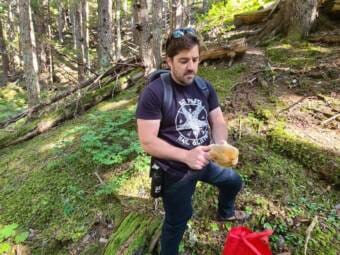
Haines chef Travis Kukull harvesting mushrooms. (Corinne Smith/KHNS)
Mushroom season is in full swing in the Chilkat Valley — or rather, full bloom. Despite a warmer summer, a mix of sunshine and rain has yielded a wide variety of edible mushrooms, if you know what to look for and what’s delicious.
A few steps off the popular Mt. Riley Trail near Haines, Travis Kukull spots clusters of golden chanterelle buttons poking out of the understory. He takes out a knife and cuts the stem at the ground, then brushes soil and leaves carefully back over the hole.
Golden chanterelle mushrooms are delicious at this size, and can grow much larger later in the season (Corinne Smith/KHNS)
“These are beautiful too,” he said. “You can feel they’re slightly moist, but really solid.”
Kukull is Haines’ resident mushroom expert, both in exploring and harvesting varietals throughout the area and in delicious ideas. He’s a chef and runs a local catering company, Malo Nista, where he incorporates local foraged mushrooms throughout the menu.
“You gotta cook them so the water dissipates and it caramelizes, and you get this chanterelle water caramelized around the outside of the mushrooms,” he said. “Then you add a little bit of butter and a little bit of garlic and some salt.”
He goes out most mornings in mushroom season, August through mid-October. He’ll take just a few for breakfast — like a chanterelle omelette — or to sauté and stock his freezer for recipes year-round.
A hike on the Mt. Riley Trail could yield a mix of golden chanterelles, neon-orange chicken of the woods, or big, meaty king boletes, also known as porcinis.
Chantarelle duck egg scramble with roasted carrots, and fava bean pesto, all made with ingredients from Haines (Photo courtesy of Travis Kukull)
“Another one I see growing here is a blue night polypor, and they’re all white like this underneath and blue on top,” Kukull said. “And they’re really good too. Right here on the trail.”
Kukull says friends will be out hiking and send him questions and pictures of mushrooms. But even after 16 years in Haines, he’s still surprised by new finds.
“My friend Leah made me a soup the other day that was filled with yellow foots (chanterelles) and I was like, where are you finding these right now? And she’s like, none of your business,” he said.
Just like fishing, people keep their favorite mushroom spots under wraps.
But mushroom hunting is about knowing what to look for — and knowing the risks. Further up the trail, we stop and take a look at another white, button-like mushroom.
“This could be a destroying angel, which is deadly poisonous,” he said. “So best to just lay off.”
Fly amanitas are poisonous, unless prepared properly (Corinne Smith/KHNS)
Kukull says whenever in doubt, leave it alone. But of course, people have found creative workarounds too. Like for the fly amanita, which has an easily recognizable, fairy-tale-like red and white-spotted cap.
“Well they’re a trippy mushroom,” he laughs. “And can also be deadly poisonous, and completely shut down your nervous system, so why would you want to risk that? But the way most people have eaten them in the past is that they’ve already been processed through reindeer. And they pick them out of the reindeer stool, and then eat them. Or make tea out of them, so it’s like cooked.”
Kukull likes to stick to the known, delicious varieties. Besides, when foraging around Haines, there’s more to consider. As he cuts the soil from a king bolete stem, he looks up suddenly and scans the forest
“Another thing I like about mushroom foraging in Alaska too is there’s bears everywhere,” he said. “It adds to the excitement.”
Bears, like people, are also foraging this time of year. So if you do go out, be aware. Mushrooms will be blooming until the first frost.
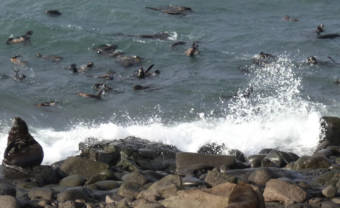
The number of northern fur seals in the Bering Sea has dropped by around 70% since the 1970s.
Fur seals are an essential subsistence food for the Unangax̂ communities in the Bering Sea’s Pribilof Islands. But for years, scientists have been unable to explain why the seals’ populations have been falling.
Now, a new study points its finger at an industry that’s long been suspected, but never definitively linked with the population declines: Alaska’s huge commercial pollock fishery, which harvests the same species that nursing female seals rely on to feed their pups.
Some scientists have suspected the pollock fishery, but evidence-based research linking the two has been scarce. According to Short, that’s because much of the existing literature has focused on the overall abundance of pollock, which is quite high.
By contrast, this new study focuses on the pollock catch — that is, the amount of fish being pulled out of the water.
“I was just astonished at how well it worked,” Short said.“Just that single number of pollock catch can explain nearly all of the [fur seal] population trajectory since about the mid-1970s.”
The team found evidence to suggest that the pollock industry, by breaking up the dense schools of fish the mothers rely on while fattening their pups, has made it harder for lactating fur seals to feed their young.
“What a female lactating fur seal wants to do is find a dense aggregation of food right next to where her pups are,” Short said. “So she can spend the minimum amount of energy to go find it, sit on top of it and eat to her heart’s content, and then swim right back and nurse her pups and repeat that all summer long.”
But commercial fishing boats also seek dense schools of fish. By fishing those schools, the fleets break them up, and the fish disperse. Which means the mother seal can’t fatten up her pups as quickly as she once could.
That’s a problem because the pups swim south in the fall. If they haven’t built up enough reserves, those seal pups likely won’t survive their first year.
And that, according to this study, is why fur seal populations are declining so steeply.
The number of northern fur seals in the Bering Sea has dropped by around 70% since the 1970s.
“I think it’s possible for the fur seal herd to eventually go extinct or become extirpated off the Pribilof Islands,” Short said.
The fur seal rookeries in the Bering Sea hold special importance to the Unangax̂ communities in the Pribilof and Aleutian Islands which rely on fur seals for subsistence.
Martin Stepetin grew up on St. Paul Island — the most populated of the Pribilof Islands — but now lives in Juneau where he advocates for Alaska Native rights.
“We eat those seals, so it gets scary,” Stepetin said.“If you’re trying to support your family, and you’re trying to put food in the refrigerator, you worry about the future. What about your kids? How much food is there going to be whenever your kids come of age? Are they going to be able to support their families?”
The study suggests that to make any real changes, the fishery — which is one of the most lucrative in the United States — would likely need to limit pollock catch to around a million tons in the areas surrounding the Pribilof Islands. That’s nearly a quarter of the total 1.375 million tons currently allowed.
One pollock industry booster, Stephanie Madsen, said she’s worried about a one-size-fits-all solution.
“It would be devastating to just have a blunt tool. And that’s what I think this is. It’s a blunt tool,” said Madsen, executive director of an industry group that represents large factory trawlers, the At-sea Processors Association.
Madsen said she welcomes the paper into the growing body of research on the subject, but she said there needs to be more precise measures than simply limiting the total allowable catch. She also expressed skepticism that limiting catch would improve the seals’ fate.
“When you’re talking about drawing circles around rookeries, and preventing fishing from occurring in there, you’re making quite a few assumptions about the pollock staying inside that circle, that the fur seals aren’t going to go outside the circle,” Madsen said.
The pollock industry employs around 30,000 people nationwide. In the eastern Bering Sea and Gulf of Alaska, the fishery brought in around $420 million in 2020, according to the National Oceanic and Atmospheric Administration.
“Thousands of jobs and tens of thousands of families depend on that income,” Madsen said. “I think depending on the size of those circles, for the most part, it could be quite damaging to the pollock fishery’s ability to harvest our quota.”
Madsen said that while she is moderately concerned about the authors’ findings, she doesn’t anticipate they will lead to immediate changes in the industry.
The North Pacific Fishery Management Council, which manages fisheries in the region, receives updates on marine mammals at the beginning of each year.
“We have great science, we have rational thinking heads,” Madsen said. “And I think the North Pacific council will take this information [when] they get their annual marine mammal updates at their February council meeting.”
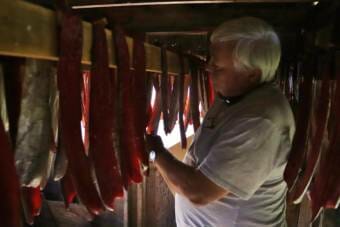
Gene Carlson checks red salmon strips in his smokehouse on July 16, 2021. Carlson was born in Chignik Bay but lives in Washington state now, usually returning in the summer to fish. He says this may be his last season. (Izzy Ross/KDLG)
Gene Carlson drove the streets of Chignik Bay one afternoon in July, between quiet wooden houses and old cannery buildings.
“That used to be a restaurant there,” he said. “That’s a web loft over there, which is shut down now. Here’s another one of my cousin’s houses. He’s not living there anymore.”
The Chignik River’s salmon runs have sustained generations in the century-old small fishing communities along the Alaska Peninsula.
But, for the fourth year in a row, the runs came in severely low. For years, residents have struggled to earn a living fishing and to put up enough fish for the winter, and some worry their villages will disappear, taking with them a fishing tradition that connects their families to the region.
Carlson was born in Chignik Bay, which is now home to around 90 people. He has fished commercially since he was a kid in 1961. Now he lives in Washington state and usually returns for the summer. Driving through the quiet village, he says this may be his last season.
“If we have another prediction like this year, I don’t think I can come back,” he said. “It’s expensive. ‘Cause you know, we come back, we bring food for the whole summer, ‘cause we’ve got to feed our crews, which you can’t find anymore.”
Gene Carlson with his nephew. July 16, 2021. (Izzy Ross/KDLG)
The area comprises Chignik Bay, Chignik Lagoon, Chignik Lake, Perryville and Ivanof Bay, and it’s been home to Native people for millennia. The village of Kalwak was previously located there, but it was destroyed when Russians came to the area during the fur boom in the late 1700s, according to the Lake and Peninsula Borough. Chignik Bay and Lagoon were established as fishing communities in the late 1800s, and more people of Alutiiq, Aleut, Russian and Scandinavian descent moved to the area.
The salmon runs are central to people’s lives in many ways. The economy has developed around the commercial fishery, and fish also provide food for the winter.
Some people think climate change is causing the runs’ decline. Others point to fishermen in other places catching Chignik-bound fish. Regardless of the cause, people are anxious that without the runs, the communities will die.
Chignik Bay. July 16, 2021. (Izzy Ross/KDLG)
The village of Chignik Lagoon, home to about 70 year-round residents, is an hour’s boat ride along the bay’s shoreline.
“It’s protected by that sand spit, which is a natural breakwater,” George Anderson said as he navigated his boat through the lagoon.
Anderson fishes commercially and for subsistence. He’s also the president of the Chignik Intertribal Coalition, which was formed after the run collapsed in 2018.
Earlier this summer, the run was so low that some people chose not to put out nets for subsistence fish. They were worried about harming the fragile run.
“We had something that we took for granted in the past — that the fish were just always going to be there for, you know, smoking, salting, freezer, whatever,” he said. “And to have that not be there for you is just something we were never prepared for. Never imagined even not subsisting.”
The low runs prompted federal managers to restrict subsistence fishing for sockeye to all but rural residents. King salmon fishing was closed completely in state and federal waters.
George Anderson on his seiner. July 16, 2021. (Izzy Ross/KDLG)
Since the Chignik run collapsed, much of the debate has centered on another state-run fishery to the south, called Area M. Critics see it as an intercept fishery, where sockeye traveling through are harvested before they can reach fisheries closer to spawning grounds, like Chignik.
This year’s early sockeye run didn’t meet its escapement goals — the minimum number of fish that managers want to see make it up the river. The late run did, and some people were able to fish. But the commercial fleet was just a fraction of its normal size. The area biologist said 15-20 boats fished, instead of around 60.
Some scientists have connected fishery failures in the Gulf of Alaska to marine heat waves in the past decade. But state research biologists also say it could be because of habitat changes in the salmons’ spawning grounds.
Salmon are notoriously difficult to research because part of their lives are spent in the ocean — a vast expanse that is mostly inaccessible to biologists. Along with warmer waters, a loss of spawning habitat might increase competition for habitat between Chignik’s two sockeye runs.
Anderson said the Chignik villages are shouldering the burden of conservation. He pointed to Area M, where South Peninsula fishermen landed more than 3.8 million sockeye this summer, and said the state wasn’t considering studies that showed Chignik fish caught further south in its management decisions.
Kevin Shaberg, a finfish research coordinator for the Alaska Department of Fish and Game based in Kodiak, said the situation is tough.
“It’s hard to understand that, you know, everybody else gets to go fishing, but you got to sit home next to the river and watch no fish go by. And that’s tough. And it’s something that we’ve, we’ve tried to handle in the past,” he said.
In previous years, he said, the department has limited fishing in nearby areas when Chignik was low. But Shaberg said the burden of conserving a run usually falls on the areas closest to where those fish should be returning to spawn.
“[Area M is] a traditional fishery that’s mandated and directed by the Board of Fish for us to prosecute, and we follow the management plans that are put in front of us,” he said.
The village of Chignik Lagoon. July 17, 2021. (Izzy Ross/KDLG)
Many people have asked for genetic sampling of harvests further south, in Area M, to figure out where Chignik fish are being caught. The state conducted tagging studies in the 1960s, and as late as the 1980s. In the 2000s, it conducted genetic studies in Area M in a project known as the Western Alaska Salmon Stock Identification Program, which showed fish from several stocks moving through — some of the sampled salmon were headed to the Chigniks, while in certain places, most of the fish were going to Bristol Bay or areas to the east. The state continued sampling in the early 2010s in parts of the area; the majority of fish caught during those studies were bound for the Chigniks, though percentages varied between areas and sampling groups
Still, Shaberg said, distribution of those catches change from year to year, so managers don’t know whether that applies to a given season. And the department hasn’t done additional testing in the area in years, he said, mostly because the state doesn’t have the budget for it.
Another question is what a study would seek to accomplish. Shaberg said a snapshot of genetics from one year, in one area, doesn’t help understanding of what’s happening or how to address it.
“One of the big issues for myself is that, you know, how long are we going to do this?” he said. “What’s the design for this? What are we really trying to answer?”
Shaberg said the department does plan to research the watershed, to try to figure out if something in the freshwater environment is affecting fish.
The Chignik Intertribal Coalition, along with state and federal agencies, has plans to research the river’s dwindling king salmon. That depends on funding approval, which they’ll find out about next year.
One of the coalition’s members, the Ivanof Bay Tribe, also received a $65,000 Tribal Resiliency Grant from the Bureau of Indian Affairs; it will partner with the coalition to gather environmental observations from Tribal members in the area.
But Chignik residents have had to contend with other forces, too. Anderson said they haven’t yet received the federal disaster relief money they were promised after the 2018 run failure. And due to the COVID-19 pandemic, the next Board of Fish meeting, which was supposed to take place this year, has been delayed until 2022.
Some industry organizations have tried to help as well. Last summer, Northline Seafoods, a commercial processor, donated thousands of Bristol Bay sockeye to the Chigniks. Lots of people said receiving that fish was helpful, but subsistence isn’t just about food; it is also a connection to place and family, as people work together to harvest.
A Chignik Lagoon beach. July 15, 2021. (Izzy Ross/KDLG)
On a warm evening in Chignik Lagoon, Al Anderson shucked clams with his wife, the shades of their house drawn to keep the heat at bay.
“It’s our lifeblood. Chignik’s going to go away — all the Chigniks are going to go away if we can’t get this run back up to where it used to be,” Anderson said. “You know, the young people are moving away. There’s not much for them here.”
Many of those who have moved away return in the summers to fish, including one of Anderson’s daughters.
“It’s so important that she comes back every year to do it. Typically it doesn’t take her three weeks to get her subsistence fish, you know,” he said, laughing. “Of course she comes back to visit, too, so that’s good.”
Elder Vivian Brandal, 80, and has lived in the Chignik area all her life. Now, she goes to Kodiak in the winter.
She said it’s difficult to comprehend what is happening.
“Subsistence fishing is a lifeline. I mean, we depend on that. That’s something we’ve done all our life,” she said. “It’s something we really depend on actually, not only fishing, but we used to be able to get caribou. We’d get caribou every year. You can’t even do that anymore.”
Brandal said the lower sockeye runs have changed the future of the Chignik communities.
“That’s five villages that depend on this fishery, and you look at it, you think, how can the state let this happen? How can they just let this happen without doing anything about it. I have grandchildren that thought this was their legacy,” she said.
Vivian Brandal in her backyard. July 16, 2021. (Izzy Ross/KDLG)
Brandal doesn’t think the state has managed the fishery correctly. She, along with many others, wants the state to be more responsive to the drop in the run and thinks it should conduct studies on why the fish aren’t coming back.
Still, Brandal is hopeful; she’s inspired by Katie John, an advocate and defender of Alaska Native subsistence rights who petitioned the state and federal government to allow for traditional fishing in her home.
“She fought for what she believed in, and that’s what I think we should do,” Brandal said. “We believe in this and we should fight for it. I won’t be able to anymore, but I just think the young people really ought to. It’s just, it’s very emotional for people. I’m sorry, I shouldn’t be crying, this is crazy. But it’s very hard.”
Brandal thinks they should work together to find a way forward, too.
This article has been updated to include additional context on the state’s genetic testing in Area M.
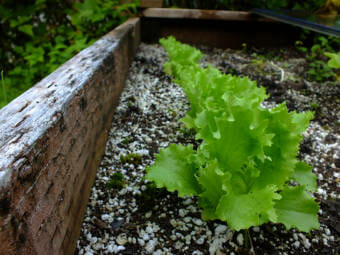
This lettuce, sowed directly into this North Douglas garden box in early summer, will likely be ready for harvest sometime in the fall. (Photo by Matt Miller/KTOO)
Some gardeners may think of vegetable gardening season winding down right now with harvesting already underway or just around the corner. Not true.
There are several vegetables that we can plant right now for late summer or even late fall and winter harvest.
Master Gardener Ed Buyarski says in this edition of Gardentalk that spinach and kale can be planted now for potential harvest in October and November.
Fast-growing lettuce and radishes or slower-growing swiss chard, early turnips, mustard greens, and bok choy are other vegetables that can be grown over the next few months or even over the winter.
He also recommends fertilizing soil in which vegetables had just been harvested. Then, plant cover crop seeds like fava beans, field peas, vetch, and oats.
“This is fast growing material,” Buyarski said. “And at the same time, they are fixing nitrogen which also improves the soil.”
Buyarski said the tips of the beans and peas are great in salads.
“So, you get double benefits,” he said. “You get food and you get soil improvement.”
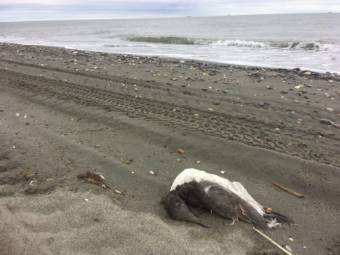
A dead seabird on a Nome beach. (Photo courtesy Gay Sheffield, UAF & Alaska Sea Grant)
Communities all over Western Alaska are finding dead seabirds on their shores for the fifth consecutive summer.
Researchers and federal scientists still have no definitive explanation for the cause.
Gay Sheffield, a wildlife biologist with the University of Alaska Fairbanks and Alaska Sea Grant, collects dead seabird samples each year from communities across the Bering Strait region.
“I would say the scope of this bird die-off is regionwide, and reports have come from Gambell, Savoonga, Koyuk, Shaktoolik, Golovin, the Solomon area, East Beach, West Beach (near Nome), even around Diomede and actually at Shishmaref as well,” said Sheffield.
The numbers total in the hundreds, and that’s only what’s been reported so far.
The National Park Service recently conducted a survey in the Bering Land Bridge Preserve and reported to Sheffield that they found upwards of 100 dead birds every two-and-a-half miles on some stretches of the beach.
According to Kathy Kuletz, seabird section lead for the U.S. Fish & Wildlife Service, the die-off is significant but not as large as the thousands found in Bristol Bay in 2019. Her team is responsible for managing seabirds across Alaska and sending any carcasses onto the appropriate testing labs like the National Wildlife Health Center in Madison, Wisconsin.
And so far in this die-off, Kuletz told KNOM, no infectious diseases or toxins related to harmful algal blooms have been identified in the seabirds’ tissues.
“The last I’ve heard, in most cases, the birds are emaciated, so they’re starved. And so far there’s been no evidence of disease or toxins from harmful algal blooms or anything like saxitoxin,” said Kuletz.
“So if you cross off toxins and you cross off disease, what’s left? And I am left thinking the birds actually cannot find the proper foods,” said Sheffield.
After five years of consistently documenting dead, adult seabirds of multiple species in the Bering Strait region, more and more evidence supports Sheffield’s claim: Seabirds are not eating.
UAF researcher Alexis Will recently released a study that ruled out food shortages as a cause for the 2018 seabird die-off documented on St. Lawrence Island. Since their usual food source — various benthic prey — was available for the birds at the time, Will cited the potential for another unknown factor that was preventing murres, specifically, from catching their prey.
Savoonga residents like Punguk Shoogukwruk have also seen distressed and dying chicks once again this summer. Shoogukwruk has been collecting seabird samples for Will’s research and continues to observe low numbers of nesting birds, similar to what he saw last year.
The unanswered question remains, however: What is causing these seabirds to starve to death?
“The Bering Sea’s ecosystem is in serious, serious trouble, and my fear is that it’s on the verge of collapsing,” said Iyaanga Delbert Pungowiyi.
Pungowiyi, a tribal member of the Native Village of Savoonga, is urging leaders to take action to reduce the effects of climate change in the Arctic. What’s happening to the seabirds cannot be reversed he said, and he wants these die-offs to be taken seriously.
For the U.S. Fish & Wildlife Service’s part, biologist Robb Kaler said its options beyond testing more birds and monitoring the die-offs are limited.
“In terms of what the agency can do about it, is well… remain vigilant, continue asking for community members to share reports and observations and then continue to work with our other colleagues to try to figure out if it’s a food issue?” said Klaer. “Is it food as well as exposure to saxitoxin or a harmful algal bloom event?”
Fish and Wildlife said it does not have plans to conduct a research cruise or do in-person seabird surveys in the Bering Strait region this year.
While more dead birds are studied, and unanswered questions remain, subsistence users across the region are feeling the impacts of the die-off.
In Savoonga, Pungowiyi said, fewer seabirds are nesting, fewer eggs are available and fewer healthy birds are around to eat, which has significant food security implications.
“Since time immemorial,” he said, “over 90% of our food security has been from the Bering Sea itself with the bowhead whales, walrus, seals, seabirds and ducks.”
One Savoonga elder even sent his dinner of seven auklet chicks to Sheffield, wondering if it was safe for him to eat as he normally would. He also reported observing seabirds eating the wrong type of krill based on his own traditional knowledge of seabirds’ diets and behaviors.
Pungowiyi, Sheffield and many others believe the five straight years of seabird die-offs are connected to an ecosystem-wide shift that’s been occurring in the Bering Sea since the cold pool barrier was removed in 2018.
Bottom temperatures in the Bering Sea (NOAA Fisheries)
Keeping with this trend, scientists with NOAA Fisheries documented extremely warm temperatures in the Northern Bering Sea on Aug. 21. According to data from this summer’s bottom trawl survey, sea bottom temperatures in the Eastern Norton Sound and other waters around Nome reached 8 degrees Celsius, or just over 46 degrees Fahrenheit.
According to climatologist Rick Thoman, these significant temperature changes are a sign of what’s yet to come.
“That is undoubtedly going to be important for commercial fisheries,” he said. “And in the long run, that is going to, I’m sure, impact the kinds of fish species that show up and wind up taking residence in the Northern Bering Sea as well.”
But in terms of what caused these significantly warm sea bottom temperatures, Thoman said, he doesn’t have enough information yet to explain that.
“It’s hard to comprehend that this is happening in my lifetime. It makes me sad just thinking about it,” said Bill Alstrom of St. Mary’s. (Olivia Ebertz/KYUK)
In Western Alaska, chum salmon stocks have sharply declined over the last two years. That’s a problem, because people in the region depend heavily on the fish for food and for work. Scientists are in the early stages of trying to understand the crash.
Bill Alstrom lives in St. Mary’s on the lower Yukon River. It used to be that if he wanted fresh salmon for dinner, he’d throw a net in the river to catch a couple. But with fishing closures this season, he can’t do that anymore.
“It’s hard to comprehend that this is happening in my lifetime. It makes me sad just thinking about it,” Alstrom said.
The State of Alaska has closed fishing for chum to protect the runs. For Yukon River families, chum is particularly important. Chinook salmon have been low for decades, but chum were the fish families could depend on until last year, when the summer chum run dropped below half of its usual numbers. This year the run dropped even further, to record lows.
Biologist Katie Howard with the Alaska Department of Fish and Game said that the chum declines are not just occurring in the Yukon River.
“When we talk to colleagues in the lower 48 and Canada, Japan, Russia, they are all reporting really poor chum runs. So it’s not just a Yukon phenomenon. It’s not just an Alaska phenomenon, but pretty much everywhere,” said Howard.
So why are the chum numbers so low? The short answer is that no one really knows for sure. But there are a lot of theories.
Every week during the summer, subsistence users, biologists and fishery managers gather on a weekly teleconference hosted by the Yukon River Drainage Fisheries Association. They share information and ask each other questions, and the subsistence users bring up one theory for the decline again and again: bycatch.
Bycatch is when ocean fishing vessels targeting one species also incidentally kill other fish. Some see it as a necessary evil, while others are opposed to it completely. The National Oceanic and Atmospheric Association tracks bycatch. Non-chinook chum salmon bycatch is already bigger than normal this year, and bycatch has been trending upwards since 2012.
NOAA distinguishes between non-chinook and chinook bycatch because chinook bycatch is heavily regulated. If trawlers catch more chinook than allowed, they have to cut short their fishing season. It incentivizes trawlers to avoid chinook feeding grounds. Trawlers must also report their non-chinook salmon bycatch, but there are no limitations on these amounts. NOAA estimates that 99.6% of its non-chinook salmon bycatch is chum.
So if chum bycatch is greater than normal this year and trending upwards, would bycatch be a major factor in Western Alaska’s chum decline? Not necessarily, said a NOAA spokesperson, because the fish that are dying on the trawlers are largely not bound for Western Alaska. About 16% are from coastal Western Alaska, and less than 1% are from the upper and middle Yukon.
The rest of the bycatch is mostly hatchery fish: fish that have been hatched in a controlled environment. They’re largely from Japan.
Hatchery fish are also cited by some as a possible cause of chum decline. Jack Schultheis is the manager of the only wild salmon processor on the Yukon: Kwik’pak Fisheries Emmonak.
“I think it’s disrupted something in the foodchain,” Schultheis said.
Kwik’pak manager Jack Schultheis says this year’s chum run is the worst he’s ever seen. (Olivia Ebertz/KYUK)
Kwik’pak is Native-owned, by a community development quota (CDQ) group called Yukon Delta Fisheries Development Association, which also owns trawlers. NOAA data shows that CDQ trawlers are responsible for less than 10% of chum by-catch, and Yukon Delta Fisheries Development Association-owned trawlers are responsible for less than 1% of chum bycatch on American vessels.
State biologist Howard doesn’t think hatchery fish are the issue. That’s because hatchery fish populations haven’t changed much in the past 30 years. But Peter Westley, an associate professor of fisheries at the University of Alaska Fairbanks, thinks hatchery fish could be at least part of the problem.
“These declines in salmon that we’re seeing in our local rivers is possibly linked to actually, ironically, too many fish in the ocean,” Westley said.
Westley said that’s because since the 1970s, the North Pacific Ocean and the Bering Sea have been full of food for both wild and hatchery chum, and both populations have grown over the decades. But now he suspects that increasing competition for food has led to the massive decline.
“The reality is, you don’t know that you were at a tipping point until it’s in the rearview mirror,” Westley said.
Westley said that climate change could be the culprit behind the lack of food in the ocean. He said that crashes in salmon stock will be more likely as the ocean continues to warm. Westley said that this competition affects hatchery and wild fish alike, leading to dwindling numbers for all salmon.
On the Yukon River, subsistence fisherman Alstrom also thinks warming temperatures could be a factor in the crash. In his 70 years in St. Mary’s, he’s seen the changes in the environment firsthand.
“And all these trees out there looks like a jungle. There used to be scrubs out there when I was growing up,” Alstrom said.
Alstrom said that the animals in the region are changing too. He never saw moose as a kid, but over his lifetime they started to move in.
Researchers are trying to understand the chum crash. For decades, biologists have mainly been focusing on chinook salmon, which have a longer history of decline and are more valued by commercial and subsistence fishermen.
NOAA and the Alaska Department of Fish and Game are leading two surveys on the Bering Sea this year to study salmon marine life. State biologist Howard is out on one of those surveys right now. She’d like to see more funding to study chum overwintering habitat in the North Pacific but said that it’s expensive and dangerous to conduct that research because of turbulent winter seas.
Westley said that the number one question that needs to be answered now is where the chum are dying in their lifecycle. That will help scientists determine what’s killing the fish.
Alstrom said that it will be hard for his community if the salmon don’t return.
“It’s just not right when you live in your region that’s supposed to be teeming with salmon, and to go without it. It’s just devastating,” Alstrom said.
Despite the decline, biologists say that chum are not endangered, and the subsistence fishing closures are helping the salmon get to their spawning grounds.
Close
Update notification options
Subscribe to notifications
Subscribe
Get notifications about news related to the topics you care about. You can unsubscribe anytime.