Food

When Yukon River chum stocks collapsed, donated fish came in from Bristol Bay

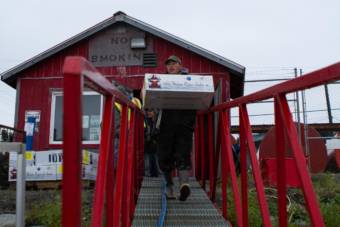
Daren Jennings loads up his skiff to deliver Bristol Bay salmon to Lower Yukon River communities. (Olivia Ebertz/KYUK)

For eight years, Tanya Ives has been traveling up from Washington each summer to work at the Yukon River’s only fish processing plant: Kwik’Pak Fisheries. The plant sits outside of Emmonak, at the river’s mouth. Normally at this time of year, Ives would be packing up chum salmon harvested by commercial fishermen along the Yukon River to sell around the world. But this summer, she’s doing the opposite.

Ives is packing up salmon, caught hundreds of miles away, to send to Yukon River villages. She wears a red sweatshirt and gloves to keep warm while working with the frozen fish.

The Yukon River has seen its worst summer chum salmon run on record, and its third-worst chinook run. The commercial fishery is closed, and Kwik’Pak can’t sell salmon. Subsistence fishing for chum and chinook is also closed, and many people along the river have not had a taste of the fish this season.
Normally at this time of year, Ives would be packing up chum salmon to sell around the world. (Olivia Ebertz/KYUK)

Meanwhile, on the southern end of the peninsula, Bristol Bay has been enjoying its best salmon run on record. To share the bounty, processors there donated 22,000 pounds of chinook and chum salmon to Yukon River villages. The Bristol Bay processors sent some of that salmon to Kwik’Pak to distribute to lower river communities.

Inside the Kwik’Pak plant, workers divide about 12,000 pounds of salmon into boxes. Ives gives instructions for how to label them.

“You’re going to write the number of fish and the pounds on this label, and then you’re going to put this donation label on the right top corner,” Ives says.

The fish are whole and frozen, so villagers can use them how they wish. Kwik’Pak is splitting the fish between 10 Lower Yukon River villages: Emmonak, Alakanuk, Nunam Iqua, Kotlik, Pilot Station, St. Mary’s, Marshall, Russian Mission and Pitkas Point.

Kwik’Pak is splitting the fish between 10 Lower Yukon River villages: Emmonak, Alakanuk, Nunam Iqua, Kotlik, Pilot Station, St. Mary’s, Marshall, Russian Mission, and Pitkas Point. (Olivia Ebertz/KYUK)

Dividing the salmon by village population, regional tribal nonprofits determined how many fish would go to each village. Tanana Chiefs Conference directed distributions upriver, and the Association of Village Council Presidents directed distributions along the lower river.

Kwik’Pak boated the salmon from community to community. Weighed down by thousands of pounds of frozen fish, a tender boat slowly motored up the cold, rainy Yukon. At the helm stood captain Daren Jennings, bundled up in a Rick and Morty sweatshirt with thick layers of raingear on top. As the skiff wound further upriver, willows more densely crowded the banks. Then spruce forests appeared.

According to local Elders, the area used to be pure tundra. The flora is changing, and sandbars claim more territory each year. They’re getting harder to avoid, even for someone who knows the river as well as Jennings.

Delivering salmon to the villages is new to him. In previous years he’d be doing the opposite: picking up commercial fishermen’s fresh catches and taking them back to Kwik’Pak to be processed. With the commercial fishery closed, he’s one of the few dozen employees that Kwik’pak has been able to hire back this year.

“Usually we’d be running way more and had way more people here, but since there’s no fishing you can only have so many workers that are doing so many things,” Jennings said.

A Kwik’pak worker unloads salmon in St. Mary’s. (Olivia Ebertz/KYUK)

The boat makes a gentle left turn onto the Andreafsky River. The river, fed by the Kusilvak Mountains, runs cold and black, a stark contrast to the muddy lower Yukon. The tender docks in St. Mary’s. Workers from the Algaaciq and Andreafsky tribes meet the tender at the bank.

“I’m droppin’ off big boxes of fish,” Jennings says, while calling the tribes to announce his arrival.

The tribal workers meet him at the shore. They load the fish into their pickups and drive them to households, until late evening. Bay Johnson from St. Mary’s is grateful to have at least a bit of fish.

The tribal workers from the Algaaciq and Andreafsky tribes load the fish into their pickups, and then drive them to households until late evening. (Olivia Ebertz/KYUK)

“We got two, and we were so happy for them,” she said. “Right now I have them thawing out so I can can them. They can last longer throughout the winter for us.”

But she said that the fish isn’t enough food for her family for the months ahead. With little opportunity for subsistence salmon fishing, her grocery bill has gone up. Her husband, Walky, said that they’ll have to try for other species of fish to get them through the winter.

A spokesperson for Gov. Dunleavy’s office also said that the Alaska Department of Fish and Game has purchased an additional 25,000 pounds of fish. Half of that arrived in Emmonak on Aug. 10 for distribution to Yukon-Kuskokwim Delta communities.

LISTEN: A lifetime of subsistence fishing tells story of Yup’ik traditions

Debbie Coolidge processes sockeye at her home in Aleknagik. (Stephanie Maltarich/KDLG)

Each summer, Alaskans take to the rivers, bays and oceans to subsistence fish. Some head out to set nets, others may use dip nets, but the end goal is the same: to stock up on enough fresh fish to last the winter.

Debbie Coolidge spends at least one week each summer catching and processing salmon that will last her the entire year, continuing the traditions she learned from her grandmother.

Coolidge grew up fishing with women in her family on the Wood River near her home on Lake Aleknagik, in Bristol Bay.

“I started fishing when I was 8 years old, it was just my grandma and my Aunt Virgin,” said Coolidge.

Today, in her mid-50s, she’s still at it, and she’s still independent. In early July, she heads downriver in her skiff to set nets.

Debbie Coolidge sets out for a day of fishing. (Stephanie Maltarich/KDLG)

Her favorite fish are kings.

“One year we went and sat down there and we didn’t expect to get a whole bunch of kings, our net was just smoking and we were trying to get the net in and trying to get the fish in, you know they are big fish,” Coolidge said.

By early July, she usually has about 10-12 kings in her freezer, but this time she only caught four.

Coolidge’s experience isn’t unique. The Nushagak River’s Chinook run started slow this summer. Additionally, the huge number of sockeye returning to the bay have filled subsistence nets, taking up room that kings may have occupied during a slower sockeye run.

Like many who fished this season, Coolidge caught hundreds of reds.

After a long day on the river, Coolidge sets up shop under a pop-up tent in her front yard. She processes fish while they are fresh.

First, she washes them. Then, she lines them up on a chest-high table.

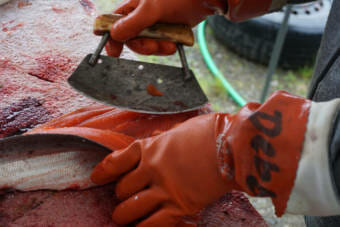
Next, she cuts them with an ulu.

“It’s considered a women’s knife. We use it for everything — cutting fish, cutting meat, cutting seal and beluga,” she said.

Often, she hangs them to dry.  But the rainy summer made drying difficult this summer.

“There has been so much rain, trying to get them to dry; they are looking sad though,” said Coolidge.

And sometimes, they end up in the smokehouse she built with her brother many years ago.

Once the processing is done?

Coolidge smiled, laughed and said, “We eat it!”

Early this summer, Coolidge and her son enjoyed watching a show that explored Japanese food and culture. The series inspired them to share food stories as they relate to Yup’ik culture and way of life.

So one day, her son took out the camera and started filming.

“We thought about doing that with king salmon and how we do strips, how we catch, process and then eating them,” Coolidge said. “We thought about doing that with greens we pick, incorporating that into the video. Berries, eating and enjoying it just showing the world what our life is like.”

For Coolidge, the project is not just about the food she eats. It’s also about culture, community and taking care of one another.

She’s not sure what they’ll do with the videos, but she hopes they can help preserve and teach others about Yupik cultural traditions.

“There are disabled people and people don’t have resources to come and get fish, so everyone shares,” she said. “Even in the wintertime when people get moose or caribou, people share with the elders and widows and people who can’t do it themselves. ”

A day of fishing and processing isn’t complete until Coolidge throws some fresh filets on the grill with her favorite marinade.

“I get a nice char on it, then I flip it over and let it cook for a while, then I put the glaze on it,” Coolidge said.

With jars of canned salmon stacked in the corner, more in the freezer and plenty hanging outside, Coolidge is stocked for winter.

State to help bring salmon to Yukon River communities hit hard by low runs

A crane unloads totes of salmon from a tender at Kwik'Pak Fisheries in Emmonak, Alaska on July 15, 2019. (Photo by Anna Rose MacArthur/KYUK)
A crane unloads totes of salmon from a tender at Kwik’Pak Fisheries in Emmonak, Alaska on July 15, 2019. (Anna Rose MacArthur/KYUK)

The Dunleavy administration has directed the Alaska Department of Fish and Game to coordinate salmon deliveries to Yukon River communities.

Kwik’Pak Fisheries General Manager Jack Schultheis said 8,000 pounds of salmon arrived at the Emmonak processing plant last week, and the company is preparing to distribute the fish to lower Yukon River communities.

The delivery is the first in what is expected to be a string of salmon shipments along the river after low runs have meant no subsistence fishing for king or chum salmon on the Yukon River this summer.
On July 22, the state did finally open subsistence fishing for other salmon species, including pink, red and coho, for the first time this season.

To help get food in fish racks and freezers, the Dunleavy administration is helping to coordinate deliveries of salmon donations from Alaska-based processors to Yukon River communities. It is working with nonprofits, including SeaShare, and shippers to make it happen.

Dunleavy spokesman Jeff Turner said the administration has allocated $75,000 to purchase king and chum salmon from Alaska processors to add to what’s being donated to communities and is asking the Tanana Chiefs Conference to match those funds.

The Tanana Chiefs Conference is helping distribute the fish to communities along the middle Yukon River near Fairbanks. On the lower Yukon River, the Association of Village Council Presidents and Kwik’Pak are helping share fish into the community.

The exact amount of salmon that will be sent to Yukon River communities has not been confirmed.

“We are still collecting quotes from seafood processors,” Turner said. “The governor’s goal is to maximize the amount of fish that can be donated.”

‘It’s the fabric of our culture coming apart’: Yukon River communities face chinook and chum closure

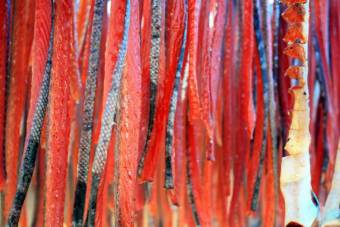
Yukon River salmon strips. (ADF&G photo)

In late June, summer chum salmon numbers in the Yukon River were the lowest on record. The chinook run is also extremely low, resulting in ongoing closures of salmon fishing on much of the Yukon River.

The loss is causing anxiety for more than 30 riverside communities that depend on chinook and chum as a main source of protein for the winter.
Ben Stevens is the Tanana Chiefs Conference tribal resources manager. Stevens is from Stevens Village on the upper Yukon and said he has never before seen such a total shutdown.

Below is a transcript of an interview with Lori Townsend on Alaska News Nightly, with minor edits for clarity

Ben Stevens: We’ve seen chinook crashes before in recent history. We were still okay with the idea because we had something else to fall back on. And that was the fall chum.

This year, it’s unprecedented because we don’t have the chinook or the fall chum, and that has disturbed our folks to a level I haven’t seen before.

Lori Townsend: Are there other river or tributary opportunities close enough that could help people get fish in other places? Or is it just not possible?

Ben Stevens: My family, when we go to fish camp, instead of setting the salmon net out there in the main stream, we’re starting to go into the back sloughs for whitefish and pike. That is another source of protein. I guess pound for pound, it’s a tremendous exertion of energy. But that’s what it is. And that’s what we’re going to do.

A lot of folks up and down the Yukon are doing similarly. If folks don’t get a moose — which, you know, is very difficult — they’re going to be staring into October with nothing in their freezers. I think that scares a lot of people.

Lori Townsend: As you’re talking to Yukon River community residents, what are you hearing about their concerns for winter protein and how they plan to try to help their families have enough to eat this winter?

Ben Stevens: Well, what we’re hearing is a lot of fear. And as an Alaska Native man, my job is to help feed the people, and that’s what I have grown up doing. But I think that there’s fear way down deeper inside folks than I have ever sensed in my life. I’ve been around, I’ve experienced some things, I’ve experienced fear before in our people. But nothing is so deep as this fear. I think that as we cannot harvest food from the land and the waters, it’s the fabric of our culture coming apart. That’s essentially what it is.

Lori Townsend: Meanwhile, as you’re probably aware, Bristol Bay is seeing the largest sockeye run in history right now. Is Tanana Chiefs Conference working to get fish from Bristol Bay or other areas for residents along the Yukon? Could that be part of at least the short-term solution for this winter?

Ben Stevens: Absolutely. We’re looking at all options in front of us. But you’re right: It is only a short-term solution. And it is not a solution that can be carried into the future. Because we should not be giving up our fish in Stevens Village to buy fish from the system out there in the marine environment. Does that make any sense? We should be able to take our families to the fish camps, have our kids pull that fishnet, have them process and that fillet goes straight on to the fire.

There’s something strong, there’s something very, very spiritual about that thing that our people survive on. It’s not just sustenance for your tummy, it’s sustenance for your soul. It’s family ties that are being strengthened.

When schools shut down in Alaska, these students went moose hunting

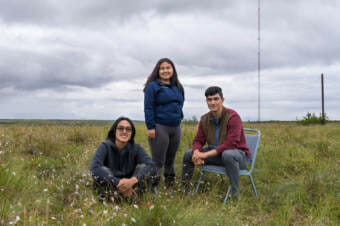
High schoolers Ethan Lincoln, Kaylee King and Jamin Crow’s podcast about their experiences subsistence hunting is a finalist in the NPR Student Podcast Challenge. The students are pictured here at the KYUK radio transmitter site in Bethel, Alaska. (Katie Basile/KYUK)

Jamin Crow waited silently for the bull moose to turn and face him. In the cold, the teen stood in an open meadow, his gun resting on a branch. He waited and waited and waited.

Then the moose turned, and his brother started to yell, “Shoot!” If Crow didn’t shoot, his brother would. So Crow took a deep breath and pulled the trigger.

“Your ears are ringing after the gunshot. And I look at my brother and he’s giving me the happiest look I’ve ever seen,” he says. “Everything is perfect at that moment …You know you succeeded in what your goal is.”

Crow lives in Bethel, in the remote Yukon Delta region of Alaska. For generations, his family has practiced subsistence hunting to get food on the table. The process hasn’t changed much, except that these days, the Crows use motor boats and snowmobiles to get to their moose camp, which serves as a home base while they’re on hunting trips.

“Food is very expensive here. You have to ship everything up,” Crow says. “We don’t go out just for the antlers. We’re not looking for trophies; we’re not hunting for something big. We’re looking for meat to feed our families.”

Crow is one of three Alaska Native students — along with Kaylee King and Ethan Lincoln — who made a podcast about their hunting tradition. The students are from different towns, but met as interns at NPR’s member station KYUK in their senior year of high school. Right before they graduated last spring, their podcast was chosen as a finalist in this year’s NPR Student Podcast Challenge.

Ethan Lincoln, Kaylee King and Jamin Crow. The three students say hunting helped them get through the isolation of the pandemic, when their schools and many other activities, like sports, were shut down because of COVID-19. (Katie Basile/KYUK)

The three students say hunting helped them get through the isolation of the pandemic, when their schools and many other activities, like sports, were shut down because of COVID-19.

In the podcast, Crow went hunting with his 17-year-old brother, Peter, but sometimes the whole family goes, including his father and grandmother. King and Lincoln — who are cousins — also go hunting with their families.

“Nowadays, you see everybody go out and hunt. Dads will take their daughters,” says Crow. “It doesn’t really matter what your gender is.”

COVID-19 did not hit Bethel until August of 2020 — when people started to travel to and from other cities. The virus quickly spread, closing schools through March of this year. Meanwhile, King’s village of about 250 people managed to make it through with very few cases, and she was allowed to finish out high school in person; she was the only graduating senior in her town this year.

The students explain that, as time goes by, fewer and fewer people are practicing subsistence hunting. King, especially, feels a pressure to keep the traditions alive.

“It makes me really sad because the way we used to do things is so different from how we do them now,” King says. “Even our language [Cup’ig] is slowly fading away.”

For the students, the practice of hunting allows them to connect with older generations.

“Whenever I go out hunting with my granny, I’m always hearing past stories about when my dad was a kid and he went hunting or my late grandpa [and] how he would just take the family up,” Crow says.

He sees peers like King practicing cultural dances, speaking the language and hunting, and he’s hopeful the traditions he grew up with will last. He already knows he wants to share the hunting experience with his own children some day.

“If we keep at this pace, I think our younger generation can pick it back up again because we have pride in our culture and we love where we are from and we don’t want to see it fade away.”

Sneha Dey is an intern on NPR’s Education Desk.

Copyright 2021 NPR. To see more, visit https://www.npr.org.

Juneau restaurant highlights women chefs of color

Rachel Barril works in the kitchen of Juneau Italian restaurant In Bocca Al Lupo for their event "Dinner with Friends: Womxn of Power edition" on June 26. (Photo by Lyndsey Brollini/KTOO)
Rachel Barril works in the kitchen of Juneau Italian restaurant In Bocca Al Lupo for the event “Dinner with Friends: Womxn of Power edition” on June 26. (Photo by Lyndsey Brollini/KTOO)

Juneau Italian restaurant In Bocca Al Lupo staff wanted a dinner party. But they also wanted to highlight women chefs of color.

So, they hosted Dinner with Friends: Womxn of Power Edition.

When doors to the downtown Juneau restaurant opened, a long line of well-dressed people streamed in. It was clearly a fancy night out for the 40 people who packed into In Bocca Al Lupo’s dining room for the sold-out event. And they were excited. Between the conversation and kitchen noise, the room was loud.

Everyone was checked in at the front door by staff to make sure they were vaccinated — a requirement to attend.

Back in the kitchen, music played loudly through the speakers while chefs prepared their dishes of the night. They were chopping vegetables, drizzling sauces over samosas, adding vegetable toppings to pancit.

Two chefs are Filipino: Aims Villanueva-Alf and Rachel Barril, and two are Mexican: Claudette Zepeda and Amara Enciso.

Claudette Zepeda works in the kitchen of Juneau Italian restaurant In Bocca Al Lupo for the event “Dinner with Friends: Womxn of Power edition” on June 26. (Photo by Lyndsey Brollini/KTOO)

Each chef made a dish that represented their culture. They also made some surprising twists to the dishes they grew up with.

And that noisy dining room? It got real quiet as people enjoyed the fusions.

Villanueva-Alf chose pancit as her dish because it represents how people made it through the pandemic.

“Pancit is about longevity,” Villanueva-Alf said. “And so, I just wanted to say that when the girls and I were here prepping everything, hearing all of you guys, and like the bustling and talking … We missed that.”

Villanueva-Alf, Barril and Enciso are all local chefs in Juneau. Zepeda is from San Diego.

Beau Schooler, co-owner of In Bocca Al Lupo, became friends with Zepeda through Instagram last year.  When Schooler and Alicia Maryott started talking about bringing Zepeda up for the dinner, Maryott had the idea of centering women chefs of color in Juneau.

“White men, in particular, get a lot of support, you know, from big money and corporations and just like, being elevated by accolades that, I feel like, have been centering white men for a long time,” Maryott said.

So the evening was just as much about pushing back against race and gender barriers as it was about having a dinner party. It also gave the women involved some space to experiment in the kitchen.

“There are other ways to just uplift and center and celebrate people of color, but women of color in particular in this situation, without, you know, having to shout from the rooftops that they have Michelin stars or James Beard nominations or whatever,” Maryott said.

Diners wait for the first course of a six-course meal being served at In Bocca Al Lupo's event "Dinner with Friends: Womxn of Power edition" in Juneau, Alaska. (Photo by Lyndsey Brollini/KTOO)
Diners wait for the first course of a six-course meal being served at In Bocca Al Lupo’s event “Dinner with Friends: Womxn of Power edition” in Juneau. (Photo by Lyndsey Brollini/KTOO)

Rachel Barril said that 10 years ago when she first started out, she thought the industry was more male-dominated, but that it is starting to change.

“The kitchen atmosphere has moved away from that, the very strict kind of like military-style, brigade style, old school French kind of hierarchy,” Barril said.

Barril works at In Bocca Al Lupo. She is a head chef at the restaurant, but she prefers going by cook. She said they don’t like using hierarchical terms in their kitchen.

Part of that change in kitchen dynamics, Barril thinks, is because a new generation of people are now owning restaurants and running kitchens. She also thought this change helped to make kitchens more inclusive.

“Haven’t really felt any, experienced any, like, I was at a disadvantage because I was female. Especially considering I dress very different for a female,” Barril said. “I never really felt that. And so, if anything, Juneau’s pretty accepting I think.”

The dish Barril prepared for the dinner was mushroom kare kare, a Filipino peanut stew. She added her own twist, and local ingredients, to the dish. She used a peanut miso she made for the base, wild mushrooms and beach greens collected locally.

“But it was, it was nice getting to do some creative stuff again. It was a relatively easy night. The food turned out pretty well. It seemed like the diners enjoyed the food,” Barril said.

And Barril really enjoyed working with the other chefs, who are all people she is friends with and admires.

Site notifications
Update notification options
Subscribe to notifications