Food

At Anchorage farm, refugees in Alaska gain training and economic opportunity

Cherry Tacang of Myanmar poses for a portrait on June 24, 2021, amid the greens she’s grown at Grow North Farm in Mountain View. (Jeff Chen/Alaska Public Media)

On opening day for Grow North Farm’s third season, Cherry Tacang walked between her neat rectangular plots teeming with vibrant greens.

“This is mustard greens, and this one is bok choy, and this one is spinach, and this one arugula,” she pointed out.

Despite the surrounding vegetation, it’s hard to forget that you’re in the middle of Anchorage’s Mountain View neighborhood. Planes landing at Merrill Field droned overhead and strip mall signs peeked over the fence.

Tacang, 34, and her husband are refugees from Myanmar. They’ve lived in Anchorage for more than five years, with their five children. Their oldest is 14 years old and the youngest is just five months.

Tacang said she farmed rice paddies and grew vegetables and corn in Myanmar, but that was very different from growing produce in Anchorage. She grows turnips here, for example, which were a new crop for her.

“Turnips, I don’t know how do you eat? I don’t know,” she said. “I eat cilantro, carrot, bok choy and salad.”

Tacang has worked her plot for all three years that the farm has been around. She’ll plant a few times throughout the summer, selling her produce at a weekday farm stand at Grow North Farm and at the Muldoon Farmers Market on Saturdays.

Farmers and visitors meander through Grow North Farm in Mountain View on June 24, 2021, the first day of this year’s farm stand. (Jeff Chen/Alaska Public Media)

The Mountain View farm took the place of a vacant parking lot. Today it’s tended by more than 20 immigrant and refugee farmers who live in Anchorage.
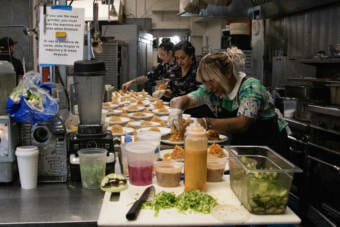
Grow North Farm is a partner effort between Anchorage Community Land Trust and Catholic Social Services. The nonprofits provide a farm training program and business development support for refugees and immigrants like Tacang, who go on to have their own plots at the farm for a nominal fee.

It’s a flexible environment that allows people like Tacang to balance work with raising a family.

“Only my husband was working, and we needed some more support,” Tacang said through a translator. “Working as a gardener, I can stay with my kids, since they’re young. And I have the extra money to support my family.”

And after years of saving, Tacang and her husband bought a house last year, in part, because of the work she does at Grow North.

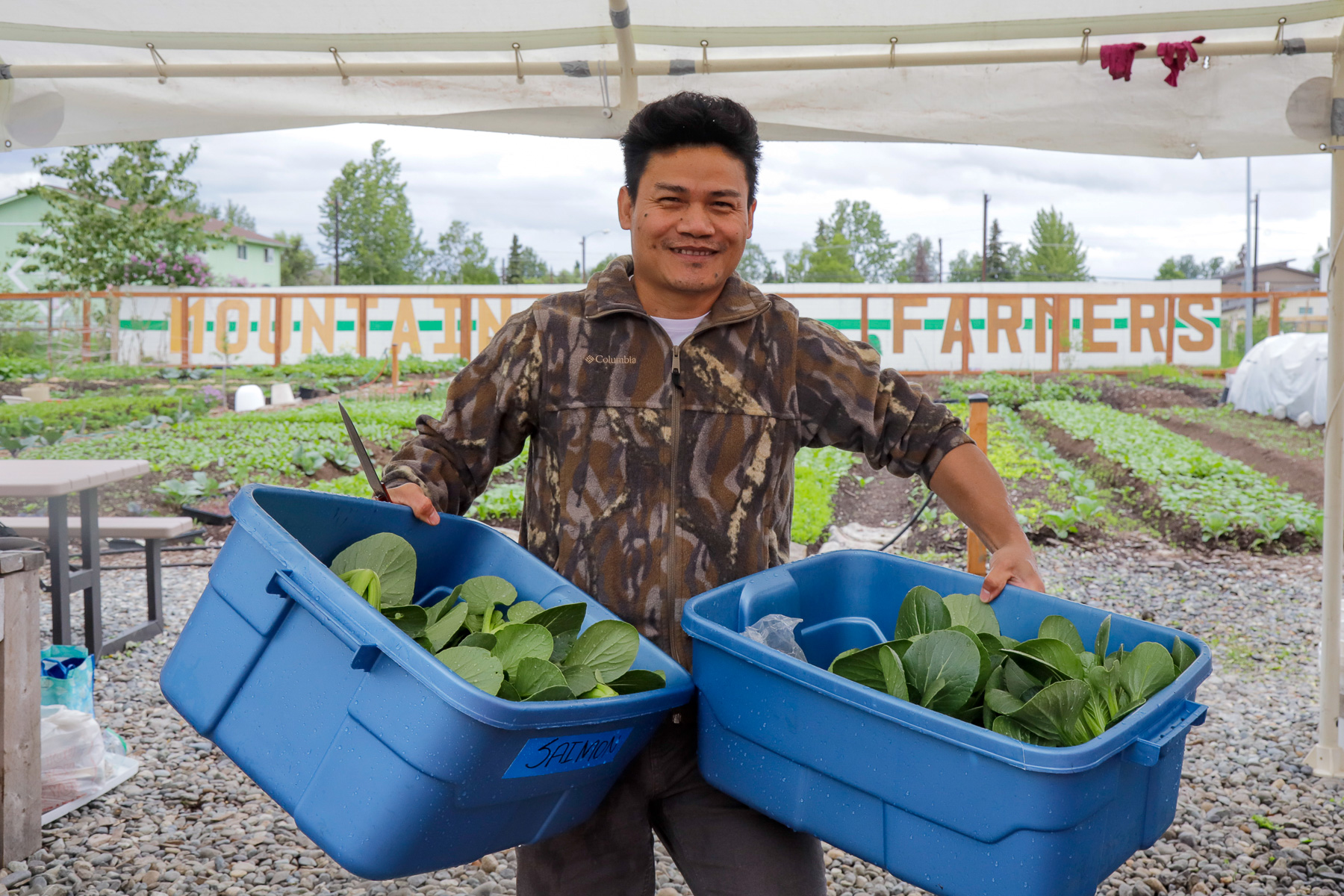
Zolian Tacang of Myanmar poses for a portrait with the bok choy he’s just harvested to sell at Grow North Farm’s first farm stand of the season on June 24, 2021, in Mountain View. (Jeff Chen/Alaska Public Media)

“The norm is Cherry’s story, not the exception,” said Issa Spatrisano. She works for Catholic Social Services and as the State of Alaska’s refugee coordinator.

Spatrisano helps settle refugees from all over the world — Eastern Europe, Congo, Sudan, Somalia, Iraq, Myanmar and more. These are people who have been forced to leave their country and gone through an often harrowing process just to be eligible to come to Alaska.

So when they finally arrive, Spatrisano said, there are some clear goals — good health and well-being, reliable transportation and employment and self-sufficiency. The farm training program is a big part of that last one.

“If you grew rice in Burma, it did not prepare you to grow turnips in Alaska,” she said. “The training program — a lot of new arrivals will do that for a year or two years, learn the basics of Alaskan farming.”

In recent years, refugee resettlement in Alaska has declined due to Trump administration policies. And last year it dropped to almost no new arrivals due to COVID-19.

Spatrisano said she expects refugee resettlement to ramp back up in the next few years. Normally, she said, her caseload would be about 500 to 600 people, with around 130 new arrivals each year.

Bhai Subba takes a break from harvesting mustard greens to talk with a visitor at Grow North Farm in Mountain View on June 24, 2021. (Jeff Chen/Alaska Public Media)

New community members from around the world makes Alaska a richer and more vibrant place, Spatrisano said.

“All of us figure out everyday what it means to be Alaskan. And refugees are part of that story,” she said.

Grow North Farm strives to integrate refugees into the community while preserving individual cultures. Emily Cohn, a spokesperson for the Anchorage Community Land Trust, said a group of Congolese women sourced seeds for a type of amaranth called dodo that they had back home. It was so popular among Congolese families in Anchorage, they didn’t even get a chance to open it up for public sales, she said.

“The space, it is providing economic opportunity, but it is also really, truly providing a space of prosperity and belonging and community for participating farmers that is just as integral as the opportunity to earn an income,” Cohn said.

Cohn said most Grow North farmers have other sources of income on top of their farm work.

Farm sales more than tripled from $20,000 to $70,000 between the first and second seasons, and Cohn expects this one to be even more successful. Also, she said, they’re looking for ways to expand the farm, which has been at capacity since it opened, to provide more growing space to farmers.

This year the farmers have expanded their offerings too.

In addition to produce, they’re selling spice blends and other prepared foods. There’s hot food from global cuisines sold every Thursday. And people can sign up for a weekly produce box subscription. All vendors are WIC and SNAP certified. On Tuesdays, all produce is half off for WIC and SNAP users.

At the farm stand on opening day, Ella Nash and her sisters walked around, enjoying date-filled Somali tea cookies and admiring the produce they bought.

“I just think it’s such a great idea. It really pulls the community together,” Nash said. “And it really took off last year. I mean, sometimes they were running out of things before I could get down here.”

This week though, Nash made it in time to buy radishes, bok choy and arugula from Tacang’s farm stand.

Yukon River on track for dismal king and chum runs

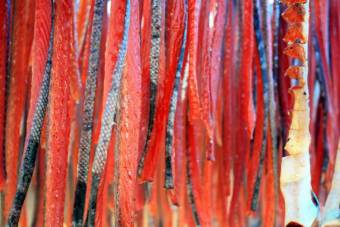
Yukon River salmon strips. (Courtesy of ADF&G)

The Yukon River Fisheries Drainage Association hosts weekly teleconferences where river residents, fishery organization leaders and government resource managers talk about what’s happening with salmon on the river.

There wasn’t much positive news during this week’s teleconference.

Yukon River Inter-Tribal Fish Commission chair Brook Woods has a dismal king salmon count from the Pilot Station sonar near the river’s mouth.

“As of Monday, June 28, just over 60,000 king have been counted at the Pilot (Station) sonar station, and that is only half the average count for this date,” she said.

Wood said the run is estimated to be about midway through, and if things don’t change, a border passage agreement with Canada and drainage-wide escapement goals won’t be met.

“If we’re not able to meet escaping goals, this will be the third year in a row,” she said.

The situation is even worse for summer chum salmon. State research biologist Fred West said just 31,000 are estimated to have passed the Pilot Station sonar as of Monday, well below the historic median of 500,000.
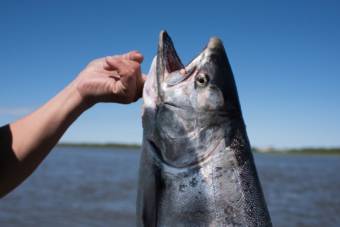
“That’s the lowest on record for this day. So yeah, so this is lower than the runs we saw in 2000 and 2001,” he said.

Deena Jallen, the state summer season management biologist, said managers had no choice but to close the fishery.

“I really feel that everyone is really struggling this year. We know it’s really hard. If there were a fish to be harvested I would you be wanting to let people harvest but there’s just no fish to be harvested so it has to be closed,” she said.

The Chinook and summer chum salmon fishing closure extends from the Yukon Rivers headwaters to its mouth as well as area coastal communities. Hooper Bay resident John Rivers lamented the situation.

“I’ve never seen Hooper they closed ever since I was a little boy to this day. It’s so sad to see it’s closed,” he said.

Martin Kelly of Pilot Station said communities need help filling the food void.

“Fish and Game and everybody else better be prepared to go out and get some crab or pollock or halibut and bring it to each household on the Yukon River,” he said.

Application for a federal disaster declaration is already in the works, according to Yukon River Inter-Tribal Fish Commission director for the Tanana Chiefs Conference, Stephanie Quinn Davidson.

“Just so folks know, that disaster declaration process takes a long time. We don’t anticipate that funding would be available to fishermen for at least a year, maybe possibly two years,” she said.

Quinn-Davidson said that a request submitted for a disaster declaration for last summer’s poor Yukon River salmon runs was just recently forwarded by the state to the federal government.

State announces Kuskokwim fishing opening, but feds say it’s illegitimate

The Alaska Department of Fish and Game has announced a fishing opening on June 28. The Yukon Delta National Wildlife Refuge manager says the opening is illegitimate. (Katie Basile/KYUK)

Kuskokwim River fishermen have been cast into confusion. Federal and state agencies both manage the lower Kuskokwim River, and they are currently at odds. The state is saying that the lower river is open to driftnets on June 28; the feds are saying it’s closed.

The Alaska Department of Fish and Game declared a driftnet opening in the lower Kuskokwim River for this coming Monday, June 28, from 10 a.m. to 10 p.m., but federal managers say that they’re not sure how that opener will be enforced.

Before the summer fishing season began, the Yukon-Delta National Wildlife Refuge declared federal management of the lower Kuskokwim River salmon fishery. They did so under the Alaska National Interest Lands Conservation Act to help conserve king salmon.

The feds have not issued an opening for June 28, and federal manager Boyd Blihovde said that they do not plan to. Blihovde said that the state’s announcement for the opening is illegal and illegitimate.

“My interpretation is that folks should not be fishing under a state announcement at all. That wouldn’t be right or legitimate,” Blihovde said.

ADF&G Kuskokwim manager Nick Smith did not respond to KYUK’s request for comment before this story was published to reply to Blihovde’s claims.

The state released their announcement via email on June 24 during FishTalk, a KYUK call-in show about summer fishing. Tribal and federal managers were guests on the show. Local fishermen asked how federal law enforcement officers would handle the state-announced opener on June 28.

“I don’t know the exact direction that the law enforcement officers will go,” Blihovde said. “Law enforcement has their own discretion. They don’t work for the refuge directly, so they have their supervisors that they’ll have to answer to.”

Blihovde said that he is working to get more information for fishermen before the opening.

“It’s just crazy,” said Kuskokwim fisherman Tim Andrew, who called into the FishTalk program, saying that the state is trying to exert its sovereignty over the federally managed waters. “The only people that are going to get hurt are the subsistence fishers, because they’re the ones that are going to get cited. They’re the ones that are going to be confused. And, above all, it may hurt our resources.”

The state and the federal managers not only disagree on who has jurisdiction to manage the lower Kuskokwim salmon fishery, they also disagree on the strength of the king salmon run.
ADF&G biologist Nick Smith was the one who issued the state opener. In a meeting on June 23 with federal managers and local advisors, Smith said that the king run looks large enough for another opening. State biologists estimate that slightly more king salmon are arriving in the Kuskokwim this year than last year, but slightly fewer than in 2018. In both 2018 and 2020, there were four drift net openings. There have been three so far this year.

Blihovde, the federal manager, expressed skepticism during the meeting that the state’s evaluation of where the king run stands is completely accurate.

“Maybe our run’s early. We may have seen the strongest part of the run,” Blihovde said.

Fishermen caught fewer king salmon per drift in the most recent opener than in the opener before that. That drop could support Blihovde’s theory that the midpoint of the king salmon run has already passed and that the king run is actually smaller than the state’s estimate.

But the kings are not the only concern this season. This year’s chum run is the lowest on record since record-keeping began nearly 40 years ago, according to the Bethel test fishery. Federal biologist Spencer Rearden said that he expects those numbers to stay low.

“Right now, we have concern,” Rearden said.

The state’s decision to announce an opener on June 28 goes against recommendations by the state’s own advisory group, the Kuskokwim River Salmon Management Working Group. On June 23, the state working group voted to oppose any openings announced by the state until the feds and the Kuskokwim River Inter-Tribal Fish Commission review the king and chum salmon run on June 25.

The state’s own advisory working group has opposed state management of the Kuskokwim River all season. At the beginning of the season, the working group voted for the state to take no management action in the lower river while the feds were managing it. The group has opposed state management actions in three votes since then.

Kuskokwim River Inter-tribal Fish Commission Executive Director Mary Peltola said that the state’s power struggle with federal and tribal managers only hurts local fishermen.

“I don’t think any fisherman on the river cares what jurisdiction they’re in. They just want to know what’s legal and when they can fish. And this is just going to cause a lot of confusion, and a lot of chaos, and a lot of hard feelings,” Peltola said.

Blihovde called the state’s decision to open on June 28 reckless and disappointing. He said that he hopes that the state rescinds its announcement.

State looks for small teams to salvage roadkill

Salvage teams across the state receive and deliver roadkill moose to people in need. On the peninsula, that work has largely been falling on charities. Laurie Speakman hopes that will change under the troopers’ new system. (Sabine Poux/KDLL)

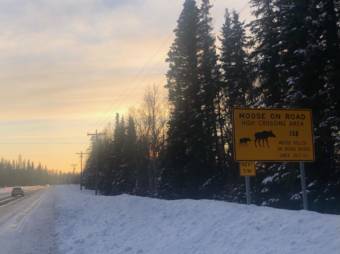
Since the Alaska Moose Federation closed up shop in November, Kenai Peninsula charities and organizations have had to get roadkill moose off the highway and into freezers themselves.

It’s been a challenge without AMF’s fleet of trucks and volunteers. And charities say they’ve struggled to get meat to the families and individuals on their lists.

Now, Alaska Wildlife Troopers are looking for small teams of volunteers to sign up online for their roadkill lists.
When there’s moose roadkill in the area, dispatchers will call those teams, who will have 30 minutes to respond. Teams can keep the meat they salvage.

Charities will still be able to retrieve moose and distribute meat to families and individuals. But Soldotna’s Laurie Speakman said the team system takes some of the pressure off the organizations to be the middlemen.

“This is something I’ve wanted to see for a long time, is the individualized program,” said Speakman, who was the AMF truck driver on the Kenai Peninsula. She’s known locally as Laurie the Moose Lady.

“And I think it will lighten the burden on the charities because they won’t have as many people on their lists needing meat,” she added.

Back when AMF was still in business, drivers like Speakman would pick up moose and coordinate with Alaska State Troopers to drop them off to AMF members.

At one time, AMF had a contract with Alaska Department of Transportation to deliver to anyone on the salvage list. In its most recent iteration, AMF was sustained by memberships.

But the nonprofit closed last year, facing a lack of funds from legal troubles and a decline in membership.

That’s put member organizations in a tough spot.

Max Pitts received moose at the Funny River Chamber of Commerce. He said it’s dangerous work without the lights, winch and other equipment AMF had. He’d sometimes field calls in the middle of the night.

“I won’t do it anymore,” he said. “And that’s been the problem, just trying to find people that have the ability to go get it.”

He said AMF’s program was valuable. Last year, he said the chamber served 120 people with the moose they received. A lot are elderly individuals and couples in Funny River.

“The other thing is, you can’t leave a dead moose lying alongside the road,” Pitts said. “Because it’s going to bring in bears and wolves and then you’re going to have more accidents.”

He thinks the new system will be better than nothing. But said he wishes AMF was still running.

Don Dyer, the most recent executive director for AMF, is trying to sell his fleet of four trucks. He said the organization plans to reimburse charities for their memberships — $500 apiece for peninsula charities. But he can’t do that until he makes the sale.

That doesn’t bother Pitts.

“I wouldn’t ask for it,” he said. “I know they gave you more value than we paid for. At $500 a year, they’re dropping off 10 to 12 moose. That’s going to be somewhere from $40 to $50 a moose, to have it dropped off.”

You can register to be a salvage team on the Department of Public Safety website. The new system goes into effect July 1.

At Middle Island Gardens, one couple is fortifying Sitka’s food web, one kale plant at a time

Fraga in one of her three gardens with her Corgi, Olive. (KCAW/Tash Kimmell)

It’s an uncharacteristically clear day in Sitka when Andrea Fraga picks me up in her skiff, her corgi, Olive, in tow.

The local gardener and self-proclaimed homesteader has agreed to give me a tour of the commercial garden she runs with her partner, Kaleb Aldred, a few nautical miles  from downtown Sitka. As we near Middle Island Gardens, Fraga spots a bear grazing in the inlet, a foreshadowing of the majestic and wild beauty of this place.

Even the root cellar, a solid wood door nestled into the moss covered earth, seems somehow ethereal. I joke that we could be in Middle Earth.

A view of the inlet at Middle Island Gardens (KCAW/Tash Kimmell)

“Middle Island anyway,” she replies.

As we walk the roughly 4000-square-feet of garden, bear spray in hand, Fraga points out the array of vegetables and ornamental flowers she’s painstakingly cultivated over the years. Gooseberry bushes give way to potatoes and lemon sorrel. A sea of garlic blends into towering kale plants. It’s from this bounty that Fraga is able to feed anywhere from 10 to 16 families a week, depending on the season. This may seem insignificant to some, but in Southeast Alaska, Middle Island is somewhat of an anomaly. Initially growing food only for Aldred and herself, the couple eventually bought the neighboring land and started a larger operation. While the towering spruce and moss-covered understory make it easy to forget, Sitka’s climate is incredibly inhospitable.

“It doesn’t seem like we have any appropriate agricultural land in Sitka for the most part. And then land is really expensive. The season is short and cool and wet. So you have to pick your crops appropriately, according to that,” says Fraga. “And I think especially if you don’t start out with crops that are going to be more successful, you could get discouraged really easily”

Living and growing on Middle Island has been a practice in patience. Once they fend off the slugs and harvest their bounty, they have to bring it into Sitka on their skiff. It’s a lot of work, but despite countless roadblocks Fraga and Aldred have stayed optimistic. From using seaweed and herring eggs as fertilizer to mixing sand and shells in the soil, Fraga has gained a wealth of knowledge through a small network of gardeners throughout the region.

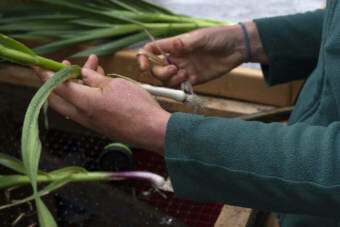
Fraga washes freshly picked green garlic (KCAW/Tash Kimmell)

“I feel like the growing community, the gardening and farming community in Southeast Alaska is really generous with knowledge not competitive so much. And that’s really great. We’re all kind of experiencing the same struggles,” says Fraga.

Even as she advocates for self-sufficient gardening, Fraga acknowledges her lifestyle is not accessible to everyone — another reason why operations like Middle Island Gardens are few and far between. With Sitka being as expensive as it is, she says she feels lucky to have the time and space to devote to such an undertaking.

However, in an island community that relies heavily on goods barged in from out of state, the reality of a food shortage is just one missed shipment away. It’s for this reason that local farmers like Fraga are so vital to the community.

One of the gardens at Middle Island Gardens (KCAW/Tash Kimmell)

“Well, I think, you know, you see, when the barge gets delayed, when we have bad weather in the winter, and then the grocery store shelves are emptying out, I think it’s just a good reminder that if at all possible, it’s best to be as self reliant as you can,” says Fraga.

With acidic, low nutrient soil already an obstacle, Fraga is being careful not to overwork the land. She hopes to find longevity and protect the vitality of the soil by planting more perennial flowers in the coming seasons.

Fraga walks the grounds of Middle Island Gardens with her Corgi, Olive (KCAW/Tash Kimmell)

“I feel like as I get older, I kind of like the plants that just like perennials, they just reliably come back like old friends and they don’t need all this pampering.”

Just like an old friend, Fraga hopes to be around for many years to come, her skiff brimming with brassicas as she pulls into Sitka’s harbor, a harbinger of full bellies to come.

With a haul of 11 whales this season, Point Hope gears up for Qaġruq festival

Guy Omnik stands with the baleen from Russell and Andrea Lane’s whale. (Photo courtesy of Guy Omnik for the Alaska Arctic Observatory and Knowledge Hub)

This weekend kicks off the Qaġruq Whaling Festival in Point Hope. Every year, people come from around the region for a three-day feast to celebrate the annual subsistence haul of the whaling season.

Rex Rock Sr. says he’s been whaling his whole life. The 60-year-old Point Hope captain says this year’s whaling season kicked off in early spring.

“Early April we went out,” Rock said. “The lead was further out this year.”

Rock explained the lead is the term for the crack in the sea ice that hunters follow to track the whales. He says this year’s lead was about seven miles outside town.

“We were able to get there,” Rock said. “I was happy that Russell and JJ Lane were able to land the first whale. They always say once you strike and land the first whale, everything else is going to fall into place.”

Point Hope whaling captains ended up landing 11 bowheads this year, a great year in Rock’s book.

With the hauling period over, Point Hope is preparing for the three-day Qaġruq Whaling Festival. Rock says over the first two days, captains will haul the whaling boats up and show off their crews flags before cutting up the whale for the large communal feast.

“First is what we call qalgi, the second day the avarriqirut, and then the third day we have an all-day cookout,” Rock said. “So we invite everybody to come up and sample all the food that we’ve been blessed with this spring.”

For many Inupiaq residents of Northwest Alaska, this year’s Qaġruq will be the first major community event since the COVID-19 pandemic began.

“I don’t think it feels much different,” Rock said. “Because we feel blessed when we go out to whale and provide for our community. Not only our community, but cousins in the outlying villages. Definitely we share the whale with everyone, everyone that wants a taste.”

Qaġruq begins on Sunday and will conclude Tuesday evening.


Site notifications
Update notification options
Subscribe to notifications