Food

Bethel tribe protests 15-day comment period for Donlin Gold water permits

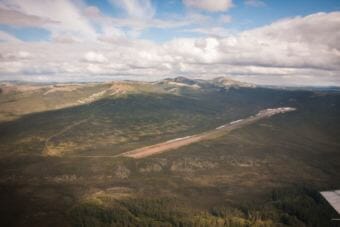
Donlin runway and camp site in summer 2014.
The proposed Donlin Gold mine would be one of the biggest gold mines in the world if completed. (Photo by Dean Swope/KYUK)

The Alaska Department of Natural Resources gave the public 15 days to comment on 12 water right permits for the proposed Donlin Gold mine in December 2020. The Orutsararmiut Native Council claims that wasn’t enough time, especially as villages locked down to slow the spread of the coronavirus, and taking into account limited access to the internet in rural Alaska.

Bethel resident and Orutsararmiut Native Council member Bev Hoffman has protested the proposed Donlin Gold mine for years and is frustrated that the Alaska Department of Natural Resources only gave tribes 15 days to comment on a dozen water right permits that it has granted to Donlin Gold. The comment deadline was December 15, 2020.

According to Hoffman, there are a lot of barriers to getting public comment in the Yukon-Kuskokwim Delta.

“Communities are in lockdown; they’re not meeting,” Hoffman said. “They don’t have internet data to hold big Zoom meetings.”

Hoffman is also worried that Donlin Gold’s plans for those streams will disrupt people’s way of life in the YK Delta. The Donlin Gold mine would be one of the biggest in the world, if completed, and will require a lot of water to treat the mercury and other toxins released during its operations. These 12 water right permits give Donlin Gold permission to draw down the water of 12 streams for its operations.

The Orutsararmiut Native Council’s letter to DNR echoed Hoffman’s concerns. ONC wrote:

“First, the Department must not proceed with approving these water rights applications without providing the public the opportunity to review and comment on those applications. Notwithstanding the inadequate information provided, we ask that the Department deny these applications pursuant to Alaska Statute 46.15.080 to 46.15.090 because they are not in the public interest and the existing uses of the waters that would be appropriated by these applications are far more important.”

Both Hoffman and the letter written by ONC said that the water permits further endanger the region’s food security.

“For them to be able to get this water permit that jeopardizes that food security in the manner that it’s happening, it’s so wrong and dangerous. Dangerous to the people that choose to live a way of life out here,” Hoffman said.

The Yukon-Kuskokwim Delta is one of the most food insecure regions in the country; many of its residents cannot access three meals a day.

Roughly 22% to 24% of YK Delta households are food insecure, according to Feeding America, a national nonprofit focusing on hunger relief. The organization reports that 21% of households in the Bethel Census Area are food insecure. In the Kusilvak Census Area, which includes villages along the lower Yukon River and Bering Sea coast, those rates are even higher, ranging from 25 to 29%. This makes it the second most food insecure region in the nation, just after Jefferson County, Mississippi. Feeding America reports that one in four Alaska Native households cannot access three meals per day, a rate double that of white households.

Most YK Delta residents depend on subsistence foods for the majority of their diet. The Kuskokwim River is the primary food source, and the Donlin Gold mine site would sit near one of its tributaries. The company has emphasized its commitment to building the mine as safely as possible.

A spokesperson for the state, Dan Saddler, said that the process was legal; state statute allows a 15-day comment period. The state can extend that deadline period, but Saddler said that they haven’t gotten a request to do that from any of the tribes or organizations who commented.

Correction: An earlier version of the article incorrectly said Donlin Gold was granted the 12 water right permits in December. That is incorrect. The public comment for the permits was in December. The article and headline have been updated to include a letter and comment from the Orutsararmiut Native Council that said that DNR did not give adequate time or information for public comment.

‘It brings back memories’: Northwest Alaska health provider cleared to make seal oil and serve it to elders

A jar of seal oil processed at the Siglauq building in Kotzebue. (Photo by Wesley Early, KOTZ – Kotzebue)

In Inupiaq communities, more than any other food, seal oil is a fixture.

“I had it for lunch today,” said Cyrus Harris. “I’ll have it for supper tomorrow.”

Like many Inupiaq people in the Northwest Arctic, Harris grew up eating traditional foods like seal oil, caribou and musk ox. When his relatives moved into Maniilaq’s Utuqqanaat Inaat long term care, he found they weren’t able to eat the same food they’d lived off for years.

“They didn’t choose to be living off the Western diet that they were being served every day,” Harris said. “So I found out I could cook a meal at home and take it to my ahna and taata over at the long term care, and serve it in that manner. But where does that leave the other 18 elders there?”

Seal oil has been a diet staple for Alaska’s Inupiat people for centuries. However, because of federal and state health regulations, you can’t buy it in stores and it can’t be served in restaurants.
Cyrus Harris is in charge of Maniilaq’s hunter support program. (Photo by Wesley Early, KOTZ – Kotzebue)

In 2015, Congress passed the federal farm bill which allowed people to donate wild game that they’ve hunted to certified non-profits, like hospitals or food banks. Since then, Harris has been in charge of Maniilaq’s hunter support program, which prepares traditional foods for elders at long term care.

The food is processed at the Siglauq, a state-certified meat processing building. The name comes from the Inupiaq word for the underground ice cellars used to store meat.

“Back in the day, everybody had their own Siglauq,” Harris said. “They had their own underground cold storage.”

Cyrus Harris shows frozen musk ox meat to be served to elders at Maniilaq’s Utuqqanaat Inaat long term care. (Photo by Wesley Early, KOTZ – Kotzebue)

Walking in the Siglauq freezer, Harris described some of the donations.

“These are some products that we will most likely use for our certain potlucks,” Harris said. “This is sheefish filet. We do have moose burger. We do have some musk ox burger.”

While getting wild meat on the menu for elders has gone smoothly for about five years, Harris says seal oil remained prohibited. The only time it could be served was at a potluck, and it had to be brought in from home. It couldn’t be made and served by Maniilaq – until now.

Just before the freezer in the Siglauq is the main processing room. And sitting on a table are three large drums with blubber floating in vats of seal oil. Harris describes the process for rendering the seal oil, which starts with separating the skin and blubber from the carcass.

“Then flesh the blubber from the skin,” Harris said. “And cut into maybe one inch by three inch pieces and set into containers like this.”

Three containers of seal oil being rendered by Cyrus Harris. (Photo by Wesley Early, KOTZ – Kotzebue)

Granted, Harris says most seal oil is made out in the field, and not under the strict lab requirements of the Siglauq.

“The best seal oil I ever had was stored in seal pokes,” Harris said. “Seal pokes have a long story behind it. It’s seal hides made into a container.”

While seal oil is generally ingested without incident, a major reason it was restricted was due to its connection to a foodborne illness called botulism, which can cause nausea, blurry vision, muscle fatigue, and in some cases, death. Since the 1950s, the Maniilaq service area has seen more than 15 outbreaks of the illness tied to eating traditional Native foods.

Chris Dankmeyer is environmental health manager for Maniilaq. For the past few years, he, Harris and others have been collaborating to develop a way to safely render seal oil. Those include food safety scientists at the Kodiak Seafood and Marine Science Center as well as microbiologists at the University of Wisconsin. After several years of running lab tests, they found that heating the seal oil to 176 degrees for 10 continuous minutes made seal oil safe.

“That completely destroys the toxin that may or may not be in the oil,” Dankmeyer said.

Dankmeyer stated that this heat treatment has only proven to make pure seal oil safe and not seal oil that contains other traditional additives.

“We’re not keeping blubber in there,” Dankmeyer said. “We’re not throwing in pieces of dry meat. And that’s a traditional thing.”

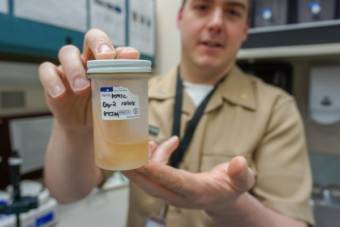
Chris Dankmeyer displays a sample of seal oil in 2018, when researchers were developing a method to heat treat the oil (Photo by Anne Hillman/Alaska Public Media)

Once the seal oil is heat treated, it’s rapidly cooled to prevent the toxin from reforming, and placed in the freezer where all the other traditional foods are.

“And we keep it frozen until it’s time to serve,” Dankmeyer said. “Basically, over there at the hospital, they’re going to dip it out frozen into a serving dish. It’s going to come up to room temp and be eaten.”

Dankmeyer says the last step is to make sure that Maniilaq’s kitchen staff are prepped on how to safely handle and serve the seal oil. For example, it can’t be left out for more than four hours, or it runs the risk of creating more toxin.

In the next few weeks elders can look forward to seeing plates filled with the traditional foods they’ve eaten their whole life.

One person excited to see the reactions from elders is Marcella Wilson, who heads Maniilaq’s long-term care facility. She says elders have been able to have seal oil during the occasional potluck, and she always sees an immediate reaction.

“It brings back memories,” Wilson explained. “Memories of when they were children and how they had the seal oil and traditional foods growing up. And that brings about storytelling. And then the storytelling starts bringing about laughter.”

Wilson says that she’s learned a lot about the Inupiaq culture from the elders, and she expects them to feel more lively as their traditional foods become more available.

“I’m not saying there’s magic in it, because there’s not,” Wilson said. “But there is such a nutritional value to it and such a cultural value to it, that the two together are just immeasurable.”

Dankmeyer says Maniilaq is the first organization in the nation approved to make and serve seal oil, and he’s excited to share their process with other organizations in the future.

Prince of Wales trappers report 68 wolves taken in 2020

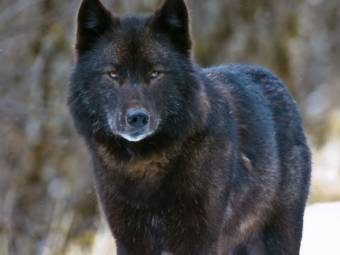
An Alexander Archipelago wolf in Southeast Alaska. (Robin Silver/Center for Biological Diversity)

State wildlife officials have reported that 68 wolves were taken by trappers on and around Prince of Wales Island.

Conservationists had unsuccessfully sued to block the 21-day trapping season. They argued that the state and federal officials are allowing wolves to be killed unsustainably.

But regional wildlife supervisor Tom Schumacher says the Alaska Department of Fish and Game’s managers are confident the island’s Alexander Archipelago wolf population is healthy.

If you can catch 68 wolves in three weeks,” Schumacher told CoastAlaska, “I think that means you still have a pretty robust population of wolves.”

The state agency estimated around 316 wolves in the fall of 2019. But that number doesn’t include the record 165 wolves  reportedly killed by hunters and trappers over four weeks later that year.

State biologists won’t have the fall 2020 population estimate until later this year to assess the impact of the latest harvest.

“We’re pretty confident that we’ll have a fall population right within our population objective range of 150 to 200 wolves,” Schumacher said.

Conservationists argue that the wolf population is threatened and that some hunters and trappers don’t report their kills. The Center for Biological Diversity filed a petition with federal authorities to list the grey wolf subspecies.

“This level of carnage shows that wolves in Southeast Alaska desperately need the protections of the Endangered Species Act or they’ll become another statistic in the wildlife extinction crisis,” Shaye Wolfe, a staff scientist in Oakland, California wrote in a statement for the organization.

Prince of Wales residents have testified in hearings that the true wolf population is higher than official estimates. Many blame the canine predators for the deer population falling in a place where venison is an affordable alternative to expensive store-bought meat.

Conservationists counter that decades of commercial clear cuts on Prince of Wales Island forests are to blame for thin deer herds. A legal challenge  filed by the Anchorage-based Alaska Wildlife Alliance is headed for trial. A date is expected to be set in February.

Moms couldn’t get baby formula in Russian Mission after the postmaster resigned, so they called in the National Guard

Russian Mission in 2018. (Dept. of Commerce, Community, and Economic Development)

Russian Mission’s post office has been closed on and off for nearly six months, and that’s made it hard for parents to feed their babies.

Before August, if you were a new mother in Russian Mission, you were probably getting your baby’s formula through WIC, a federal option that helps boost food security for mothers and kids under five. It would have come through the mail. You also could have bought formula at the store or ordered it online. Either way, it would arrive via the post office.

But ever since the postmaster resigned, mothers have been left to scramble for new options. Tribal Administrator Olga Changsak has been trying to get formula to Russian Mission for months.

“The mamas are getting very stressed out,” she said, “But they’re nice enough to share amongst each other.”

Changsak has two grandchildren on formula, so she did what any concerned grandmother and tribal administrator would do.

“I called and got a hold of National Guard and Homeland Security,” she said.

Changsak said she was working with those government entities to get formula up until two weeks ago, when they were called away to a different emergency: devastating landslides in Southeast Alaska. Luckily, other organizations stepped in.

Word about babies without formula spread to the state Department of Homeland Security and Emergency, who contacted the Salvation Army. They got in touch with Changsak and shipped 120 pounds of baby food and formula to Russian Mission via cargo plane. It was briefly lost in transit but finally arrived late last week.

While Changsak was waiting for the shipment, the tribe reached into its own bank account and purchased a small but costly emergency freight order of formula from the store in Aniak. Changsak hopes it arrives soon, before the Salvation Army formula runs out.

And the post office closure has delayed more than just baby formula. Residents have developed other temporary workarounds to access critical supplies. Some residents are receiving packages from private shipping company UPS. The regional tribal health corporation is sending prescriptions to the village clinic by small plane, rather than through the mail.

Occasionally, the village is able to borrow a postmaster from the downriver community of Mountain Village, who comes every few weeks and sorts through the heap of new mail. The village council president helps distribute it. But until Russian Mission gets a permanent postmaster, problems will remain. There are some things the tribe can only do through the mail.

“The thing that hurts us as a business is we have checks we have to send out for our bills and stuff. And with no post office, we’re gonna get penalized, you know?” Changsak said.

But all these solutions are temporary. What is Changsak really hoping for?

“I think I should write to Santa and ask him for a postmaster for Christmas,” she said.

Changsak said Russian Mission does have one applicant for the position of postmaster, but the hiring process is slow.

The United States Postal Service and Alaska’s U.S. Senators did not respond to our requests for comment for this story.

Correction: A previous version of this story said that FEMA contacted the Salvation Army about the shortage of baby formula in Russian Mission due to the town’s post office closure. That is incorrect. The Alaska Department of Homeland Security and Emergency management contacted The Salvation Army about the shortage.

Federal COVID-19 funding for Alaska farmers largely lies fallow

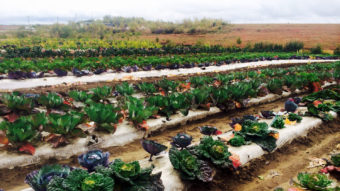
A field near harvest time at Meyers Farm in Bethel, Alaska, can now grow crops like cabbage outside in the ground, due to rising temperatures. Daysha Eaton/KYUK
A field near harvest time at Meyers Farm in Bethel, Alaska. (Daysha Eaton/KYUK)

All Alaska agricultural producers are eligible for federal assistance under a new USDA program. But days before the deadline, not many have applied.

This is the second round of Coronavirus Food Assistance Program, or CFAP, administered by the USDA’s Farm Service Agency. Round one was reserved for producers who worked with certain commodities and could prove they were impacted by the pandemic.

This round is open to many more producers working with a large swath of commodities, said Alaska FSA Program Manager Jeff Curry. That includes peonies, a popular crop on the Kenai Peninsula.

“Any farmer in Alaska that sells their commodity commercially would probably have a commodity out there that is on the eligible list,” he said.

But as of Sunday, only 46 Alaska applications had been approved — a small fraction of the 760,000 applications approved nationwide. The USDA’s most recent Census of Agriculture identifies nearly 1,000 farms in Alaska, with a total market value of over $70 million.

Curry said he’s not concerned about the numbers because his office has done a lot of outreach to local organizations and to commodity groups like the Alaska Peony Growers Association. He says at this point, it’s up to producers.

Abby Ala, of Ridgeway Farms in Soldotna, plans on applying for the program. She said she’s heard producers say they’re hesitant to apply for federal funds because they worry about government control.

“I’ve been in a situation for about 40 years of being on boards that have watched and there has been no government intrusion on farmers,” she said.

Ala has benefited from other federal programs during the pandemic, including a grant that helped the Alaska Food Bank buy produce from her and other farmers.

Generally, Ridgeway Farms had an okay season.

“Oh, kind of average to a little below average,” Ala said.

Heidi Chay, district manager of the Kenai Soil and Water Conservation District, said she’s heard similar reports from other local farmers.

“A lot of Alaska producers did well this year. There was strong demand for local food,” she said. “If they weren’t prevented from being face-to-face at the market because of their own health concerns, they might have done quite well.”

Farmers markets and a surge of local shopping this summer helped some surpass their 2019 sales. The Kenai Peninsula Food Hub, an online marketplace for local farmers, saw sales triple this year.

Data from the USDA breaks down how funds have been distributed to Alaska farmers since the program opened earlier this fall.

Because of this, Chay said she thinks some farmers will think they are not eligible for funding. But CFAP2 funds are available to any producer, regardless of how they were impacted by COVID-19.

“We really looked at it and USDA determined that everybody’s been impacted by COVID-19, whether it’s getting supplies in or selling their product, and this is just one way to give them some relief from that,” Curry said.

Beyond misconceptions about funding, some producers may just not want to apply. Alaska FSA Executive Director Bryan Scoresby said that could be a factor for some of Alaska’s many small producers.

“We have a lot of very small farmers in Alaska and with the size of it, by the time they go through and figure how much money it’s worth to them, they say it isn’t worth the effort of applying,” he said.

Payments are limited to $250,000 per producer. Recipients are eligible for a portion of their 2019 earnings on a sliding scale.

Lou Heite, of Eagle Glade Farm in Nikiski, said she’s not sure if she’ll apply for funding. She said her farm did pretty well with some crops and poorly in others this year.

“My experience with most USDA programs is that if you can’t afford a bookkeeper, at least, and preferably an accountant, the amount of work involved in doing the applications doesn’t pay back,” she said. “And, yes, it’s wintertime, yes, we’re sitting around looking out the window at the snow. But, you know, there’s still other things that have to be done.”

The FSA gave out under $300,000 to 18 Alaska producers in the first round of the program and almost $10.5 billion nationwide.

So far in the second round, it’s given out about $415,000 in state and over $11.5 billion nationwide.

The deadline to apply for CFAP2 is Dec. 11.

After low salmon year, supporters rally to get Yukon River mushers dog food for winter

Residents help unload bags of Purina dog food in Tanana (Photos courtesy of Courtney Agnes in Tanana via Stephanie Quinn-Davidson)

Donated dog food is making its way to some Yukon River communities where poor salmon runs have left mushers without fish to feed their teams.

When village mushers reached out to her back in September, Yukon River Intertribal Fish Commission Director Stephanie Quinn Davidson says she wasn’t able to take official action.

So Quinn Davidson says she decided to launch her own online effort to seek help.

“I took to Twitter and Facebook, my personal pages, and just posted kind of the plight that we are facing on the Yukon River with these low salmon runs, what it means for these traditional dog mushers,” she said. “I tagged a bunch of large dog food companies in that post and one of them, Purina, responded.”

Davidson says Purina agreed to provide 39,000 pounds of premium dog food, and shippers Tote Maritime and Carlisle got the kibble to Fairbanks. She says she started a GoFundMe page to cover the cost of flying the food to villages. And the mushing community responded with hundreds of donations

“We raised enough money to ship it out to rural Alaska, but then I had an individual, Rocky Riley, in Fairbanks reach out to me and say, ‘Hey, I might be able to get Everts Air Cargo and donate the freight for you, and then you would have more money to be able to buy even more dog food and help out even more mushers,’” she said.

Quinn-Davidson says Everts shipped the initial batch of Purina-donated dog food to Fort Yukon and Tanana in mid-November

“The mushers are so so grateful,” she said.

Tanana musher Pat Moore credits Quinn Davidson with leading the effort to help village mushers get their dogs through the winter.

“In my mind, she’s kind of like a saint,” he said.

Moore says the village received 26,000 pounds of kibble, which was divided on a per dog basis among local mushers.

“I’ve heard that everybody in Tanana has enough to last them through the end of April.”

Ongoing donations from individuals and businesses are expanding the effort. Quinn-Davidson said mushers in additional communities including Circle, Huslia, Hughes, Holy Cross, and Old Crow in the Yukon Territory are also receiving food for their dogs. In all, she said they’re helping feed 500 dogs.

Quinn-Davidson says the effort has so far raised over $120,000 in food, transportation and cash donations.

Site notifications
Update notification options
Subscribe to notifications