Food

At Sitka herring camp, an advocate passes down subsistence traditions

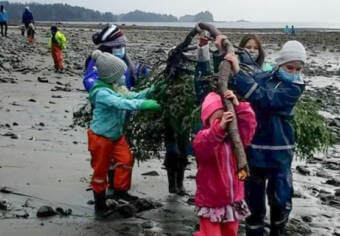
Students at Herring camp carefully carry a Hemlock branch across the beach. Gamble said he told students to treat the branch like they would their food, taking care to not let it drag in the sand. (Courtesy of Tom Gamble)

The beginning of the herring spawn in Sitka Sound signals the wind-down of commercial fishing and the start of the subsistence harvest: the millennia-old tradition of submerging hemlock branches along the shoreline, and waiting for herring to coat them in a thick layer of eggs.

Subsistence harvester and former Tribal Council member Tom Gamble is determined to see this tradition continue — by working to protect herring stocks and teaching kids how to harvest eggs. This spring, he shared some of his knowledge in a herring camp for kids.

“This was their first time seeing what subsistence herring eggs are all about,” Gamble said about his herring campers. “They’re really excited about it, they, they like to eat them, but they’re not really sure how to harvest them.”

Gamble said the camp created a lot of “aha” moments.

“There were a lot of those moments for these kids who had never seen anything like it before,” he said. “Giving them just the mental images for the first time, and being able to manipulate, you know, a branch and a twig and, and the hope that maybe they might get some eggs.”

The camp is an extension of his new business, the Alaska Native Indigenous Training Academy, or ANITA, named after Gamble’s late mother. Over the course of several hours one day in late March, he taught around 10 students and their chaperones the basics of harvesting herring eggs on branches, from the technical to the familial.

“So the very first activity they had to do was to go and find a rock together. And then they had to learn how to tie it together and to communicate what works and what didn’t,” he said. “Because if you’re out there and you’re harvesting, and you’re not talking with your family, then it’s just work. You might as well just get a job and call it work. It’s got to be fun.”

“Helping Tommy set the trap for the herring — it was fun,” said 8-year-old Lukas Schmidt, who participated in the class. “I liked doing it, and I got to learn something new,” he said.

Lukas’s mom Jeren said the camp was an important experience for her kids and her homeschool classroom.

“It’s important to carry on some of the Tlingit traditions and to learn about them,” she said. “My family and I are Iñupiaq, so this is all new to us, but it’s fun to learn about the traditions of the local Indigenous peoples.”

Lucas Schmidt holds a buoy (often an empty milk jug or water bottle) as Tom Gamble demonstrates how to set a branch along the shoreline. (Courtesy of  Jeren Schmidt)

Subsistence is a lifelong practice for Gamble. He is Kiks.ádi from the Clay house and his family uses the Herring Rock as their emblem, signifying strong cultural ties to Sitka herring for thousands of years. His advocacy for herring has become energized by what he’s seen on the water over the last couple of decades.

“As a subsistence harvester, we’re the frontline. We see a lot of changes,” said Gamble. “My involvement if you would, wasn’t chosen, where I wanted to draw a line in the sand and say ‘I want the commercial side to be over here and I want the subsistence guys to be over here,’” he said. “My involvement came because we realized if we didn’t stand up, there were never going to be any changes, and we were going to get run right out of our own way of life.”

The Sitka Tribe of Alaska sued the state in 2018, calling for changes to the management of the commercial fishery. The case is still being litigated but some incremental changes have been made. The state must further document its efforts to show they’re allowing “reasonable opportunity for subsistence.” But Gamble is concerned that the state’s modeling is far from perfect.

“Most recently, the indescribable coming back from a different harvesting trip, I had to stop in the middle of the ocean to watch the herring surface,” Gamble, thinking back on a day in mid-March. “This was on the day that science flew everywhere in the Sound and said that they didn’t see a single herring. So the traditional harvester had the herring come up under me. I’m telling you again that our traditions and our knowledge have proven over time. When we say that the herring are disappearing, that’s what we meant.”

Gamble understands that commercial seiners are just trying to earn a living, but he believes the fleet is too large and should be reduced through a permit buy-back program. And he’d like locals to have a larger role in managing the fishery through a stakeholders committee.

In the meantime, it’s important that the subsistence harvest of herring remains viable in Sitka Sound, so that it can be taught down through the generations. Gamble plans to continue teaching subsistence camps throughout the year. It’s a way to honor his mother, Anita, and a hedge against the day when he is an elder himself and may depend on others for this food.

“When I was growing up I never thought for the life of me that even my own kids would be so busy that I can’t get help harvesting. And I thought ‘Well maybe if I trained a couple of these youngsters around here, I can sit at home and one day they just bring me a deer or a seal,'” Gamble said. “I’m gonna train this next generation how to take care of Elders in their community by just taking care of themselves.”

Editor’s note: This story is part of a series sharing different perspectives on herring.

Low Stikine sockeye forecast could mean early subsistence closure

Boat leaving Wrangell, 2020. (Sage Smiley/KSTK)

Federal managers are warning that there may not be enough sockeye salmon to allow a full season of subsistence fishing on the Stikine River. That could lead to a premature closure of an important source of food in the Wrangell area.
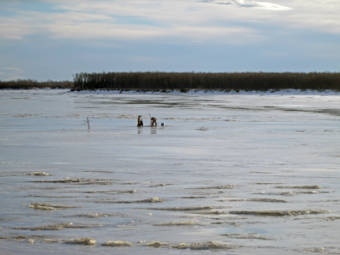
Federal fisheries biologist Rob Cross manages the districts near Petersburg and Wrangell. He says the U.S. Forest Service doesn’t take these decisions lightly.

“Our goal certainly isn’t to close the subsistence fishery,” Cross said. “This year, we have a below average preseason forecast for sockeye. So basically, we just want to give harvesters a heads up and let them make an informed decision about where they’re going to focus their efforts this year.”

The preseason forecast for Stikine sockeye is 56,000 fish. That’s less than half of the 10-year average.

Cross says managing the subsistence fishery is a balancing act.

“Our primary goal is to maximize subsistence opportunity for these communities, because they really depend on the Stikine fishery,” he said. “But at the same time, we need to make sure that there’s a healthy stock for fish as well. So we’re basically just letting people know that there’s a possibility of a closure throughout the season.”

An early closure isn’t guaranteed. The Forest Service says it will be working with Wrangell’s tribe, the Wrangell Cooperative Association, to conduct harvest surveys throughout the summer.

This isn’t the first time in recent years that a low pre-season forecast has led the Forest Service to warn subsistence fishermen of a possible closure for sockeye harvest. In 2019, Wrangell District Ranger Clint Kolarich closed the subsistence sockeye fishery nine days before the set close date because of low escapement.

Cross says that possible closures to the sockeye subsistence fishery up the Stikine would not affect the coho subsistence fishery in the area.

The federal subsistence fishery for chinook salmon has been closed since 2017 due to low return numbers and mature fish being smaller than average.

Management of Kuskokwim king salmon uncertain after Dunleavy order

Kuskokwim River at Bethel on January 25, 2014. (Ben Matheson/KYUK)

State and federal fishery managers are waiting on more information to determine which government entity will have the authority to manage king salmon on the lower Kuskokwim River this summer.

Since 2014, federal officials have managed the harvest of kings in the lower Kuskokwim to conserve the salmon species at the request of local subsistence users. Federal officials managed the harvest in federal waters within the Yukon Delta National Wildlife Refuge, but it’s unclear if federal managers will have that authority this summer.

Last week, Gov. Mike Dunleavy sent a letter to President Joe Biden saying that the state was taking control of Alaska’s submerged lands beneath navigable waters, citing the 2019 U.S. Supreme Court decision in Sturgeon v Frost, which affirmed the state’s right to manage travel on a navigable river.

Alaska’s congressional delegation supports Dunleavy’s assertion. The Sturgeon decision includes language that upholds federal authority over subsistence management in waters that pass through federal lands. Dunleavy said that the state will release maps showing which waterways the state plans to assert control over.

Yukon Delta National Wildlife Refuge Manager Boyd Blihovde would serve as the Kuskokwim River federal fishery manager if federal authority assumed management of the lower Kuskokwim king salmon. Blihovde said that he and his staff are waiting to see if the refuge waters will be included on the state’s forthcoming maps.

“Until forced to do something differently,” Blihovde said, “we will continue to work very hard to collaboratively manage the Kuskokwim River with all partners who have a stake in its conservation.”

Charles Brazil, state fishery manager with the Alaska Department of Fish and Game, said that the management authority under the new state policy “has not been fully determined. However, the department’s intent is to take the same management approach this season as in recent years.”

At stake is co-management with Kuskokwim tribes. Federal managers have an agreement to consult with the Kuskokwim River Inter-Tribal Fish Commission on salmon management. State managers do not have this obligation.

Financial needs linger among Alaskans, a year after the start of the pandemic shocked the state’s economy

Byron Corral helps pass out boxes of food at the Food Bank of Alaska’s emergency distribution site at Tikahtnu Commons in East Anchorage on Monday, July 20, 2020. (Tegan Hanlon/Alaska Public Media)

In the spring of 2020, Alaska was seeing the first impacts of the pandemic. That included a huge spike in unemployment as the state asked residents to stay home and imposed restrictions on businesses and travel.

Suddenly, many Alaskans were in need of a lot of help, and organizations worked quickly to provide it. While needs have settled down after that early spike, many Alaskans are still dealing with the financial impacts of the pandemic, which are expected to linger in the months ahead.

Alaska 211 is a hotline run by the United Way of Anchorage. It’s a place residents can turn to when they need help finding resources for things like food, housing, health mandates or information about vaccines.

“The 211 system is a bellwether for any community condition that’s happening,” said Sue Brogan, chief operating officer of United Way of Anchorage. Brogan’s in charge of the 211 hotline. She said the pandemic caused a dramatic increase in the number of calls to the hotline.

“In June of 2019 we had a call volume total for the month of 1,301 calls,” said Brogan. “In June of 2020 we had 8,435 calls.”

While calls have slowed from summer highs, Brogan said she expects pandemic impacts to continue into the months ahead.

Cara Durr, with the Food Bank of Alaska, said the organization saw an average 75% increase in demand for food assistance early on. She said that demand has leveled off some — it ebbs and flows — but Durr said it’s remained high, and it’s not going away.

“Looking at the last six months of 2020, compared with last six months of 2019, Food Bank of Alaska distributed 43% more pounds of food,” said Durr. “Which is a huge, huge increase for us.”

Durr said the food bank expects high demand to stick around.

“We’re thinking very long term,” said Durr. “The need is certainly very elevated right now. But we expect that even as things improve with the pandemic, we’re going to see the economic repercussions of this for quite some time.”

While thinking ahead, Durr said there’s a more immediate concern. Earlier this year, Alaska’s COVID-19 emergency declaration lapsed, and the state has yet to implement a new one. That’s put emergency allotments of Supplemental Nutrition Assistance Program benefits in jeopardy.

Durr said the increase in SNAP benefits during the pandemic funds about 2.2 million meals a month for Alaska residents, amounting to about 1.4 million meals on top of what the food bank distributes monthly.

“So clearly, this is a huge gap that we would be trying to make up,” said Durr. “And really, it’s just not possible.”

It’s not clear what’s happening with emergency SNAP benefits. The Alaska Department of Health and Social Services said it’s waiting to hear back from the federal government about its request for the benefits for the month of April. According to the department, Alaskans may be able to receive the benefits without an emergency declaration.

Many Alaskans also still need help paying their bills.

In March, just over 29,000 residents applied for rent and utility relief through the Alaska Housing Finance Corporation. That’s up from around 8,000 people who applied for an earlier rent and mortgage assistance program. Bryan Butcher is the organization’s executive director.

“It was early in the pandemic when we ran last year’s program,” said Butcher. “So a lot of people that might have been under more financial distress weren’t there yet. Now it’s been going on for a long period of time. And obviously there’s a difference between having lost your job for a month and having lost your job for nine months or 10 months. The amount of assistance we can give is also different.”

The recent program offers up to twelve months of assistance, and can cover current or past payments.

Major John Brackenbury, divisional commander of the Salvation Army Alaska Division, said while some of his organization’s programs changed, nothing stopped because of COVID-19. In fact, he said, the Salvation Army ramped up its efforts.

Brackenbury said the need among Alaskans is still great, but things are a lot calmer now, and there’s a lot more money available.

“People are becoming more aware of what’s out there, what’s available, how they can get help,” said Brackenbury. “There have been a lot of other opportunities through the CARES Act dollars that have been made available to state and local governments that the Salvation Army has benefited from as well, in being able to provide necessary assistance to individuals across the state.”

Brogan, with United Way, said she’s grateful for the resources that entered the state during the pandemic to help meet the needs of Alaskans.

“Everyone’s been trying to go above and beyond, because the need is still great,” she said.

According to the Alaska Department of Labor, January job numbers were down 7.4% from the same month in 2020 — that’s 23,000 fewer jobs.

Without the Alaska Moose Federation, roadkill salvage falls to charities

Salvage teams across the state retrieve and deliver roadkill moose to people in need. On the peninsula, that work falls directly on local organizations and charities. (Sabine Poux/KDLL)

Moose didn’t stop crossing the road when the Alaska Moose Federation closed up shop late last year. And there are still hungry families that can use the roadkill meat.

Without the Moose Federation, the salvage work is largely up to charities. It’s hard work.

“And if they can’t do it, then they’re denying the moose,” said Laurie Speakman, known as Laurie the Moose Lady.

Speakman was the Moose Federation truck driver on the Kenai for years. The federation shut down in November due to a lack of funds, from legal troubles and a decline in memberships.

Previously, charities on the peninsula took out memberships with the Moose Federation. Volunteer drivers, like Speakman, would pick up moose roadkill in AMF trucks and bring the meat to members, who then distributed it to people who could use it.

Now, law enforcement calls charities directly. Speakman said that without the organized support from AMF volunteers, moose often end up sitting on the road for longer.

“I do feel that there is a need to have some sort of general program, ’cause some of the charities just aren’t doing it, but they still want the meat,” she said.

Not all charities on the list have the bandwidth to send someone to a site. Speakman said the local branch of Veterans Affairs, for example, has had a hard time responding to moose calls and has had to pass on collecting carcasses.

It’s something she thinks could be fixed with an individual salvage team — a model used in other parts of the state.

“In order to set up a salvage team, like let’s say I would run it, as an example, under Laurie the Moose Lady, or figure out a different name,” she said. “My high hopes would be to completely be able to work with Fish and Game, Wildlife Troopers, State Troopers and local PD.”

Speakman and a friend are trying to develop a plan to create their own team, but she said funding is a huge barrier. Between trucks, insurance and fuel, costs are steep. Speakman considered buying a truck from Moose Federation Executive Director Don Dyer but said it was too expensive.

“’Cause I do. I really miss picking up moose right now,” she said.

Anchorage’s largest soup kitchen pivots to packaged meal service, with long-lasting effects

Workers prepare dinner at Bean’s Cafe 3rd Avenue location on March 3, 2021 (Lex Treinen/Alaska Public Media)

Since the pandemic began, Anchorage’s largest soup kitchen has had to overhaul how it serves residents in need of a hot meal moving from communal meals to prepackaged ones. And those changes may be part of a lasting shift in how the city addresses the needs of residents who are homeless.

The benefits of moving to pre-packaged meals have been two-fold, said Scott Lingle of Bean’s Cafe. First: COVID safety. Soup kitchen managers realized that communal meals were a big vector helping to spread the disease.

That concern will fade away with concerns about COVID-19, but Lingle said that there’s another bonus: prepackaged meals offer homeless residents flexibility.

Workers prepare trayed meals for the packaging machine at the Bean’s Cafe 3rd Avenue location on March 3, 2021. The machine can process over 30 trays per minute. (Lex Treinen/Alaska Public Media)

Imagine you are without a place to live, said Lingle. With prepackaged meals, “I can focus my energy and my attention on finding housing or finding a job, or whatever I need to focus on in my day, it might even be something as simple as getting some sleep. I can focus on that because I don’t have to worry about food,” he said.

At the Sullivan Arena shelter, communal lunches are still served, though managers hope to phase them out within a month. Lunch still draws dozens of guests who stand in a line that snakes around the mezzanine level in front of the concession stand.

Residents receive lunch meals of turkey or ham sandwiches at the Sullivan Arena emergency mass shelter on March 8, 2021 (Lex Treinen/Alaska Public Media)

Guest Jonathan Cash said that he likes the prepackaged meals. He said sometimes the communal meals aren’t enough, so he’ll stash a meal away for later.

“Sometimes I’ll wake up in the middle of night hungry, and I’ll have one of those,” he said, “I think my favorite would be fried rice with chicken.”

The packaged meals are offered 12 hours a day, and shelter operators say the lines have gotten shorter as guests have gotten used to having meals available throughout the day.

The pandemic forced Bean’s Cafe to do a quick pivot. It not only took over operations of the Sullivan Arena shelter but also had to expand food production about threefold. Paid staff in the kitchen on 3rd Avenue near Ship Creek went from two to 40 basically overnight.

Bean’s Director Lisa Sauder said that as the number of people within the city’s shelter grew, Bean’s and its partner organization, Children’s Lunchbox, have increased the number of meals it serves threefold. It’s now delivering 2300 meals a day to the Sullivan and other hotels.

“In just under a year, that’s tremendous growth,” said Sauder.

The expansion of its kitchen has offered opportunity for some of the soup kitchen’s patrons as well. Head Chef Aaron Dollison, who himself struggled with addiction and homelessness and frequented Bean’s in his younger years, has kitchen staff that includes a number of people who were residents at the Sullivan. As part of the Shelters 2 Success program, people like Francisco Calvo have been able to get full-time work preparing meals. Calvo found himself at the shelter when he lost a job due to the pandemic.

Francisco “Frisco” Calvo at his job at the Bean’s Cafe kitchen on March 5, 2020 (Lex Treinen/Alaska Public Media)

“I’m quite blessed that I actually am working, you know, and I’m actually contributing to help people, whether it’s just putting a smile or putting food in their stomach,” he said.

And he’s learning more than just how to make spaghetti and meatballs. He’s learning skills and techniques that will help him in other restaurant jobs.

“We’re not just trying to do the basic European meals, we’ll try to mix it up. We’ll throw in adobo, we’ll throw in kimchi fried rice, just to give people a different diverse flavor,” he said.

Bean’s sold its old kitchen as part of a larger property acquisition by a group of philanthropists while it waits to move into a new permanent spot. It’s now relocating its kitchen to a smaller administrative office.

The Sullivan Arena emergency mass shelter on March 8, 2021 (Lex Treinen/Alaska Public Media)

There’s a lot of uncertainty for the operation still as Anchorage must decide how it wants to address homelessness once it closes the temporary mass shelter at the arena.

“I think there’s a lot of community discussions that have to happen. Do we want one big shelter? Do we want numerous smaller shelters? Do we want a combination? There’s many options on the table,” said Sauder.

City officials have said they hope they hope to have a more permanent option for guests currently staying at the Sullivan Arena by the end of the summer, but the plan will ultimately fall to the next mayoral administration and the Assembly.

Site notifications
Update notification options
Subscribe to notifications