Food

Renovations planned at Superbear IGA

Tyler Myers, president of The Myers Group, says they hope to update Superbear IGA with new flooring and lighting while the deli and produce sections will be expanded. (Photo by Matt Miller/KTOO)
Tyler Myers, president of The Myers Group, says they hope to update Superbear IGA with new flooring and lighting while expanding the deli and produce sections. (Photo by Matt Miller/KTOO)

A makeover is planned this summer and fall for the Superbear IGA store in the Mendenhall Valley.

“In my opinion, the Superbear store is a very well run store,” said Tyler Myers, president of Washington-based The Myers Group and new owners of the store that anchors one end of the Mendenhall Mall. “The standards, the sanitation is all very, very good. But I do think it is a bit dated.”

Myers said their recent purchase of Superbear was just an opportunity that came up. Former owner Charlie Robinson passed away and his wife Judy Robinson was interested in selling. Myers referred to a confidentiality agreement and declined to disclose the price of the June 18 purchase.

(Photo by Matt Miller/KTOO)

“Superbear was something that came along when we came to Juneau. That wasn’t our goal to have two stores in town,” Myers said. “We’ve become very fond of Juneau. We think the people are great. Obviously, one of the most beautiful places on the planet.”

The Myers Group just finished renovating their previous purchase, Alaskan & Proud in downtown Juneau which became Foodland IGA and Ace Hardware. A pharmacy may open at the back of the hardware store later this summer and another small storefront at the Foodland Shopping Center is tentatively designated as either a future liquor store or health supplement store.

“Then, ultimately we would like to run both the stores as IGA stores with a common ad, leverage our buying power with the two stores, be able to lower some retail (prices) and make better offers for customers, and run two sister stores in Juneau with one on each end of town,” Myers said.

Myers said they retained all of the Superbear employees at the same pay, provided a retirement plan and provided medical, dental, and vision coverage for those working over 30 hours a week. There are 180 employees total at Superbear and Foodland, and current part-time workers could split their work at both stores to pick up more hours.

As for the upcoming renovations at Superbear IGA, Myers said they won’t be knocking down walls or rearranging the store’s layout. He wants to preserve Superbear’s back room, which is an expansive warehouse space and big walk-in freezer at the rear.

Tyler Myers says the Superbear IGA back room includes a walk-in freezer of approximately 2600 square feet. (Photo by Matt Miller/KTOO)
Tyler Myers says the Superbear IGA back room includes a walk-in freezer of approximately 2,600 square feet. (Photo by Matt Miller/KTOO)

Instead, he said they’ll update the store’s lighting, flooring and exterior signage, and slightly expand the produce and deli sections.

Like at Foodland IGA, Myers said hundreds of new items will be introduced at Superbear IGA. Many of the new products will include specialty, natural and organic foods.

“For the consumer, what drives our business is the customer,” Myers said. “So, if a customer comes in and there’s something they don’t see that they want, all they have to do is ask.”

Besides a possible limited expansion to the meat counter, Myers promises no major changes to what may be the most popular department at Superbear.

“The meat counter in the store has an unbelievable reputation,” Myers said. “If you don’t hear anything else I tell you, my number one goal is not to mess up anything that is working really, really well.”

In addition, The Myers Group’s new company Seak Distributors will be distributing Sysco products and Franz baked goods in town.

State changes food stamp rules for “able-bodied adults without dependents”

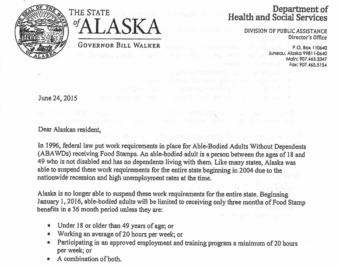
In this letter dated June 24, 2015, the state Department of Health and Social Services informs food stamp recipients of changes to the program.

A change in state policy will end access to food stamps for thousands of Alaskans.

A letter sent out from the Division of Public Assistance on June 24th to all state residents receiving Food Stamps says “able-bodied adults without dependents” who do not meet the program’s work requirements will no longer be eligible three months into the new year.

Most food stamp recipients will not be affected. The work requirements hit those who are between ages 18 and 49, do not have a noted disability status, and have no dependents.
But the letter has left many worried they will lose important access to food.

“We received… five, six calls just in the last week,” said Derrick Pennington, who works for the LINKS Mat-Su Parent Resource Center in Wasilla, although he added most of the clients he serves fall within the exempted categories.

Still, Pennington said many feel unsure, “Folks who received the letter and are just really confused about whether or not their benefits are going to be impacted. ”

Work requirements have been a contentious part of public assistance rules since a 1996 change to the federal laws. Alaska suspended the work requirements in 2004 because of high unemployment rates.

The state’s Department of Health and Social Services has also fielded questions from concerned residents, according to Public Information Officer Sarana Schell. In an email, Schell wrote, “With improving economic conditions throughout the country, many states no longer qualify for these statewide waiver, including Alaska.”

Officials have requested a waiver covering 28 borough and census areas, along with 155 Native villages where unemployment is 20 percent above the national average. The only area not covered by that request is Anchorage, where as many as 3,000 residents stand to be affected.

Schell wrote the Public Assistance Director’s letter is intended to inform recipients about how to meet work requirements so as to keep as many people as possible qualified for the Food Stamps program.


Pesticide Drift Threatens Organic Farms

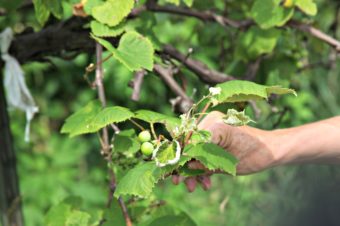
Organic farmer Margot McMillen holds a grape leaf damaged by pesticide drift on her farm, Terra Bella Farm, in central Missouri. Kristofor Husted/Harvest Public Media
Organic farmer Margot McMillen holds a grape leaf damaged by pesticide drift on her farm, Terra Bella Farm, in central Missouri.
Kristofor Husted/Harvest Public Media

Chert Hollow Farm sits nestled between rows of tall trees and a nearby stream in central Missouri. Eric and Joanna Reuter have been running the organic farm since 2006. That means they don’t plant genetically modified crops and can only use a few approved kinds of chemicals and fertilizers.

“We’ve traditionally raised about an acre and a half of pretty intensively managed produce, so it’s a very productive acre and a half,” Eric Reuter says.

Their neighbors grow acres of conventional corn and soybeans, and they mostly got along. That is until one July evening in 2014. Joanna Reuter was transplanting some broccoli when a sound caught her attention.

“I basically heard this loud noise,” she says. “It was coming north to south, and I basically yelled, ‘What the ‘beep’ is that?’ ”

They spotted a crop duster passing unusually close to their property. Shortly after experiencing headaches and irritation, they knew the wind had blown something chemical onto their land. Without knowing what it was, they were left in the lurch, with a big asterisk on the authenticity of their organic crops.

“We were concerned about how do we properly market ourselves, because we feel very strongly about openness and honesty,” Eric Reuter says. “We felt a little odd about marketing farm shares and such for the next year as a sustainable, chemical-free farm.”

They’ve opted not to sell their produce this year and hope the contaminated soil will rebound for next year. It’s a big hit for their small business.

And for the crop duster? He received a warning letter. The farm next door did not respond to my requests for an interview.

“We’re more susceptible to that kind of contamination than we thought,” Eric Reuter says. “And that raises the stakes significantly for a farm like ours.”

In the U.S., farmers use nearly 900 million pounds of pesticides every year to protect their crops from weeds and insects. Sometimes those chemicals drift to neighboring property, which can ruin crops on organic farms.

Although conventional farms can also get hit with unwanted pesticides, it’s the $40 billion organic industry that’s most vulnerable. As more organic farms pop up, these kinds of disputes will only be more common.

Kaci Buhl of the National Pesticide Information Center says there’s no clear picture of how common pesticide drift is for the nearly 20,000 organic farms nationwide.

“The data would get better, and possibly resource allocation would increase, if there was more consistent reporting,” she says.

Each state’s agency responsible for handling pesticide-drift investigations — typically, it’s the state agriculture department or the equivalent — deals with the probes differently.

Organic farmers Margot McMillen and Julie Wheeler check on their tomato plants. They moved the plants into a greenhouse to protect them from pesticide drift. Kristofor Husted/Harvest Public Media
Organic farmers Margot McMillen and Julie Wheeler check on their tomato plants. They moved the plants into a greenhouse to protect them from pesticide drift.
Kristofor Husted/Harvest Public Media

Missouri Department of Agriculture spokesperson Sarah Alsegar says the department does its best, but is sometimes limited by the turnaround time of lab analysis, as well as gathering records from the pesticide applicators in the region.

That’s why the organic industry is pushing for national regulations that prioritize drift investigations and consider stricter penalties for negligent farms. Farmers say investigations into chemical drift can drag on for months, and penalties vary.

“Once we do have a federal approach to pesticide drift, I suspect we’ll be a lot more coordinated in our responses, and potentially, have better prevention strategies and more timely reaction to events when they do occur,” says Nate Lewis with the Organic Trade Association.

Lewis says that drift needs to remain on the forefront of policy efforts, especially as organic acreage grows and farmers become more aware of pesticide drift. Currently, there is no federal policy outlining pesticide drift investigations or recourse.

Paul Schlegel with the American Farm Bureau Federation says unless the drift problem escalates, the current state regulatory system that handles drift incidents works. The focus should be on improving education and drift-reduction technology.

“I think you would probably find in the organic sector as whole, there’s a greater reluctance to accept pesticides as a whole,” he says.

Ultimately, he says, pesticides are part of the food production landscape all farms just have to navigate.

Recently, organic farmer Margot McMillen was traipsing through her muddy farmland, about 25 miles from Chert Hollow. At her farm, called Terra Bella Farm in central Missouri, she grows all sorts of vegetables.

While scanning her crops after a recent rain, she noticed some possible pesticide damage on her grape vines.

“This curling of the leaf is real characteristic, and there’s a real thinness of that leaf,” she says, cradling the leaf in her hand. “To me they look like little fists (saying), ‘Help, help.'”

McMillen is all too familiar with curled up foliage. She says in 2014, pesticide drift destroyed $25,000 worth of her tomatoes. The state agriculture department confirmed drift occurred, but couldn’t identify the culprit.

Even if her contaminated produce had survived, it was no longer sellable as organic. Pesticide drift puts McMillen and much of the organic industry in a tough spot.

“It’s so out of our hands,” she says.

This year, she says, she’s been forced to grow her plants “defensively.” Large bushes now block the wind from the road. She moved crops over a hillcrest, away from other farms, and moved the tomatoes inside the greenhouse.

“Everybody (who) doesn’t use [pesticides] is running into this problem,” she says.

McMillen says she knows her farm is still vulnerable. She says a federal policy would help, but planting defensively — even through it’s not foolproof — is the best she can do for now.


This story comes to us from Harvest Public Media, a public radio reporting collaboration that focuses on agriculture and food production.

Copyright 2015 NPR. To see more, visit http://www.npr.org/.
Read Original Article – Published JULY 31, 2015 3:45 PM ET
Site notifications
Update notification options
Subscribe to notifications