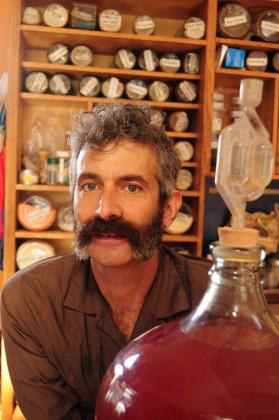
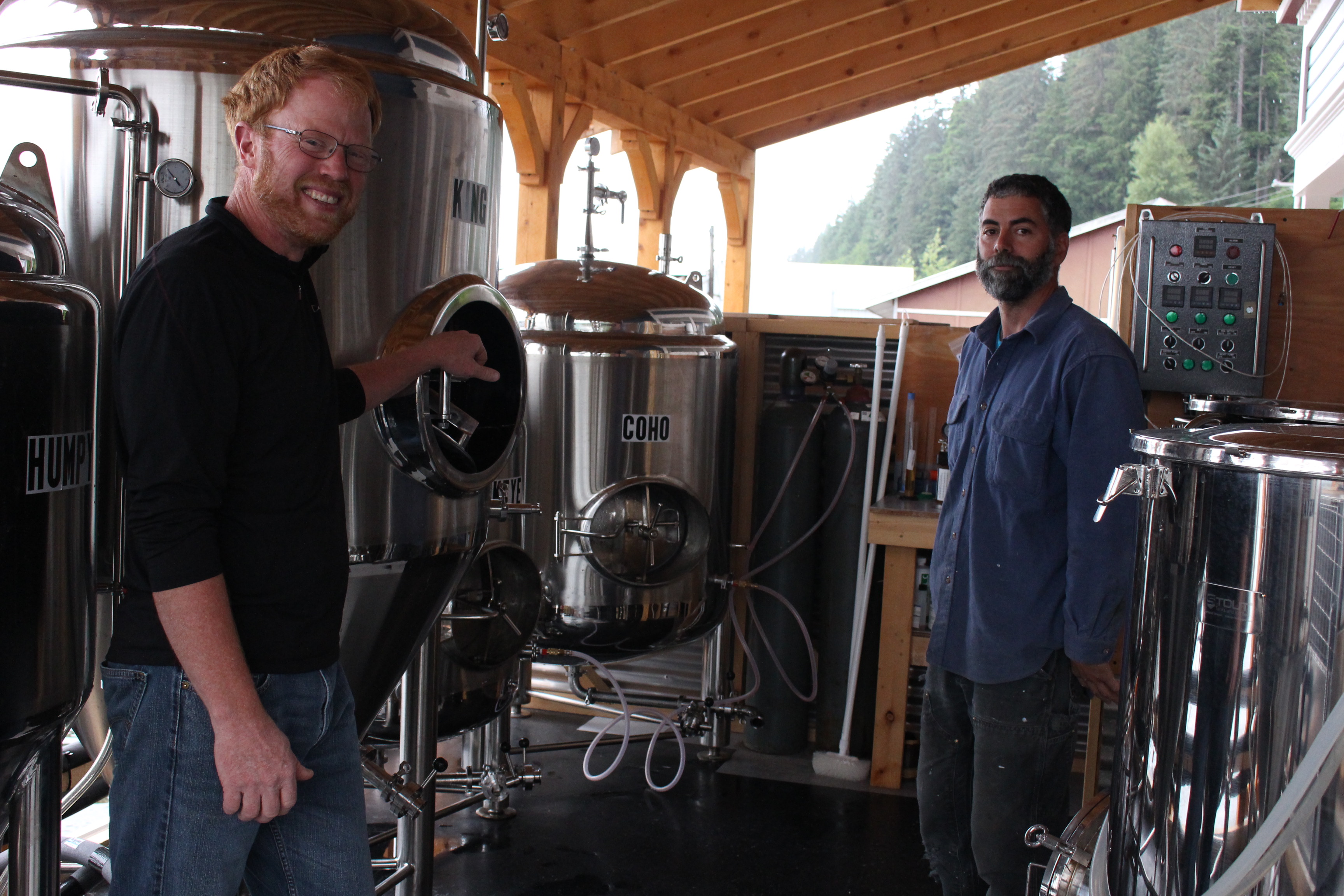
Dan Kane and his business partner Todd Thingvall. (Photo by Elizabeth Jenkins/KTOO)
On Saturday, a Hoonah microbrewery is opening its doors to serve the village a variety of craft beers. Kegs used to become scarce around the same time tourists did. Now fresh pints are guaranteed through winter.
Todd Thingvall and his business partner Dan Kane have been working hard to renovate a 100-year-old house on pilings above water, the site of the new brewery and taproom. Both left good jobs to start the business. Kane says his kids asked if he was having a midlife crisis.
“There’s been a lot of sleepless nights,” Kane says. “I’m sitting in Anchorage at my house there and I have a good life. There’s a lot mornings I would be sitting there going, ‘Have I lost my mind, is this really what I want to do?'”
He’s been homebrewing for about 20 years. They met each other through their wives.
“Dan had beer so I instantly liked him. We hit it off ever since,” says Thingvall.
He pitched Kane the idea of opening the Hoonah brewery. They invested about $400,000 and are living upstairs. The long-term plan is to move the tanks to another site but for now, they’re on a patio above the water.
Usually stainless-steel fermentation tanks are labeled one, two, three.
“We decided, eh. Let’s stay with a Southeast theme and we went with keta, humpy, king, sockeye and coho. Of course, the king is the big seven barrel,” Kane says.
(Photo by Elizabeth Jenkins/KTOO)
They’re cooled by a refrigeration unit that runs partially off solar panels. Electricity can be expensive in Hoonah and the panels could pay for themselves in a little over a year.
On the bottom of the king tank is a well kept brewer’s secret.
“You’re very lucky to see this. It’s called a sample valve. It allows you to take samples or actual drinks out of a vessel. So this is our pale which was the first beer that we made here,” Thingvall says.
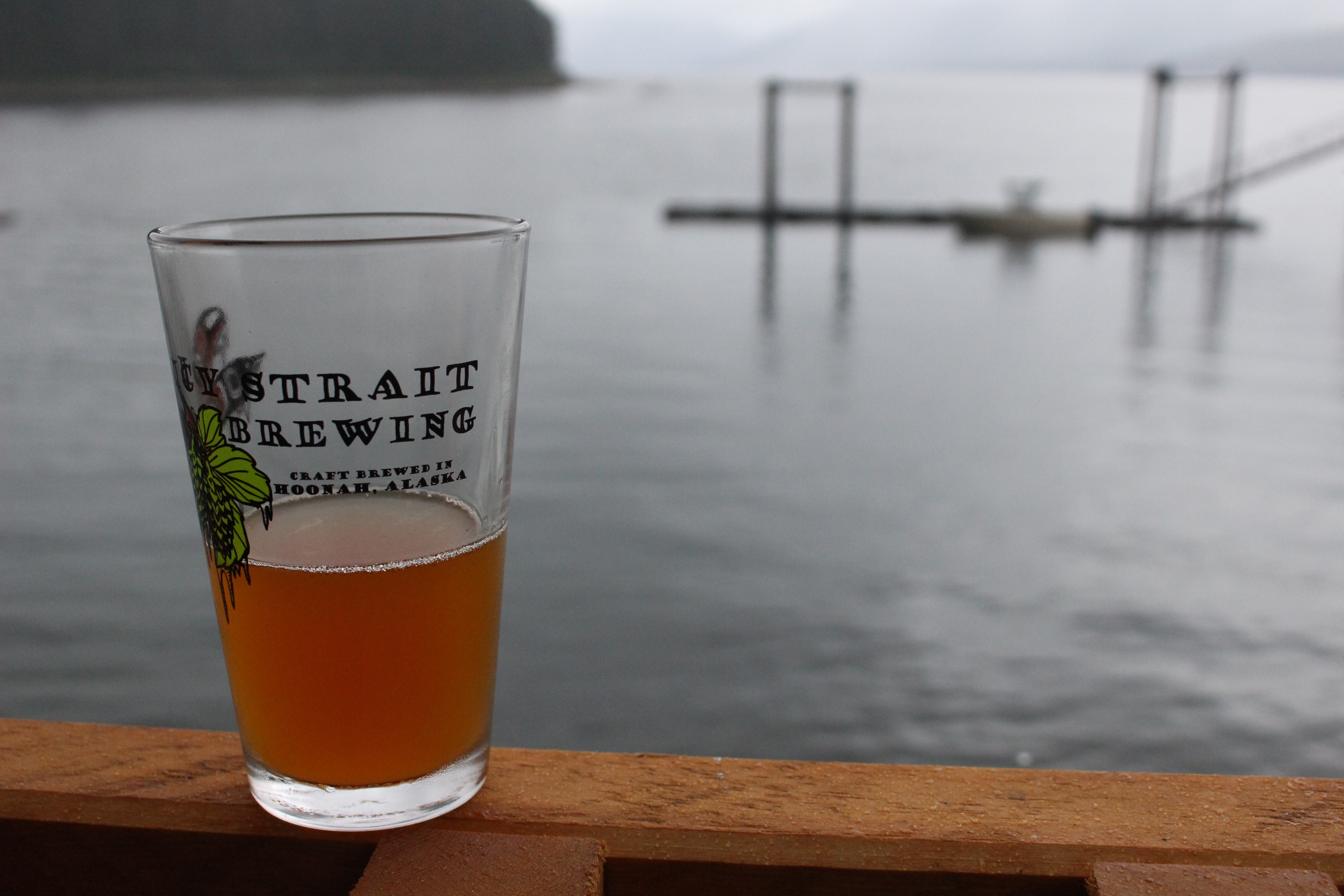
He fills up a frothy golden glass of beer made with Cascade hops.
With no connecting roads, the Pacific Northwest hops and brewer’s yeast is shipped using FedEx. Thingvall and Kane say it can be nerve-wracking waiting for the delicate ingredients to arrive. Most need to remain temperature controlled. It travels from Seattle to Juneau, then over to Hoonah by small plane. A few weeks ago, their yeast was overdue.
“One great thing about a small town, even the postmaster, she knew exactly what I was looking for and it came in Saturday after their closing hours and she called us. And said, ‘Hey it’s here.’ And waiting for us to come pick it up,” Kane says.
They’ll serve pale ale, IPA and hefeweizen. A pilsner and stout are also in the works. Production will be about 500 barrels a year, and some of the kegs could be distributed to Southeast’s smallest communities like Gustavus and Elfin Cove–maybe eventually making its way to Juneau.
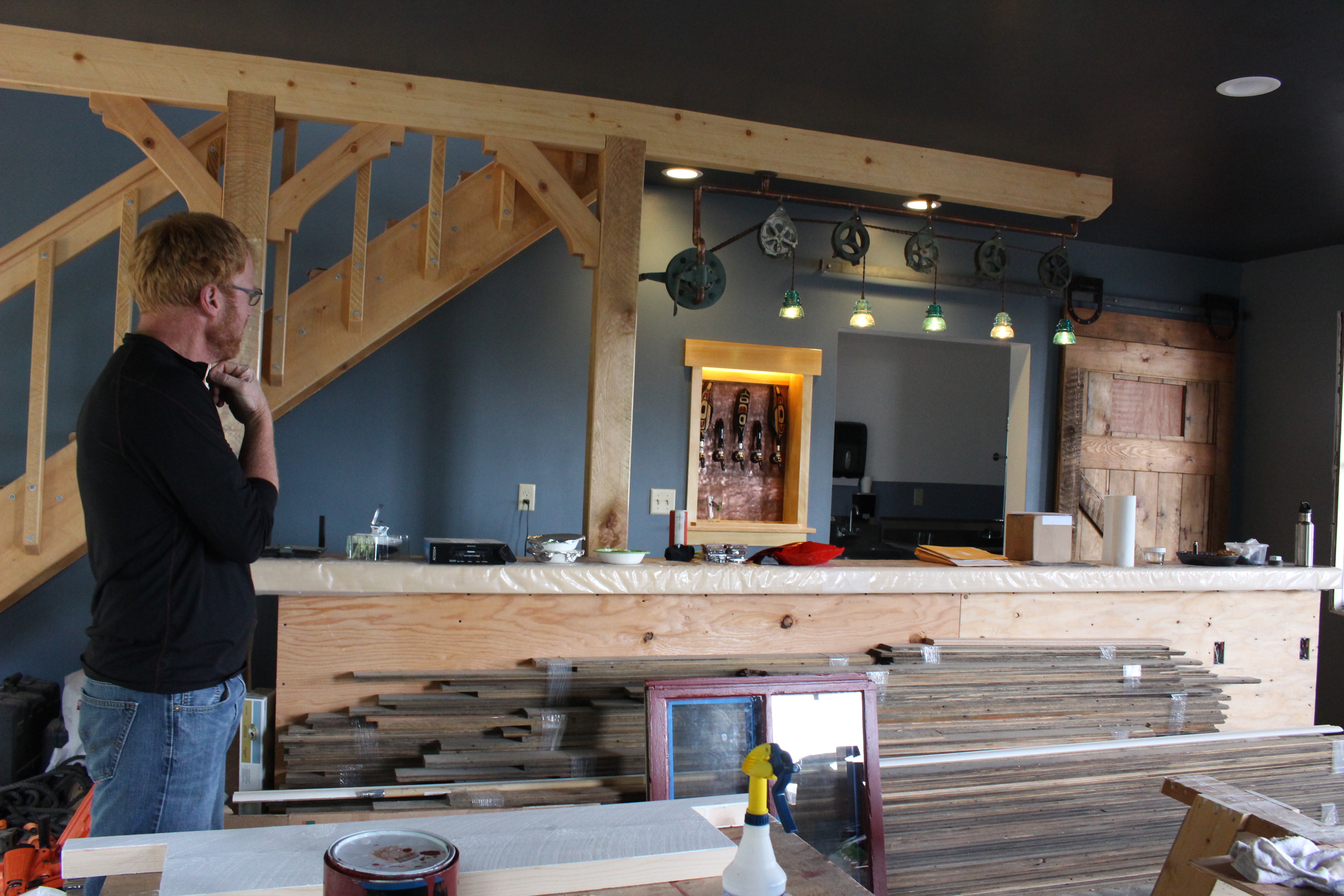
Overlooking the taproom of Icy Strait Brewery. (Photo by Elizabeth Jenkins/KTOO)
What Kane says they’re really looking forward to the most is experimenting with ingredients like Hudson Bay tea, a medicinal plant that grows in the muskeg.
“When it first hits your palate, it was more of light clean, crisp beer and then as it hit the back of your palate that’s when that tea just came alive,” Kane says.
It can be tricky getting FDA approval for ingredients that are locally sourced, but they say they’re up for the challenge. They want Icy Strait Brewing to reflect the community.
“Hoonah has a slogan: The little place with the big heart. And it’s true. The people here are wonderful,” Thingvall says.
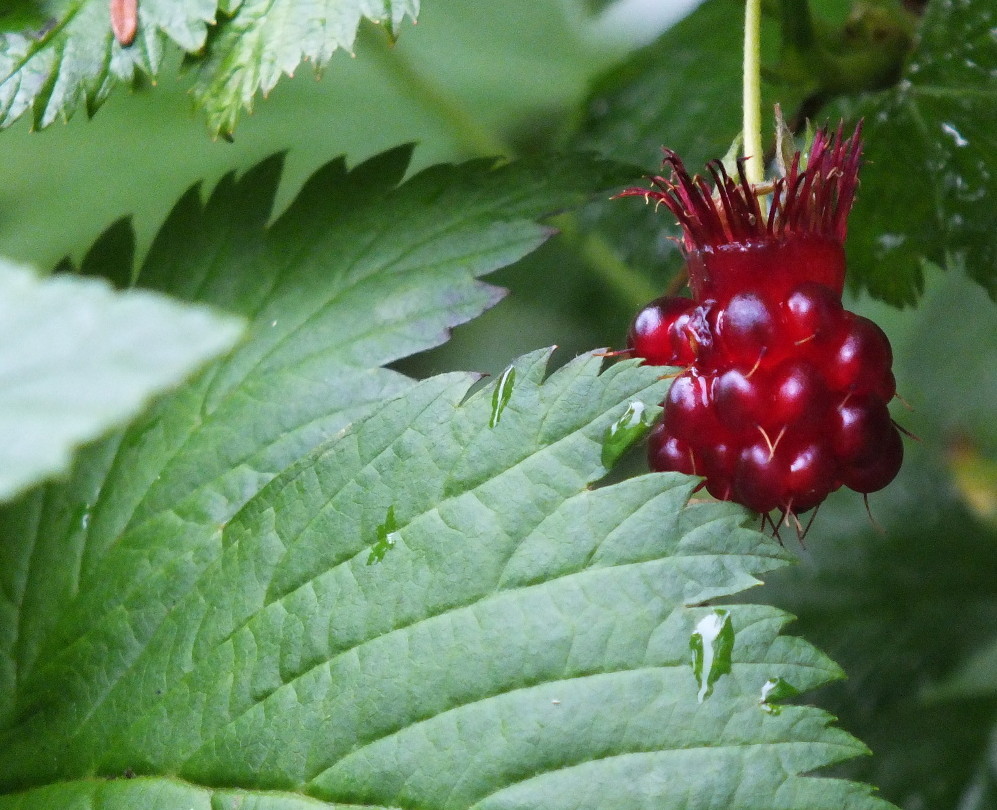
This overly ripe salmonberry is about ready to drop to the ground. (Photo by Matt Miller/KTOO)
Master Gardener Ed Buyarski has some tips on picking berries and apples before they get too ripe and begin losing flavor. This Gardentalk segment aired Aug. 6 on KTOO’s Morning Edition.
“Timing is real important,” says Buyarski. “Tasting as you go.”
Yellow transparent apples, for example, may be tart and a little green before they ripen and turn a pale yellow-white within about two weeks in sunny and warm weather.
“At that point, they’re overripe,” Buyarski says. “They cook great down into applesauce. But they’re very mealy, not tasty for eating.”
Buyarski also checks in on this season’s gooseberries, raspberries, and kiwis.
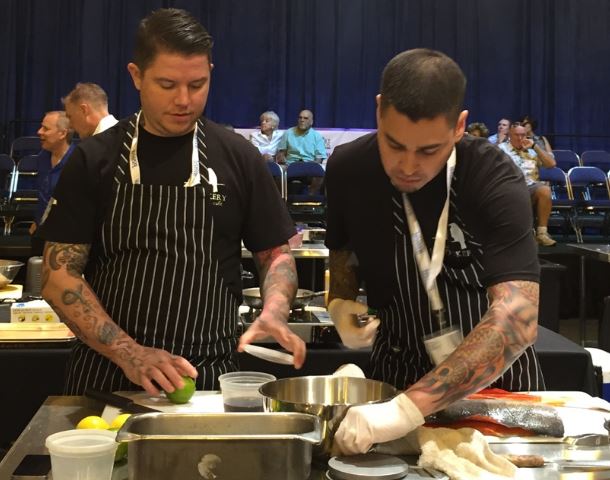
Juneau chef Beau Schooler and sous-chef Travis Hotch at the Great American Seafood Cook-Off in New Orleans. (Photo courtesy Alaska Seafood Marketing Institute)
Juneau chef Beau Schooler was crowned “Best Seafood Chef” at the Great American Seafood Cook-Off this weekend in New Orleans. He was one of 12 competing chefs from all over the country. He won with a dish that only had one main ingredient – Alaska wild salmon.
Louisiana Chef Cory Bahr tears open the first place envelope.
“From the state of Alaska, Chef Beau Schooler!” Bahr announces.
As Schooler kneels on one leg to be crowned, confetti falls from the ceiling. Schooler is chef and co-owner of The Rookery Café in Juneau.
“First time ever Alaska’s winner,” Bahr says.
Alaska is usually at the competition, which has been around for 12 years. Gov. Bill Walker nominated Schooler to compete this year and the Alaska Seafood Marketing Institute paid his way.
Schooler and sous-chef Travis Hotch brought sockeye salmon from Juneau company Taku River Reds to the competition.
Schooler describes their cooking method as a nose-to-tail approach, using every piece of the fish.
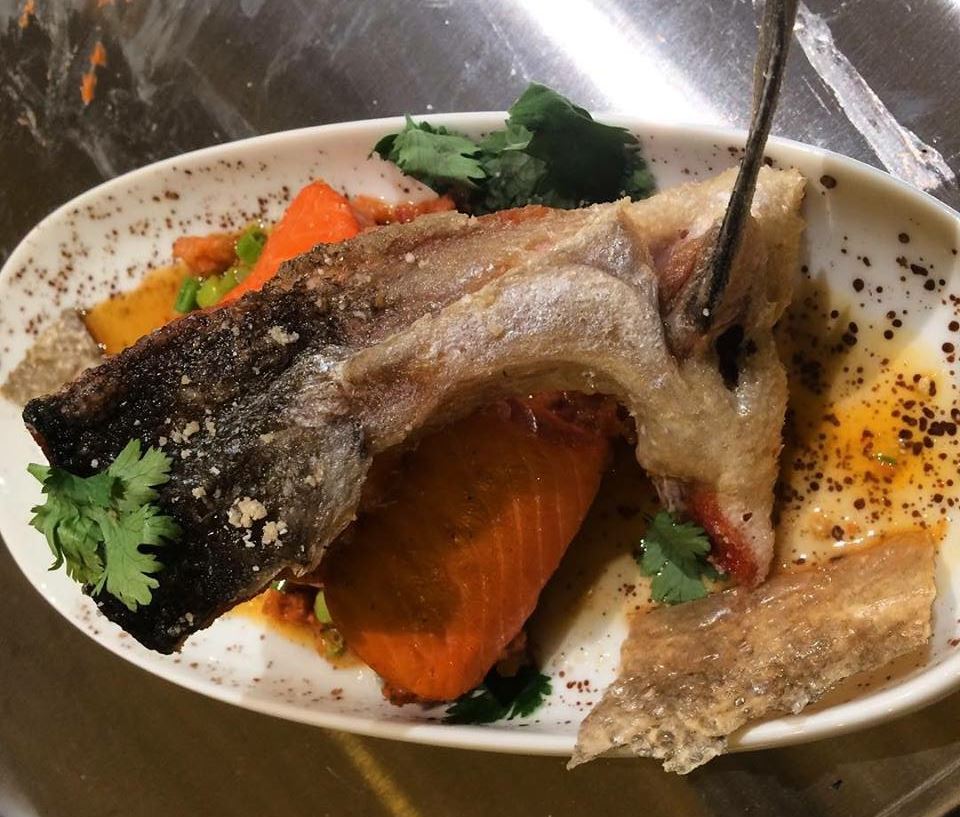
“The fillet portions, we brined and cedar roasted. All the scrap that’s usually clinging to the bone and the belly pieces, we ground that up and turned it into a salmon chorizo,” Schooler says.
They made crispy chips out of the skin and fried the salmon collars, the bony part between the head and the body.
“And then we have been working on this thing called bone salt where we’re taking salmon bones and cleaning them up and dehydrating them and then grinding them up and they kind of have this oceany, salmony flavor, so we seasoned the whole dish with this salmon bone salt,” Schooler says.
Schooler’s winning dish featured salmon skin chips, salmon bone salt and salmon chorizo. (Photo courtesy Laura Hotch)
For Schooler and Hotch, cooking the various components came easily.
“We were kind of doing stuff we do at the restaurant every day. So getting that all done in an hour and presenting it to people, it was just kind of another day at work really,” Schooler says.
You can find the chorizo at The Taqueria, another Juneau restaurant Schooler is part of. Everything else has been on the menu at The Rookery before.
Schooler and Hotch had discussed different ideas before settling on, “Let’s do all the different parts of the fish and just put it on one plate and not put anything else on there,” Schooler says.
That was a pretty novel concept at the competition. The cook-off hosts talked about it while the judges deliberated.
“How dangerous is that to just do fish on the dish?” asked Johnny Ahysen, a Baton Rouge TV reporter.
“I don’t know. I think he was really confident. It was just fish but it was a lot of different flavors there, a lot of different preparations there,” replied Louisiana Chef Randy Cheramie. “Could it be seen as a gamble? Maybe so, maybe not. We’ll see.”
“That was a bold dish from Beau Schooler,” added New Orleans TV News Anchor Charles Divins.
After the competition, Schooler and Hotch spent time exploring the food scene in New Orleans, then Seattle for, as Schooler put it, “a couple days of gluttony,” before returning home.
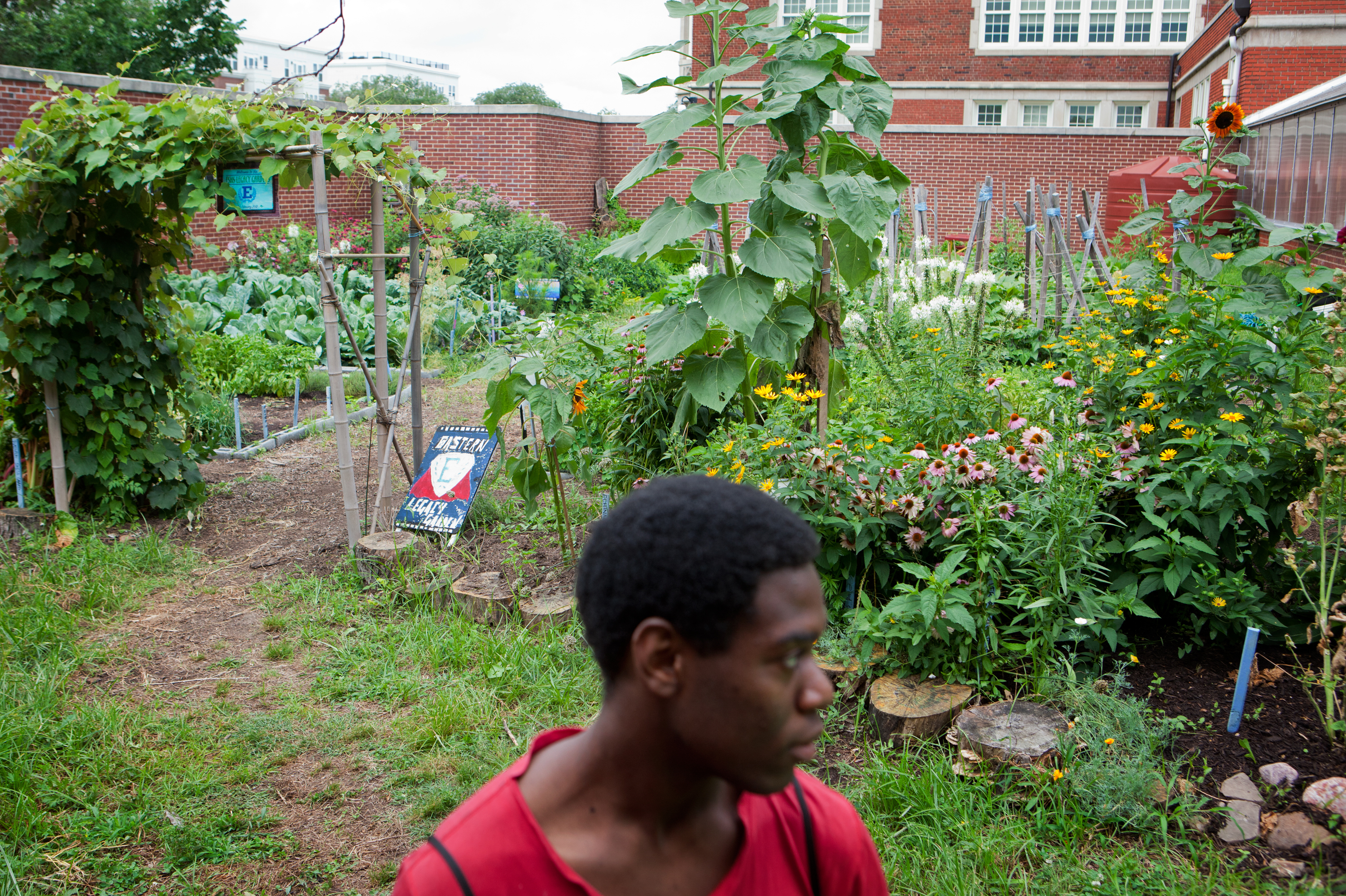
Tall brick walls conceal a colorful garden at Eastern Senior High School in Washington, D.C., where students like Romario Bramwell, 17, harvest flowers and produce. The program is run by City Blossoms, a nonprofit that brings gardens to urban areas. Lydia Thompson/NPR
School is still out for the summer, but at Eastern Senior High School in Washington, D.C., students are hard at work — outdoors.
In a garden filled with flowers and beds bursting with vegetables and herbs, nearly a dozen teenagers are harvesting vegetables for the weekend’s farmers market.
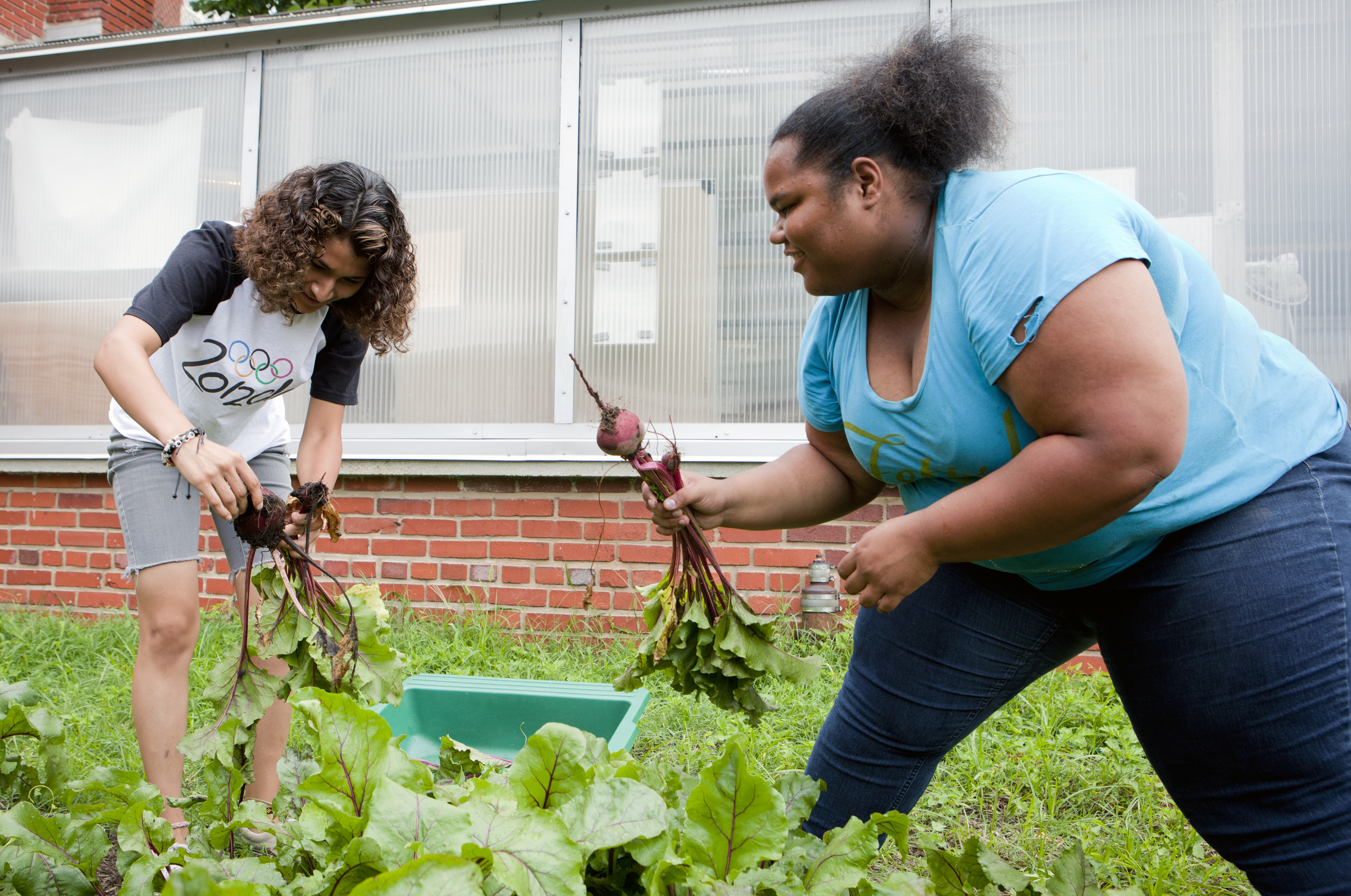
Roshawn Little is going into her junior year at Eastern, and has been working in this garden for three years now. “I didn’t really like bugs or dirt,” Little says, thinking back to when she got started. “Well, I still don’t really like bugs, but I like the dirt,” she laughs. She gathers a handful of greens, yanks from the stem and pulls up a baseball-sized beet.
During the summer, Little gets paid to work Tuesday through Saturday from 9 a.m. until 2 p.m. with City Blossoms, a nonprofit that brings community gardens to schools, community centers and other places where kids gather in urban areas.
Little believes that working in the garden has taught her to try all sorts of new things — like eating different kinds of vegetables more often. And she’s taken those healthy behaviors home with her. Little brings home vegetables from the garden, and she says her eating habits have encouraged her family to buy more fruits and vegetables.
Yanci Flores (left) and Roshawn Little harvest beets from the garden at Eastern Senior High School on July 17. Lydia Thompson/NPR
“We’re a chubby family and we love to eat. Well, I do,” she adds with a laugh. “We mainly live around liquor stores and snack stores. There aren’t that many grocery stores. They’re way out, and you have to drive so far” — a common problem in low-income urban areas. “It seems so pointless, when there are snack stores right there,” she says.
City Blossoms is one of many groups across the country teaming up with local communities to install school gardens, like the one at Eastern, in areas with low access to fresh, healthy foods. These gardens, advocates say, are really outdoor classrooms where kids learn valuable lessons — not just about nutrition, but also about science and math, even business skills.
By The Books
Many of these groups have big ambitions to tackle complex problems. But there is research that shows the benefits of school gardens can be real and measurable, says Jeanne McCarty, the executive director of REAL School Gardens.
“There’s a trend across the country where kids are not spending enough time outdoors, period,” McCarty says.
Top Left: Nychele Williams, 15, gathers basil in the garden at Eastern Senior High School. Bottom left: Yanci Flores rinses recently harvested beets. Right: Carrots and beets are displayed at the Aya farmers market, where students sell their produce on Saturdays. Lydia Thompson/NPR
To counter that, the nonprofit, which operates in Texas and Washington, D.C., Maryland and Virginia, works with schools to create “learning gardens” and trains teachers on how to use them to get students engaged and boost academics. For example, the gardens can be used for math lessons — like calculating the area of a plant bed — or learning the science of how plants grow.
McCarty says REAL School Gardens — which has built nearly 100 gardens — is constantly evaluating the outcomes of its programs, and the numbers are encouraging.
She says partner schools have seen a 12 to 15 percent increase in the number of students passing standardized tests — not just those in the garden program, but schoolwide.
Students at Eastern Senior High School in Washington, D.C., trim bouquets to sell at the farmers market. Lydia Thompson/NPR
And 94 percent of teachers in the REAL School Garden programs reported seeing increased engagement from their students, according to an independent evaluation conducted by PEER Associates and funded by the Rainwater Charitable Foundation.
She says the benefits don’t end with the students, either. Schools that installed learning gardens saw less teacher turnover, McCarty says.
Principal Margie Hernandez tells us she’s seen the effect firsthand among her teachers.
“They start realizing that they need something to invigorate themselves, so they can invigorate their classrooms and invigorate their students,” she says. Her school, Pershing Elementary in Dallas, has worked with REAL School Gardens since 2011.
Rebecca Lemos-Otero (right), co-founder and co-executive director of City Blossoms, helps Erwin Tcheliebou, 15, pick flowers to sell at the farmers market. Behind her is a wall featuring the painted portraits of Eastern Senior High students who have worked in the garden. Lydia Thompson/NPR
And for her students — who come from predominantly low-income backgrounds — the experience can be a nutritional eye-opener, Hernandez says. “It totally changed my kids’ perceptions of where food comes from, and what it takes to produce food.”
If They Grow It, They’ll Eat It
Many studies have found that kids are more likely to eat fruits and vegetables if they help garden them. That’s part of the motivating principle behind Colorado-based Denver Urban Gardens, or DUG, a school garden program that puts a heavy emphasis on having kids taste the produce they grow.
DUG has 13 garden programs at schools where more than 90 percent of the students qualify for free and reduced-price lunches. Some of the produce that students grow then gets sold to the school cafeteria. That way, kids can recognize the fruits (and vegetables) of their labor in the lunch line. DUG has found that 73 percent of the students who work in the school garden reported increasing their actual consumption of produce.
Rebecca Andruszka, who works with DUG, says her friend’s children will only eat vegetables from the garden at school — not from the grocery store.
“I think it’s just that it seems less foreign when you’re a part of the growing process,” Andruska says.
A Business Education
In D.C., the kids of City Blossoms are also part of the business process: They take their produce to farmers markets.
On a recent weekend at the Aya farmers market in Southwest D.C., the kids’ table is decorated with handmade signs that read “onions” and “garlic,” with little pictures drawn beside them. The kids greet customers warmly, shaking their hands and calling them “sir” or “ma’am.”
Roshawn Little (left) invites customer Nate Kohring to try the herbed salt with bread at the Aya farmers market on Saturday. Lydia Thompson/NPR
Roshawn Little mans the table, inviting people to try their herbed salt with bread. Working at the market has helped her practice her public speaking skills, she says. Plus, it teaches her business and money skills.
“I used to spend money on anything, mainly junk food,” Little says. “Now, as I’m working here, I learned how to use my money more responsibly.”
Homemade signs decorate the table at the Aya farmers market, where the kids of City Blossoms sell their produce on Saturdays. Lydia Thompson/NPR
Nadine Joyner of Nutrition Synergies LLC, a nutrition education company, has a booth next to the kids at the market. She often buys produce from them to incorporate into her quiches. She says she’s constantly impressed by the kids’ knowledge of what they’re selling — they know how to grow it, how to prepare it, and how to cook it.
“It’s a very impressive thing to see young urban entrepreneurs,” Joyner says, looking over at the kids. “It’s a refreshing thing.”
Joyner believes that teaching young people the importance of healthy eating will have long-term payoffs.
“The payoff is exponential, because they’ll be young mothers or young fathers someday, and they’ll feed their children based on what they’ve learned now,” she says.
Students from Eastern Senior High School in Washington, D.C., sell vegetables, soaps and salts at the Aya farmers market on July 25. Lydia Thompson/NPR
But the kids aren’t thinking of that bigger picture. Instead, they’re just enjoying the little things, like the way their hands smell after harvesting herbs, or the satisfying crunch of a freshly picked carrot.
Copyright 2015 NPR. To see more, visit http://www.npr.org/.
Read Original Article – Published AUGUST 10, 2015 7:03 AM ET
Author and fermentation expert Sandor Katz. (Photo by Sean Minteh)
A fermentation specialist recently visited Homer. He’s making his way through Alaska, teaching about the crossover among food preservation, microbiology and community. He taught an intensive fermentation workshop on a local farm.
It’s a sunny day over the Caribou Hills. A group of more than 50 people are milling around a large, green farm, lunch plates piled high with pungent food that saturates the summer breeze.
Sandor Katz is sitting on a log near some chickens, wearing a white shirt with a pattern of bright red radishes. He’s the King of Fermentation.
“I ended up being given the nickname ‘Sandorkraut’ because I was always showing up with sauerkraut and evangelizing about the healing powers of sauerkraut,” says Katz.
Yes, sauerkraut.
“You can make it in dazzlingly bright colors, or contrasting colors, or different sizes and shapes of cutting up your vegetables. It’s actually an incredibly versatile food,” says Katz.
Despite the teasing for always being that guy, the one who brings fermented food to a dinner party, he truly has a deep passion for this process. Through his eyes, the complex world of microorganisms and bacteria at work take on new and beautiful life.
“Before I see anything, I smell this delicious sourness,” says Katz. “I taste this sourness that speaks to me in this very deep way. What I see is last season’s garden that’s still feeding us and nourishing us. It’s actually never occurred to me that sauerkraut could be ugly.”
And his art is gaining popularity. In the pushback against processed and packaged foods, do it yourself preservation methods are becoming more popular.
“People are waking up to the fact that a lot has been lost by severing our connection with producing food and so they’re interested in figuring out how they can play a role in producing their own food,” says Katz.
Charles Meredith, who goes by Chaz, is active in the local farmers market and independent growing community. He says he’s seen a resurgence of traditional food ways, like canning, pickling, dehydrating and fermenting.
“I feel like in rural places, in general, the older traditions stick around more and are more appreciated by people in those areas,” says Meredith. “So, I think it’s partially holding onto the past where you can obviously see it slipping away.”
Like many people in Homer, he’s comfortable with lots of types of food preparation. Over by the picnic tables, Marcee Gray is scooping up sticky sourdough starter with a spoon.
She finishes packing it into a mason jar, picks up some lunch at the buffet and settles down in the shade with friends.
“In our culture we do have a little bit of a fear of things like mold and bacteria,” says Gray.
Gray’s friend, Mary Lou Kelsey, says she likes the mystery of fermentation.
“I was somebody who asked him, ‘So how do you know what organisms are in there?’ If you were really worried about trying to identify all the organisms, it would be difficult … so you kind of have to [accept] that it tastes good and it’s a great mystery,” says Kelsey.
Katz says in fermentation, microorganisms exist in communities — kind of like the people who are once again taking an interest in these complex processes.
“If you think the baker and the cheesemaker and the sauerkraut maker as some archetypal fermenters, and we can’t forget the beer makers, then these are all products that give rise to exchange and informal barter and economies of community,” Katz says. “I think the revival of local food systems is all about building and strengthening community ties.”
That revival can be seen in Katz’s own work. He brings people with common interests together, to eat communal meals, to trade containers of their homemade concoctions, and he does it all through his teaching of the art of fermentation and one jar of sauerkraut at a time.
Each July and August, dozens of Bristol Bay residents take to the berry flats. Some are casual gatherers, picking handfuls here and there. Others set out to harvest enough salmonberries to rival the year’s salmon harvest.
Kim Williams, her sister-in-law Liz Johnson and aunt Judy Samuelson are the latter.
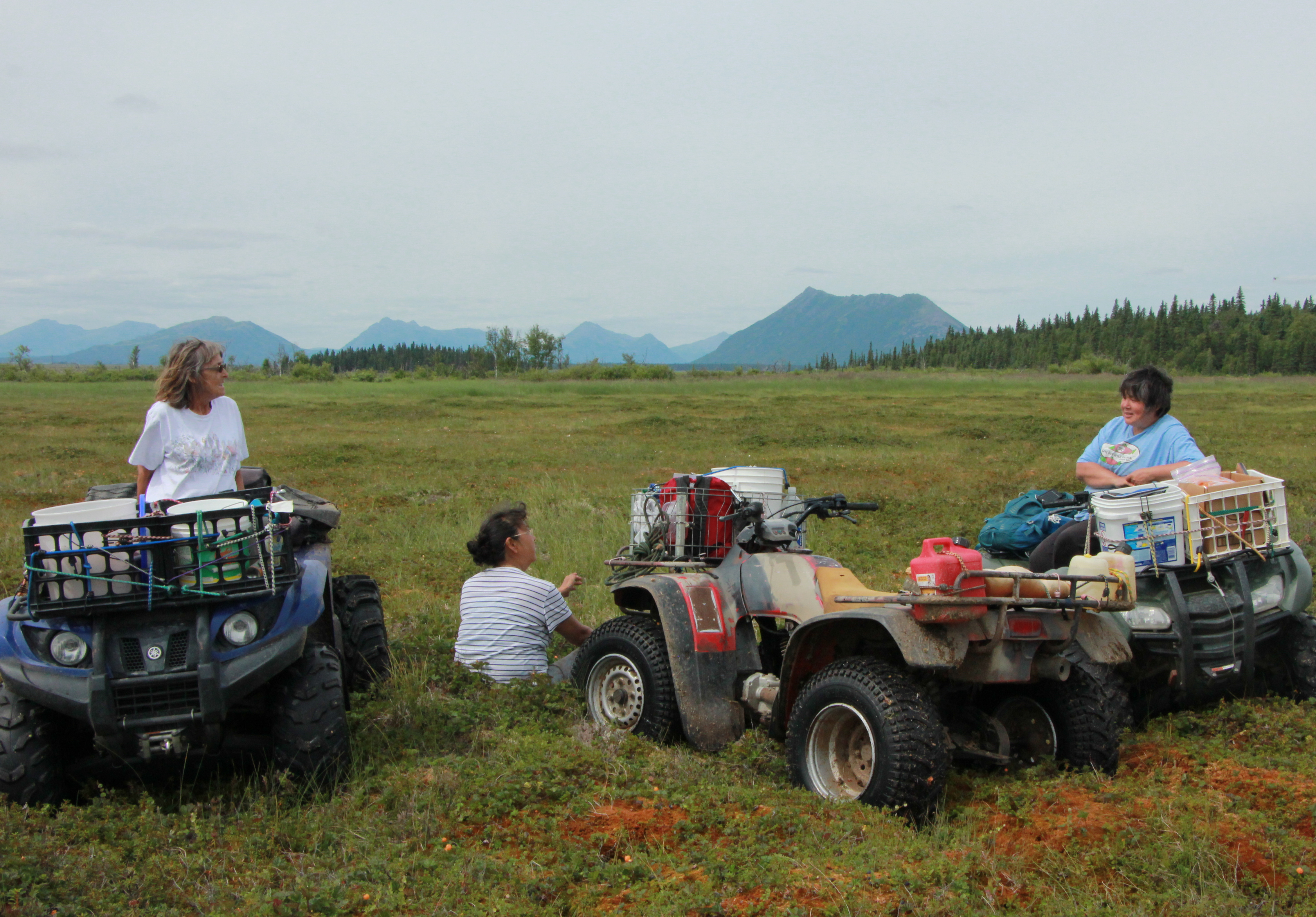
Around 9 a.m., the three women embark on their tenth day of salmonberry season. Williams says it’s been a good haul so far.
“How many bags you put away?” she asks the group. One says 37; another says 40.
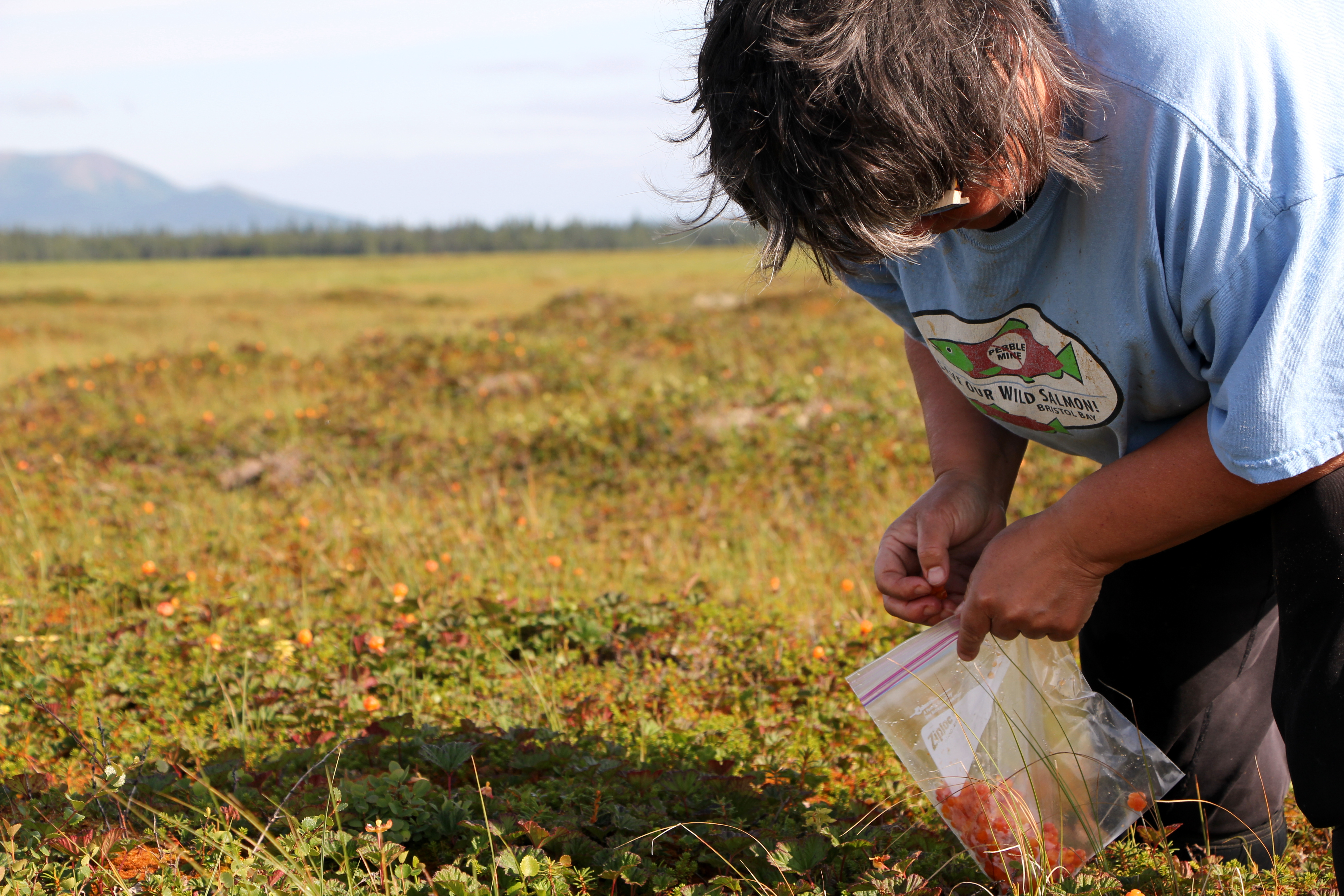
They load plastic buckets and quart-sized Ziploc bags onto their four-wheelers. Williams leads the group onto the tundra, picking her way between swampy patches. She’s heading toward one of their closely guarded berry spots.
“We have spots that we regularly look at beause we’ve been [going] there for at least 30 years,” She says. “We have spots that we go back and check. Some years they’re there and some years they’re not.”
Last year was an off year with no salmonberries to be found. Williams says heavy wind and a late frost killed the delicate blossoms.
“These berries are really fragile,” she says. “They’re a white blossom – a lot of rain can knock the blossom off [or] the wind … a lot of things can happen so they don’t berry.”
This time around the conditions were right and the berries early. Williams says they started scouting for June 9, more than a week earlier than usual.
“We always know that when you hear the cranes out on the berry flat, berries are ready. And when the fireweed is blooming, berries are ready. That’s the sign to tell you to go look,” she says.
Judy Samuelson, Liz Johnson and Kim Williams take a mid-afternoon rest after leaving one patch of berries picked nearly clean. Credit Hannah Colton/KDLG
Today’s destination is a prime berry spot the ladies have visited before. We arrive to find the flats thick with the big, bright orange berries that Williams says they favor.
“We want them big. We leave the small ones,” she says. “We don’t like them white, we don’t like them with black dots, we we don’t like them hard so you have to clean ‘em … they have to be just right.”
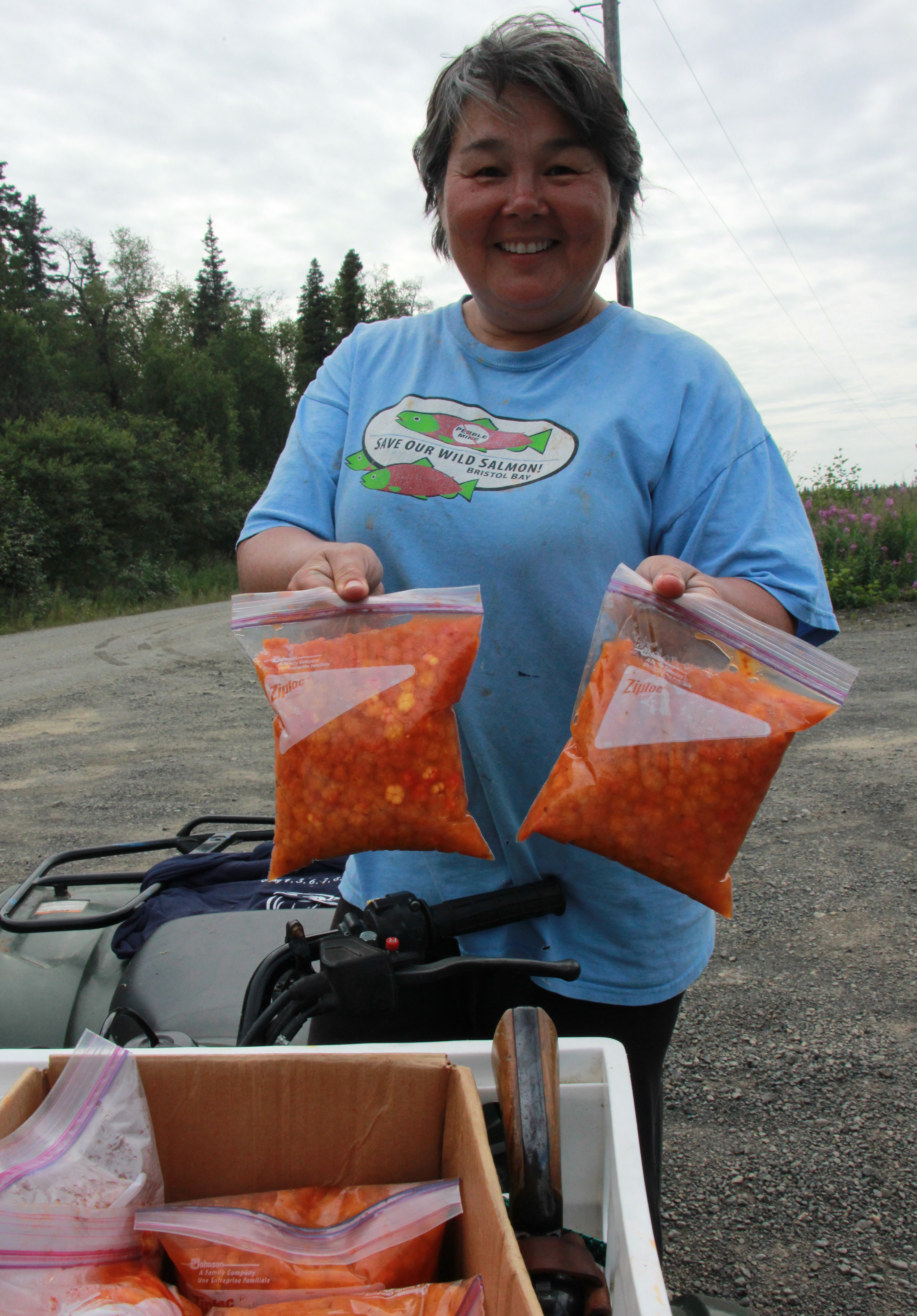
Kim Williams with part of a day’s haul. Credit Hannah Colton/KDLG
These flawless berries could sell for $100 a gallon or more, but Williams says they won’t put them on the market.
“We never sell. I did sell one year, my old ones, when I had like 80-some bags,” she laughs. “We’re not hoarders!”
William’s says her berries will go straight into her father’s freezer. Her family will enjoy a year’s worth of akutaq, a dessert made with berries mixed into shortening and sugar.
“Usually for my family we take out two bags when we’re going to have a meal of salmonberry akutaq, and I take blackberries or blueberries and I add it and it stretches it,” she says. “Now auntie Judy, she likes just strictly salmonberry akutaq. But she’s a picking fiend!”
The three women pick the area for several hours, with a light breeze keeping the bugs off. Before leaving for new territory, they try to tally up their haul from this one spot…
“Forty-four!” she exclaims. “Eleven gallons! That’s really good! … That’s lots, no wonder our backs are hurting!”
By late afternoon, they’re running low on Ibuprofen and freezer space, making it about time to call it the end of a successful salmonberry season.
Close
Update notification options
Subscribe to notifications
Subscribe
Get notifications about news related to the topics you care about. You can unsubscribe anytime.

9(MDEwMjQ0ODM1MDEzNDk4MTEzNjU3NTRhYg004))