Flowers are just starting to blossom on these tomato plants in a North Douglas greenhouse. But even with grow lights, it’s unlikely these plants will provide much fruit before the end of the season. Leaves also need to be thinned out to allow for more sunlight. (Photo by Matt Miller/KTOO)
It’s nearing the end of the season for greenhouse tomatoes. Master gardener Ed Buyarski recommends trimming new tomato flowers so that any existing fruit can mature and ripen.
“I’m pretty sure that those blooms that are on there now are not likely to set fruit and ripen fruit with conditions we have,” Buyarski says. “So, I’m clipping the growing tips off. And that way, the plant is going to push its energy into ripening all of the green tomatoes that are already on the plant.”
Trimming some of the branches and leaves to allow more sunlight into the greenhouse will also help the ripening process.
“More sun translates into better color, better sugars, and better flavor in the fruit,” Buyarski says.
Listen to the Gardentalk segment that aired Sept. 3 on KTOO’s Morning Edition:
Ed Buyarski’s tomatoes as featured on Sept. 3 edition of Gardentalk, just before they were consumed. (Photo by Matt Miller/KTOO)
Word is spreading among Bethel residents that a new chain restaurant is coming to town. (Facebook screenshot)
A national fast food chain is opening a new restaurant in Bethel.
Taco Time announced its new location with a sign at the Alaska Commercial Company store, also known as the AC store. KYUK in Bethel reports the grocery store will be home to the new franchise.
Store managers say negotiations to open the new restaurant were completed about eight months ago, although an opening date has not been finalized.
Taco Time was started in Eugene, Oregon 1960s and specializes in Mexican fast food. They have over 300 locations in the U.S. and Canada; Ketchikan is home to the only Alaska franchise.
The only other fast food chain in Bethel is Subway. In 2012, Bethel had a Taco Bell truck delivered by plane and helicopter after rumors circulated that the franchise was opening a location in Bethel. They never did.
Editor’s note: We previously reported that the Bethel Taco Time would be the state’s first; in fact, Ketchikan is home to one of the franchises. We regret the error.
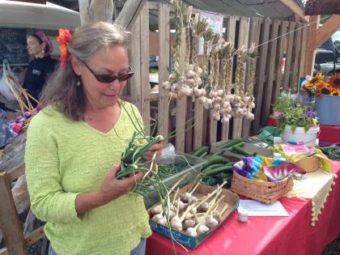
Lori Jenkins of Synergy Gardens holds garlic scapes her WWOOFers helped harvest. (Photo by Shady Grove Oliver/KBBI)
Every summer, Homer and the surrounding area is inundated by a transient population that’s come to work for eco-friendly businesses. They’re called WWOOFers and they spend weeks in different places around the world learning how to live sustainably.

Across Kachemak Bay from Homer, in the small community of Little Tutka, Emma Bauer is setting up kayaks on a beach.
“Today we have a bigger group of guests,” says Bauer. “I think they’re all a big family but it’s seven people. Like the other day we just had a tour of two people. So sometimes the guides and the volunteers outnumber the guests but today we have to take out the majority of our kayaks. So it takes us a little bit longer to get everything ready.”
She’s a college student from Huntington, West Virginia, who has spent the last several weeks working for an eco-friendly lodge and tour company as an all-purpose helper. She assists with kayak tours around the bay, washes dishes, collects seaweed for organic soup, and turns down bedding when guests leave. She’s not paid, but in exchange she gets to stay in a cabin with an ocean view nestled in a scenic coastal forest, and do things she otherwise wouldn’t have the opportunity to do.
“I had not traveled much before, so this is my first big adventure,” says Bauer. “I had never flown commercially so that was a big thing. This whole trip was a bunch of firsts for me.”
She’s part of the WWOOF program, which stands for Worldwide Opportunities on Organic Farms. Emma is one of the nontraditional WWOOFers doing something aside from farming.
“I thought it would be really neat to learn about sustainable living,” says Bauer. “I’d like to do another WWOOFing experience where I’m farming because here it’s a little different where I’m doing the kayak tours with them but I’m still learning a lot about the environment and things that go on here.”
Most of the WWOOFers here are like Noel Krasomil. He’s been working at Synergy Gardens on the Homer side of the bay. Today, he’s helping out at the farmers market booth.
“Today we are selling our wonderful garlic, first of the season harvest braids,” says Krasomil. “We have scapes. We had tomatoes, they’re about out, cucumbers, flowers, everything — really great stuff all-around.”
He says he’s wanted to learn how to farm organically his whole life. For the past three weeks he’s seen the inner workings of an independent growing operation from every side.
“Oh, it’s different every day,” says Krasomil. “It all depends on the needs of the farm. Some days I’ll harvest kale and arugula. I’ll harvest garlic, hang it to dry. I’ll run around town getting beer waste for the compost. I’ll go grab manure. I’ll dig ponds … any number of things — whatever they need me to do.”
“A lot of people think WWOOFers just weed, but it’s just way more,” says Lori Jenkins, owner of Synergy Gardens and Noel’s host. “Each person’s going to have different strengths and different weaknesses. So I ask them every day, ‘What do you want to learn today?’ And then I have my goals of what I need to achieve, as far as whether we’re replanting, what needs irrigating, what needs harvesting, what needs weeding.”
She says she likes to have WWOOFers in residence for at least two weeks, so they get the rhythm of day-to-day operations. That may sound like a very short time, but quick turnover is one of the ideas behind WWOOFing.
It was started in the 1970s by an English secretary named Sue Coppard who lived and worked in London. She wanted to spend more time in the country without leaving her job, so she coordinated with a farm in Sussex to let her come out for the weekend. Thus began Working Weekends on Organic Farms, its first title.
Since the seventies, it’s spread to more than 50 countries, from Ghana to Poland, New Zealand and Bangladesh. In 2010, the most recent year with WWOOFing stats, nearly 12,000 host organizations filled more than 80,000 positions. Many of the WWOOFers jump from farm to farm every few weeks to spend an entire year traveling and working.
Jenkins says having new people in the house every few weeks has taken some adjustment.
“I’m getting used to communal living, and that’s been a shift,” says Jenkins.
It’s also not free. She says she’s done the math and it costs her about $500 per month to house, feed, and provide water for her WWOOFers.
Despite the cost, Jenkins says it’s worth it.
“So here, I have an educated college grad, coming to my place, and then they’re often world traveled. It’s not for everybody, but with the attitude of give and take, I think it’s awesome,” says Jenkins.
It’s like-minded people coming together for a common cause and mutual benefit. And Jenkins asks, really, what’s better than that?
Vegetables were among the many entries in the 2013 Harvest Fair. (Photo by Matt Miller/KTOO)
Master Gardener Ed Buyarski suggests preparing to harvest those potatoes that were planted early in the season. For those plants which are already turning yellow and dying back, Buyarski recommends cutting off the plant tops and covering with a tarp. Wait at least a week before a general harvest so that potato skins can toughen up.
Buyarski also encourages anyone who harvested anything from their garden to submit entries at this Saturday’s Harvest Fair at the Juneau Community Garden on Montana Creek Road. Gardeners can submit vegetables, fruit, flowers, herbs, jams, jellies and pickles. There’ll be awards for categories such as the largest and strangest items.
Exhibitors enter – All Juneau gardeners welcome
Sign up for 2016 plots
Farmer’s market and garden tours
Food sales and kid’s activities
Exhibits open
Award ceremony
Fair closes
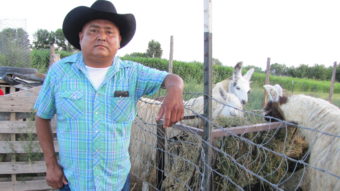
After the Animas River spill, rancher Irving Shaggy is forced to travel a 70-mile round trip to get water for his livestock. “It’s going to be a long struggle,” he says. Laurel Morales/NPR
The Environmental Protection Agency was investigating an old mine near Silverton, Colo., earlier this month, when it accidentally released 3 million gallons of toxic waste water into the Animas River.
Initially the agency downplayed the incident and provided little information. So Navajo President Russell Begaye traveled to the source of the toxic spill and posted a video of it on Facebook.
In the video, he stands in front of the still-leaking mine.
“This is the story that was related to us just now,” he says. “The person was working the backhoe and trying to block off more of this area, but then he saw a spring … and the water burst through here and it went straight down the mountain.”
The mustard-colored water then flowed downstream to the Navajo Nation in New Mexico. The Navajo Farming Authority has shut off public water intakes and irrigation canals, leaving hundreds of Navajo farmers driving long distances to water their crops.
It’s where rancher Irving Shaggy gets water for his family’s livestock and to irrigate his fields.
“[I’ve] been growing sudangrass for my cattle and sheep, which is our livelihood,” Shaggy says. “We sell the wool; we sell the cattle every year.”
But Shaggy doesn’t know if his cattle will be contaminated and unsaleable. He fights back angry, tired tears at the disruption of his usual routine.
“I mean, I’m upset, mostly because every two days I haul water to my livestock,” he says. “And I get it from the river and I irrigate my fields.”
Now, he says, he has to make a 70-mile round trip to get water.
“I can’t irrigate,” he says. “It’s taking a lot out of me cuz I’ve been hauling out of the other river and that costs a lot of money.”
Shaggy says the EPA isn’t providing enough clean water or enough information, leaving him and hundreds of other farmers to speculate about the rest of the farming and ranching season — and the future.
“It’s going to be a long struggle,” he says. “The water’s still contaminated and it’s embedded in the mud and the rocks and the tree branches along the river.”
This contamination brings up memories of other environmental disasters caused by the federal government. One in particular that Navajo people are talking about is uranium mine contamination — a decades-long legacy that still affects people on the reservation today. The EPA has only started in the last seven years to clean up those mines.
At an EPA meeting at the Shiprock Chapter House last week, a farmer spoke angrily to EPA representatives.
“These folks here are hurt,” he said. “They’re connected to the land. They’re connected to the water. We can’t be compensated for that. We can’t be compensated for all the prayers that was given to that water of life.”
“We are working hard very hard to get this right,” answered EPA emergency responder Randy Nattis. “I’m frustrated. I know everyone here is frustrated. I haven’t slept. No one has slept since this has happened.”
The Navajo say it’s difficult to trust the EPA when agency workers spent much of last week handing out forms to the farmers that would essentially waive their rights to sue the federal government for future damages.
The Navajo president said in a statement, “The Feds are protecting themselves at the expense of the Navajo people and it is outrageous.”
The National School Lunch Program is a federally assisted meal program administered by the United States Department of Agriculture, Food and Nutrition Service operating in public, nonprofit private schools and residential child care institutions. (Photo by Bob Nichols/USDA)
All students at Dillingham City Schools will be provided with free school breakfast and lunch this year. That comes as changes were made to the Community Eligibility Provision, a federal program run through the U.S. Department of Agriculture.
“If you have 40 percent poverty in your district, you now qualify for every child in the school to be able to get free lunch and free breakfast,” says Superintendent Danny Frazier.
That’s down from a prior threshold of 80 percent, which was just above Dillingham’s calculated poverty level.
But the majority of students have been eligible in the past for free lunches through other programs, like the federally-funded Title I-C Migrant Education Program.
“We’ve always been able to offer the free lunch to students that filled out the application with Migrant Ed, and Migrant Ed students automatically qualified also,” said Frazier. “So yes, we’ve had a significant amount of students that did receive free lunch, free breakfast, but now it’s 100 percent.”
High school students are allowed to and often do leave the school grounds and take lunch elsewhere. But the district has been tracking that more students are opting to eat school lunch than in years past.
Frazier credits staff with keeping more students in the cafeteria at lunchtime, where the meals are cheaper and often more nutritious.
The district had a grant last year to buy more Alaska Grown-labeled products, which included produce from local farms. That federal grant ended, but Frazier said he still intends to buy locally as it’s available.
Close
Update notification options
Subscribe to notifications
Subscribe
Get notifications about news related to the topics you care about. You can unsubscribe anytime.