Food

After a missed year, Alaska State Fair vendors say things feel almost normal despite pandemic risk

Fairgoers, few of whom wore masks, walk between vendor booths at the Alaska State Fair on Thursday, Aug. 26, 2021. (Matthew Faubion/Alaska Public Media)

Even mid-morning on a Thursday, the Alaska State Fair was bustling with activity. Swinging, whirling amusement park rides were filled with thrill-seeking children and their acquiescent parents, teenagers perused tie-dye stands and the smell of every type of fried food wafted through the fair’s busy corridors.

The 2020 Alaska State Fair was canceled due to COVID-19 risk. This year, you’d hardly know there’s a pandemic, said some vendors.

“I was really kind of curious what to expect with COVID going on, and everything else with the delta variant. But it has been pretty normal,” James Strong, owner of Sweet Caribou macarons, said from behind the counter of his booth near the south entrance.

This is Strong’s fifth year at the fair. When the Anchorage-based Sweet Caribou was starting out, the fair made up a big chunk of sales. But now it’s more a marketing opportunity, a chance to talk to people and debut new flavors, like sour lime and raspberry.

James Strong, owner of Sweet Caribou, poses for a photo in his booth at the Alaska State Fair. (Matthew Faubion/Alaska Public Media)

Strong said he wasn’t too worried about the coronavirus risk this year because he’s had COVID-19 and is vaccinated. But he joked grimly that anyone who is concerned about the virus shouldn’t come.

“I’m sure that cases for the state will not go down for the next three weeks, while the fair is going on,” he said. “I assume at some point it will spread through everyone here. I just don’t see a way around it when you gotta pack 10,000 people in here and cram them in here. Like last Saturday, I mean, you couldn’t move.”

The Alaska State Fair averages 300,000 visitors each year, according to CEO Jerome Hertel. That’s about 40% of the state’s population, and it’s more people than turn out to vote some years. In an effort to spread out the crowds, Hertel said, the fair is taking place over three weekends this year, instead of two.

Face masks are encouraged but not required at the fair. Very few people wore one on Thursday. Alaska is in the throes of a major surge of coronavirus cases, with the state on Thursday reporting its highest daily tally of COVID-19 cases of the year. Hospitals across the state are also strained, including in the Mat-Su, where all 14 of the borough’s ICU beds are filled as of Friday, according to the state’s coronavirus dashboard.

At the fair, people don’t seem too stressed about the virus, said Tiffany Jackson, who serves milkshakes and Italian sodas at a 1950’s-themed soda fountain called the Alaskan Soda Jerk.

“I mean, people are here,” she said. “So if they’re here, I don’t think that they’re really too worried. I don’t think that the organizers, the vendors or anybody else is very worried either. As long as people are being smart and safe, there’s no reason to be closed.”

The Soda Jerk caters and works events at the fairgrounds throughout the summer. Jackson calls each event a “show.”

“We’ve got poodle skirts for the ladies. The guys wear blue jeans, a white button up and a bow tie,” she said, adding that she’s occasionally worked a shift on roller skates. “We’re really loud, we’re really out there.”

Tiffany Jackson, manager at the Soda Jerk. (Matthew Faubion/Alaska Public Media)

Jackson, who grew up going to this fair with her family, said it was sad to miss out on the experience last summer. It was also a big hit to business, she said.

“The fair is a very small portion of the summer, it’s the last two weeks, but it’s close to half what we make,” she said.

Things didn’t feel as busy as usual, Jackson said on Thursday, but with sunny weather forecasted this weekend, she expected crowds will pick up.

Further down the row, Cathleen Gordon took a break scooping ice cream at Cornucopia Cones, which she’s owned with her husband since 1983. In nearly 40 years working the fair in her same booth, she said, this year has been a new challenge.

“​​We just decided to do masks in our booth. And we didn’t put napkin dispensers on the front counter. You know, we’re just trying to be careful,” she said, adding that she’s seen hardly any visitors wearing masks.

Cathleen Gordon, (left) owner of Cornucopia Cones with her co-worker Debbie Bentti, (right). (Matthew Faubion/Alaska Public Media)

Over the years Gordon said, she’s gotten to know her “neighborhood” of nearby vendors. This year, though, there are a lot of new booths on her corridor.

“It was [COVID] partly,” she said of the turnover. “And people are aging. You know, some of the people that retired were like, ‘I’m getting old enough already.’ I even told my husband, ‘I’m getting too old for this!’”

CEO Hertel said there are about 100 new vendors this year. He said some businesses from previous years were hit by labor shortages and others from the Lower 48 had difficulty coming through Canada with border restrictions. Others took another year off due to COVID-19, he said.

“There were some that were a little uncomfortable, still a little uncomfortable, about setting up and operating their business,” he said.

Hertel said fair organizers were also concerned about COVID-19 risk but opted to move forward with the new, longer schedule and preventive measures like sanitizing stations, free masks and one-way traffic in indoor areas. Also, he noted, the fair is primarily outdoors.

“We consulted with the Department of Health, and an outdoor event is one of the safest events you can attend. We have 300 acres here of ground. And so there’s an opportunity for people to social distance,” Hertel said. “So we felt pretty good about that.”

Two people take a ride on the ferris wheel at the Alaska State Fair. (Matthew Faubion/Alaska Public Media)

This weekend, livestock, horticulture and arts and crafts exhibits will be on display at the fairgrounds in Palmer. Lumberjack and motorcycle shows, plus as a concert series, are in store as well.

The state fair encourages masking and is asking anyone with symptoms to stay home. The fair runs through Sept. 6.

Supply shortages, shipping delays hit Southeast Alaska businesses

Some shelves at the Trading Union grocery store in Petersburg are nearly empty. (Katie Anastas/KFSK)

A COVID-19 outbreak at a warehouse in Centralia, Washington has led to shipping delays at grocery stores throughout Southeast Alaska, including in Petersburg. Some shelves are nearly empty. They’re not likely to be filled anytime soon. And it’s not just grocery stores feeling the strain. Many businesses in Petersburg are experiencing supply shortages and delays more than a year into the pandemic.

Walking down the aisles at the Trading Union grocery store in downtown Petersburg feels like traveling back in time to the start of the pandemic. There’s no toilet paper. There’s no milk. Customers have cleared granola bars off the shelves.

The store’s general manager, Barry Morrison, said they’ve gone six weeks without freight shipments following the Centralia warehouse outbreak.

“The first thing they stopped shipping out was dry goods,” he said. “Those are typically your biggest orders, and they’re the bulk of all store orders. So you want to start limiting cases. You go strictly fresh. But it did impact our meat. They didn’t ship it one week. They missed our whole milk order, so it was a little rough.”

The supplier, United Natural Food Incorporated, sent the Trading Union some orders from their warehouses in Stockton, California and Billings, Montana.

That helped, said Morrison, but it adds two days of travel time. Plus, he said, he couldn’t order more than two cases of any product. He expects it’ll take six to eight more weeks until things are back to normal. In the meantime, backup supplies are running low.

“We’ve made sure since the pandemic started in the beginning that we have extra flour, extra mayonnaise, extra sugar,” he said. “We have extra, we’ve just gone through most of that extra having six weeks of no freight.”

The grocery supply shortage is the most dramatic in Petersburg right now. But other businesses are dealing with their own shortages too.

Will Ware owns The Cedar Box, which sells Alaska Native art and fishing supplies. He said he has more customers this summer compared to last year, when the pandemic severely restricted tourism. This year, he said, the biggest challenges are shipping delays and higher freight rates for supplies.

“I’ll use an example. Like hangers for our slat boards for our wall, we recently got those. We were waiting months for those and we just got them in,” he said. “Even supplies like bags to put our products in, it’s been really difficult to get a steady supply in regularly.”

Down the street, Mark Kubo co-owns FireLight Gallery and Framing. The back of the shop is where the custom framing happens, mostly for local customers.

“We’re still dealing with some backorders,” Kubo said. “Items have been on backorder for almost half a year now.”

Kubo said they’ve found ways to save time on their own. Before the pandemic, the frame moldings would be cut by suppliers before getting shipped to Kubo’s business.

“But during the course of the pandemic, as we saw that shipping was becoming a problem in getting supplies, and getting supplies could be a problem as well, we decided to invest in a chopper so we can chop things down to size,” he said.

Having the chopper means he can process some orders in the shop from start to finish. Though he’s been able to adapt, Kubo said, the future is still uncertain as the highly contagious delta variant of the coronavirus spreads.

Neal Fried is an economist with the Alaska Department of Labor. He said, on a national and international level, the pandemic’s toll on supply chains is unprecedented.

“The supply chain’s going to be studied very heavily in the future as something that we always took for granted in the past,” he said.

A big piece that we took for granted: labor, Fried said. Even when there’s enough of a supply, a lack of workers can mean that supply stays put. Anytime there’s a COVID-19 outbreak at a warehouse like the one in Centralia, it puts the whole process on pause.

Eventually, things will work themselves out, Fried said. But when will that happen? It’s hard to say, he said.

“You know, a year ago I might have been brave enough to tell you,” he said. “But now that we know we were almost all wrong, I don’t know.”

At the Trading Union, Morrison is putting backup supplies on grocery store shelves. At Firelight, Kubo is cutting his own frames. Whatever way businesses might buy themselves time, Fried said, patience and flexibility are key.

Declining sea ice in Kotzebue Sound is shortening subsistence hunt for seals, study finds

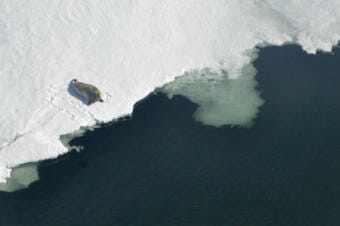
A bearded seal sits on the ice edge in Kotzebue Sound. (Photo by Jessie Lindsay, NMFS MMPA Permit No. 19309.)

Seal meat makes up a good portion of what’s in subsistence hunters’ freezers in Kotzebue. However, the sea ice the seals haul out on is diminishing, and new research has shown the window to hunt seals is getting shorter as a result.

Iñupiaq hunter Cyrus Harris has harvested ugruk, or bearded seal, his whole life. For many people in Kotzebue and the surrounding region, the rotund mammal is a dietary staple.

“Ugruk, once we process it into a seal oil form and using it as a preservative for the meats, the product itself is very nutritious,” Harris said. “We may be processing this stuff in the month of June, but we’re thinking ahead to fill our Siglauq, or storage, with product that’s going to run us through the winter.”

Harris says the hunting season starts in the spring, as the sea ice breaks up in the Kotzebue Sound. But he’s noticed a change in the season length.

“Once the ice flows break loose and are drifting north, we’d have about a two-week timeframe to do that on a regular hunting season,” Harris said. “But the shortest I’d seen it happen was about three days.”

The sharp decline in the season length can be directly linked to the decline in sea ice due to a warming climate. That’s the finding of a new collaborative study conducted by the Native Village of Kotzebue and the International Arctic Research Center at the University of Alaska Fairbanks.

Alex Whiting is the environmental program director for the Native Village of Kotzebue. He’s a co-lead author on the study and has been documenting the change in the ugruk hunting season for almost 20 years. He says it’s become more relevant as the tribe has studied the change in sea ice extent.

“Notes that I had been taking since 2002 did show a pattern of shorter ugruk hunting seasons because the ice would disappear a little bit earlier and earlier over time,” Whiting said.

That change has translated to an average loss of a day per year for the hunting season since 2002. The study found that the season is ending an average of 26 days earlier than normal. Whiting says the sea ice extent fluctuates.

“Some years it resembles a little bit like it used to in the 20th century,” Whiting said. “But other years, like 2018 and 2019 in particular, by the time the ugruk hunting season began, the ice in the Kotzebue Sound, which was 70 to 80 percent gone already, looked like it would at the end of June or the beginning of July.”

Roswell Schaffer, an Iñupiaq elder and hunter from Kotzebue, Alaska, who helped co-author the study. (Photo from Sarah Betcher, Farthest North Films)

With these changes, Whiting says hunters are having to plan their hunts earlier in the year.

“If they wait, all you need is a week of strong west winds, and you could lose out on your opportunity for that year,” Whiting said. “Because the ugruk hunting season only occurs during that short window of May, June.”

To date, researchers haven’t seen any drastic decline in hunters’ ability to land ugruk, but it’s largely due to hunters adapting to the shifting ice.

Donna Hauser is a marine ecology researcher with the International Arctic Research Center and the other co-lead author on the study. She says normally hunters would have a lot more sea ice to travel out on to harvest ugruk, often meaning packing more gear and gas for their boats. That is changing as the sea ice extent becomes smaller.

“Some sea ice had grounded close to Kotzebue, within 10 miles,” Hauser said. “And so people could make more frequent, shorter trips, use more gear, less gas, and actually be really successful still. So hunters have had to adapt to these changing conditions. That has allowed them to still be successful, despite the sea ice loss.”

In researching the impacts of sea ice extent on ugruk hunting, Hauser says the process was collaborative from the start. That meant input from more Western academics at the university level, but also the inclusion of village officials as well as an Indigenous Elder Advisory Council, something Whiting from the tribal office says is a first. Hunters like Harris were added as co-authors of the study.

Hauser says the co-production of knowledge was valuable, and the research wouldn’t have been as robust without the inclusion of Indigenous knowledge from the study’s inception.

“This is really responding to Indigenous sovereignty over the entire research process,” Hauser said. “It creates a more inclusive and sustainable research process, which hopefully will lead to more equitable outcomes in terms of incorporating those Indigenous perspectives in climate change planning and adaption.”

As Hauser and others look forward to further collaboration, hunters like Harris say they’re looking ahead to this upcoming winter, to see what sea ice it’ll bring for spring.

Gardentalk – Cleaning and curing your garlic harvest

Garlic
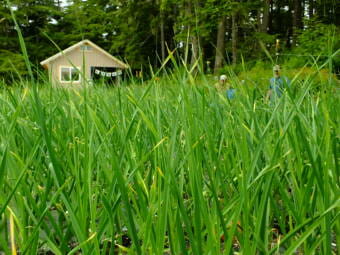
Sam Bertoni and Joe Orsi of Orsi Organic Produce harvest the scapes of nearly 2,500 garlic plants that are already 3-4 feet high. In this picture taken in early July, the tips of some of the leaves are just beginning to turn yellow. Orsi says when half of the leaves are yellow, then it’s time to harvest the entire garlic plant. (Photo by Matt Miller/KTOO)

When half of your garlic plants’ leaves turn yellow, then that’s the signal to harvest.

Joe Orsi follows that guideline for his small commercial operation located out the road.

In the latest edition of Gardentalk, Orsi described how he uses a special tool to harvest a lot of garlic at one time. But most gardeners can simply dig down to the bulb to carefully harvest the bulb. Never pull them up by the leaves.

Orsi also soaks or washes the soil off the garlic bulbs before peeling or removing the first few layers of wrappers or the skin surrounding it. Then, he chokes or gathers them up in bunches of five to hang for several weeks to dry out.

How low chum runs changed the lives of these Western Alaska fisheries workers

Commercial fisherman Paul Andrews makes $9 a day measuring the water level in Emmonak. (Olivia Ebertz/KYUK)

For decades, Kwik’Pak Fisheries in the Western Alaska village of Emmonak has provided reliable summer employment in one of the state’s most unemployed regions. The company is the only fish processor on the Yukon River.

But with salmon runs low and commercial fishing closed, it’s offering few jobs this summer. Commercial fishermen and women are feeling the economic stress, and those who are still working at the plant have had to transition to new roles.

Every day at half past noon, Paul Andrews walks to the river bank in Emmonak, stopping at a small metal marker nestled on a dune. He takes out a surveyor’s measuring tape, hooks it on to the marker and walks it to the water line. Then he phones the National Weather Service.

“Make that 79 feet at 12:30,” Andrews said.

Paul Andrews marks the rain gauge and the level in his notebook. (Olivia Ebertz/KYUK)

Andrews is measuring the water level of a slough off the Yukon River, not far from the mouth. He marks the rain gauge and the level in his yellow notebook. He usually takes his youngest child with him for the task.

In Andrews’ notebook, the water levels date back to early July. That’s when he started this job. He gets paid $9 per day. It’s a massive pay cut from his previous work.

In prior summers, Andrews worked as a commercial fisherman for Kwik’pak. It was his only employment during the year, and he said that he usually made $10,000.

“My wife works. But you know, that’s not enough. But we get by,” said Andrews.

He took the water reporting job this summer because he knew there wouldn’t be any commercial fishing openings. The chum salmon numbers on the Yukon tanked last year, and sunk to record lows this year. All commercial and most subsistence fishing for salmon on the river is closed.

Usually Kwik’Pak pays out $7 million to $10 million to local workers. This year it’ll be paying out $700,000 to $800,000 to plant workers, and nothing to commercial salmon fishermen and women.

Kwik’pak is able to hire plant workers at all because it is experimenting with new endeavors. The company built three greenhouses to grow vegetables, and it’s trying its hand at very limited commercial cod processing. This summer the company is buying a few fish from commercial cod fishermen to see how it goes, though they’re not selling it quite yet.

Most of the people working at Kwik’pak this summer are its long-term, most loyal employees. And they’re all having to get used to new roles. Like Lisa Andrews. Usually she does fish accounting, but now she supervises teen workers in the greenhouse.

“I wasn’t certain, but now I like it. These kids actually grown on me,” said Lisa Andrews, who is not related to Paul Andrews.

For now, Richard Akaran’s job as a welder hasn’t changed, though he knows it could. (Olivia Ebertz/KYUK)

When she started hearing about the low chum runs, she said she thought she might not have a job at all this summer.

“I called many times, because I was worried that I wasn’t going to work,” she said.

She said that she’s lucky she got a job. She had worked at a gardening store in Anchorage, so she felt prepared for the new role.

There’s also some folks who haven’t quite felt the impacts of the low chum numbers on their job descriptions yet. Like welder Richard Akaran from Kotlik. He’s wearing overalls and a thick leather welding jacket. He builds boats for the Yukon Marine Manufacturing company, which sits on the Kwik’pak campus.

“We build boats for the fisherman. The fishermen that fish for Kwik’pak,” Akaran said.

For now, he said, his job hasn’t changed. But he knows it could. It’s been two years of low chum runs now. Already other welders have been impacted. Half of them have not been hired back. Akaran said that he hopes next year’s runs are better.

Meanwhile, Kwik’Pak and its workers are trying to keep up with chum runs that are declining faster than the industry can adjust.

Yukon subsistence users go to new lengths for food after massive salmon decline

“I had to go 100 miles north up just to get my subsistence needs,” Herman Hootch said. (Olivia Ebertz/KYUK)

This has been the worst salmon fishing season on record for the Yukon River. King salmon, a regional favorite, have returned in low numbers for years, but now a typically stable species, chum salmon, has also collapsed. Subsistence fishing on the lower Yukon River for both species is closed, and residents who usually depend heavily on the fish are pivoting toward other ways to get meat.

“I started fishing on the Yukon when I was six years old. There was one point, me and my grandpa were coming down here for supplies and we had a summer chum jump into the boat. But those days are gone,” Jason Lamont said.

Lamont is from Emmonak and lives off of subsistence food, which in past summers has meant salmon. His family doesn’t buy meat from the store; the salmon caught during the summer will help carry his family through the winter.

“We used to target 300 fish to put away. We’d get that in about two to three hours. Nowadays in our freezer we have only one fish so far, and we’re lucky to have it,” Lamont said.

Elder Herman Hootch also relies on subsistence food. Like Lamont, Hootch is from Emmonak near the Yukon River mouth.

“We learned from our parents that food from the store is not healthy,” Hootch said.

Neither Hootch nor Lamont have been able to subsistence fish for chums or kings on the Yukon this year. Subsistence fishing for the species has been closed all season.

A lone skiff motors up the river past a fish camp. (Olivia Ebertz/KYUK)

In order for the Alaska Department of Fish and Game to open subsistence fishing, over 500,000 summer chum salmon first need to be counted in the river. Five hundred thousand fish is the lower end of the escapement goal.

Normally that number is met without a problem. On average, the run size is 1.7 million summer chum, as counted by a sonar in Pilot Station. But last year the run suddenly dropped to just 700,000 fish. The number dropped to a fraction of the average run size this year: just 153,497 fish.

Hootch and Lamont are missing a big part of their diet. And to make up for the lost protein, they’ve gone to some pretty extreme lengths.

“I had to go 100 miles north up just to get my subsistence needs,” Hootch said.

He traveled to the Norton Sound area to harvest chum this summer, but the numbers weren’t great there either. According to state fisheries biologist Kathrine Howard, chum numbers have been dismal all over the Bering Sea area since last year. Howard theorizes that climate change is responsible for the decline.

But because subsistence fishing was at least open in Norton Sound, Hootch made the journey.

“But that first trip I didn’t have any luck,” Hootch said.

The second time Hootch did have some luck and caught about 100 chums. He estimates that each round trip cost $500. That means with all the expenses added up, each chum cost him about $10. It was expensive, but cheaper than groceries in Emmonak. And he wasn’t the only one trying his luck there.

“What surprised me this year was the whole delta of the Yukon was up in Norton Sound. We saw hundreds of nets up there. And I said, ‘holy cow, that’s the first time that this ever happened,’” Hootch said.

Jason Lamont has been traveling 50 miles out into the Bering Sea on a small skiff to try his hand at ocean fishing. (Olivia Ebertz/KYUK)

Lamont has also ventured into new waters. He’s been taking his river-going skiff out into the testy waves of the Bering Sea.

“There’s a small group of us who are crazy enough to go out there and start harvesting food,” Lamont said.

But they’re not targeting salmon, they’re going for cod and other ocean species and learning in real-time what ocean fishing entails. Lamont said that he takes his boat sometimes as far as 50 miles off the coast. Most boats that go out that far are several times larger than his small skiff.

“And we go out there to the same size ocean, but the storms are the same too,” Lamont said.

But Lamont is determined to not give up on his Yup’ik culture’s subsistence traditions.

“You either gotta adapt, or lose it,” he said.

Three hours upriver by skiff, in the community of St. Mary’s, folks don’t have the same option to travel all the way out to Norton Sound. Instead, they’re supplementing their diet with extra groceries, more whitefish, and they’ll try to bag extra game meat.

Empty skiffs line the shore in St. Mary’s. (Olivia Ebertz/KYUK)

At the St. Mary’s boat harbor, Bay and Walky Johnson are on their way out to pick berries. Theirs is one of the only skiffs leaving the harbor that day. The rest of the boats bob along the shore, empty of fishing gear. I ask the couple how they will fill their pantry this winter.

“We’ll go after other species of fish,” Walky said.

“Definitely more moose,” Bay said. “We hope to get fall chum, but I doubt it. Fall chum are good for canning. Also when making more dry fish. But we didn’t see any last summer, so I doubt we will see any this summer either,” she added.

The state has no plans to open subsistence fishing for fall chum. That’s because an international treaty governs salmon fishing on the river, and not enough fish will pass through to meet treaty numbers.

Bay and Walky Johnson plan to target more moose to supplement their diet for the winter. (Olivia Ebertz/KYUK)

Correction: An earlier version of this story said that the Pacific Salmon Treaty between the U.S. and Canada dictates summer chum subsistence fishing, and that 300,000 summer chum salmon must be counted to open fishing. That is incorrect. It dictates fall chum subsistence fishing. To open summer fishing, 500,000 summer chum salmon must be counted. To open fall fishing, 300,000 fall chum must be counted.

Site notifications
Update notification options
Subscribe to notifications