Food

Ketchikan Indian Community’s new president says she’ll push for greater access to traditional foods

""
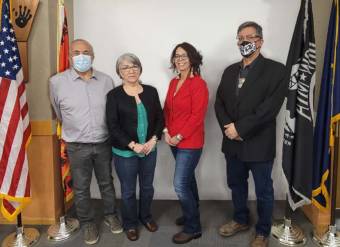
Ketchikan Indian Community’s newly-elected 2022 Tribal Council executives. From left to right, Vice President Norm Skan, Secretary Judy Leask Guthrie, President Trixie Bennett and Treasurer Chas Edwardson. (Photo courtesy of Ketchikan Indian Community)

Ketchikan Indian Community’s Tribal Council elected a new president this week. Trixie Bennett says she plans to lead the community’s advocacy to preserve Indigenous ways of life.

Ketchikan Indian Community’s new president says ensuring tribal members have access to traditional foods and medicines is among her highest priorities.

“File it under sovereignty if you want, but right up there with sovereignty is our food,” Bennett said in a phone interview.

Trixie Bennett, Lingít from Wrangell, is the new president of Ketchikan’s 6,000-member federally recognized tribe. She’d previously served as the council’s vice president.

In her new role, Bennett says she plans to continue pushing for stricter environmental standards for mines near rivers that flow from Canada into Southeast Alaska. Conservationists and tribes say mine waste threatens salmon runs in the region. Bennett says she plans to continue working with groups like Salmon Beyond Borders and the Southeast Alaska Indigenous Transboundary Commission to push for a ban on tailings dams that hold back mine waste along cross-border rivers.
“Part of my priority is to keep putting some attention on that because salmon is our way of life,” she said. “It’s our canary in the mine for the environment.”

She says she’s planning trips to Washington D.C. and Ottawa in the coming months to keep the pressure on.

Closer to home, Bennett says she plans to continue a push to have Ketchikan designated as a rural area under a federal law that governs who can participate in certain subsistence hunts and fisheries.

“Access to the land is equals access to our foods. It’s been that way — my great grandfather was Chief Shakes in Wrangell in … the 1890s, and he was fighting for the same thing: access to our lands and our foods. So that will continue to be a focus for me and this tribe,” Bennett said.

As it stands, the Federal Subsistence Board considers most of Ketchikan, with the exception of Saxman, to be a non-rural area. And that means most people in Ketchikan can’t hunt or fish under subsistence rules on federal lands.

“We fought for the fishery to open for subsistence users on the Unuk (River) for eulachon every spring, and we actually won — people could go out and get five gallons each. But we didn’t get to go ourselves as a community, and our tribal people weren’t allowed because of that rural designation,” she said. “It’s just not right.”

Bennett says another area of focus is addiction, mental health and homelessness.

“It all goes together,” she said. “We have a lot of amazing programs and services and a treatment center in the works that we’re working on plans for. We’ve gotten through a feasibility study, so that’s coming down the pike, and (we’re) looking forward to collaborating with the rest of the community. We know it’s a real need here.”

Beyond that, Bennett says she plans to put her new business and management degree and her experience on staff to use making KIC a better place to work and get health care.

Before assuming the presidency, Bennett worked for the tribe’s clinic for more than a decade before winning a seat on the tribal council in 2018. These days, she runs a small online traditional medicine store called Tongass Tonics and says she’s in talks to purchase another downtown business.

“Our traditional foods, a lot of our people never have had to this day because they get shipped out to the highest bidder. I’d like to see more of those things offered by businesses in town,” she said.

Bennett replaces Gloria Burns as president. Norm Skan, who preceded Burns, will return to council leadership as vice president. Treasurer Chas Edwardson and Secretary Judy Leask Guthrie round out the 2022 executive committee.

In Alaska’s largest school districts, families are still waiting for last year’s food assistance

""
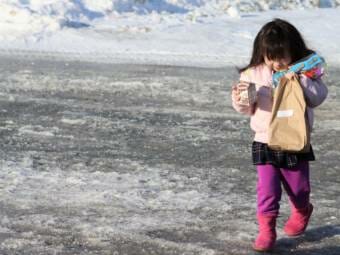
A child carries breakfast and lunch from the school bus in Glencaren Court in East Anchorage on Friday, March, 20, 2020. (Photo by Tegan Hanlon/Alaska Public Media)

Tisha Pike lives in Eagle River with her son, who’s in second grade. Before the pandemic, he got free lunches at his school, Birchwood ABC Elementary. Then, schools went online, and she had to spend more on groceries.

She got reimbursed for those groceries through a federal program called the Pandemic-Electronic Benefits Transfer Program, or P-EBT.

“That stability, and being able to know that I have money coming to make sure that my child has food, it means the world,” she said. “Because I know that’s something that he doesn’t have to stress out about.”

Students were eligible for P-EBT if they were enrolled in their school’s free or reduced-price meal program and if the school closed due to COVID-19. In the Anchorage School District, nearly 14,000 students — about a third of students in the district — meet the requirements for free and reduced meals.

Anthony Reinert, the SNAP outreach manager for the Food Bank of Alaska, said it’s meant to make up for those lost meals.

“This is not a benefit in the traditional sense — this is a reimbursement,” he said. “Those children who couldn’t attend school because of the pandemic missed meals that would have been provided through free and reduced meal programs. Those meals then had to be paid for by parents while they ate at home.”

Families can check the Food Bank’s online eligibility calculator to see if they were automatically enrolled for the 2020-2021 school year. Reinert said some families could receive up to $1,800 per child.

Last year’s rollout of the program was plagued with issues and delays. According to the Food Bank of Alaska, just 28 school districts in the state have received P-EBT funds for the 2020-2021 school year. Families in the state’s largest districts — Anchorage, the Matanuska-Susitna Borough, Fairbanks and others — are still waiting.

Jo Dawson, the state administrator for the department of education’s child nutrition program, said reimbursing families for spring 2020 was an easier process. That’s because closures were fairly consistent across schools.

“Essentially two weeks in March, four weeks in April, and three weeks in May,” she said. “School year 2021 was all over the map.”

Last year, schools were closing and reopening at different times. Some students switched schools or left their districts. That made the data much more complicated.

Shawnda O’Brien directs the state’s Division of Public Assistance. She said dispersing funds is taking so long because state workers are combing through school district data manually. Automating the process requires using an outdated computer programming language.

“Most of the individuals who have that experience are retired or retiring,” she said. “It’s not something that someone in college would be learning to do.”

Starting from scratch in a more modern programming language would take years. They’ve started that process, but in the meantime, the department is looking nationally for people who can work with the existing system.

“Asking folks to be patient is difficult, especially when it comes to money,” O’Brien said. “The biggest thing we can do is let them know that we’re working on it, and we understand the hardship that it’s placing on families and that we’re working as hard as we can to find a solution.”

Some states have applied for P-EBT again for this school year. But like many states’, Alaska’s application is still pending. For now, families waiting on last year’s funds can check the Food Bank of Alaska’s website for updates or sign up for their emails.

Until their cards arrive in the mail, parents like Pike will have to keep waiting.

“Most people have written it off,” Pike said. “I’m never going to get that money. At this point, it’s like beating a dead horse.”

O’Brien said the Division of Public Assistance aims to have a clearer disbursement timeline within the month.

Federal disasters declared for 14 Alaska fisheries

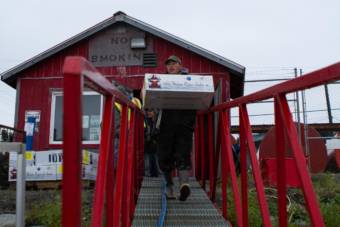
Daren Jennings loads up his skiff to deliver Bristol Bay salmon to Lower Yukon River communities. The Yukon salmon fisheries saw their lowest runs ever in the summer of 2021. Yukon River families were not allowed to fish for subsistence, and the commercial fishery remained closed. (Olivia Ebertz/KYUK)

Fourteen Alaska fisheries have been declared federal disasters by the U.S. Secretary of Commerce. Gina Raimondo issued the declarations last Friday, and the announcement could lead to federal funding for fishermen.

The disaster declarations include the 2020 Kuskokwim River salmon fishery and the 2020 and 2021 Yukon River salmon fisheries. These fisheries saw significant salmon declines both years, with the Yukon salmon fishery seeing its lowest runs ever in the summer of 2021. Yukon River families were not allowed to fish for subsistence, and the commercial fishery remained closed.

Executive director for the Yukon River Drainage Fisheries Association, Serena Fitka, helped lead a group of Yukon River tribal and fishing organizations to campaign for the Yukon disaster declarations.

“I give the credit to the Yukon River communities, everyone that pulled together to make their voices heard that we are in crisis mode right now,” Fitka said.

The groups issued a letter last fall that listed the impacts of the salmon collapse on residents, “which include cultural loss, food security, psychological impacts, and the overall wellness of the people along the river.”

With the disasters now declared, Congress could choose to allocate federal funding for assistance. It’s an action that both Alaska’s U.S. senators signaled that they are ready to push for in a statement celebrating Secretary Raimondo’s decision.

“Our great fisheries resources provide a pillar within Alaska’s economy and culture. Now that a fishery disaster has been declared, we can work to secure appropriations to fund these fishery disaster declarations,” Alaska Republican Sen. Dan Sullivan wrote in a statement.

On the Yukon River, Fitka is once again mobilizing the same groups that campaigned for the disaster declarations. This time they will campaign for federal funding.

“That’s really making sure that the fishermen get the assistance they need. Not only for commercial, but for subsistence users as well,” Fitka said.

On the Kuskokwim River, Mike Williams Sr. chairs the Kuskokwim River Inter-Tribal Fish Commission. He said that he hopes the disaster declarations will provide relief to Kuskokwim and Yukon River families. For years, these families have not met their subsistence needs through king salmon, and other species runs are also declining.

“I just hung two chums on my rack all summer, and our hearts go out to people on the Yukon, because they got zero,” Williams Sr. said.

He criticized how long it took the federal process to declare the fisheries as disasters. Some of the fisheries listed in other areas of Alaska are from as far back as 2018.

“Right now, the only thing I can say is better late than never,” Williams Sr. said.

He said that he hopes some federal funding will go toward researching why the salmon are declining.

Secretary Raimondo issued determinations that fisheries disasters occurred in:

  • 2018 Upper Cook Inlet east side set net
  • 2018 Copper River Chinook and sockeye salmon
  • 2019 Eastern Bering Sea Tanner crab
  • 2020 Prince William Sound salmon fisheries
  • 2020 Copper River Chinook, sockeye, and chum salmon fisheries
  • 2020 Eastern Bering Sea Tanner crab
  • 2020 Pacific cod in the Gulf of Alaska
  • 2020 Alaska Norton Sound salmon
  • 2020 Yukon River salmon
  • 2020 Chignik salmon
  • 2020 Kuskokwim River salmon
  • 2020 Southeast Alaska salmon fisheries
  • 2020 Upper Cook Inlet salmon fisheries
  • 2021 Yukon River salmon fishery

Alaskan kids ‘do everything except pull the trigger’ in class moose hunt

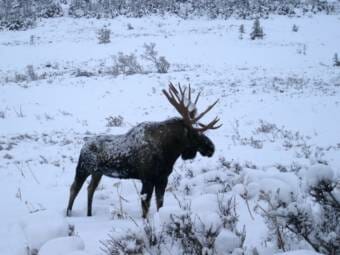
A large bull moose standing in a snowy field
Alaska moose in winter in 2019. (Photo courtesy of Paul Twardock)

One day last November, a group of Nikiski students found themselves standing in a circle around a nearly thousand-pound moose their teacher had just shot. Soon, the class was butchering the massive animal. The scene was part of an effort to instill knowledge in the kids about how to hunt, as well as respect for where their food comes from.

The school’s outdoor exploration class is not unique in Alaska, just as hunting for food is a normal way of life here. But to many readers of the New York Times, which recently published a story about the class’s successful hunt, it was a surprising and unfamiliar topic.

Alaska-grown New York Times reporting fellow Victoria Petersen wrote the story, which she says had been in the back of her mind ever since her days as an education reporter at the Peninsula Clarion newspaper. Petersen says she described it to her editors at the Times as, “The kids do everything except pull the trigger.”

Listen here:

The following transcript has been lightly edited for clarity.

Victoria Petersen: Students in the outdoor explorations class at Nikiski Middle High School are taught a lot of different things in their time in the class, one of which is hunter safety and hunter guidelines specifically for Alaska. And then students who choose to can opt to go on this educational moose hunt, which doesn’t happen during school hours. It was on an in-service day when we went, and then the moose had to sit for two days, and then the students came in on a Saturday to help butcher it.

Casey Grove: Oh, that’s cool. I guess some of the kids had been hunting before, but was part of that preparation for the students just about the realness of this, and the blood and all that stuff?

Victoria Petersen: I asked some of the students how they prepared and a lot of them told me that in their backyards, they would practice how to build a fire and just some of the more practical things, maybe like knife skills. But a lot of it was learned on-site, hands-on. The teacher and the volunteers showing them how to hold the blade, where to cut, where to pull. It was very interactive and hands-on. And so the students were kind of following along as they were going.

Casey Grove: There’s a lot of just really interesting first-person reporting about that and these great photos from Ash Adams along with that New York Times piece. And there was one scene in there when they pulled the heart out, and they were kind of passing it around. I wondered as you hit observed this, did you see kind of a change in those students, in terms of respecting the moose and respecting where their food had come from?

Victoria Petersen: Yeah, the kids were really, I feel like, they didn’t really know exactly how to handle themselves at first. Because a lot of them haven’t been around a dead animal, especially one as large as a moose. And so there was some timid exploration of it. When we first got to the kill, the kids were, like, petting it and looking at it, examining it.

Some of the girls specifically were really grossed out when it came to opening up the gut area where it starts to smell really bad. But their teacher was explaining everything using very technical terms. And, because there were some kids going, “Ewwww!” he was like, “It’s fine that you think it’s gross, and you can walk away and look away and all that, but um, you know, your reactions affect other people.” After he said that, the students were more quiet and just sort of observing everything after that. And that was right before he pulled the heart out.

When he pulled the heart out, I think one of the students volunteered to hold it right away to bag it up. One of them was like, “Oh, it’s still hot.” And then the other kids were really interested. And they’re like, “Oh, it’s still warm. Wow. Oh, let me feel it.” I think that was sort of a moment of like: this was a living animal. And yeah, some respect for the whole thing, the whole hunt.

Casey Grove: It makes me wonder, like, the broader question, I think maybe is, why is this important? But to that instructor, to that teacher, what did he say about why this was important to him? It seems like a little bit of an extra thing to take a bunch of kids out. So why would he do that?

Victoria Petersen: He is a hunter himself and does a lot of hunting. And he has young children. And he talked about, as a hunter, it’s pretty easy to just leave his kids at home and do it himself, because they don’t know exactly what they’re doing. You have to teach them and you have to walk through everything and maybe it’s just easier for someone who knows what they’re doing to just do it themselves. But he says that this class is a way to give the kids that knowledge and that encouragement to feel like they know what they’re doing or they can participate in this thing that can sometimes feel inaccessible. He also talked a lot about just the importance of knowing where your food comes from.

Casey Grove: What did the kids tell you about this experience?

Victoria Petersen: They all seem super excited about it. Some of the kids really liked the hunting part and the being outside by the fire and helping take apart the animal. Other kids did not like that part at all. They were just trying to get through it. And then some of the other kids really, really enjoyed cutting the meat and processing it and found cutting the tendons and the fat off of the meat was really satisfying. So there was a broad range of experiences on that trip, but I think overall, the kids said that they would do it again and felt more empowered to do it again as well.

The Year in KTOO News: Juneau arts and culture

Erick Heimbigner keeps an eye on his son, 4-year-old Emmett Heimbigner, as he practices riding his bike at the Archipelago Lot along Juneau’s Seawalk on Oct. 21, 2021. Juneau Docks and Harbors officials want to rename the lot “Peratrovich Plaza” after the Alaska civil rights leader and the subject of the mural behind them. (Photo by Jeremy Hsieh/KTOO)

The year 2021 was a great one for public art in Juneau. In February, signs went up around town that tell people much more than just where they are physically located. Each one tells an oral history about the place as part of a project called Juneau Voices. Ten stories are narrated by people from Dzantik’i Héeni, whose family histories go back generations.

Over the summer, a Juneau coffee shop got a makeover from Lingít artists, including a mural of a misty seascape by Michaela Sheit.een Goade, who is well-known for her work illustrating a Google Doodle and winning the Caldecott Medal for illustrating the book “We Are Water Protectors.” At the counter there’s an aluminum carving by Robert Mills that tells the story of the Fog Woman. Mills is also responsible for the 20-foot-long formline canoe called Yaadachóon installed this year along the seawalk at Overstreet Park.

Interior of Sacred Grounds coffee shop showing a mural by Michaela Goade and aluminum carving by Robert Mills. (Photo by Lyndsey Brollini / KTOO)

A mural of civil rights icon Elizabeth Peratrovich now adorns the side of the downtown library and parking garage. It’s the work of Crystal Worl. The city is considering changing the name of the whole area around the mural to Peratrovich Plaza. 

Crystal Worl’s mural is several stories tall. One of her brother’s works is miniscule by comparison, but also made a huge splash this year. Rico Lanáat’ Worl’s designs caught the eye of an art director at the U.S. Postal Service, who encouraged Worl to submit artwork for a postage stamp. Eighteen million stamps featuring Worl’s depiction of the raven and the box of daylight story were released to the public in July. A ceremony in Juneau celebrated the first stamp ever designed by a Lingít artist and the importance of the design and its story to the people who live in Lingít Aaní today.

Tlingit artist Kaasteen Jill Meserve in the process of making a pickle medallion that will be featured in the show Reservation Dogs. (Photo courtesy of Jill Meserve)
Lingít artist Kaasteen Jill Meserve in the process of making a pickle medallion that will be featured in the show Reservation Dogs. (Photo courtesy of Jill Meserve)

In September, a local artist’s beadwork was featured on the hit Native comedy show Reservation Dogs. Kaasteen Jill Meserve was commissioned by the show to make two phallic medallions for an episode. One’s a pickle and the other is a microphone. Meserve is a huge fan of the show and said everyone should watch it. “In not just, like you know, in our Native communities but like for Hollywood and what it means to be really truly represented in media and on screens. It’s very monumental,” she said.

One of Juneau’s newest restaurants, Black Moon Koven, opened up this spring very elusively and mostly through word of mouth. Its dark, moody ambiance has drawn a cult following. It’s a big risk to open a restaurant during the pandemic, but owner Aims Villanueva-Alf’s gut told her to just do it. Last year Villanueva-Alf had closed her wildly popular Auke Bay space GonZo after she was assaulted there.

“I feel like Black Moon was my way of healing through my trauma and continually is a place where it could be, and seems super dark to people, but it actually brought a lot of life and light into my own darkness,” she said.

Aims Villanueva-Alf works in her restaurant Black Moon Koven on August 5, 2021 in Juneau, Alaska. (Phyto by Lyndsey Brollini/KTOO)

KTOO is looking back at 2021 through the stories that had the widest and strongest impact on the community. Read stories about justice in Juneau, the cruise industry’s return to Juneau, or the year in state government.

Juneau restaurant hit by Bristol Bay king crab season closure, skyrocketing prices

Derek Schneider at Tracy's King Crab Shack
Derek Schneider works with some king crab legs at Tracy’s King Crab Shack in Juneau on June 8, 2021. (Photo by Jeremy Hsieh/KTOO)

Tracy’s King Crab Shack has served Alaska king crab below market price for years, but the restaurant isn’t able to do that anymore. Owner Tracy LaBarge said prices have gone up 100%. 

“It’s not a small increase. It’s double what it was in 2019. So that’s been a tough one to take,” LaBarge said.

Crab shortages and inflation are hitting seafood restaurants across the country.

Those crab shortages are being caused by multiple factors. One of the biggest ones in Alaska is that there are just not as many crabs. This year, all major stocks of crab in Bristol Bay were low, not just king crab. 

Forrest Bowers manages commercial fisheries for the Alaska Department of Fish and Game. He said that the number of mature male and female crabs has been declining for years.

Mature crabs are the ones that reproduce, and over the last 12 years, fewer and fewer crabs are reaching that age. 

“You know, in general, the reasons why productivity can be lower are that environmental conditions are unfavorable,” Bowers said.

Bowers said there are a lot of factors coming into play that can impact crab populations.

Environmental conditions could be related to effects of climate change — like warming water temperature or ocean acidification — or related to food scarcity or predators. Fishing and bycatch can also impact the crab stock.

The end result of this trend of declining crab stock is that Fish and Game closed the red king crab season in Bristol Bay, and that closure had a direct impact on LaBarge’s restaurant. 

“It’s kind of what we prided ourselves in, was always buying Alaska king crab, this Bristol Bay king crab,” LaBarge said. “So this is kind of the first time that we’re having to go, you know, buy Russian crab or Norwegian crab, basically, just to stay in business. Because the crab season is closed.”

Next season, she will still have other Alaska crabs, like Dungeness, snow or tanner. But not Bristol Bay king crab. 

And there’s still high demand for crab, especially overseas. LaBarge said live markets in China, Japan and South Korea are buying more crab, and that there is always a big push for crab around Lunar New Year.

Combine increase demand with the crab shortage and it’s made the price of all species of crab go up a lot

“We’re double in our pricing, which is a shock to people who have been longtime customers, you know, but it is what it is. We’re all just trying to survive,” LaBarge said.

Normally, LaBarge already has all her crab purchased for the next tourism season, but with the high prices, she said it didn’t make sense for her to do that. 

She hopes the prices will go down after the holidays and she can buy her crab then. But she also doesn’t want to wait too long and then not have enough crab either. 

LaBarge said this next tourism season will make or break her business. This year’s season was better than 2020 but she still operated at a loss and she can only do that for so long.

“The one thing we’re good at is we’re good at adjusting our menu, we’re good at adjusting our labor. This is 17 years now we’ve been doing this so we’re pretty good at adjusting to the market. But this has been a not a fun one,” LaBarge said.

LaBarge thinks sales next year will be better than this year, but that it’s still just a guessing game at this point.

Site notifications
Update notification options
Subscribe to notifications