Food

State roughly halves the number of Alaskans waiting on food aid, but more than 8,000 remain

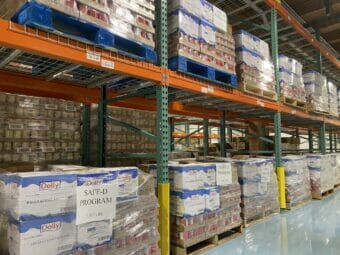
Bulk food in Food Bank of Alaska’s Anchorage warehouse on April 21, 2023. (Photo by Claire Stremple/Alaska Beacon)

Mary Wood has been waiting for food stamps since she filed a renewal application in August. She takes care of three of her grandsons intermittently, and qualified for more than $800 a month in benefits.

“Around Christmas it was really hell,” she said. “I told my landlord, ‘I don’t have any money to give you. I can’t even buy the kids presents.”

Now she says her refrigerator and freezer are all but empty — she and her grandsons eat things like oatmeal, peanut butter and jelly sandwiches, and dehydrated emergency food rations that she’d purchased in case of a natural disaster. “It’s survival food,” she said, and added that she usually adds meat or vegetables to it when she can.

Wood borrowed money from her daughter to keep up with bills for a few months. She said she is now behind on rent again after she spent her income on food, but feels lucky because her landlord hasn’t kicked her out — instead he shares moose meat with her and gives her quarters for the laundry machine.

She said she’s visited and called the Division of Public Assistance multiple times, and they tell her the application is in the system so she just has to wait. She said the situation makes her feel worthless. “It’s really hard,” she said.

She’s one of thousands of Alaskans who waited for months for food stamps, due to extreme delays in the Division of Public Assistance. The state says it has worked through thousands of backlogged applications, but thousands more Alaskans are still without food benefits.

Chipping away at an 18,000 person backlog

The state’s own reporting says that so far in 2023, the Division of Public Assistance has processed fewer than a third of its food stamp renewals on time this fiscal year. But division Director Deb Etheridge said that’s been turning around in recent months.

“I’m feeling really positive,” she said. “We’ve implemented some pretty significant changes in our staffing pattern, in order for us to not only take care of the backlog, but also assure that it doesn’t grow.”

The state pledged to cut its 10,000 person wait list for new food stamp benefit applications in half by the end of October as a result of a class-action lawsuit filed in May. Etheridge said that the backlog is down to 8,794 people as of last week. If the state fails to meet the deadline the lawsuit will continue, but Etheridge said they are on track. Staff is divided into teams: Some work on the backlog while others tackle incoming applications for food stamps. A third team works on Medicaid renewals.

And Etheridge is celebrating a partial victory: The division cleared all the recertification applications in its backlog. There were more than 8,000 of those earlier this year, she said.

The state has put millions of dollars towards solving the problem since this spring, including $6.8 million of state and federal funds toward staff for the Division of Public Assistance. Etheridge said she’s hired 46 new eligibility workers and has 19 positions posted. Twenty more hires are pending.

“We are really aggressively recruiting to hire,” she said. “We are not adequately staffed up yet for keeping current.”

As of this month, the average decision time for SNAP benefits this fiscal year was nearly 60 days — double the federal limit.

“It’s getting better. It’s getting hopeful.”

An eligibility worker that spoke out about understaffing and systemic issues in the Division of Public Assistance in the early days of the backlog said that things have turned around since this April. Eligibility workers process paperwork for state benefits. The Beacon is not using their name because they fear they could lose their job for speaking out.

“It’s getting better, it’s getting hopeful,” they said.

The eligibility worker said they and their colleagues are back to processing cases and getting people food stamp benefits again, rather than being tied up on the phone with distraught families. That’s thanks in part to the state hiring contract workers to handle its phone system.

But the eligibility worker said another stress point is gone, too. From October of last year until this April, eligibility workers weren’t allowed to process cases on the phone. They said new management changed that.

“This director and commissioner have been really working on getting it done, on getting us actually working cases,” they said. “We’re able to help people like we haven’t been able to before.”

The eligibility worker said Mary Woods’ nine-month wait is pretty normal—it’s what happens when an application is submitted into the system, but not entered into the database. The worker said they saw a few other cases from August in the last couple of weeks, and it’s likely other eligibility technicians do, too.

They say they’re also excited about policy changes in the division that should reduce the paperwork burden on families and staff. Alaskans used to have to renew their food stamps applications every six months, but that will be increased to a year. And starting in December, there will be an online application for food stamps like in the rest of the country.

“I’m proud of our union, administration and workers for doing this work,” they said. “It’s about time.”

This story originally appeared in the Alaska Beacon and is republished here with permission.

A gardener’s plan to plant half a million carrots is growing Kodiak’s local food movement

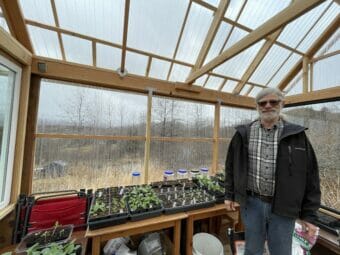
Dave Jackson in his greenhouse at his home in Bell’s Flats. Jackson grows carrots indoor and outdoors, along with other vegetables. (Kirsten Dobroth/KMXT)

Kodiak Island is home to a burgeoning local food movement — one that could get a whole lot bigger this summer, thanks to one gardener’s ambitious plan to plant half a million carrots across the archipelago.

You could say Dave Jackson is Kodiak’s carrot kingpin.
Jackson’s got a thriving garden at his house on the sunny side of Bell’s Flats, just past Kodiak’s Coast Guard base. There are onions and asparagus and rhubarb and beds of greens, but carrots are the main attraction.

“Three out of these four beds right in front here is where I’m going to grow carrots,” Jackson said. “And I grow quite a few carrots. I give a lot away. I probably put 2,000 seeds in there.”

That might seem like a lot of carrots. But it pales in comparison to Jackson’s bigger goal for this summer: to distribute 1,000 growing kits — each containing hundreds of carrot seeds — to gardeners across the island.

“The goal is to put half a million seeds out there and try to get people to plant them,” he said.

But Jackson said the plan started off much smaller. One of his friend’s asked if he could put together a carrot planting packet to give to the neighborhood kids, who kept eating carrots out of his garden.

So, he posted on Facebook to ask if other people wanted their own packets, too.

“And it got like 150 hits right off the bat,” said Jackson. “And I went, ‘Whoa.’ Next day, I ordered this bucket of seeds.”

That bucket, which contains 500,000 seeds and other materials, cost about $1,800 altogether, according to Jackson. The local 4-H club, Kodiak Harvest Food Cooperative and some friends pitched in money for him to upscale the project.

Jackson worked as a fisherman and then for Alaska’s Department of Fish and Game for three decades. He said carrots are perfect for commercial fishing communities like Kodiak. You can leave them for weeks at a time – which is especially convenient with salmon season on the horizon.

“I learned how to do these carrots, high intensity, low maintenance, I do no thinning and no weeding,” said Jackson. “And so once I get the carrots up a couple of inches, I can go away and go fishing or whatever. And come back in six weeks and start eating carrots.”

Jackson’s carrot kits come with 500 seeds, solar mulch and instructions. (Kirsten Dobroth/KMXT)

Each carrot kit comes with an envelope filled with 500 seeds and everything you need to plant them. Jackson said the kits are perfect for aspiring or established gardeners, and they’re available for free at locations around Kodiak, including the Little Store in Bell’s Flats and Kodiak Harvest’s Food Co-Op.

He’s not shipping the kits outside Kodiak, but they have made it to other parts of the state, including Homer and the Aleutian Chain.

He said he doesn’t have a long term goal for the project — just that at least this summer, it means more locally grown food will end up on people’s plates.

“I really don’t have a way to judge how effective we are, you know, scientifically or anything, but I’m expecting there’s going to be lots of carrots,” he said.

Jackson’s advice is to plant by mid-May to have carrots in time for fall.

Alaska health department pledges to halve 10,000-person food-stamp backlog within 6 months

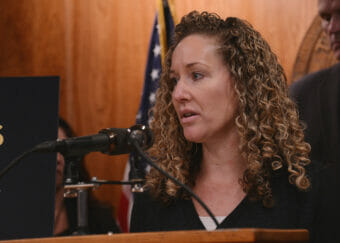
Heidi Hedberg, interim commissioner of the Alaska Department of Health, speaks at a news conference on Thursday, Dec. 15, 2022, at the Alaska State Capitol in Juneau. (Photo by James Brooks/Alaska Beacon)

After a lawsuit from Alaskans in need of food aid, the Alaska Department of Health has agreed to cut the waiting list for the state’s Supplemental Nutrition Assistance Program by half in six months.

The action was among several conditions in an agreement announced Tuesday between the state and 10 plaintiffs who filed a class-action lawsuit against the state over extensive delays in what’s commonly referred to as the food-stamp program.
In exchange for the agreement, the plaintiffs agreed to stay — or hold — further legal action until Oct. 31. If the state fails to hold to the agreement, the lawsuit will continue.

“I’m happy with the result in the immediate term,” said Nick Feronti, an attorney with the Fairbanks-based Northern Justice Project who is representing the plaintiffs.

“It’s probably the fastest pathway we have to fixing things on a system-wide basis,” he said.

Asked whether he believes the state can meet its pledge, he said he does.

“We have moderate confidence they should be able to meet it. Hopefully, they can exceed it,” he said.

In a prepared statement released by email, Department of Health Commissioner Heidi Hedberg and Attorney General Treg Taylor said the state is doing everything it can to eliminate the waiting list, which stood at 10,598 people as of April 20.

“Alaska is committed to taking the necessary steps to resolve this backlog and get benefits to Alaskans who need them. We are continuing to hire more employees and bring on additional support,” Hedberg said.

The text of the agreement says the state has signed a contract for 75 contract workers to help alleviate the backlog, and that it expects all of them to begin working no later than July 1.

“The state is doing everything it can to resolve this issue,” Taylor said in the statement.

Alaska’s backlog began growing last year, as the state exited the COVID-19 pandemic emergency and congressionally authorized changes to the SNAP program ended.

Feronti said the backlog was exacerbated by some optional choices by the state. One example, addressed in this week’s agreement: Many food-stamp recipients were required to reapply every six months, more frequently than federal law requires.

In some parts of Alaska, the backlog led to widespread hunger and even a few cases of malnutrition that required hospitalization, the Anchorage Daily News reported.

The backlog is smaller than it was at its peak, according to state-published figures, but state food banks are still reporting high demand.

Alaska isn’t alone in dealing with the problem.

“Overall, there are delays and access problems in a number of parts of the country right now,” said Saima Akhtar, a senior attorney with the National Center for Law and Economic Justice.

Akhtar is a co-counsel with Feronti on the lawsuit, and her organization has filed a similar lawsuit in Missouri. Alaska’s problems are worse than those in Missouri, she said.

“The scope of this problem is really extreme,” Akhtar said.

A more involved government, in a different place and different time could have addressed the issue proactively, Feronti said, but “we don’t have a proactive state government right now.”

“The state has known for years, from its own data, that this was a growing problem,” he said. “Maybe we can learn to be more proactive.”

Alaska food banks still ‘inundated’ as state works to fix food stamp backlog

Bulk food purchased with the $1.68 million Gov. Mike Dunleavy put towards supporting food banks is staged for delivery in Food Bank of Alaska’s Anchorage warehouse on April 21, 2023. (Photo by Claire Stremple/Alaska Beacon)

Southeast Alaska Food Bank patrons have doubled since last November. Director Chris Schapp said demand continues as high as it’s ever been. A major driver has been the months-long backlog for the Supplemental Nutrition Assistance Program, known as food stamps, in the Division of Public Assistance.

“We’ve just been inundated with people needing help,” he said. “A week doesn’t go by where I don’t see new faces.”

By his count, Southeast Alaska Food Bank is on track to distribute more than half a million pounds of food in Juneau this year — a record that reflects what it takes to feed about 450 people a week. He said the food bank hasn’t run out of food or had to scale back services yet, thanks in part to aid from the state.

It’s been about two months since Gov. Mike Dunleavy reallocated $1.7 million from other state programs to bolster depleted food banks and slake a growing statewide demand for food. The action was in response to the public disclosure of the food stamp backlog that left thousands of Alaskans waiting months for aid. State officials have said it will take time to get SNAP back on track. That leaves organizations like the Southeast Alaska Food Bank to attempt to meet an overwhelming need — the organization has spent about two-thirds of the $150,000 in state money it got in March.

“We’re still buying food and trying to keep our store and our warehouse stocked as much as we can. But it’s going out almost as fast as it comes in,” Schapp said.

The same dynamic is playing out at food banks across the state. While food from the state’s response is reaching Alaskans in need, people at food banks say the demand is as high as ever.

The time it’s taking to meet the demand is raising concerns in the Legislature.

On the House floor this week, Rep. Alyse Galvin, I-Anchorage, said there’s more work to do if Alaska’s most vulnerable residents are still hungry.

A swing and a miss

On the House floor on Wednesday, Galvin used the baseball analogy “a swing and a miss” to describe the state’s response to the food stamp crisis.

“​​The governor tried to do something,” said Galvin, in reference to the money Dunleavy reallocated to ease the burden on food banks. “And it’s important to note that it was a good swing. But if you do the math, we’re still not even anywhere close to being whole again.”

Galvin said the Legislature has approved spending millions to update the Division of Public Assistance’s computer system, which it says is partly to blame for the backlog, but she wants the body to take a longer view. She pointed to when the Legislature approved cutting more than a hundred jobs from the division just a couple of years ago.

“We need to remember that some of the big decisions that are made here have implications over and over again in later innings that we may not see right now, but that are really important to the whole of the work we have for the whole of the game,” she said, continuing her baseball metaphor.

The state’s Division of Public Assistance is in the process of hiring and training 30 new employees as part of state action to correct the backlog.

Galvin said she’s having conversations with her colleagues about what more they could do.

“It’s going to take much more than just one legislator,” she said. “But yeah, how can we pull together our energy and do something better than this Band-Aid that seemingly hasn’t fixed the situation?”

“The anti-hunger network was not designed to replace SNAP”

The bulk of the money Dunleavy allocated for food aid to address the crisis went to the Food Banks of Alaska, the statewide body serving local anti-hunger programs. The organization distributed 185,000 pounds of food to replenish food banks across the state over the last month and is on track to roughly triple that number. Meehan said their partner organizations have reported serving nearly 200,000 Alaskans.

“Our partners continue to see elevated need,” said Ron Meehan, Food Bank of Alaska’s policy and advocacy manager. “The anti-hunger network was not designed to replace SNAP.”

He estimated SNAP provides at least 10 times as much food as the food bank network does. Food banks reported they didn’t have enough food on hand to help their patrons before the infusion of state funds, Meehan said.

The new program doesn’t fully meet the need, Meehan said, but added that it was not intended to fill the gap.

“Having additional appropriations for direct food purchasing would make a huge difference,” he said.

He said the biggest help would be clearing the food stamp backlog.

This story originally appeared in the Alaska Beacon and is republished here with permission.

USDA announces first-ever grants for Indigenous meat processing

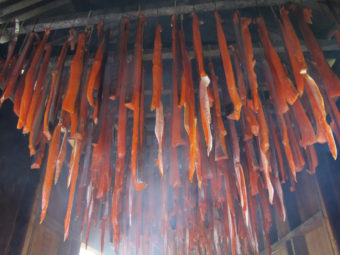
Strips of silver salmon hang in Valerie Davidson’s smokehouse on the Kuskokwim River in Bethel, Alaska. (Photo by Annie Feidt/APRN)

WASHINGTON, D.C. — The U.S. Department of Agriculture announced Wednesday it would – for the first time – offer grants for harvesting, processing and storing Indigenous meats such as bison, reindeer, moose, elk and salmon, offering a boost to tribes working to improve food sovereignty.

The change will expand USDA funding, which had been available only for meats the department regulates, such as beef, pork or chicken.

“We are thrilled that we’re going to invest in Indigenous animal processing,” said Heather Dawn Thompson, the USDA’s director of the Office of Tribal Relations. “We have heard loud and clear in our consultations with tribal governments that they want to make sure that they have proteins that are based on Indigenous animals for their communities. This is the first time that our funds are going to be available for those animals. We’re changing the course of history together.”

The department’s Indigenous Animals Harvesting and Meat Processing Grant Program will provide up to $50 million to improve tribal nations’ food and agricultural supply chain resiliency by developing and expanding infrastructure related to meat from Indigenous animals. The program will fund projects that focus on expanding local capacity for the harvesting, processing, manufacturing, storing, transporting, wholesaling, or distribution of indigenous meats.

“USDA is proud to offer this investment in tribal nations’ food chain resiliency as a part of USDA’s broader efforts to restore Indigenous food ways,” USDA Under Secretary for Rural Development Xochitl Torres Small said in a statement. “By expanding and enhancing local processing capacity, these projects will provide culturally appropriate food and community food security to tribal communities.”

Eligible applicants are tribes as well as wholly-owned arms and instrumentalities, and joint or multi-tribal government entities. There is no maximum dollar figure for a grant application nor a minimum. Additionally, there are no matching fund requirements. The deadline for applications is July 19.

The new grants announced Wednesday are part of USDA’s Indigenous Food Sovereignty Initiative, which promotes traditional food ways, Indian Country food and agriculture markets, and Indigenous health through foods tailored to American Indian/Alaska Native (AI/AN) dietary needs.

The USDA is partnering with tribal-serving organizations on the projects to reimagine federal food and agriculture programs from an Indigenous perspective and inform future USDA programs and policies, officials said. The USDA Food Sovereignty Initiative was announced in 2021.

“USDA is committed to empowering tribal self-determination and bringing Indigenous perspectives into agriculture, food, and nutrition,” said Agriculture Secretary Tom Vilsack.

This story originally appeared in Indian Country Today and is republished here with permission.

State’s fix for Alaska’s food stamp backlog misses the mark, insiders say

Gov. Mike Dunleavy redirected $1.7 million to help replenish food banks because delays in food stamps have strained food aid systems statewide. Ron Meehan, who manages policy and advocacy for the Food Banks of Alaska, said that money should last about six weeks. (Courtesy of Food Bank of Alaska)

Thousands of Alaskans waited months for food stamps from last fall through this winter, as applications built up in the state’s Division of Public Assistance. Thousands more are still waiting.

Gov. Mike Dunleavy signed a bill Friday that will put millions of dollars into a fast-tracked solution to fix the state’s months-long backlog. But advocates and insiders say the emergency funding doesn’t go far enough — and the biggest problems are going unaddressed.

‘Very much a Band-Aid’

The bill will put $3.1 million toward overtime pay and dozens of additional temporary and contract workers. Dunleavy’s proposed capital budget also includes $54 million toward an overhaul of the Department of Public Assistance’s aging computer system.

Those funds come on the heels of $1.7 million that the governor redirected to help replenish food banks because delays in food stamps have strained food aid systems statewide.

Ron Meehan, who manages policy and advocacy for the Food Banks of Alaska, said that money is already in use. Pasta, green beans, corn and trail mix are already loaded on trucks and on their way to food banks across the state.

He said that will make a big difference — but for only about six weeks.

“It’s very much a Band-Aid,” he said. “It’s a very temporary solution. And it’s not meant to fill the full gap. But it puts us in a much better position than we were in before we had it.”

By Meehan’s calculation, if the state usually distributes $348 million a year in food stamps, a four month backlog means roughly $120 million isn’t getting to Alaskans. He said the Supplemental Nutrition Assistance Program, or SNAP, provides at least 10 times as much food as the food bank network does in Alaska.

Meanwhile, state officials say they’ve nearly worked through the thousands of backlogged food stamp applications. But Meehan said the state’s food banks haven’t felt relief yet — many are seeing more demand, especially among working families.

On the Kenai Peninsula, the food bank is averaging three new families a day — some who haven’t used the service in years. In Cordova, the Salvation Army has gone from serving 57 families to 80. And the Fairbanks soup kitchen has served a record number of people every month since last November.

“The people we support are frustrated, they’re confused, and they’re hungry,” Meehan said. “We’ve heard from people that have been watering down soup to feed their kids, eating dog food or simply going days without eating.”

Attrition problem led to a ‘human catastrophe’

People who process benefits like food stamps say all of this could have been avoided. And to set things right, the state needs to figure out how to hire and retain fully trained staff.

State leadership blamed the backup on its old computer system, a deluge of recertifications after pandemic benefits ended and a cyberattack in May of 2021.

“That’s just not true,” said Fred Rapp, an eligibility worker of 15 years who works for the Fairbanks office. “COVID and the computer hack that occurred — the only thing that really did was just finally expose what was actually happening at the division. It made it so that it was not able to really be hidden anymore from the public.”

He said people started quitting in 2010, during the Parnell administration, due to a combination of staff cuts and drastic changes to processes — including abandoning the department’s longstanding case management approach, where eligibility workers worked with assigned families.

And he said the benefits for Tier IV state employees don’t incentivize them to stay. (Teachers and other state workers have described similar problems with Tier IV.)

“We just lost so many really, really smart and good people, because they just weren’t willing to put up with what was going on anymore,” he said. “You gotta keep asses in the seats. If you don’t do that, then everything else that you’re trying to do is not going to work.”

Rapp said he’s been asking elected officials to address the high rates of attrition ever since Gov. Parnell was in office. He said he hears about the effects of his department’s dysfunction every day.

This winter, Rapp said he talked to an elder who couldn’t get food stamps. Her freezer was getting bare, and she didn’t have anyone to hunt for her. She told him she was just hoping a squirrel or a grouse came through her yard so she could cook it, he said.

And the backlog affects other benefits, too. He said he often talks to new mothers caught in the wait for Medicaid. They risk losing postpartum care coverage if they don’t have appointments in the first two months after delivery — but simple address changes can keep people from getting care, and an update can take the division months.

Rapp calls it a “human catastrophe,” which he says could have been avoided if the division had enough staff and could retain experienced eligibility workers.

Rapp said his experience makes him a fast worker. But because so many newer hires quit, long-time employees are thin on the ground. He wants to see the state get serious about retention.

He — and other eligibility workers, who spoke with KTOO anonymously for previous stories — said they’re dismayed to see the state instead put millions into software that has proven to be unreliable.

The system in question is called ARIES, or Alaska’s Resource for Integrated Eligibility Services. Workers say it barely functions.

“The reason why that’s so terrifying to me is because everybody that uses ARIES knows that it’s a junker,” Rapp said. “The best way I can describe it to you is that they were going for building something like a Ferrari, but when they actually opened the hood and put the engine in, it ended up being something like a lawnmower engine.”

When asked about ARIES, the Department of Health spokesperson Sonya Senkowsky said in a statement that “any issues with the ARIES system have been easily addressed and have not had a significant impact on processing the backlogged information.” She said after the investment, the system will function differently, and some Medicaid applications may be automated.

But Rapp said frequent “hiccups” with ARIES lead to delays in getting people approved for Medicaid. Each time the program fails, he has to set that case aside, file a trouble ticket and wait for someone in IT to get things back on track. In nine years, Rapp said he’s seen documentation of at least 70,000 such trouble tickets.

ARIES was supposed to be a tool for processing all the state’s public assistance, but the state only rolled the system out part way. Rapp and other eligibility workers say they have serious concerns about putting all the division’s programs on a system Rapp said “can’t even handle Medicaid.”

More work to be done

“He’s not wrong at all,” said Magen James, a SNAP Outreach Manager for the Food Banks of Alaska. She works closely with state eligibility workers like Rapp to help Alaskans get SNAP benefits.

James doesn’t work directly with ARIES, but she said it was never fully implemented, and that slows workers down.

“They started the migration process, but they never completed it. And so it was wasted funding,” she said.

And she agrees that the state needs to address deep-rooted staffing shortages and invest in retaining fully trained employees. She said she’s found that new, hastily trained staff make a lot of mistakes.

“Many of the [Division of Public Assistance] employees that are staffing their call center, they’re not even trained with the appropriate information,” she said. “We’re consistently having to correct the misinformation that comes out from these front line workers that are just being thrown into the fire.”

She said she’d like to see the state fund some solutions they haven’t tried yet. Alaska is one of only a handful of states that doesn’t use a federal tool that lets families who qualify for certain other benefits automatically qualify for food stamps. It saves eligibility workers time, which translates to state savings, and it’s also proven to help low-income working families.

James also said people should be able to apply online. Alaska is one of only two states that doesn’t have an online application for SNAP. The legislature passed a bill last year that should have had online applications available by last July, but it hasn’t happened. Now the state aims to have it in place by December of this year.

And James said that trying to help people navigate such a dysfunctional system takes a toll on workers, too.

“My entire team is basically dealing with secondary trauma all day long, because everybody that we deal with is hungry and don’t have their benefits,” she said.

James described hearing from people who have to choose between medicine and food while they try to get their benefits straightened out. She hopes the state can turn things around — both for hungry Alaskans and for workers like Rapp who hear these stories and struggle to make things right.

“These people are making decisions between two survival choices. It’s very difficult to hear and to help,” she said.

A rare federal reprimand

Jesus Mendoza Jr. runs the regional United States Department of Agriculture office, where he oversees food stamp programs. He said that Alaska’s backlog is the worst in the western states.

“It is serious, it is very serious,” he said. “There’s a substantial number of Alaska citizens that are not getting benefits.”

He sent a letter back in February to Alaska’s Department of Health Commissioner, Heidi Hedberg, addressing the division’s failures. He asked her to come up with a plan to fix the backlog. Alaska is not the only state with a backlog, but it is the only state to receive such a warning.

“We expect that the state will work as fast as possible to redress the situation,” Mendoza said. “Because if it’s a month, if it is two months, it is too long for recipients not to get benefits.”

He was quick to point out the state’s progress, though, like new contract hires and the $1.7 million that Gov. Dunleavy put toward food banks. But he acknowledges that the computer fixes the state is proposing will take time.

“Replacing an eligibility system is not going to be easy. And it’s gonna take probably more than a year,” he said. “We have to work with the state to make sure that in the meantime, and while we catch up with the backlog, we don’t end up in the same place a few months later down the road.”

But eligibility workers like Rapp say that’s a likely future without a more honest reckoning about the staffing issues.

‘They’ve known about this the whole frickin’ time’

Rapp said he doesn’t want the state to get in trouble, but he sees the need for an intervention with teeth.

“I really do wish that the federal government would step in,” he said. “If they have to start fining the state, if that’s what it is that finally gets the state to pay attention and do the right thing, you know, then maybe they need to consider that.”

Rapp describes himself as a Dunleavy supporter and said he mostly likes Dunleavy’s policies, but he thinks the governor is missing the mark with solutions.

“He could own this thing if he wanted to,” he said. “It’s not like anyone’s going to hold him accountable at the polls.” Dunleavy is serving his second consecutive term, the state’s limit.

Rapp said he tried to warn Dunleavy and the legislature about the dysfunction in 2018, and that neither Govs. Parnell and Walker nor the legislature showed the will to solve the problem, either.

“There should be no more excuses. Excuses are over,” Rapp said. “They’ve known about this the whole frickin’ time. They just chose not to do anything.”

This story has been updated to reflect that Gov. Dunleavy has now signed the fast-track bill.

Site notifications
Update notification options
Subscribe to notifications