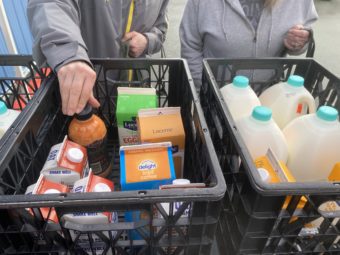
Juneau residents select some dairy products at Southeast Alaska Food Bank in Juneau. November 15, 2022. (Claire Stremple/KTOO)
It’s the season of gratitude and giving, and Juneau-area food banks say they’re relatively well-stocked headed into the holidays. But the need is still great.
Just last weekend, the Caring is Sharing food drive collected more than 19,000 pounds of food for families and individuals in need, according to Southeast Alaska Food Bank Manager Chris Schapp.
“That’ll give us a good shot in the arm as far as keeping the shelves full for a couple of months,” he said.
Still, Schapp said different organizations have different needs in terms of food and ingredients they’re looking for. And the demand remains high.
“Most of the agencies that we partner with tell me the same thing, that their pantry numbers are higher and they’re just trying to keep up and keep everybody fed,” Schapp said.
He said there are many factors at play when it comes to food insecurity in Juneau, like the rising cost of food combined with a lack of affordable housing. Ongoing issues with the state’s Supplemental Nutrition Assistance Program, or SNAP, are also contributing.
Schapp said they distributed more than 581,000 pounds of food last year through their public pantry and their 33 member agencies in Juneau and other nearby communities.
That was a new record, but it may not last.
“We’re actually on pace now to exceed that number,” he said.
The Southeast Alaska Food Bank is looking to expand next year, with a new 5,000-square-foot warehouse. Schapp said the new facility will allow them to buy bulk loads of food at cheaper prices and get more aid to partners serving other communities in the region.
A list of local food pantries and their hours can be found here.
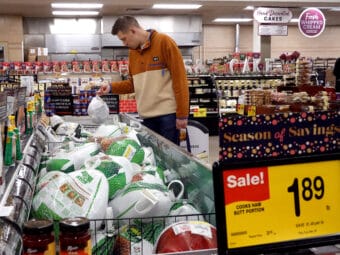
A customer in Chicago looks for turkeys offered for sale on Nov. 20, 2023, ahead of the Thanksgiving holiday. Turkey prices have fallen — but the cost of many groceries are still higher. (Scott Olson/Getty Images)
As friends and families gather around the dinner table later this week, some will be giving thanks for lower inflation.
Grocery prices are still high, but they’re not climbing as fast as they had been. And the cost of a traditional Thanksgiving feast has actually come down a little bit from last year.
The American Farm Bureau Federation estimates the total cost of a Thanksgiving meal for 10 this year is $61.16. That’s 4.5% lower than last year, but still the second highest total since the Farm Bureau began tracking prices in 1986.
Here’s a look at some of the traditional favorites that will cost more — and less — for Thursday’s feast.
Turkey prices have indeed fallen
Turkey, of course, is the at the center of many Thanksgiving traditions — and there’s good news: Prices have fallen.
“There’s a lot of turkey available right now,” says Michael Swanson, an agricultural economist at Wells Fargo. “They just have to price it down to move it.”
The average price of a 16 pound turkey in early November was $27.35, according to the Farm Bureau — a drop of 5.6% from a year ago.
Many stores offer additional discounts on turkey in the days leading up to Thanksgiving.
Cranberries are cheaper — but only if they are fresh
Turkey is not the only relative bargain on the Thanksgiving menu.
Fresh cranberry prices have dropped dramatically this year, thanks to a bumper crop. But people who prefer canned cranberries — the kind where you can still see the ridges of the can even when it’s on the plate — may have to pay more — as a result of higher processing and packaging costs.
“The entire canned market is up, whether you’re talking about beans or cranberries or pumpkins,” Swanson says. “Can prices really shot up.”
The price of canned goods could go even higher next year, if the Biden administration slaps new tariffs on imported steel used in making cans.
“We’ve been pleased that the Department of Commerce has held off on those tariffs for the most part,” says David Chavern, CEO of the Consumer Brands Association. “But there’s going to be a final determination at the beginning of 2024 that we’re watching very closely.”
But groceries are still expensive
Some of the money shoppers save on turkey this year may get gobbled up elsewhere.
Sweet potato prices are slightly higher than last year. And pumpkin pie filling is also more expensive.
Grocery prices overall have risen 2.1% in the last 12 months, according to the Labor Department, following an increase of 12.4% in the previous year.
“That’s the cost of living,” said Angelina Murray, standing outside a supermarket in Washington, D.C., a few days before Thanksgiving. “Nothing we can do until prices come down. We’re just going to have to deal.”
Grocery prices overall are still higher than last year, including for sweet potatoes and pumpkin pie filling. (Scott Olson/Getty Images)
Then again, some things are still worth paying for
Some shoppers told NPR they are cutting corners in preparing for Thursday’s meal — opting for store-branded products, for example, instead of more expensive national brands.
But most said Thanksgiving is a time for counting blessings, not hunting for bargains.
Carrie Murray was pleasantly surprised to find some discounts in the produce department, even if she had to pay more for staples such as olive oil.
“Things that are expensive —it’s the stuff that has been expensive for a while,” Murray said, loading groceries into the back of her car with Colton Parker.
“Looking at the receipt you say, ‘Oh wow,'” Parker agreed. “But you know, it’s for families. It’s for the holidays.”
Copyright 2023 NPR. To see more, visit https://www.npr.org.
IGA Foodland Grocery Store Juneau Alaska, December 20, 2022 (Photo By Paige Sparks/KTOO)
Many Alaskans have faced long waits for food over the last year as the state Division of Public Assistance worked through a lengthy application backlog for SNAP, the supplemental nutrition assistance program, formerly called food stamps.
The current backlog is about 7,000 applications, according to Deb Etheridge, the division’s director. During a discussion Oct. 31 on Talk of Alaska, Etheridge said the division is also taking steps to streamline the application process.
“We’re working right now to develop an online SNAP application which includes an individual’s portal so people can just upload their information and apply online,” Etheridge said.
State Rep. Genevieve Mina, D-Anchorage, also has a proposal to streamline the process. During the discussion, she highlighted recent legislation she introduced that aims to simplify SNAP applications, make more people eligible and to reduce work for the Division of Public Assistance.
“It allows a state to increase the income limit for the eligibility for SNAP from 130% poverty level to 200% poverty level,” Mina said. “Additionally, it allows states to remove the asset test. The asset test is part of the SNAP process where they look at your savings.”
Mina said the bill would allow people who need assistance to be able to start saving while still getting SNAP benefits. That would avoid what is sometimes called the “benefits cliff,” when a small increase in earnings or savings makes someone suddenly ineligible for benefits.
The backlog has also highlighted the need for more local food production, according to Andrew Jenson, a policy advisor for food and energy security for Gov. Mike Dunleavy. During the discussion, Jensen noted that as a policy goal for the coming year.
“In the upcoming legislative session, you are going to see a package of policy proposals put forward that are designed to incentivize and really ‘de-risk’ the production of food in Alaska,” Jensen said.
Despite progress, Etheridge said it’s still difficult to estimate exactly when the current backlog of SNAP benefits will be addressed.
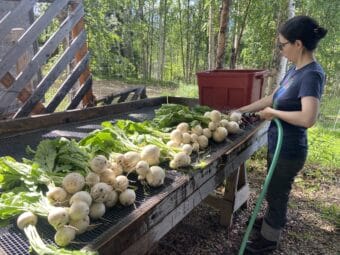
Farmhand Jeanetta Carroll washes turnips at Calypso Farm in Fairbanks, Alaska in summer 2023 (Photo Courtesy of Susan Willsrud/Calypso Farm)
In October, fall gives way to winter for much of Alaska. But each year, the first frost is arriving later and later. That could be a boon for Alaska farmers.
University of Alaska Fairbanks professor Glenna Gannon says the longer growing season is making some types of crops possible for the first time.
“We’re successfully able to grow things like artichokes and field-grown tomatoes, peppers and corn here in Fairbanks,” Gannon said. “I don’t think, you know, 30 or even 10 years ago, that would have been successful.”
Fields at Calypso Farm, summer of 2023 (Photo Courtesy of Susan Willsrud/Calypso Farm)
Gannon runs crop trials at the university’s experiment farm, where nine out of the 10 latest first frosts on record have occurred since 2001. For many places, especially in the Interior, that shift is allowing farmers to keep their crops in the field through mid-September.
In a state that’s struggled with food security, shifting seasons and hotter temperatures brought on by human-caused climate change could allow Alaska farmers to grow more abundant and diverse produce. But climate change can also bring drought, pests and permafrost thaw.

And it can make weather more erratic too. Tom Zimmer of Calypso Farm, just outside of Fairbanks, said that’s what he worries about most.
“Yes, frost-free days are increasing,” Zimmer said. “But the instability of the climate is making it probably more difficult to farm.”
Zimmer and his wife have run their small organic farm since 2000. This year, snow and frost lingered late into the spring, which delayed planting. Then a hot, dry summer came on quickly. Some plants thrived.
“This year, we had excellent green beans, amazing cauliflower,” Zimmer said. “But other crops bolted. It was too hot.”
Hot summers will become more and more common for many regions across the state, according to climate researcher Nancy Fresco with the university’s International Arctic Research Center. Fresco develops climate models to predict Alaska’s agricultural future.
“We’re anticipating continued increases in both the length of the growing season — how many frost-free days — but also in the cumulative heat across the growing seasons,” she said.
Summer heat gives some crops a boost
As the climate warms over the coming decades, the frost-free season will likely get longer by weeks or even months. And summers will continue to get hotter.
Every plant has its own baseline temperature where it begins to sprout and grow. To mature for harvest, it needs a certain number of days with temperatures above that threshold. Hotter summer days that linger later in the year can increase the number of good growing days to give certain crops a boost.
Warm-weather species, like tomatoes, corn and peppers, need temperatures of at least around 50 degrees to start growing. To ripen, they need a lot of days that fall above that threshold. So historically, those crops have been hard to grow in Alaska without a greenhouse.
But even cold-tolerant species, like brussels sprouts, have been a challenge because they take a relatively long time to mature. Farmers and gardeners who have tried to grow them in Alaska have risked losing their crops to frost and snow before the harvest.
Theoretically, climate change could help both types of crops. But Fresco said existing climate models also neglect a lot of important factors that shape farming.
“We were really just looking at air temperature, which is of course, a big deal in growing crops,” Fresco said. “But there are some really important factors about what can grow, — that are particular to Alaska, that are challenging in Alaska — that we haven’t yet had a chance to model.”
Glenna Gannon harvesting peppers at the University of Alaska Fairbanks experiment farm in summer 2023 (Photo courtesy of Glenna Gannon)
Permafrost — a layer of soil that remains frozen throughout the year — is one of the most pressing factors in the Interior. It can affect soil temperature and moisture, which can inhibit plant growth regardless of air temperatures. But as it thaws, it will likely destabilize seemingly viable farmland in the sub-Arctic.
And even as atmospheric conditions become more favorable, farmers will still have to contend with the long hours of sunlight — up to 22 hours for some farms in the Interior. Some crops just can’t tolerate that much light.
Farmers proceed with caution
Zimmer, from Calypso Farm, says there’s a disadvantage for every advantage that climate change brings. Some of Alaska’s more cold-tolerant crops, like cabbage or broccoli, may actually fare worse as temperatures warm. And many regions in the state are also facing a higher threat of summer drought.
Winters are also becoming more mild overall. While that can be great for certain perennial crops, like fruit trees, Zimmer said it’s brought more aphids and root maggots to his crops.
“In our 20 year experiment, one of the things that’s most noticeable to me is the insect life cycle,” Zimmer said. “One of the beauties of growing in Alaska is a harsh winter that kills a lot of our pests. And that’s starting to go away.”
Climate change will increase the breadth of crop varieties and the amount of land that’s viable for farming in Alaska. In some ways, Zimmer said, that’s a great opportunity to improve food security and access to locally grown food.
“We really want to focus on growing more farmers in Alaska,” he said. “But it’s not like Alaska is warming, everything’s great. We have to proceed slowly, carefully and work with the natural cycles.”
Both Zimmer and Gannon say that planting a diversity of crops is the best way for farmers to prepare for climate change. Though warm weather crops are becoming more possible, they might not be reliable.
“We have the ability to have a much greater breadth of what we grow here,” Gannon said. “But I still want to plant the seed of caution for anyone who’s going out to grow their garden or plant their farm. You know, they’re still in Alaska.”
Shopper looks at food products while shopping at Foodland IGA on February 10, 2023. (Photo by Tasha Elizarde/KTOO)
Alaska’s food assistance program has processed the oldest applications from a backlog plaguing the state for more than a year, but many applicants still have to wait for up to three months to receive benefits.
The state Division of Public Assistance administers the federally-funded Supplemental Nutrition Assistance Program, or SNAP, which served about 90,000 Alaskans last year, about 12% of the state’s population.
In April 2023, when the backlog was at its worst, thousands were waiting for help buying food, some for as long as eight months. State officials blamed a cyberattack and an influx of paperwork when its COVID-19 public health emergency ended but some state workers pointed to chronic understaffing.
Public Assistance Director Deb Etheridge said the division has hired more people to process applications. She said the federal Food and Nutrition Service that oversees the program wanted the state to prioritize the oldest applications and renewals.
“We had some guidance from FNS where they really strongly recommended that we focus on the original backlog, because some of those cases were very old,” Etheridge said. “So we did. We attacked. We got rid of the old backlog on Sept. 1, and then that has unfortunately created sort of a newer backlog.”
Etheridge said the current processing wait is about three months. But she said people with very low income or assets who qualify for an expedited application will have access to benefits without having to wait for the department to catch up.
Etheridge said applications in what she calls the “new backlog” are easier to process, because the applicants’ information is more often up-to-date. People are less likely to have moved or changed jobs in the time they’ve been waiting. And she said there are now two teams managing applications and renewals: One is working on the current paperwork, and the other is dedicated to the backlog.
Etheridge would not offer a guess on how long it might take to get through all the 8,500 pending applications and renewals, but she said the backlog team is processing about 500 cases per week.
“We’re just really laser focused on getting through our backlog,” Etheridge said. “And we’re committed to problem solving so we’re not in this situation again.”
Etheridge said the department is creating an online application for SNAP, which they plan to start using in December. She thinks that will help make applications easier to process because people will be less likely to skip required fields in an online form. The department also plans to create an online client portal to manage applications which Etheridge said eventually will help make back-and-forth communication more transparent.
A display of Alaska sea salt products. (Tash Kimmel/KCAW)
An article by Fairbanks writer Amy Loeffler will appear in the prestigious national anthology “Best American Food Writing,” which will be released next week by Harper Collins.
“Human beings have really evolved to have this mineral be a very fundamental part of our body chemistry,” Loeffler said. “We literally would die without salt.”
Loeffler is a science writer. Her story chosen for the 2023 edition of Best American Food Writing is about the science of salt in relation to sex and love throughout human history.
“We typically do associate love and sex and everything that has to do with romance as being sweet. And doing research, I found some scholarship — you’re really talking about the nitty gritty of sex and lovemaking, you’re talking about a lot of things that are made with salt and are salt-inspired,” she said.
Amy Loeffler (Robyne/KUAC)
To explain a little of the effects of salt on the human brain, she spread out a sampler of foods and salts for a tasting.
“So, what happens when you put salt on fruit? In tropical countries, where there’s a lot of fruit, people tend to salt their fruit because sodium ions interact with your tongue to tamp down bitterness. They neutralize the taste buds that receive bitterness, and the fruit actually tastes sweeter when you salt it,” Loeffler said.
She says that, when she met a chef who was drying out water from the Atlantic Ocean to make her own sea salt, it inspired Loeffler to research the different types and tastes of salt.
Soon she was writing about salt and attracting the attention of chefs and foodies like former New York Times food editor Mark Bittman, who edited the articles in this year’s edition of Best American Food Writing. She says salt is a mundane mineral, but we can’t live without it. It is also a cosmic element ound in space and star matter.
“I went down this huge rabbit hole learning about salt,” she said. “How has salt figured into human history? And it really has been a prime ingredient in human culture and existence, including sex.”
The book comes out on Oct. 17, but Loeffler’s article was first published last year, in Whetstone magazine.
Close
Update notification options
Subscribe to notifications
Subscribe
Get notifications about news related to the topics you care about. You can unsubscribe anytime.