KMXT is our partner station in Kodiak. KTOO collaborates with partners across the state to cover important news and to share stories with our audiences.
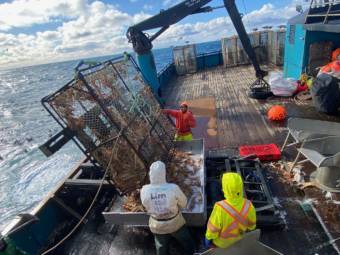
Crew from the Silver Spray empty snow crab pots while fishing in the Bering Sea. (Courtesy of Bill Prout)
The U.S. Secretary of Commerce has approved six fishery disaster designations for the state of Alaska, including the Yukon-Kuskokwim and Chignik salmon fisheries for last year. Crabbers will also see relief for this year’s Bristol Bay red king crab and Bering Sea snow crab fisheries. The Alaska Department of Fish and Game announced this fall that both fisheries would remain closed for the season due to low population numbers.
Alaska’s congressional delegation applauded the disaster approvals in a joint statement Friday.
Gabriel Prout is a Bering Sea crab fisherman from Kodiak. He owns the F/V Silver Spray with his family. He says there’s still uncertainty in the fleet about the road ahead, but Friday’s announcement is a big step forward.
“Definitely brings a little bit of some type of psychological relief that they’re working and taking this disaster seriously and what the fishermen are going through,” said Prout.
Alaska Bering Sea Crabbers Executive Director Jamie Goen said in an email that the trade group “looks forward to Congress acting swiftly to appropriate the necessary funds to help America’s fishermen and coastal communities weather these crises and to fund research to help avoid them in the future.”
Researchers say they aren’t certain what caused the snow crab’s population collapse, which led to the fishery’s closure, but they believe climate change was a factor. Changing ocean conditions due to climate change are also likely contributing to salmon declines in parts of western Alaska.
Congress still needs to allocate funding for each disaster designation, and fishermen have to apply for financial relief. The process often takes years to get money to skippers and their crews.
The U.S. Secretary of Commerce issued determinations that disasters occurred in these fisheries:
2021-22 Bristol Bay red king crab and Bering Sea snow crab fisheries
2021 Kuskokwim River salmon and Norton Sound chum and coho salmon fisheries
2021 Chignik salmon fisheries
2020 Copper River/Prince William Sound coho and pink salmon fisheries
2020-21 Norton Sound red king crab fisheries
2022-23 Bristol Bay red king crab and Bering Sea snow crab fisheries
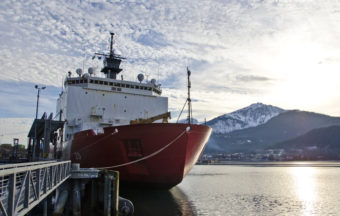
The icebreaker Healy in Juneau in November, 2012. (Photo by Heather Bryant/KTOO)
The U.S. Coast Guard is expanding its fleet of icebreakers and could be homeporting one of the vessels in Alaska. Icebreakers are built with thicker hulls to navigate the world’s icy, northernmost waters.
The U.S. Senate voted Thursday evening to authorize the National Defense Authorization Act for the upcoming fiscal year.
On a call with reporters Wednesday, Sen. Dan Sullivan, a Republican, said the National Defense Authorization Act for the upcoming fiscal year appropriates $150 million towards buying and converting an existing icebreaker. The vessel most likely would be homeported in Juneau, according to Sullivan.
Sullivan said he hopes it’s the first of many to be someday based in Alaska.
“It should be a series of ports in our state that can homeport an icebreaker, but right now I think this is huge news for our state,” said Sullivan.
The U.S. currently has two operational Arctic icebreakers, both based in Seattle. The Department of Defense announced plans late last year to build a new icebreaker at a cost of $552,654,727.
Sullivan said adding an icebreaker to Alaska’s existing Coast Guard fleet would bring 190 service members and hundreds of millions of dollars in infrastructure spending to the state.
Language in the legislation would also cut down the timeline for purchasing an existing icebreaker from more than six years down to one, according to Sullivan.
Sullivan said adding to the fleet in Alaska is a top priority. Russia has the world’s largest icebreaker fleet, with dozens more than the U.S.
“Everybody in our state intuitively knows we need more icebreakers to promote our security, economic, environmental interests. And if you have icebreakers in America, they should be homeported in the Arctic,” said Sullivan.
Both Sen. Sullivan and Sen. Lisa Murkowski voted in favor of the bill Thursday evening. The final version outlines $858 billion in defense spending. It now heads to President Biden’s desk.
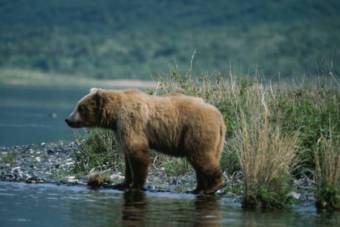
A brown bear on Kodiak. (Photo by Steve Hillebrand/USFWS)
A highly contagious form of avian influenza was found in a Kodiak brown bear cub. It’s one of only four mammals in Alaska known to have contracted the virus, and the first brown bear to be found with the disease.
A deer hunter found the cub’s carcass on Nov. 26 about half a mile from the road near the Pasagshak State Recreational Site in Kodiak and reported it to the Alaska Department of Fish and Game. A necropsy later determined the cub died of a strain of avian influenza that has plagued both feral and domestic flocks across the country.
Dr. Kimberlee Beckmen, a wildlife veterinarian for the Fish and Game, says the virus doesn’t spread between mammals, but it can affect scavengers like Kodiak brown bears.
“It’s not foodborne, so they don’t get it by ingesting, but they get it by inhaling the virus,” she said.” So while they’re scavenging, they’re probably inhaling the virus and that’s how it gets into their system.”
The virus has ravaged bird populations across the nation, but especially waterfowl.
“It’s a virus that’s carried by waterfowl normally, and not every bird gets sick,” said Beckmen. “But certain species are more susceptible — and we’ve been seeing this outbreak mainly hit birds like eagles and ravens, and other birds that scavenge on dead birds.”
The virus hasn’t been widespread in mammals, and Beckmen said it’s not much of a threat to humans.
“In the world there’s only been three people that have had the virus, and the one in the U.S. wasn’t even sick from it,” she said.
While there have been no cases of domestic pets such as cats or dogs infected with the virus, Beckmen warns they could be at risk while swimming or while retrieving hunted game.
“The risks that I perceive for dogs would mainly be for retrievers if they’re used to retrieve waterfowl, or if they’re taken out and swum in a lake or a pond that’s highly contaminated with waterfowl droppings,” she said.
Nate Svoboda is Fish and Game’s Kodiak area wildlife biologist. He says wetland areas near rivers and streams are most likely where waterfowl and other animals can get infected.
“Anywhere where waterfowl congregate would be an area that is probably more likely to experience the sort of outbreak or have birds that might have died from this,” said Svoboda.
The biologist said some of the most reliable signs of infection would be an animal stumbling around or walking in circles.
“For example, the cub that was found in the Southeast that also suffered from bird flu, the people who reported it said it appeared drunk,” he said.
Other signs of infection are dead animals with no obvious cause of death such as predation. Svoboda said the best thing the public can do is to keep an eye out and report suspicious animal behavior and deaths to Fish and Game.
“If animals start dying for an unknown reason, let us know you know, even if it’s domestic poultry, that comes up dead, you know, that would be valuable for us to know and potentially test them for the virus,” he said.
Crew from the Silver Spray empty snow crab pots while fishing in the Bering Sea. (Courtesy of Bill Prout)
Gov. Mike Dunleavy requested $287 million from the federal government last month for fishermen impacted by the Bering Sea snow crab and Bristol Bay red king crab fisheries closures. The current process of getting financial relief to fishermen is cumbersome and takes a long time, but Bering Sea crabbers are hoping the plight of the snow crab population might change the way financial relief is delivered to fishermen.
Gabriel Prout is a second generation Bering Sea crab fisherman from Kodiak; he owns the F/V Silver Spray with his dad and brothers. He said there’s one big problem with the current process for handing out fishery disaster funding.
“If you’re going to have a fishery disaster request program, you should be able to make it so the money is getting into the hands of those affected very quickly,” said Prout.
Right now, it takes years for money to reach skippers and their crews.
After a governor requests a disaster declaration, it needs to be approved by the U.S. Secretary of Commerce — and Congress needs to appropriate funding. The money goes through several agencies on its way to fishermen, who have to apply for a slice of it. And most fishermen have to figure out how to stay in business years before the money hits their bank accounts.
Wait times for subsistence fishermen can take even longer. And in the meantime, it costs money to stay tied up at the dock.
Bering Sea crabbers like Prout are following the process closely.
“Right now, the big hurdle is it’s sitting with the [U.S.] Secretary of Commerce and waiting for her approval to sign off on it,” he said.
Jamie Goen is the executive director for the Alaska Bering Sea Crabbers — that’s a trade organization that represents the fishery. This year is the second in a row that the king crab fishery is closed, but she says the first-ever snow crab closure is devastating.
“People are still in shock. It’s been a lot to digest as far as what comes next,” said Goen.
About 60 vessels go out for Bering Sea snow crab each year. Goen said skippers and crew still have bills to pay, and without some sort of rapid relief, many won’t make it to the next season.
“We’ve been telling Congress that we need money within 6 months to a year for these small businesses to be able to weather this,” she said.
Bering Sea crabbers aren’t the only ones waiting on the current system. Earlier this year, the U.S. Secretary of Commerce approved more than a dozen disaster requests for fisheries in Alaska, spanning the years 2018 to 2021.
At the same time, improving the current fisheries disaster funding process has gotten attention from policymakers, but climate change has made that conversation more complicated.
The Arctic is warming more quickly than other parts of the world — that includes coastal Alaska. Researchers don’t know for sure what caused the snow crab population’s collapse, but they think warming ocean waters caused by climate change had something to do with it.
Gunnar Knapp is a retired University of Alaska Anchorage economics professor who has studied Alaskan fisheries for decades. He said fishermen have always shouldered financial risk, and over the years, many can attest to having good and bad years. But the recent crab fisheries closures highlight just how much climate change is tipping the scales.
“Now with the sort of dramatic changes that are occurring in the global climate and in our waters and in our climate, we don’t know whether fisheries that decline will come back,” said Knapp.
Sen. Lisa Murkowski’s office recently announced a Working Waterfronts Framework that seeks input on the disaster funding process. And ideas for fixes have included something similar to crop insurance for farmers. But Knapp says if fisheries are failing more frequently, that might not be the answer.
“If the problem is serious enough, then neither private insurance nor government insurance is really going to work cause it’s just too expensive if whatever has caused the loss of income is happening too regularly,” he said.
Alaska Bering Sea Crabbers’ Goen said she’s hoping the fishery’s total closure will expedite the process of getting money to crabbers, and that the attention the snow crab collapse has gotten will bring about bigger changes for the commercial fishing industry as a whole.
“What’s happening in our fishery right now I’m hoping will be a tipping point to creating a new program that’s faster and more efficient. Or reforming the current program,” she said.
Biologists say the Bering Sea snow crab population will likely continue to decline for the next few years. Prout, the Kodiak fisherman, said he hopes his family doesn’t have to wait that long until there’s a better program in place.
Jayson Vinberg with his father and stepmother Tony and Esther Furio in 2018. (Photo courtesy of Furio family)
The family of a man killed by a guard on a military base in Kodiak is still looking for answers more than two years after his death. The Navy SEALs have a video of the shooting, but they have stonewalled the family’s requests to see it. So now, the family says, its only hope is a federal lawsuit.
In the spring of 2020, Tony Furio was driving out to gather firewood in Chiniak, near where the road ends on Kodiak Island. Furio and his son, Jayson Vinberg, loaded up the truck with sandwiches and a big bag of potato chips in case they got hungry on the way.
“I can remember on the way back he started laughing, and I’m going, ‘What are you laughing about?’ And he said, ‘Well, here, Dad, you better have some of these before I finish the whole bag.’ It was just a fun time,” said Furio.
A few months later, Vinberg was dead.
On a warm June night, the 30-year-old man wandered onto Kodiak’s Naval Special Warfare Detachment — it’s known as the SEAL base to locals.
According to investigators, Vinberg was carrying a pair of kitchen knives. He tapped them on the glass of the guard house, where a lone watchman was stationed. The report says the guard repeatedly ordered Vinberg to leave. Vinberg started to walk away. Then, still carrying the knives, he turned around and walked toward the guard, who opened fire, killing him. A blood test later showed Vinberg had been drinking — he had a blood alcohol level of .11 — and also had marijuana in his system.
Back in January of this year, a joint state and federal criminal investigation concluded that Vinberg’s killing was justifiable, because the guard acted in self-defense.
But Vinberg’s family still has questions. The military has told them almost nothing. It made them file a Freedom of Information Act request just to see the results of the investigation. And even then, it has refused to show them the surveillance video that captured the final moments of their son’s life.
“I mean we have a peace in many ways, but not necessarily a peace about the circumstances that happened,” said Esther Furio, Vinberg’s stepmother.
Jayson Vinberg on a fishing trip in Kodiak in 2018 (Photo courtesy Esther and Tony Furio)
What happened that night in June is at the center of a lawsuit Vinberg’s widow, Becky Vinberg, filed this summer against the U.S. government. She declined to be interviewed. The Furios are not listed plaintiffs, but say they support the suit.
Attorneys Jeffrey Robinson and Ashley Sundquist of the Anchorage law firm Ashburn & Mason are representing Jayson Vinberg’s family.
The original complaint named the United States, U.S. Navy and the petty officer who shot Vinberg, Bradley Udell, for wrongful death and negligence in his killing. The latter two were dismissed as defendants, but a judge ruled last month that the lawsuit against the U.S. could proceed, noting that the United States “has not been forthcoming with what only it knows about the circumstances surrounding the shooting.”
The U.S. Attorney’s office declined to comment on the lawsuit.
Tony Furio said the lack of transparency has been painful.
“When you think that you’ve almost got it, it’s not true because that finality is not there,” he said. “It’s just hard, that’s all.”
In July, Naval Criminal Investigative Service, or NCIS, released hundreds of pages of material in response to FOIAs filed by KMXT, CoastAlaska and Vinberg’s family.
But the report is heavily redacted — all the names are blacked out, and in some places, it’s hard to understand what it even says. And while surveillance video footage of the incident is repeatedly referenced in NCIS’s report, the military so far has refused to release it to KMXT or the family. It says after 9 months, the video remains under review.
KMXT filed another FOIA request for the video in September, this time with Naval Special Warfare Command. Alaska State Troopers have also declined to release the tape or additional material regarding the case, deferring to the level of redactions placed on the full report by federal investigators.
That’s not normal. These days, when a government employee kills someone in the line of duty — and it’s captured on video — the authorities almost always release it.
Rich Curtner is a longtime public defense attorney in Alaska with experience representing people who have been shot by police officers. He’s not involved with Vinberg’s case, but he said releasing body camera footage or surveillance video when it’s available has become an important protocol for departments across the country.
“And when an incident is recorded, that it can be made public in a timely fashion — not two years, three years, or a whole process of going through the records,” said Curtner. “It should be publicly released as soon as possible.”
Curtner points to cases like the 2019 fatal shooting of Bishar Hassan by Anchorage police officers as one instance where seeing what happened changed the perspective of the shooting.
In Hassan’s case, dashcam video showed officers almost immediately opening fire after he pulled what was later determined to be a BB gun from his waistband. And minutes went by before anyone applied first aid after he was struck by multiple rounds. The footage also was not made immediately available to the family or the public.
Curtner said making information accessible to the public can also corroborate a department’s telling of events and whether an officer’s action were warranted.
“You can’t distinguish between an overreaction or a belligerent, dangerous person unless you see the video,” he said. “Then you know what that person was acting like.”
Page after page of NCIS’s report into Vinberg’s death includes interviews with his family, friends, coworkers — even some people who didn’t like him. There’s information about past legal dust-ups and drug use, mostly from when he was younger.
Tony Furio said his son wasn’t perfect, but in all the questions investigators have asked about him, the family hasn’t been able to ask their own questions about what happened to him.
Esther Furio said the process is one that no family should have to go through.
“Anytime you lose someone really close to you it’s not like, ‘Okay, finally it’s over,’” she said. “It’s always there, there’s always the memories, the pain and those things too. But when it goes on for this long, it’s like you couldn’t really grieve because there’s no ending to it.”
This year, on the second anniversary of the shooting, the Furios went to Kodiak’s Fort Abercrombie State Park. Esther Furio had made a floating flower arrangement, and together they placed it in the water at the bottom of the park’s rocky cliffs.
Tony Furio said he likes to talk to his son at Abercrombie, and he’s tried to find peace where he can. He’s said two prayers since the night he learned his son had died — one for forgiveness for the guard who shot his son and the guard’s family.
“Not that they had any part of it, but that their lives, our lives, everyone who’s connected to Jayson is changed,” said Furio. “And for God’s truth to be known in the end.”
More than two years later he said he’s still waiting for that prayer to be answered.
Editor’s note:This storywas produced as a collaboration between American Public Media and KMXT.
Gov. Dunleavy requested disaster declarations for the Bering Sea snow crab and Bristol Bay red king crab fisheries, citing the closure of both this year. (Photo courtesy Corey Arnold/Alaska Bering Sea Crabbers)
Gov. Mike Dunleavy has requested federal disaster declarations for two Alaska crab fisheries after their populations crashed. The Alaska Department of Fish and Game announced earlier this month that the Bering Sea snow crab fishery will not open, for the first time in its history.
The governor requested expedited disaster designations to jump-start the process of sending money to fishermen in both the 2022 Bering Sea snow crab and Bristol Bay red king crab fisheries, citing the complete closure of both this season.
Dunleavy also requested a disaster declaration for last year’s Bristol Bay red king crab fishery, which will remain closed for the second year in a row this season.
Rep. Mary Peltola has also requested emergency relief funding in a letter addressed to U.S. House Speaker Nancy Pelosi and the chair of the House Appropriations Committee.
In a letter to U.S. Secretary of Commerce Gina Raimondo dated Oct. 21, Dunleavy blamed “warming ocean temperatures” for the collapse of both Bering Sea crab stocks — and said the closures would be a $287 million hit to Alaska’s economy in seafood landings alone.
In a press release Wednesday, Alaska Bering Sea Crabbers Executive Director Jamie Goen said that total economic losses to supporting industries, workers and coastal communities would likely be hundreds of millions of dollars more than that. Alaska Bering Sea Crabbers is a trade organization that advocates for Bering Sea fishermen.
Goen also said the closures represent a “defining moment in U.S. fisheries management” and that financial relief will likely take years to reach fishermen, even with the expedited disaster requests.
King crab numbers have been on the decline for years, and snow crab stocks in the Bering Sea crashed between the years 2018 and 2021. Researchers don’t know exactly what happened, but they believe warmer ocean conditions caused by climate change is a main driver of the snow crab’s population decline.
Close
Update notification options
Subscribe to notifications
Subscribe
Get notifications about news related to the topics you care about. You can unsubscribe anytime.