KMXT is our partner station in Kodiak. KTOO collaborates with partners across the state to cover important news and to share stories with our audiences.
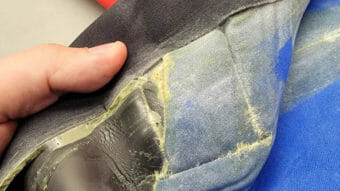
Close-up of the defect on a new Survitec immersion suit. Glue attaching the zipper to the neoprene shell does not adhere well. (Photo by Dylan Simard/KMXT)
Kodiak Marine Supply is a large department store on Kodiak’s dockside, selling just about anything one might find on a fishing boat. Normally, that would include survival suits — but not right now.
Jordan Clay is a sales representative at Kodiak Marine Supply. She says that her store got a call from the Coast Guard in early July.
“They did tell us to inspect and pull our suits off the shelf,” Clay said.
Kodiak Marine Supply stocks Jumbo Immersion suits, which are made by Survitec. The Coast Guard issued a warning on July 1 cautioning sailors and vendors to look carefully at immersion suits made by Survitec.
After inspection, Kodiak Marine Supply pulled out their whole remaining inventory of about six suits.
“Most of the boats prefer that suit over other suits,” Clay said.
The defect involves a patch of glue that is meant to adhere the suit’s waterproof zipper to the suit’s neoprene shell. The defect could allow freezing seawater to enter the suit, making it unsafe. Most of the suits have been manufactured very recently.
Kodiak Marine Supply has already sold 20-30 of these suits — the Coast Guard requires fishermen to have survival suits on board.
Clay says they’re offering refunds. But it’s too late for some fishermen, who are already chasing the red salmon run in Southeast Alaska.
“A lot of guys are keeping their stuff on their boats just to … for something. I mean, they can’t have nothing,” Clay said.
It’s unclear how Survitec is going to respond — Clay says she expects a refund to retailers.
Survitec has not responded to requests for comment.
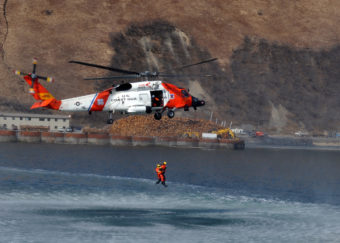
MH-60 Jayhawk helicopter crews perform a search and rescue demonstration off the back of the Coast Guard Cutter Munro April 15, 2013, in Womens Bay, Kodiak, Alaska. (U.S. Coast Guard photo by Petty Officer 3rd Class Jonathan Klingenberg.)
The Coast Guard has found a serious defect with a common brand of survival suit that may reduce their usefulness in emergencies.
Survival suits, also called immersion suits, are full-body protective suits that the Coast Guard requires on commercial fishing vessels for sailors to wear in an emergency. The suits have flotation devices and are meant to protect sailors from freezing water as they await rescue.
Close-up of the defect on Survitec immersion suits. The glue attaching the zipper to the neoprene shell does not adhere well.
Scott Wilwert is the commercial fishing vessel safety program manager for the Coast Guard in Alaska. He says the problem was discovered during a routine inspection in June.
“Inspectors that were out in Bristol Bay a few weeks ago reported finding issues with relatively newly manufactured immersion suits,” Wilwert said. “And what they were finding was an area of what appeared to be a delamination, or a lack of adhesion of the glue that’s used to fix the zipper assembly to the neoprene part of the suit.”
The suits are Imperial Immersion Suits manufactured by Survitec Group, a safety equipment manufacturer based in the United Kingdom that makes everything from lifeboats for submarines to “G” suits for fighter pilots. They are one of only a handful of companies approved by the Coast Guard to make survival suits for use in the United States.
Wilwert says the Coast Guard isn’t sure how widespread the issue is. The problem became apparent in late June. After the Coast Guard notified Survitec, the company told the Coast Guard they had seen suits in Canada with a similar defect.
Wilwert says the Coast Guard then began finding more suits in Alaska with the same problem.
“I started to get a little feedback from some local Alaskan Coast Guard units who had taken it upon themselves to walk into some of the retail stores and vendors in their towns,” Wilwert said.
The Coast Guard did find suits on shelves that bore the defect. All were Imperial suits manufactured in the last few years.
Wilwert says that Survitec is investigating the defect and may soon issue a “general service bulletin” that will outline the extent of the problem and possible remediation for it, potentially including a recall.
Survitec could not be reached for comment in time for this story.
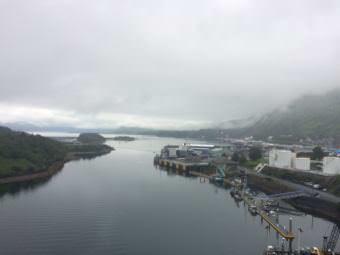
View from the Near Island Bridge. (Photo by Mitch Borden/KMXT)
This week marks the start of Kodiak’s first cruise ship season since 2019 — 565 passengers will be on board the Roald Amundsen when it docks at Pier 2 in Kodiak on Thursday.
Aimee Williams is the executive director of the visitors center Discover Kodiak.
“This is a good sign that life is returning back to normal and tourism is returning back to normal.” she said.
Kodiak’s cruise ship season tends to look a little different compared to other parts of the state, Williams says. The ships tend to be smaller than the ones that frequent Southeast Alaska — and there’s a lot less of them.
Thirty large and small cruise ships called in Kodiak back in 2019. That was a record year. This year, just 10 cruise ships will visit the island. Juneau saw 70 large and small cruise ships over the course of its shortened season in 2021, by comparison.
Fifteen cruises were originally on the schedule released by Alaska Maritime Agencies in March, but that number has gone up and down due the ongoing pandemic and invasion of Ukraine.
Williams says that while cruise ship tourism gives Kodiak businesses a boost, its downtown was spared from some of the economic hardships faced by other coastal communities when COVID stopped the cruises from coming.
“When they weren’t here for the last two years, we weren’t devastated, and we didn’t lose businesses because cruise ships weren’t in town,” Williams said. “It’s exciting, and those businesses that are going to make money I’m sure are very excited, but we don’t have to change our posture a lot for when there’s a cruise ship here or when there’s not.”
The Roald Amundsen will continue on to Dutch Harbor after it stops in Kodiak this week, and it will visit twice again in August. Six cruise ships will call in Kodiak throughout September including the Nieuw Amsterdam, which has a carrying capacity of more than 2,000 passengers.
“When those big ships come, anything that’s over like 900 people, we kind of have to change the way we do business downtown,” said Williams.
Kodiak’s cruise ship season wraps up in early October, when the nearly 700-passenger Regatta calls in Kodiak on its voyage from Los Angeles to Tokyo.
The Alaska Marine Highway System ferry Tustumena sits at the dock in Akutan on the Alaska Peninsula, July, 28, 2012. (Photo by David Waters/KTOO)
The M/V Tustumena returns to service this week. It’s the only Alaska Marine Highway System ferry that sails between all 13 ports of call out the Aleutian Chain and regularly visits Kodiak Island.
The Tustumena’s first sailing since then will be on Saturday, when it departs Homer on its way to Kodiak.
The M/V Kennicott has been the only ferry sailing to Kodiak since the nearly 60-year-old Tustumena went into the shipyard for repairs back in December.
“The Kennicott’s been pulling double duty trying to fill in for Tustumena, but obviously it doesn’t provide as many runs as the Tustumena’s normal schedule, so it will be nice to have that boat back out there and doing what it does best,” said Sam Dapcevich of the state Department of Transportation.
The Kennicott was able to serve most but not all of the Tustumena’s port calls. Several communities in the Aleutians have had to skip ferry service all-together because the Kennicott is too large to make it into their smaller ports.
A replacement is in the works for the aging Tustumena, but the more than $200 million project isn’t expected to be completed for another five years.
Dapcevich says DOT hopes to begin construction on the replacement vessel next year.
Anastasia Ashouwak, pictured third from right in the bottom row, was part of a group of Alaska Native children, pictured here, sent to the Carlisle Indian Industrial School in 1901. (Photo courtesy: Lara Ashouwak)
An Alaska Native girl who died more than 100 years ago at a boarding school in Pennsylvania will return home to Kodiak Island. Earlier this summer, the U.S. Army began the process of returning the remains of eight Indigenous children from the school to their families across the country.
According to records, Anastasia Ashouwak was taken from an orphanage on Woody Island in the Kodiak Archipelago and sent to the Carlisle Indian Industrial School after her mother died in 1901. Alutiiq Museum executive director April Laktonen Counceller says Ashouwak was part of a group of Alaska Native children sent to the school.
“There were 11 students that went on that journey,” Counceller said. “There’s records of their steamship travel, and the remainder of their travel once they hit the West Coast was by train.”
Indian boarding schools like Carlisle stripped Indigenous children of their culture and had notoriously poor conditions. Just last summer, the Department of the Interior announced it would be looking into the “troubled legacy” of Indian boarding schools in light of the discovery of 215 graves near a boarding school in Canada. It released its first report on the schools in May.
Ashouwak spent the next three years at the school before dying of tuberculosis at the age of 16.
She was buried alongside other children in the school’s cemetery. For more than a century she remained buried under a headstone inscribed with the name Anastasia Achwack.
Counceller says records indicate that Ashouwak was Sugpiaq/Alutiiq and had ties to the former village of Kaguyak on the southern tip of Kodiak Island, which was washed away in the 1964 tsunami. Her family then moved to the village of Old Harbor, where many people still share her last name.
Cassey Rowland is an Alutiiq artist from Kodiak and one of Ashouwak’s descendants. Her father, Ted Ashouwak, who is from Old Harbor but now lives in Maine, is Ashouwak’s great-nephew and closest living relation. Rowland says she never heard about the boarding schools from village elders when she was growing up.
“They just didn’t talk about it, it was just too painful for them,” she said.
Rowland has a daughter the same age as when Ashouwak left Kodiak Island for the Carlisle School, and she’s been honest with her daughter about what happened at Carlisle and other schools like it.
“We’ve been learning about the Indian boarding schools before we even learned about our ancestors being a part of it, and she’s been asking questions and I’ve been telling her the whole truth. I’m not the type of parent that’s going to hide away,” Rowland said.
Rowland and her daughter flew to Pennsylvania earlier in July where they gathered with other members of their family as Ashouwak’s grave was dug up in preparation for her reburial in Alaska. Members of the Alutiiq museum and a Russian Orthodox priest from Kodiak also joined the family.
Rowland said she brought paint to decorate the box that will carry the remains of Ashouwak home — she planned to incorporate Alutiiq and Russian Orthodox designs for the casket.
“And then the bright colors of the island just to bring her home — lots of bright greens and blues, oranges, pinks, so, just trying to make it look like a little girl,” she said.
The U.S. Army is in the process of identifying the children buried at Carlisle, and repatriating them to their families. (Photo courtesy of Lara Ashouwak)
Counceller said Ashouwak’s return to Kodiak is different. The U.S. Army oversees the cemetery at the Carlisle Indian Industrial School. It’s in the process of returning the remains of children who can be identified to their communities.
The Alutiiq Museum knows of another girl from Kodiak buried at Carlisle and hopes to bring her home next summer, Counceller said.
When Ashouwak returns to Kodiak, Counceller said she’ll receive services at the local Russian Orthodox church in the city of Kodiak and an Alutiiq ceremony at the museum. The Alutiiq Dancers — including Rowland’s daughter — also will perform. Ashouwak and her family will then be flown to the village of Old Harbor for a graveside service followed by a potluck.
Counceller says there’s a sense of relief among the community that Ashouwak will finally return home.
“As many of us Native people know, we’re kind of all related around the island so, although this is one individual, it’s a moment for all Alutiiq people to think about how important this kind of work is,” she said.
Rowland says a part of her will also be at peace when Anastasia is finally alongside members of her ancestors in Old Harbor.
“She’s gonna be where she is wanted. We need her home. And she’s gonna feel that, we believe. Her spirit will finally be at rest,” said Rowland.
Rowland says she’ll be processing why it took so long for Ashouwak to return to Old Harbor for the rest of her life.
Services and burial for Anastasia Ashouwak will be Saturday, July 9th, in Kodiak and the village of Old Harbor.
Monks and volunteers carry the dome that is now installed on the top of Spruce Island’s newest chapel. (Photo courtesy of Father Andrew)
The village of Ouzinkie on Spruce Island has an Orthodox church, and the far side of the island also has its own chapel over the grave site of St. Herman. But the three monks who live in the middle part of the island only have a small indoor chapel in their shared house.
Father Andrew is the superior of the monks living on Spruce Island. He said that even though there are places of worship on either side of the island, the new chapel will give the small community their own place of worship.
“This is our home,” said Andrew. “And we have guests, especially in the summer months, and now also, local people in our Sunny Cove area who attend church here.”
The chapel is nearing completion and should be finished sometime in the fall of this year. A golden dome has already been raised over the structure, but final artistic work still needs to be done. Father Andrew is hoping that it will be open for services in spring of 2023.
The chapel should be open for services in spring of 2023. (Photo courtesy of Father Andrew)
“Like other churches in Alaska,” Andrew said, “although it’s very remote, you can see some nice architecture and fine carpentry.”
Over 200 years ago, the first Russian Orthodox monastery in North America was founded in Kodiak, in the modern-day city of Kodiak. The head of the monastery at the time, Herman of Valaam — known today as St. Herman — renounced his position and took on the life of a hermit on Spruce Island.
“He ended up taking care of orphans, especially after the 1819 epidemic. Many orphans were sent to him, and he had a community down in Monk’s Lagoon, and there are now four chapels down there. And it is a place of pilgrimage where people come from all over the world,” Andrew said.
Father Andrew says many visitors from Russia and Ukraine typically pilgrimage to Spruce Island during the summer months. He doesn’t expect them this year due to Russia’s ongoing invasion of Ukraine, but he is still expecting summer visitors from around the United States and Alaska.
Close
Update notification options
Subscribe to notifications
Subscribe
Get notifications about news related to the topics you care about. You can unsubscribe anytime.