KMXT - Kodiak

KMXT is our partner station in Kodiak. KTOO collaborates with partners across the state to cover important news and to share stories with our audiences.

Remains of Alutiiq people returned to Kodiak after decades-long process

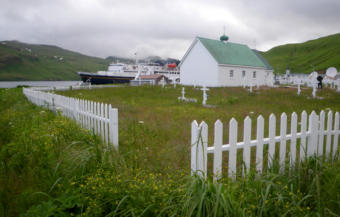
Community members gather for the burial of four Alutiiq individuals recently repatriated to Kodiak Island (Photo courtesy of Alutiiq Museum)

The remains of four members of the Alutiiq community came to their final resting places at a cemetery in Kodiak this week. Members of the Sun’aq Tribe and the Alutiiq Museum gathered at Kodiak’s City Cemetery for the burial on June 6. The graveside service was led by the local Russian Orthodox church.

April Counceller is the executive director at the Alutiiq Museum in Kodiak, which coordinated the reburial. She said the homecoming was long overdue.

“There’s a growing awareness that it is not fair or just to hold on to ancestral human remains,” she said.

Of the four individuals laid to rest, one was repatriated from a university collection, and two were returned by the Alaska State Museum. The fourth was found during construction on private land.

The Native American Graves Protection and Repatriation Act, or NAGPRA, which was passed in 1990, was meant to codify the process of returning cultural items — including human remains — from institutions that receive federal funding to the tribes they belong to. But Counceller said it’s been slow going.

The museum has identified the remains of more than 160 Native individuals that have yet to be repatriated to Kodiak — and there’s likely more they’re unaware of. The U.S. Department of the Interior announced last year it was considering changes to NAGPRA to expedite repatriations.

Counceller said the remains of the four buried recently in Kodiak were too old to be identified, but there’s a sense that they’re finally home.

“We consider any ancestral remains to be part of our family,” she said. “And for those individuals who were reburied, I can only think that they may now feel some peace.”

That’s a step in the right direction, according to Counceller, that likely won’t be the last.

Scientists examine Gulf of Alaska sea floor to see effects of bottom trawling

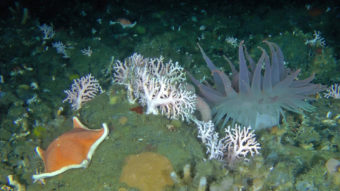
Corals seen at the bottom of the ocean near Kodiak Island. (Photo courtesy of Oceana)

A group of researchers is hoping that data collected from the Gulf of Alaska’s sea floor will shed new light on the effects of bottom trawling.

Scientists from the conservation group Oceana, which is based in Juneau, spent eight days aboard a research vessel circumnavigating the Kodiak archipelago late May. Jon Warrenchuck is a senior scientist and fisheries campaign manager with Oceana.

“The Gulf of Alaska is a very special place and a very productive ecosystem,” Warrenchuck said. “Our timing of our survey here in the spring means we saw just an abundance of life, from the phytoplankton to the fish to the birds feeding at the surface.”

The focus of the trip, though, was to document life at the very bottom of the sea to better understand the impacts of commercial trawling, Warrenchuck said.

The group surveyed 23 locations during the trip. Warrenchuck said they sent cameras and remotely operated vehicles down to depths more than a thousand feet deep at some sites, and photographed areas of the seafloor that had never been seen before.

“We chose sites to explore that were both open and closed to bottom trawling and we did see differences between those types of sites,” Warrenchuck said.

Researchers documented coral gardens and groves of sea whips, but the group also saw evidence of heavy damage to the ocean floor, including areas of crushed coral where commercial trawling is permitted. Warrenchuck said they don’t know what those areas of the sea floor looked like before trawlers arrived. But Oceana scientists plan to submit their observations to the North Pacific Fisheries Management Council and the National Marine Fisheries Service — they’re in the midst of an essential fish habitat management review process that’s completed every five years for the area.

Warrenchuck hopes the photos and videos from the waters off Kodiak will help make the case to keep trawlers out of some areas of the ocean.

“So much of the ocean has remained unexplored that any information we gather on seafloor habitat characterization, locations of sensitive habitat that will only help us make better fishery management decisions going forward,” he said.

The essential fish habitat summary report is slated to come out in October, according to the North Pacific Fishery Management Council’s website.

Alaska air carriers are feeling the pinch of nationwide pilot shortage

A young pilot in a plane in the air
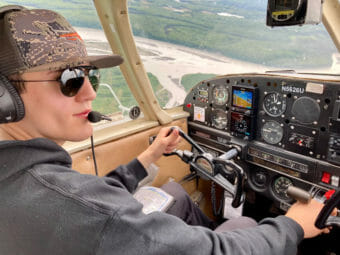
More commercial pilots now come from civilian backgrounds, like Connor St. Laurent, and are trying to fill the pilot void. (Photo courtesy of Connor St. Laurent)

The airline industry is in dire need of pilots — and Alaska is no exception. Just this spring, Alaska Airlines became the latest company blaming an ongoing pilot shortage for canceled and delayed flights.

Data from the U.S. Bureau of Labor Statistics points to nearly 150,000 vacant pilot positions that will need to be filled over the next decade. But finding new pilots remains a hurdle, and it’s not easy to get into the cockpit of a major airline.

Take Connor St. Laurent. He’s 23-years-old and from Anchorage. When we spoke in early May, he was just 25 flight hours shy of being able to test for his commercial pilot’s license.

“Right now I’m just time building, so I’m just cruising around — you know, go to Talkeetna, grab a pizza, or just practicing maneuvers by myself,” he said.

Time spent in the air, though, is just a fraction of the work.

“Once you start pushing towards making sure you’re ready to do your check ride, I’ll probably study over 5 hours, 6 hours a day,” St. Laurent said.

It’s taken St. Laurent about 3 years to get to this point. The Federal Aviation Administration requires 250 flight hours before prospective pilots can sit for their commercial check ride, and there’s an oral exam they need to pass, too. Along with the time commitment, it’s expensive.

St. Laurent flies out of Fly Around Alaska, a flight school based in Palmer, Alaska. But he started at a flight program in Montana, which he said cost about $40,000 a year.

Connor’s dad, Leon, learned to fly in the military and then spent most of his career flying for a major airline. That’s a path about two-thirds of commercial pilots used to take. But the military has had its own problems recruiting pilots and has upped its efforts to retain the ones it has.

Most commercial pilots come from a civilian background now — like Connor’s — meaning they have to shell out the time and money on their own. And that’s causing a bottleneck.

“Just chipping away at the hours, I feel like that’s kind of where everyone gets to,” St. Laurent said.

There isn’t clear data for Alaska’s pilot needs, but airlines are noticing a pinch. United Airlines opened its own flight school to mint new pilots back in February, and in March, Alaska Airlines became the latest company to announce a scholarship program for applicants who agree to fly for the company or for sister carrier Horizon Air once they graduate. The Seattle-based carrier did not respond to multiple requests for an interview.

""
Smaller flight operators that run supplies between villages in Alaska are also feeling the pinch from the pilot shortage. (Photo by Kirsten Dobroth/KMXT)

Adam White heads the government and legislative affairs program for the Alaska Airmen’s Association, an advocacy group for pilots in Alaska. He says the industry has seen waves of pilot shortages before and knew this current one was coming. The pandemic just sped up the process.

“Back in the late 80s, early 90s we had a big exodus from the Vietnam era pilots, and there was a little bit of a crunch at that point,” said White. “Now we’re getting to the mandatory retirement age for a lot of other commercial pilots that came on board about that timeframe.”

And there’s another problem — more than a thousand-hour experience gap from the time a pilot gets his or her commercial license until they can work for an airline.

Many of those pilots start at smaller commercial carriers that haul mail or freight and don’t have the same hour requirements. In Alaska, those companies typically fly supplies between villages off the road system.

White said pilots for those carriers used to stay with a company for two or three years before going to another job, but that’s not the case anymore.

“Sometimes they’re staying 6 months now because they’ve been able to get enough experience that now they have an opportunity to talk to an airline and the airline will bring them on much sooner than what they would have two, three, five years ago,” White said.

White said some companies are even recruiting older, recreational pilots to fill flying jobs in the communities where they live.

The big challenge now, according to White, is getting young pilots to stay in Alaska. He says many regional flight operators in Alaska are starting to offer better employment benefits and higher pay to try and solve that problem.

And more organizations — like the Alaska Airmen’s Association — are handing out financial assistance for Alaskans to get into flight school. Some high schools in the state have also started offering flight classes.

Connor St. Laurent said he wants to fly for a major airline someday, but he’s not trying to leave Alaska anytime soon. He’s just focused on the step right in front of him.

“You’re over the hill at 250 hours and you get that commercial check ride done,” he said. “You can finally say, ‘Hey, I could be getting paid right now to fly a plane.’ You can go make some money instead of spending all of it and get paid to fly instead of pay to fly.”

If the current economic outlook is any indication, his job prospects are good.

Most paralytic shellfish poisoning cases were among Alaska Natives, but state lacks data for subsistence foods

Blue mussels at Nahku Bay. (Photo by Claire Stremple/KHNS)

Kodiak Island had the most cases of paralytic shellfish poisoning in Alaska over the last nearly 30 years, according to a wide-ranging April report by state health authorities.

The state’s latest data dump provides a look at paralytic shellfish poisoning in Alaska between the years 1993 and 2021. Paralytic shellfish poisoning is an illness caused by a marine toxin that’s spread by harmful algal blooms. It’s serious, sometimes fatal, and most commonly found in butter clams and blue mussels, and according to the latest data from the state Department of Health and Social Services, it has started to be more common year-round and not just in warmer months.

Andie Wall, an environmental coordinator at the tribal health nonprofit Kodiak Area Native Association, said commercially harvested shellfish has to be tested for PSP toxins before it can be sold to customers.

“But there’s no state testing program for subsistence harvest,” Wall said.

Statewide, 53% of PSP cases were among Alaska Natives. Wall said the gap in subsistence testing is a big deal in coastal communities across the state — including Kodiak, where digging clams is a popular sunny day pastime and clams are an important food source.

Cases on Kodiak comprised 25% of statewide incidents of the illness. Areas in Southeast Alaska — like Juneau, Ketchikan and Prince of Wales Island — also recorded high case rates.

“Shellfish are an important subsistence resource to a lot of people around the state and to just say ‘don’t collect shellfish, don’t harvest shellfish,’ it’s not feasible,” she said.

KANA was awarded a federal grant from the Bureau of Indian Affairs back in 2018 to monitor beaches on Kodiak Island for high levels of toxins. And the public could send in locally harvested clams and mussels to the organization as part of the program.

KANA would ship the samples to the Southeast Alaska Tribal Ocean Research in Sitka for testing free of charge, and they would let people know if their shellfish was safe to eat — per guidelines from the Food and Drug Administration — based on the levels of toxins detected. But the program’s funding ran out at the end of last year, and KANA hasn’t been able to restart testing since.

Sen. Lisa Murkowski’s office announced in March that $50,000 in federal stopgap funds were included in the omnibus spending package to jumpstart the program. KANA won’t receive the funds and won’t be able to start testing again until September.

Meanwhile, the latest state data also showed a 77% decline in reported cases of PSP across Alaska over the last four years. Wall said that might not paint a full picture of what’s going on.

“The question there is: Is that from people not eating it? Is that from people losing this important resource or is that from increased testing?” Wall said. “I don’t know the answer to that. I hope one day it will be the increased testing.”

Subsistence harvesters on Kodiak Island can still send their local shellfish to SEATOR for $75. Alaska’s Department of Environmental Conservation also provides testing for a fee.

Deadline extended for Alaska businesses to apply for pandemic relief grants

An empty street in downtown Anchorage
Many businesses closed or reduced operations early on during the COVID-19 pandemic. (Photo by Abbey Collins/Alaska Public Media)

Alaska businesses impacted by the pandemic have a little more time to tap into tens of millions in unspent federal relief funds.

That’s according to state Department of Commerce, which announced Monday that there will be two more weeks to apply for the state business relief program, which will disburse funds from the American Rescue Plan Act.

That means the new deadline to apply for a share of $34 million in federal relief for Alaska businesses is April 30.

Businesses that already received ARPA funds won’t be eligible. The threshold to qualify for the relief has also changed — applicants now have to show they lost at least 30% of their gross revenue between 2019 and 2020 because of the pandemic. Business owners previously had to show a 50% loss.

More information is available on the State of Alaska’s website.

Alaska lawmakers applaud Biden administration ban on Russian seafood imports

Fish at the Ocean Beauty seafood plant in 2014. Russia slapped an embargo on American fish and seafood products in 2014, and lawmakers at the state and federal levels have been calling for a Russian seafood ban for years. (Photo by Eric Keto/Alaska’s Energy Desk)

State and federal lawmakers from Alaska are applauding the Biden administration’s decision to ban Russian seafood imports. It’s part of a series of escalating sanctions against Russia over its invasion of Ukraine. Sen. Dan Sullivan and Rep. Don Young released statements Friday welcoming the move.

Legislators at the state and federal levels have been calling for a Russian seafood ban for years. Kodiak Republican state Sen. Gary Stevens says the White House is finally paying attention to the issue.

“I’m really pleased the President has made this announcement, and I think it’s extremely important for Alaska and the Alaska seafood industry, you know, it’s been a totally unfair relationship in the past,” Stevens said.

Russia slapped an embargo on American fish and seafood products in 2014 in response to U.S. sanctions imposed over its annexation of Crimea.

The waters off Alaska are home to the country’s largest commercial fisheries by value and volume. And Kodiak is the third largest fishing port in the country. Kodiak Republican House Speaker Louise Stutes said Alaska fishermen are ready to fill the void.

“Alaska is positioned pretty well in their seafood and I think we can step up to the plate and supply Americans with good, fresh, nice seafood,” she said.

Just how the ban will play out on the market could come down to the type of seafood though. Bruce Schactler is the global food aid program director for the Alaska Seafood Marketing Institute. He’s also been a fisherman in Kodiak for the past 50 years. And he said there’s a spiny red elephant in the room — Russia’s enormous king crab fishery.

“I’d say availability is not going to be good because there’s a little bit from a Norwegian king crab. I’m not sure where they are in their harvesting timeline or anything but their volume is low,” Schactler said. “So, it’s not really going to supply much at all. So basically, it looks like, as I said before, unless enforcement is nil, and they allow the king crab to come to the US through China. There’s just not going to be any king crab to eat.”

bill making its way through Congress from Alaska Sens. Dan Sullivan and Lisa Murkowski could close the China loophole by banning seafood of Russian origin even if it’s shipped from China. In a call with reporters Friday an aide in Sullivan’s office said the bill could get a vote in the Senate next week. The aide said the Biden administration has indicated it would be in favor of signing it into law.

Site notifications
Update notification options
Subscribe to notifications