KMXT - Kodiak

KMXT is our partner station in Kodiak. KTOO collaborates with partners across the state to cover important news and to share stories with our audiences.
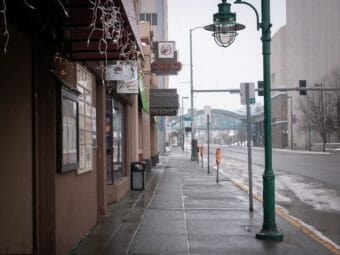
Kodiak is slated to see its first cruise ships since 2019

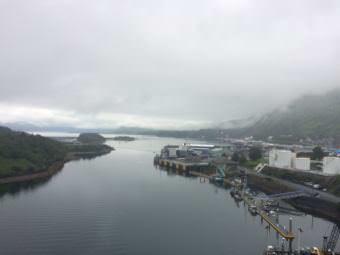
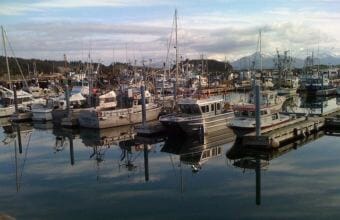
View from the Near Island Bridge. (Photo by Mitch Borden/KMXT)
View from Kodiak’s Near Island Bridge. (Photo by Mitch Borden/KMXT)

Kodiak is slated to see its first cruise ships since 2019. Nick Szabo is the resident port agent for Kodiak with Alaska Maritime Agencies. He says 15 large and small cruise ships are scheduled to call in Kodiak — unless COVID-19 or the situation in Ukraine disrupts those plans.
“If we have another variant that is as severe as some of the others, the CDC is probably going to put a no-sail order out,” said Szabo. “But if things keep getting better, then I expect we will have a cruise ship season.”

Kodiak Island doesn’t see as many cruise ships as places like Skagway and Ketchikan do. Szabo says in a normal summer, about 25 ships carrying summer tourists dock in Kodiak. And back in 2019, 30 cruises visited the island.

But COVID isn’t the only thing that might affect cruise operations this summer.

“Some of the cruise ships in the past, they stop at Russian ports,” said Szabo. “So, that’s not going to happen for sure. And then there’s a lot of apprehension about just how this whole Ukraine thing is going to play out.”

The situation in Ukraine could affect island’s first cruise ship of the season. The Minerva, a 152-passenger cruise ship, is scheduled to dock in Kodiak on May 19 before making its way to Russia and ultimately Japan.

Stories from Gulf of Alaska fishermen are headed to the Library of Congress

Fishing boats line up at the salmon tender the F/V Muskrat to drop off their catch. (Photo by Mitch Borden/KMXT)

A fisherman from Seldovia is collecting stories from fellow Gulf of Alaska fishermen. The oral history audio project will eventually be sent to the Library of Congress.

It was in the mid 1990s when Josh Wisniewski landed in Kachemak Bay as an 18-year-old. Today, he’s a set netter and still fishes halibut out of Seldovia. That’s also where the inspiration for his current audio project was born.

A man in a surgical mask looking out an airplane window at a harbor
Wisniewski visited Kodiak in January for the project and plans to return later this spring. (Photo courtesy of Marissa Wilson)

“When I was a kid and came across the bay here and started, you know, meeting and fishing for Alaskan Native elders who have been here forever – but as well as other people who had been fishing here since before statehood,” he said, “I was just amazed by peoples’ stories for one, but also the depth of peoples’ knowledge.”

The Library of Congress’s American Folklife Center hands out grants annually to document the oral histories of tradespeople across the country. They’re then sent to the Library’s archive. Wisniewski was one of six awarded the grant last year through the Alaska Marine Conservation Council.

This year’s audio contributions include stories from mail carriers in Appalachia and healthcare workers in New York’s Hudson River Valley. Wisniewski’s recordings will be the first stories from Alaska.

“It’s just a really wide range of people that reflect the diversity of the United States,” he said.

He started recording stories last fall and plans to talk to 20 fishermen. He’s been to Homer, Seldovia, the southside of Kachemak Bay and Sitka. He was also in Kodiak last month and will visit again later this spring. He said many of the stories touch on the changes in commercial fishing’s technology over the years.

“I find a common theme of just an intrinsic value people have on the experience of it, whether it’s pivotal experiences on the ocean and opportunities to see yourself and test yourself as you push yourself physically and mentally and emotionally sometimes, in complex situations. And just an overall evaluation of the camaraderie among fishermen,” said Wisniewski.

Wisniewski plans to whittle down his recordings and submit them to the Library of Congress this summer. He said he’ll continue the project after that though, and hopes to release a podcast from the stories.

Winter means hibernation for some — but not all — of Kodiak’s bears

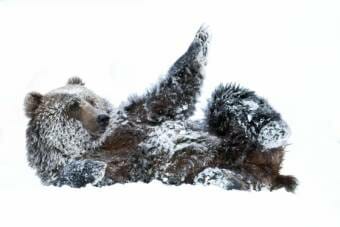
a brown bear rolling in the snow
A Kodiak “ice bear” during a recent snowfall. (Photo courtesy of Jennifer Fogle Smith)

Jennifer Fogle Smith is a wildlife photographer in Kodiak. She’s been documenting the island’s bears for over 20 years — and she has some stories.

“This last year I had a beautiful ,sub-adult female, who was very athletic, was an acrobat,” she said. “And she had a beautiful, brilliant red salmon. And she picked it up, and then she caught it, and then she threw it up in the air again and caught it fully extended. And then she played with it for a little while and then she sauntered down the beach.”

She calls moments like that magic. They’re harder to come by in the winter, but this year was special — thanks to an earlier than usual snowfall and frigid November temperatures.

“Mixed all together, we had bears that we could see that were actively fishing, and they would be covered in ice,” said Fogle Smith. “And ice bears are kind of unique and exciting to see.”

Larry Van Daele was the bear biologist on Kodiak Island for 34 years and most recently served on the Board of Game. He retired last summer. Van Daele said the last time the ice bears were out was four or five years ago.

“And it’s an opportunistic thing as well because we have a group of bears here on the road system, especially this year, that are real tolerant of people,” he said. “And they’ve stayed out longer than usual on the salmon streams because the silver salmon are running real late.”

A brown bear walking with its fur crusted with ice
Most Kodiak bears hibernate during winter, but about 30% of males continue foraging for food year round. (Photo courtesy of Jennifer Fogle Smith)

There are more than 3,000 bears on Kodiak and the surrounding islands. They’re the largest species of brown bear in the world. And they’re generally less aggressive than grizzlies, their Interior relatives.

Van Daele said Kodiak bears don’t have to fight over food and territory like other brown bears, thanks to Kodiak’s expansive habitat and food sources. And they’ll generally stay within one or two drainages looking for food.

“The bears on the north end of the island don’t go down to the south end to go fishing,” he said. “They just use basically what’s in their backyard.”

By late November and into early December, they head into their dens for hibernation — but not all of them. About 30% of the Kodiak male bear population don’t den at all, according to Nate Svoboda, the state’s area management biologist with Fish and Game.

“So, there are bears out and about on Kodiak Island year round,” he said. “And that’s an important thing as a manager to know and certainly an important thing to know as a resident of the island.”

Those bears spend their time foraging and intermittently bedding down under spruce trees, kind of like a winter nap schedule. Biologists don’t know exactly why some of the bears don’t hibernate, but Svoboda said it is unique. Running across a Kodiak bear in winter is unlikely, but it can happen.

“And if you do, I think it’s important to realize that, you know, bears this time of year are very slow and lethargic,” said Svoboda. “Their metabolism is slowed down, they’re moving very slow, so they might not respond to people like they will in the summer.”

There’s been just one bear-related fatality on Kodiak Island in the last 75 years. The last attack was back in late summer of 2020, when a runner surprised a bear on a trail on Pillar Mountain, just above town. Svoboda said Fish and Game managers from all over the country call him for advice on how to cut down on interactions between humans and bears. He said locals’ respect for bears is key to that relative harmony. Part of that is economic – visitors fly to Kodiak Island for bear sightseeing tours and trophy hunting trips. But veteran bear biologist Larry Van Daele said there’s also a cultural pretext.

“The Alutiiq people, the Sugpiaq people, who were the original stewards of this land, they have a very strong tradition of respecting bear,” he said. “And I think the other folks that have come over the years have blended in with that strong tradition of respect.”

Svoboda said the bears should start making their way out of the den in June.

Kodiak’s tanner crab season is back after yearlong closure

Tanner crab (Photo courtesy of Alaska Department of Fish and Game)

Dave Kubiak spent a recent rainy Thursday stacking the deck of his boat, the Laura Lee, with crab pots in preparation for Kodiak’s tanner crab season. He says the night before the season is always exciting.

“We’ll leave in sufficient time to get there and to go someplace and anchor up,” he said. “And then wait for the morning, and then run out and get all nervous and jittery on the opener. Which is silly, but we do.”

Kubiak says he got a nickel per pound for tanner crabs back in the 1960s. Due to low supply and high demand across the country, prices for this season — which opens Jan. 15 — are much higher. The Kodiak Crab Alliance Cooperative and local canneries agreed to $8.10 per pound.

Kodiak’s tanner crab fishery didn’t open last year. The last time it was open was back in 2020, and crabbers fished for $4.25 per pound. The Alaska Department of Fish and Game set guideline harvest levels at 400,000 pounds that year. This year, guideline harvest levels for the Kodiak fishery were set at 1.1 million pounds.

Chignik’s tanner crab fishery is also open, with harvest levels set at 200,000 pounds. The guideline harvest level for the south peninsula’s tanner crab fishery is 500,000 pounds.

“This is a bigger quota than we’ve had in a while. The last three seasons, we’ve had have been near the regulatory minimums,” said Nat Nichols, a Kodiak-based area management biologist with Fish and Game.

Nichols says that starting back in 2001, the agency started seeing local tanner crab numbers surge every few years. He’s been tracking this year’s cohort since 2018.

“And that’s exciting,” he said. “It looks promising for the next few years at least because this is sort of the front edge of that [2018] pulse of crab, and there are quite a few crabs behind them.”

For Kubiak and the crew of the Laura Lee, that’s even more exciting than preseason jitters.

“You don’t have to catch a lot of crab to make some money,” said Kubiak. “And of course that trickles down to the community, that goes to crew, that’s money in crews’ pockets. It’s wonderful.”

Kodiak’s tanner crab fishery will remain open until this season’s quota is caught. That could be just a few days, or it could be a week or more, depending on conditions. Seventy-nine vessels had registered as of Friday, Jan. 14, for this year’s tanner season, but Nichols said he expected a few more boats to register throughout the weekend.

Kodiak schools go remote as 5% of borough residents test positive for COVID

Kodiak high school, and other Kodiak Island Borough schools, will move to remote learning beginning Thursday, Jan. 13, 2021. (Kavitha George/KMXT)

Kodiak students will be learning remotely beginning Thursday, the borough school district announced Wednesday in a letter to parents.

This comes as COVID-19 cases in the Kodiak Island Borough continue to rise to unprecedented levels. The Emergency Operations Center Wednesday reported 174 new cases of COVID-19 from tests taken from Jan. 4-11.

The new cases have pushed the active case count in the island to 711 cases. That means 5% of the Kodiak Island Borough’s population is known to presently have COVID, using the data from the latest census in 2020.

According to the letter, the district has over 60 staff absent and 12 substitutes available. Over 145 staff and students at Kodiak High School and 300 staff and students from the district at large are absent for isolation and quarantine.

Superintendent Larry LeDoux said the district has exhausted its supply of healthy staff.

“We’ve been doing everything possible to keep the schools open and to fight that battle,” he said. “But you have to have staff and you have to have principals in the hallway with kids instead of teaching classes and you have to have aides there to help people achieve their goals. And you have to have a safe environment for kids.”

LeDoux said it was a difficult decision.

“I’m really troubled about it. I believe it’s the right decision. But it’s not a decision I wanted to make. And I hope I don’t have to make it again the rest of the year,” he said.

The borough hopes to return to in-person learning on Tuesday, Jan. 18, according to the letter sent to parents.

Breakfast and lunch will be available to pick up from the high school main entrance between 11:00 a.m. and 2:00 p.m. for all students Thursday and Friday.

There will be a second testing and supply pickup event later this week, according to the school. A date and time have yet to be announced.

Alaska gains residents for the 1st time in 4 years

""
Air Force F-15s at Eielson Air Force Base in 2015. (U.S. Air Force Photo)

Alaska has gained residents — albeit slightly — for the first time in four years, according to population estimates released by the Alaska Department of Labor and Workforce Development. From April 2020 to July 2021, Alaska’s population increased by 932 people.

“It was just  0.1 percent,” said David Howell, the state demographer. “But still, it broke our trend of population losses that we’ve been seeing.”

Howell said much of the growth is due to an influx of military personnel, particularly at Eielson Air Force Base near Fairbanks. Interstate migration is also down, meaning fewer people moved out of the state. That’s a nationwide trend as more people stayed put during the pandemic.

Still, despite the overall statewide gain, it might seem like there are fewer people in most communities. That’s because 21 of Alaska’s 30 boroughs saw declines in their populations over the same time period.

Anchorage’s population declined by about 0.5% or 1,550 people. Juneau’s population declined by 0.25% or 100 people. In Kodiak, there was just over a 1% dip in residents. Howell said that’s partially because of the Coast Guard base.

“We survey the military bases around the state and our numbers were really just down from the census, so that was what was going on there,” he said. “There wasn’t really any dramatic change in the Kodiak Borough, just with the Coast Guard numbers being a little bit down.”

Fairbanks grew the most, gaining 1,860 people, or about 1.5%, followed by the Matanuska-Susitna Borough with 1,724 more people, about 1.3%.

An uptick in the number of deaths across the state was particularly striking, according to Howell. COVID-19 deaths added to the numbers, but Howell said that’s not the whole story.

“There were 380 COVID deaths but we saw this 760 jump in deaths, so it’s not the only thing occurring,” said Howell. “Of course, it could be delayed medical treatment that sort of thing, I mean, there’s lots of possible reasons. We just don’t have the data to flush out at this point.”

Nationally, doctors and public health experts have expressed concern that some people included in excess death figures did die of COVD-19 but aren’t counted as COVID-19 deaths because they were not tested or diagnosed with it.

The population information from the state is an estimate and not a formal count like the 2020 Census.

Site notifications
Update notification options
Subscribe to notifications