KMXT - Kodiak

KMXT is our partner station in Kodiak. KTOO collaborates with partners across the state to cover important news and to share stories with our audiences.

Kodiak opposes salmon cap agenda change

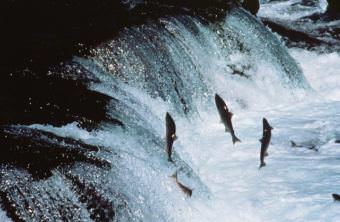
Adult sockeye salmon encounter a waterfall on their way up-river to spawn. (Photo by Marvina Munch/ U.S. Fish and Wildlife Service)

Kodiak is gearing up to oppose what it considers a threat to its fisheries.

The Alaska Department of Fish and Game released a study  last year that found a percentage of Kodiak area sockeye salmon are Cook Inlet fish.

Some Cook Inlet fishermen now want to set caps for sockeye salmon in the Kodiak area.
The United Cook Inlet Drift Association is asking the Board of Fisheries to consider an agenda change at its work session next month.

The change would move the consideration of a new Kodiak area management plan up to a sooner date. The next time the Board of Fisheries is scheduled to look over the management plan is 2020.

The request is based on findings from a genetic study of sockeye salmon in the western Kodiak management area.

According to the study, Cook Inlet sockeye salmon made up roughly 8 percent of the overall sockeye sampled in 2014, 37 percent in 2015, and 30 percent in 2016.

United Cook Inlet Drift Association vice president Eric Huebsch said it throws Cook Inlet’s sockeye management off when other areas harvest their fish.

“All the escapement goals come into question. The brood tables, the management plans, all those things are dependent on using the best science we have, and when those fish are harvested into another area, the data’s not gathered in this area, we don’t know how many fish were being caught, and so the department can’t do its job.”

Huebsch wrote a letter to the Board of Fisheries in January posing the question of how Kodiak’s interception of salmon as they travel into Cook Inlet affects escapement.

He would hope the board would take a look at the management plan in light of the latest genetic work to minimize the harvest of Cook Inlet and other non-local stocks.

Fish and Game’s Westward regional supervisor Nick Sagalkin said they published the study results last year, and Sagalkin says they weren’t really surprising. At least locally.

“The areas we expected to find most of our major stocks – like sockeye salmon for Karluk – we were finding those in the areas that we expected, we were finding them in the temporal we expected.”

The United Cook Inlet Drift Association is requesting sockeye caps through the last week of June and through the month of July. When Kodiak fishermen have caught the max number of sockeye, all salmon fishing stops.

But Sagalkin said that’s not how the management system currently works in Kodiak. Instead, it’s based on the health of the run.

“There’s sort of a couple of things that that concept misses is that it doesn’t take into account all the other species that we’re targeting – pink salmon, chums – and it doesn’t really even look at how we’re trying to control escapement.”

He said there is one sockeye cap – on the North Shelikof Strait.

A sockeye salmon management plan there limits harvest of sockeye to account for the last time the issue came up in 1988. Cook Inlet and Kodiak fishermen grappled back then too, and the Kodiak Salmon Work Group formed as a response.

And now the work group is back.

They’re rallying other Kodiak stakeholders including local government to protest the agenda change.

At their recent joint work session, the Kodiak Island Borough Assembly and the Kodiak City Council looked over a letter they’ll jointly address to the Alaska Board of Fisheries.

The letter addresses the damage the fishing limits could cause to the Kodiak economy.

Borough Mayor Dan Rohrer said the word that comes to mind is “catastrophic.”

“The facts that I’ve heard in regards to it, it’s devastating for our community,” he said. “I don’t want to ever be guilty of crying wolf or anything of that nature, but on this one, there are truly catastrophic consequences.”

The letter also states the agenda change request fails to meet the Board of Fisheries’ three requirements for a change: meaningful new information, conservation concerns, or mistakes in regulation.

The deadline for the city and borough to sign and send the letter is October 3, as is the rest of public comment.

Family returns to Kodiak after 10 years sailing around the world

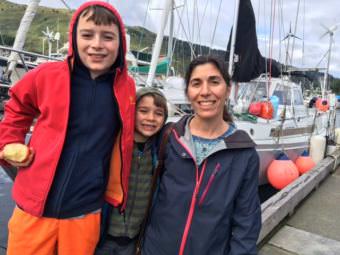
Elias, 11, left, snacks on an apple before going off to a cross country race with his brother Eric, 7, and mom Alisa Abookire. Along with their boys' dad, Mike Litzow, returned to Kodiak after roughly 10 years of sailing the world. (Photo by Kayla Desroches/KMXT)
Elias, 11, left, snacks on an apple before going off to a cross country race with his brother Eric, 7, and mom Alisa Abookire. Along with their boys’ dad, Mike Litzow, returned to Kodiak after roughly 10 years of sailing the world. (Photo by Kayla Desroches/KMXT)

Alisa Abookire traces her family’s journey on a plastic globe.

“And then we went back to French Polynesia – lucky us – for the third time, and then we spent a year in Patagonia and went to the Falkland Islands.”

Behind her, Eric 7, and Elias 11, fuel up on fruit. They’re getting ready for an afternoon cross country race. Elias is trying his hand at track and field.

It’s the first time the boys have joined team sports, Alisa said. They’ve spent most of their lives at sea.

Mike Litzow and Alisa raised their two sons while living a sea-faring nomadic lifestyle. The couple returned to Kodiak this July after roughly 10 years of sailing the world.

Now, the family plans to call Kodiak home for the foreseeable future.
Alisa and Mike lived in Kodiak for seven years, and set off for their world travels when Elias was younger than a year old.

On the globe, Alisa points out Australia – where Eric was born.

“We kind of combined two dreams. Mike wanted to sail to Australia, and I wanted to be a full time mom, so we did it at the same time.”

They lived in Australia for a couple of years, and another a year in Chile, and otherwise traveled where they wanted.

Mike made a living remotely working on fisheries data analysis and Alisa home-schooled their sons, who otherwise entertained themselves with everything from bird watching to drawing.

Eric climbs onto a counter in their kitchen and points out a couple of his creations.

“This one’s two knights fighting, this one’s a bird.”

Elias holds up what looks like a self-made reference chart covered in a colorful fish lures and other objects.

“It’s what I’d actually want to buy if I had a bunch of money, but it would cost so much money. Technically, it’s a ton of fishing gear.”

Elias talks about some of the other activities he did to pass the time on the boat, like snorkeling and sailing.

“But fishing’s sort of my favorite all the time, 100 percent of the time.”

His family caught squid, mahi-mahi, and wahoo during their travels.

They had a fridge on board, but not a freezer, which means the fish didn’t stay good very long unless they canned or consumed it.

“When we catch a fish, we stop fishing, and then we eat fish for breakfast, lunch and dinner,” she said.

The family arrived in Kodiak in July. Alisa said they’re settling in.

“Sometimes it feels like we’re still visiting, but for the most part it’s wonderful. We’re really glad to be back in Kodiak.”

Eric adds that they may get a house someday and Alisa agrees.

Mike says it’s the right time for a more permanent home.

“Our kids are getting to the point where they’ll be happy to be in school and have some friends outside the family and have some friends who they know for more than month at a time. You know, we’ve been leading this very peripatetic life where they didn’t have any really stable friendships. And I guess, really, my wife and I love Alaska is what it comes down to. This is still home to us and where our hearts are, so it’s just sorta time to come back.”

Mike has returned to the science scene in Kodiak. He now works as an assistant research professor at the Kodiak Seafood and Marine Science Center on Near Island.

Man returns Alutiiq lamp to Kodiak Island

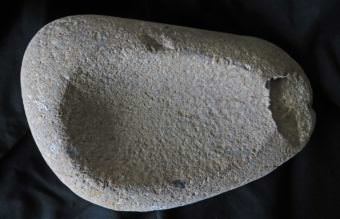
This stone lamp was found by Calvin Fair at Chief Cove in western Kodiak around 1987. It has been returned to Kodiak’s Alutiiq Museum. (Photo courtesy Clark Fair)

Artifacts sometimes end up in attics or storage boxes miles away from their places of origin.

That was the case for one object that started on Kodiak Island and found itself in Soldotna many years later.

Clark Fair said he was sorting through his late father’s den and found a stone lamp among his things.

Fair said he didn’t think much about it at the time. He stored it away, and there it stayed for a few years. Until his mother moved and he rediscovered it.

“I turned it over, and it said ‘Calvin,’ which was my father’s name, ‘stone lamp from Chief Cove area, Kodiak, Alaska, 1987.’”

Fair, a former journalist, loves a mystery. And that’s where this one started.

He says he spoke with a regional expert and eventually connected with the Alutiiq Museum on Kodiak Island. Archaeology curator Patrick Saltonstall wanted more information, and Fair was happy to oblige.

He scoured his father’s records and consulted maps.

It turns out his father picked the lamp up while on a hunting expedition.

Calvin Fair stands high on “Buck Mountain” north of his group’s hunting camp in a public-use cabin in Chief Cove, which can be seen behind Fair in this October 1986 image. (Photo courtesy Clark Fair)

“I found a picture of my father on top of what they call Buck Mountain and it had Chief Cove in the background, so I used Google Earth, changed the angle, rotated the whole thing around until the angle on the screen matched the angle in the photograph, and then I knew I was exactly in the right place because everything matched up perfectly.”

Saltonstall said that was in the Uyak Bay area on Kodiak’s west side, and the lamp probably dates back roughly 1,000 years. And it would have been used as a lamp traditionally is used.

“You would have filled it with oil, and then you would have a little cottongrass or sphagnum moss wick, and it would have sat in the oil and sucked up the oil, and then it would have burned like a candle.”

The museum gets a few “returns” like this one every year, Saltonstall said. It’s a change in attitude from 20-plus years ago, when people might have taken tokens from archaeological sites and never thought twice about where the artifacts really belong.

“I think people now, they respect that these things have value and that they should be at the museum and that it’s not good to dig into sites. There has been a shift,” he said. “In the ‘60s it was a little different too because that was right after the ‘64 earthquake and there was stuff everywhere. All the sites were eroding.”

“Everybody collected artifacts, and nobody really thought about it much,” Saltonstall said.

The Alutiiq Museum’s collections committee, which reviews objects before the museum accepts them, will take a look at the lamp next week. Saltonstall said.

With Exxon Valdez settlement money, Alaska preserves nearly 2,000 acres near Kodiak

The state of Alaska purchased nearly 2,000 acres of Afognak Island around the Thorsheim drainage, pictured here, for land preservation through Exxon Valdez settlement funds.
The state of Alaska purchased nearly 2,000 acres of Afognak Island around the Thorsheim drainage, pictured here, for land preservation through Exxon Valdez settlement funds. (Photo courtesy Great Land Trust)

An initiative to conserve one coastal habitat in the Kodiak Archipelago is now complete. The Thorsheim drainage on Afognak Island includes almost 2,000 acres of natural habitat.

It’s now safe from development and tree harvest.

The executive director of the organization that mediated the agreement, Ellen Kazary with the Great Land Trust, said the parcel includes nearly the entire watershed.

“So, it has just that whole variety then of fisheries habitat. So, in that area you find three species of salmon. Right off the coastline, we have continuous kelp beds and eel grass, which is a great kind of spawning habitat for juvenile fish and, while the salmon and the fisheries are one of our priorities, we also have Dolly Varden and Steelhead and Arctic char, and so it’s just rich with fish.”

This conservation effort traces its roots back to the 1989 Exxon Valdez oil spill. After that catastrophe, the Exxon Valdez Oil Spill Trustee Council put funds from a civil settlement into helping the damaged habitats recover.

That’s where the Great Land Trust comes in.

Kazary said part of the council’s efforts includes commissioning the nonprofit to find valuable coastline habitats and mediate agreements to protect them.

“This particular piece of property was scheduled to be logged in 2017 and 2018,” Kazary said. “By putting it into conservation, it means that it will no longer be logged now or in the future, so it’s retiring those rights to subdivide or develop or log or clear-cut or whatever other development actions could happen on the property.”

Uyak Natives Inc. had owned the Thorsheim drainage parcel. They had also sold logging rights on that land to a company called Trans-Pac Alaska Limited Partnership.

With funding from the trustee council, the Great Land Trust arranged for the transfer of ownership to the state of Alaska and the handover of the conservation easement, or development rights, to the Bureau of Land Management.

In return, Uyak and Trans-Pac split a total about $6.3 million between them.

Uyak President and CEO Gabe McKilly said the corporation had tried and failed before to conserve the land, and he’s satisfied with this most recent development.

“I think it was a fair price to us and a fair price to the state in what they got in return. This is very unique land. This is not normal. This is not harvested, not touched. So, it’s got a value – you really can’t place a number on it.”

The Afognak Island parcel is just one of the Kodiak properties the Great Land Trust has identified for conservation. This year the organization finalized a similar conservation easement transfer for Termination Point, a popular hiking spot.

Site notifications
Update notification options
Subscribe to notifications