KMXT - Kodiak

KMXT is our partner station in Kodiak. KTOO collaborates with partners across the state to cover important news and to share stories with our audiences.
Alaska sockeye market shifts away from Japan

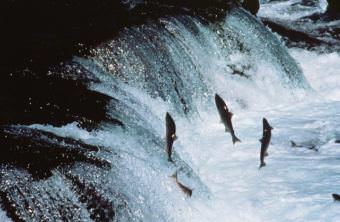
Adult sockeye salmon encounter a waterfall on their way up-river to spawn. (Photo by Marvina Munch/ U.S. Fish and Wildlife Service)

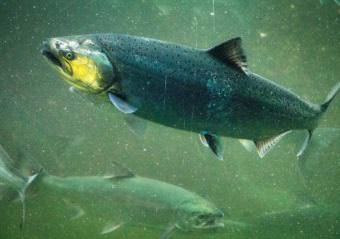
The demand for Alaska sockeye has shifted away from some of the traditional Asian markets.

In the early 2000s, most Bristol Bay sockeye was fated to either be canned or shipped frozen to Japan, McDowell Group seafood economist Andy Wink said. That’s a much smaller part of the market now – about a third of the volume of Alaska sockeye.

“It’s been an amazing transformation and that’s not something that just happens by itself. That took a lot of investment. A lot of foresight and planning. And a lot of really good work over those 15 years to develop new markets in the U.S. and in Europe.”

According to the McDowell Group’s 2017 fall sockeye market analysis, in 2016, “only 34 percent of Alaska sockeye production went to Japanese or canned markets.”

As outlined in the same analysis, the seafood industry struggled across the board in the early 2000s.
Wink said the state and federal government eventually solved many of those issues with grants, infrastructure and marketing.

The industry is now in a better place because of it, he said.

“I mean, we had that downturn in pricing in 2015 and 2016, but we’ve recovered a lot faster, and there’s several reasons for that, but one of them is that we’re much more diversified in terms of our markets and our products, and that just means that when one market isn’t as strong, we’ve got other places to put fish, and that’s super important.”

The analysis goes over some other elements that affected the American market’s increasing demand for sockeye salmon.

That includes higher fish quality resulting from sockeye fishermen chilling their harvest and consumers’ growing awareness of the benefits of wild sockeye over farmed salmon.

Kodiak’s commercial kelp harvest begins inside a seaweed nursery

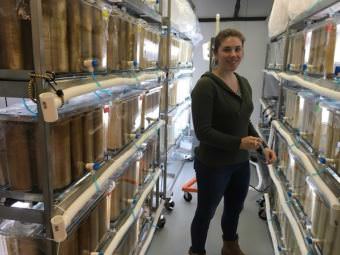
Tamsen Peeples stands in the room where Blue Evolution keeps its tanks full of seeded string, which will eventually grow into seaweed. (Photo by Kayla Desroches/KMXT)

Kodiak’s seaweed industry is growing, partly thanks to the investment of one company.

Blue Evolution, which is based in the Lower 48 and turns kelp into pasta products, successfully completed harvest in May with a local fisherman in the City of Kodiak.
Now, they’re gearing up to plant some more seaweed in Alaska waters.

Tamsen Peeples, Alaska Operations for Blue Evolution,  unwraps some dried kelp and drops the leaves into a large tank at the Alaska Department of Fish and Game’s Kodiak Fisheries Research Center.

“We basically try to simulate spore release by stressing out the plants,” she said. “We dry them out, we put them in the dark, and that stimulates them to release their spores when they’re reintroduced to sea water.”

Next, she pours some fertilized water into the tank to encourage spore release.

The ultimate goal is to grow the spores out enough to transfer them to one of their sites, a process which Peeples says takes six to eight weeks.

Peeples carries the tank back to the cold room where Blue Evolution keeps the rest of the seeded tanks.

The room is set at the optimal grow temperature for the kelp, about 50 degrees in the water, Peeples said.

Each tank is full of what looks like brownish spools of thread, which isn’t far off from the truth. They’re pipes wrapped in seeded string, and the string is darker or lighter depending on the growth.

Peeples points out the labels on the corner of each tank.

“You can see the date that’s listed is the date they were seeded,” she said. “When we put the spores into these tanks with the string wrapped around the pipes, those spores swim around for about 24 hours before they settle onto the pipes. From there, they… grow into tiny little blades.”

Peeples said some of the spores are growing better than others, although she’s not sure why – the conditions are all the same, from the water to the fertilizer.

“The more I learn about kelp the more I realize we know nothing about kelp,” she said. “We like to think that we know what we’re doing with it and how it operates and behaves, but it always ends up surprising us.”

Blue Evolution relies on the natural cycles of Alaska kelp and uses those plants to source the seed they use in their lab.

Their pilot year was an especially warm one and, it turns out, 2017 is on the chillier side.

“Last year, we were in full operation in our hatchery by late August, and we are currently still producing seed, so we’re gonna be two of three months behind what we were last year. Whether or not that’s behind schedule, we’ll see.”

She said the permitting process also delayed things, but the Onion Bay and Larsen Bay sites now have their paperwork in order and are ready for outplanting.

She said the other two sites are Womens Bay in Kodiak and one spot in the Ketchikan area.

Alaska meets global demand for sea cucumbers

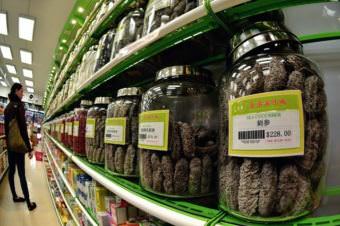
Sea cucumbers in a store in Chicago. (Photo by Juan Carlos Martin/Flickr)

The sea cucumber fishery in Southeast opened for harvest in the beginning of October. It’s now half way through its season. And, much like salmon this year, it looks like the state’s sea cucumber harvest is also finding success on the global market.

Out of all the divers in Southeast, most touch down in Ketchikan.

Bo Meredith, the Alaska Department of Fish and Game assistant area management biologist for commercial fisheries in Ketchikan, said about 160 divers recently made landings in Southeast. 100 of those were in Ketchikan.

He said the other region where divers harvest sea cucumbers is the Kodiak Management Area.

In Kodiak, fewer than 20 divers this year participated for a total guideline harvest level of 140,000 pounds.

“Southeast Alaska has this year 1.2 million pounds, but you’re talking about approaching the northern end of the geographic range for the red sea cucumber or California sea cucumbers, so your productivity is not gonna be as high, whereas Ketchikan is more in the prime zone of the geographic range for the sea cucumbers as you head south.”

This year, there are 18 different harvest areas in Southeast, each with its own GHL, he said.

Once an area reaches its limit, it closes and reopens three years later.

He said sea cucumbers take three to four years to mature, so that helps avoid overfishing. And that could play into why Alaska-sourced sea cucumbers are doing so well worldwide.

Meredith said Alaska saw a change in the value of sea cucumbers about six years ago.

“All of sudden the price went up from about $2 or $2.50 a pound to $4 or $5 a pound, and it’s been kinda steady at about $4 a pound, and this year it shot up to $5 to $5.50 a pound.”

Alaska Glacier Seafoods processes sea cucumbers in Juneau.

Part owner Mike Erickson believes poor management and overfishing in other countries could be why Alaska has risen in the ranks.

“The supply is not meeting the demand, hence the price starts going up.”

Sea cucumber. (Photo by Mary Harrsch/Flickr)

Erickson says, according to some of his buyers, Mexico used to be a big player in the global market.

“And they still are, but they don’t have the volume that they had a couple (or) three years ago. They have literally fished out some of their areas, so consequently they don’t have the supply that they had, and a lot of those cukes that were from Mexico were going to China.”

He said Alaska Glacier Seafoods also sends many of its cukes to China.

“You have a skin and you have a meat, so basically you extract the meat out of the skin and then those two items kinda go to different markets,” he said. The skin will basically head to Asia and the meat, even though we do sell some over into Hong Kong, we sell a fair amount of meat on the east coast here in the U.S., believe it or not.”

Erickson said he thinks sea cucumbers are doing so well partly because of Fish and Game’s management system.

He also credits Alaska’s reputation for “pristine” waters and a high quality product.

Correction: A previous version of this story incorrectly stated the station that Kayla Desroches works for. She works for KMXT in Kodiak, not KDLG in Dillingham. This version of the story has been corrected.

Alaska salmon season a success in global market

Salmon roe. (Photo by Ken Schwarz / Flickr)

It was a generally good salmon season for Alaska, according to Andy Wink, a seafood economist with the consulting firm McDowell Group. Except for one species.

“It was a disastrous year for chinook harvest,” Wink said.

Wink said while king salmon may be the most famous salmon species among Alaskans, it also makes up the lowest total value of all the different commercial salmon species.

“Sockeye, pink salmon, chum salmon, those are the species that for the commercial fleet really move the needle in terms of total value,” Wink said.

Wink said Alaska’s chum season stood out in the global market.

“We’ve seen higher prices on fillets and on frozen (headed and gutted) chum as well, which is really kind of amazing to see,” Wink said. “When you get a record harvest, usually prices will go down with that additional supply, but this was a very unique year where it just worked out that other fisheries around the world were kind of in a downswing and our peaked.”

Japan catches a lot of chum and produces a lot of roe.

Alaska is the second market consumers turn to when Japan’s harvest falls, Wink said, like it did this year. He said 2017 is seeing higher roe prices for both chum and pink salmon, and that can play into overall market success.

Pink prices went over 40 cents a pound in 2013, he said.

“There’s a lot of things that kind of came together to create that situation and to create that price, and there were just a lot of things that were kind of external factors, but ended up benefiting Alaska pink prices, but one of the main things was roe,” Wink said. “Roe accounted for like 40 percent of pink value from that year.”

Wink said roe is unique to wild salmon. It doesn’t face competition from farmed salmon, unlike with fillets.

Wink said a lot of big markets and other chains will turn to farmed salmon if the prices are good. But he says farmed salmon prices are up, which makes wild salmon all the more valuable.

Mental health clinicians work to keep students safe in Kodiak schools

Kodiak Police Department vehicles in front of Kodiak High School. (Photo by Kayla Desroches/KMXT
Kodiak Police Department vehicles park October 10, 2017, in front of Kodiak High School. (Photo by Kayla Desroches/KMXT

It’s been at least nine years since a student in the Kodiak Island Borough School District has taken his or her own life.

The Kodiak Island Borough School District and the Providence Kodiak Island Counseling Center have partnered for years to provide mental health services to the region’s schools.

For at least nine years, the Alaska Department of Health and Social Services says, not a single person between the ages of 5 and 19 has taken his or her life in the Kodiak Island Borough.

It also says from 2012 to 2016, the Kodiak region had one of the lowest rates of suicide in the state.

District superintendent Larry LeDoux said he’s lost students to suicide in the past, so he’s grateful for this reprieve.

“Sometimes I don’t know why we haven’t had any,” he said. “I’m just thankful we haven’t had any.”

The school district includes about a dozen schools across the Kodiak archipelago.

The recent lull can’t be attributed to any one thing, LeDoux said.

“If I were to point a finger at why do we have fewer suicides it’s because we have a community working together to keep kids safe,” he said. “We can do our best as a school system as a community just to make sure that people have services readily available and that’s what we’re doing.”

That community,  LeDoux said, includes mental health professionals. The district partners with the Providence Kodiak Island Counseling Center, or PKICC, to bring mental health clinicians into schools.

“Our clinicians have their fingers on the pulses on what’s going on in the school.”

Counseling Center director Mary Guillas-Hawver thinks the lack of suicides over the last nine years has a lot to do with the counseling center’s relationship with the district.

The counseling center has worked with the school district to keep students safe for over 20 years.

Four clinicians are embedded in Kodiak’s public schools: two serve the city’s elementary schools and two serve its middle and high school.

As for rural schools, they, also get regular visits from clinicians, who are constantly on the lookout for signs of distress in students. Among the red flags are thoughts of suicide.

“They are trained to watch for any behavior or anything that might indicate that child may be in need of additional help.”

The clinicians work with students on issues ranging from learning disabilities, addiction and trauma.

Guillas-Hawver thinks their interventions have been key to preventing tragedies in Kodiak communities. That’s especially important in Alaska, which had the second highest suicide rate in the U.S. in 2015 according to the Center for Disease Control and Prevention.

“Alaska is a vast, vast, geographical place, but when it comes to population we’re really are very small,” Guillas-Hawver said. “One person lost affects the community very, very badly.”

“It’s catching kids that are falling through the cracks,” said Jolene Rogers, who has worked as a clinician in Kodiak Schools for two years. “That might get overlooked and it’s giving them a place where they feel like they belong.”

Rogers now works with older teens and adults, but she said she loved working with students.

As a clinician, she got to see kids grow and feel more confident. She says it was also good to work with school counselors and teachers to figure out what it would take to make a student feel supported.

“Do they need a snack at this part of the day? Do they just need a high five from a certain adult figure in the school? Do they need a positive male figure in their life? Who can we use to fill that need? And I think at the end of the day our goal is to have our kids learn and thrive in their classrooms.”

Counseling center clinicians don’t stop treating students when the school year is over. They stay in contact with them over summer breaks as well.

It’s this kind of attention that makes the program so effective.

The district plans to continue improving and revising its partnership with the Providence Kodiak Island Counseling Center to keep students safe — and successful.

—–

If you or someone you know is having suicidal thoughts please call the Alaska Careline at 1-877-266-4357. That’s 1-877-266-4357. You can call 24 hours a day, seven days a week. You’ll be connected with someone who you talk to about what you’re going through. It’s free and confidential. They can help, really. Call the Alaska Careline at 1-877-266-4357.

Kodiak Coast Guard hoists crewman after fall


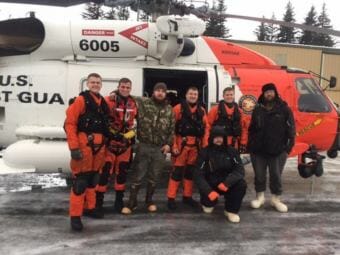
A Coast Guard Air Station Kodiak MH-60 Jayhawk helicopter crew forward deployed to Cold Bay, Alaska, medevacs a man from the 655-foot motor vessel Delsa 130 miles southeast of Cold Bay Oct. 19, 2017. (Video courtesy U.S. Coast Guard.

Coast Guard Air Station Kodiak opened its forward operating location in Cold Bay last week.

The annual assignment shortens the response time to incidents at sea, like one that happened Thursday.

A crewman on a vessel southeast of Cold Bay fell 20 feet from the boat’s scaffolding, according to a Coast Guard news release. He suffered possible injury to his back and hip.

The 42-year-old was working on the 655-foot motor vessel Delsa.

The boat’s captain reported the fall to Kodiak watchstanders at about 7:30 p.m., and a MH-60 Jayhawk helicopter crew made it to the location and hoisted the man at 10:45 p.m.

The weather on-scene at the time was mild, with clear skies, 11 mph winds, and 7-foot seas.

According to the news release, the crew transported the man to Cold Bay. And from there, he went to Anchorage for medical care.

Site notifications
Update notification options
Subscribe to notifications