KMXT - Kodiak

KMXT is our partner station in Kodiak. KTOO collaborates with partners across the state to cover important news and to share stories with our audiences.
Kodiak mayor testifies before U.S. Senate committee

The U.S. Senate Committee on Energy and Natural Resources held a hearing Tuesday on natural disasters.

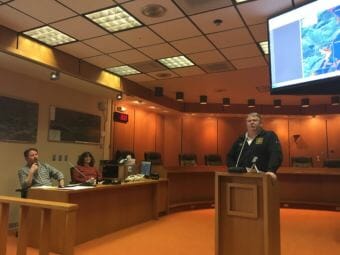
The city of Kodiak’s mayor Pat Branson was a part of a six-person panel and testified on the city’s recent tsunami scare.
U.S. Sen. Lisa Murkowski, R-Alaska, chaired the meeting and started it by talking about the 7.9-magnitude earthquake in the Gulf of Alaska that triggered a tsunami warning.

“We do understand that the earthquake caused some damage, including in Kodiak,” she said. “But the tsunami associated with it was quite small and that means basically we just got lucky.”

Mayor Branson shared how Kodiak came together to respond to the potential disaster and what the city learned from the event.

One of her main focuses was the community’s need for updates to its emergency framework.

“While Kodiak has been diligent in utilizing its limited resources and personnel to maintain our emergency response capability we have some glaring shortfalls in communication equipment and public safety infrastructure,” she said. “The coast of eliminating these shortfalls is in excess of $15 million.”

The number one priority for Kodiak, according to Branson, is building a new fire station.

The current one is old and located in the city’s tsunami inundation zone.

She doesn’t think testifying will bring about funding for it directly.

But it’s given her the opportunity to speak with Murkowski, Sen. Dan Sullivan and Rep. Don Young face to face about the community’s situation.

“We need to relocate that fire station,” she said. “Have it equipped and ready to go for not just these disasters but just emergencies with ambulances and that kinda thing.”

Kodiak was the only Alaska coastal community represented at the hearing. It was Branson’s first time speaking before a Senate committee.

Branson was glad to be invited to speak because she believes it was important for the senators to hear about Kodiak’s recent experience.

“I think it really is an education for people to understand the vulnerability not just of Kodiak Island, but of the coastal communities.”

The Kodiak City Council is in the planning stage of replacing its current firehouse. It’s placed it at the top of its state and federal capital projects list and is currently looking at locations for it, all of which are above Kodiak’s inundation zone.

State of Alaska honors Judge Roy Madsen

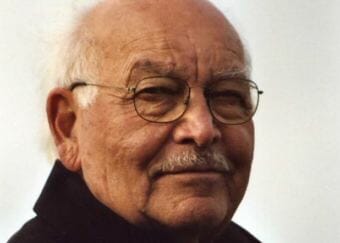
Roy Madsen. (Photo courtesy of Roy Madsen, Joint Archives of the Alaska Court System and the Alaska Bar Association)

Gov. Bill Walker ordered all Alaska state flags be flown at half-staff today to honor Kodiak’s Judge Roy Madsen who passed away on Dec. 26.
Madsen, 94,was the first Alaskan Native to become an Alaska superior court judge and he served on the bench from 1975-1990.

Madsen left his mark on the community of Kodiak and helped make history throughout his life. Before becoming a judge, he had a private practice in Kodiak and served as the city and the borough’s lawyer.

He helped rebuild the community after the 1964 earthquake and tsunami. He also was among those who worked to pass the Alaska Native Claims Settlement Act in 1971.

Walker stated in a news release that:

“Judge Madsen led a life of service, leadership, and honor, and Alaska is a better state because of his service.”

The Governor’s Office says Alaskan flags will be at half-staff for the next two days in honor of Madsen. Flags will be returned to full mast at sunset on Thursday, Feb. 1, 2018.

Madsen is survived by his wife, Linda Madsen, his children, and grandchildren.

Kodiak fishermen find extra work through halibut research amid stock concern

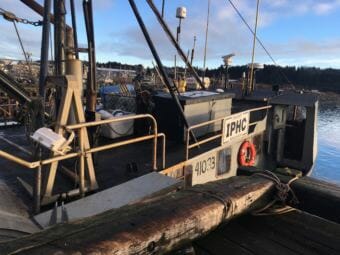
Fishing vessel Kema Sue under commission to the International Pacific Halibut Commission for research. (Photo by Kayla Desroches / KMXT)
Fishing vessel Kema Sue under commission to the International Pacific Halibut Commission for research. (Photo by Kayla Desroches/KMXT)

The Pacific halibut fishery may see a drop in stock over the next few years and the International Pacific Halibut Commission, which regulates the fishery, uses surveys in Kodiak waters to collect data.

The surveys also give local fishermen another job to tackle during the winter season, especially with the recent announcement of the 80 percent cut to Pacific cod quota in 2018.

Dock workers throw frozen fish through the hatch and into a large bin, and deckhands help transfer the headed and gutted bait into containers.

Fisherman Terry Haines next to a container of bait. (Photo by Kayla Desroches/KMXT)

Longtime Kodiak fisherman Terry Haines and his son are deckhands on the trip. They set gear and bring in the fish so scientists on board can focus on the research.

“They can see how we harvest the resource and then we can see how they assess the stock and it’s kinda great to have that interaction between, I think, the harvester and the scientist,” Haines said.

It’s also a good way to make some extra cash.

“With the cod stock the way it is, this is a pretty good job right now this winter, and it’s not during the regular longline season when I would  be doing regular halibut and black cod,” Haines said.

This particular research trip focuses on the halibut reproductive cycle.

“We’re going out there and gathering both males and females, and they take all kinds of different samples, and they use those for their science,” he said. “They take that back to the lab and they get it all figured out, and their scientists make an assessment based on this data that they’ve gathered from the field here.”

They need 30 males and 30 females, and they’ll head back to town whenever they catch the required amount.

Part-owner of the longliner Kema Sue, Jorg Schmeisser said the crew’s pay is the same no matter what. $350 a day for five days.

Walk away after the first day or the fifth, it’s still the same amount.

And he said, for him and his vessel, participating in the research has been essential.

“It’s become a viable chunk of the program here. Without it, I don’t know. I don’t know (if) we would have the boat even,” Schmeisser said. “It’s gotten pretty skinny on the catcher end of the longline year for us without a cod season now, and so this definitely helps.”

He says he does abundance surveys with the halibut commission in the summer and the rare survey in the winter, like this one. They fish halibut and black cod in the spring and fall, and used to fish Pacific cod in the winter time.

The reproductive study is one of a few projects the commission is doing in Kodiak.

The commission’s biological and ecosystem science program manager, Josep Planas said they collect halibut samples at the beginning of each month.

“To basically understand reproductive progression and maturity in both males and females of Pacific halibut throughout their entire reproductive annual cycle and how maturity advances and progresses throughout the year,” Planas said.

The project started a few months ago and is set to wrap up in August or September.

Planas mentions two other projects.

One, which they completed in November, studied hook release techniques in the longline fishery to better understand the injury to fish and the effect on their survival rate.

The other study looks at halibut size.

“Those fish are getting smaller every year in certain areas, and we’re trying to understand whether growth plays a role in this decrease in size-at-age.”

According to a commission end of year assessment for 2017, Pacific halibut stock saw a steady decline between the late 1990s and about 2010 because of shrinking size-at-age and weaker recruitment strengths.

A report from the committee’s November meeting in Seattle, Washington, shows a high risk for stock decline over the next couple of years.

International Pacific Halibut Commission will discuss the decline and next steps at its upcoming meeting in Portland, Oregon later this month.

Ferry service in Kodiak will temporarily shut down in March

AMHS Ferry Tustumena in Homer
The Tustumena docked in Homer in 2009. (Creative Commons photo by Isaac Wedin)

The city of Kodiak, Ouzinkie and Port Lions won’t have ferry service from March to early April this year, because the Tustumena needs to complete its state overhaul — an annual process to make needed repairs and conduct mandatory inspections.

“We have to follow federal regulations that these inspections must be done,” said Capt. John Falvey, Alaska Marine Highway System general manager. “Some of them are yearly, some of them have to happen every five years. We have to pull the shafts and the propellers out every five years. There is (a) tremendous amount that goes into being very very sure that when that ship sails out of there they’re safe.”

The region experienced a similar gap in service last year, according to Falvey. But, he says, the Marine Highway used to be able to cover these absences.

“Now in year’s past, when we had 11 ships running, of course, we’re down to nine ships now because of budgets. We had extra money to cover these gaps. We had the money to run the Kennicott to go cover that potential four- or five-week gap that the Tustumena’s got that we just can’t afford to cover it because of budgets.”

These kinds of service gaps, Falvey said, could continue into the future if the Marine Highway doesn’t get more funding.

He estimates the Kodiak region should have normal ferry service again in early April.

Coast Guard begins the new year by safely rescuing three hunters in Prince William Sound

The three men rescued posing with the aircrew that found them. (Photo by Lt. Brian Dykens/Coast Guard)

Coast Guard personnel spent the weekend searching for three hunters in Prince William Sound and found them on Monday.

The crew of an MH-60 Jayhawk Helicopter spotted the hunter’s boat and a flag on the south side of Chenega Island, which is where the hunters had taken shelter.

The men were transported to Seward and none of them had any medical concerns, according to a Coast Guard news release.

The Coast Guard began its search Friday after the hunters were reported missing. Sea and aircrews searched more than 1,600 miles before finding the men.

The search was impeded by severe weather and some Coast Guard personnel were delayed by it. It was reported in some areas that winds were about 50 mph and seas at 10 feet.

The release says the hunters were able to get through the ordeal by eating kelp and sheltering in a cabin they found.

Michael McNeil, the command duty officer for the Anchorage Coast Guard Sector said, “Starting the new year with a positive outcome to a difficult case is all we can really ask for.”

The Coast Guard urges mariners to be prepared when they go out on the water by staying informed, wearing life jackets, and filing a float plan.

People should also make sure they have a radio, marine flares, and a working bilge pump on their boat.

Salmon Work Group gears up to fight possible threat to Kodiak fisheries

The intersection of the Sockeye run and the Chinook run. (Creative Commons photo by Ingrid Taylar/Flickr)
The intersection of the sockeye run and the chinook run. (Creative Commons photo by Ingrid Taylar/Flickr)

A Kodiak fisheries group is connected to a genetic study that found Cook Inlet fish in Kodiak waters.

In response to the study, the United Cook Inlet Drift Association asked the Alaska Board of Fisheries to look at a possible cap on commercial sockeye in the Kodiak area.

The Salmon Work Group, which also came together the last time the same issue came up in 1980s, has revitalized to address what many Kodiak salmon fishermen consider a threat to their fisheries.

Most recently, the Alaska Board of Fisheries rejected an agenda change request that would have moved up that discussion.

The board is now scheduled to have that discussion at its regular meeting cycle in 2020, which gives the salmon work group a few years to gear up.

Duncan Fields was a member of the work group back then, and is a member once again.

“The work of the salmon work group over the next year is to continue to assess the scientific information,” Fields said. “It’s to more fully evaluate the changes in the Kodiak management area regarding salmon and compare those to changes in Cook Inlet.”

It’s not likely to be the last group formed around the Cook Inlet – Kodiak issue.

At a recent meeting of the city and borough’s Kodiak Fisheries Work Group, fisheries analyst Heather McCarty said the Board of Fisheries may put together a task force.

“A working group made up of members of the stakeholder groups in each one of those places, but maybe a couple of board members,” McCarty said. “They do that quite often at the board of fish to sort of flesh out the issues and discuss things and then present them to the full board.”

McCarty said that meeting will be in March.

Site notifications
Update notification options
Subscribe to notifications