KMXT is our partner station in Kodiak. KTOO collaborates with partners across the state to cover important news and to share stories with our audiences.
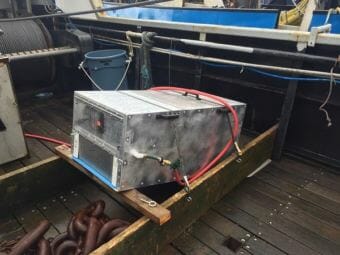
The chute camera device. (Photo courtesy Craig Rose)
A researcher is developing a device that could help make monitoring halibut bycatch more efficient.
Craig Rose from FishNext Research is in town for Kodiak’s fisheries trade show, ComFish, and will talk about the ongoing project: a chute camera and its accompanying software.
“You slide fish through and it automatically triggers a picture, sends that to a computer that then analyzes that image,” he said. “Our main use has been to –as a primary test issue – is to put it for measuring halibut bycatch from trawlers.”
Rose said the device identifies and measures halibut one by one.
He explains a few years ago the North Pacific Fishery Management Council was considering implementing individual quotas for Gulf of Alaska trawlers.
That didn’t become a reality, and he says the chute camera is unlikely to see much use in Kodiak.
But the camera chute could be helpful in other areas.
He said they may apply the device to Bering Sea catcher-processors with individual quotas.
It would help automate the deck sorting process when observers can’t be there to monitor it.
Sorting fish above deck instead of below increases the likelihood that halibut remain alive, which is a goal for a prohibited species like halibut.
Rose said they’re still testing the chutes in the Bering Sea, but should wrap up in Kodiak by the end of spring.
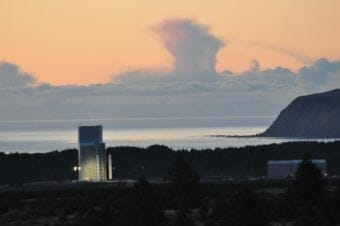
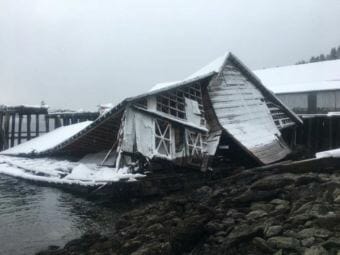
Around 3,000 gallons of oil were released into the Shuyak Strait after this building collapsed. (Photo courtesy U.S. Coast Guard)
At the end of February, 3,000 gallons of oil spilled into the Shuyak Strait about 50 miles north of the City of Kodiak.
The oil was in a building that collapsed because of a severe windstorm.
Since then, a response has been underway to contain the oil, clean it up, and prevent future spills.
When asked how long it’s going to take to clean up the oil spill in the Shuyak Strait, the Alaska Department of Environmental Conservation’s on-scene coordinator Geoff Merrell said longer than weeks, but less than years.
“Can’t mark a date on the calendar says we’re going to be done by here.”
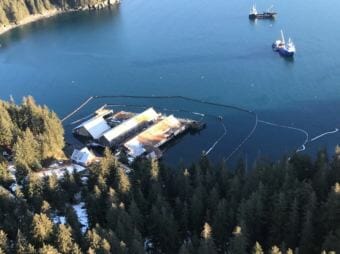
The spill happened when a building on Shuyak Island collapsed and a fuel bladder in it, filled with about 3,000 gallons of bunker C oil, released its contents into Shuyak Strait.
The oil’s been contained, but cleanup efforts have been impeded because the wreckage of the building is blocking the initial spill site.
A crane has been ordered to the area to help remove the structures remains.
Merrell said it may seem like the cleanup is taking a long time, but he says the operation is complicated.
“It can be a delicate tricky thing on a removing the oil without destroying everything else there in the process which really doesn’t serve any purpose at all.”
The building that collapsed was a part of a bigger compound made up of structures of all shapes and sizes, some of which date back to before World War II.
The site’s been used for all sorts of things like a steamship fuel depot, a fish processing plant, and a float plane terminal.
Merrell said the site doesn’t seem to be used for much at the moment and currently there’s an investigation into who all owns the property.
The spilled oil isn’t the only problem facing the area, Merrell said. There’s another estimated 3,000 gallons of fuel, oil, and other lubricants stored in buildings near the water that could collapse in the future.
Cleanup personnel are carefully making their way through the old structures looking for these petroleum products.
“So that they don’t become either an additional pollutant or a pollutant down the road where we just be out to the same sight in the future cleaning up something that we left behind this time.”
So far, there hasn’t been any signs the oil spill has affected local wildlife. Merrell’s team is keeping an eye out for oiled animals, especially those that call the strait their home.
“Aquatic mammals specifically sea otters, sea lions and river otters,” he said. “Then very shortly we’re are going to start the annual bird migration so there will be an increasing presence of waterfowl in the area, which we are concerned about.”
Recently, an in-depth environmental and structural analysis was done at the spill site.
According to a recent Coast Guard news release, the study will help personnel safely conduct further cleanup efforts.
Around 240 bags of oily waste has been removed from the Shuyak Strait so far.
Gov. Bill Walker and Lt. Gov. Byron Mallott signed a letter last week asking the federal government to declare the 2018 Pacific cod fishery in the Gulf of Alaska a disaster.
That could make the fishery eligible for federal relief funds, although who specifically would receive money would be figured out later.
It follows a decline in stock and a deep cut to the 2018 Pacific cod quota in the gulf.
According to the letter, the value of the 2018 Pacific cod harvest is looking at a more than 80 percent drop in revenue from the five-year average. Barbara Blake, senior adviser to Walker and Mallott, said crossing that 80 percent threshold makes the fishery eligible for a disaster declaration.
Blake said the letter will go to the secretary of commerce for a decision.
“How we’ve seen this come about in the past is that request goes in along with other natural disasters, and that’s how we end up getting the appropriations for that, is they roll it into natural disasters like hurricane relief and things of that nature,” Blake said.
That’s also how the fishery disaster for the 2016 Gulf of Alaska pink salmon season won funding this year. It’s unclear if the timeline for this declaration will be comparable.
An unusual number of dying sea otters were found in Southwest Alaska.
The U.S. Fish and Wildlife Service launched an investigation into what was killing these seemingly healthy animals.
In late January, dead and dying sea otters washed ashore near Port Moller and Nelson Lagoon.
At the time, it wasn’t clear why these otters were dying, said Michelle St. Martin, the U.S. Fish & Wildlife Service biologist who investigated the event.
Forty otters have been confirmed dead, but some locals have reported a number closer to 200.
Some of the otters were sent to Madison, Wisconsin, for analysis.
The cause of death was determined to be an infection caused by the bacteria Streptococcus, which is also known as strep, St. Martin said.
“It tends to be sort of a quick death and so all the carcasses that we received, all the animals were in good body condition.”
Strep occurs naturally and has caused otter deaths in the past, but St. Martin said not a lot is known about strep.
“We don’t really know why this bacteria or how this bacteria goes about in the ecosystem.”
U.S. Fish & Wildlife Service biologist Joel Garlich-Miller focuses on sea otters. He studied similar mortality events in the past at Kachemak Bay.
He said one thing scientists do know is otters get strep from something in their diet, but researchers aren’t sure from what.
“The otters are eating these prey items and are getting access to it that way rather than just swimming through the water and catching this.”
Researchers aren’t sure if it’s possible for humans to get a strep infection from a dead otter.
Garlich-Miller said there hasn’t been any evidence showing otters have passed the bacteria on to any other animal.
“In Katemack bay, it’s been very interesting. There’s a whole bunch of marine mammals in that area. We got minke whales, humpback whales, harbor seals, sea lions. There’s all sorts of birds that have been scavenging on the otter carcasses. We haven’t really seen any sort of strep-related mortality in any other species.”
The U.S. Fish and Wildlife Service doesn’t know how the recent die-off affected the otter population near Nelson Lagoon and Port Moller.
Sea otters in Southwest Alaska are considered a threatened species. Their numbers have decreased about 50 percent since the 1980s.
Currently, the U.S. Fish & Wildlife Service is preparing a survey on the area’s otter population, which will be released later this year.
Unified Command response teams deploy secondary boom and absorbent materials in the continued oil spill response efforts in Shuyak Strait (Photo courtesy of Alaska Chadux LLC)
Oil response crews continue to work on the scene of a spill north of the City of Kodiak.
According to a Coast Guard news release Sunday, responders collected six bags of oil and are using containment booms on the remaining waste.
No oiled wildlife has been reported and response crews are looking into cleaning up debris.
Last week, according to a situation report from the Alaska Department of Environmental Conservation, high winds caused a spill of up to 3,000 gallons of fuel at a facility on Port William, on the southern end of Shuyak Island.
As stated in the report, a dock collapsed and much of a building along with a fuel bladder fell into the water. The facility’s caretaker originally drew attention to the issue.
The Coast Guard contracted with Alaska Chadux on the response.
Over the last few years, the Kodiak Island Borough School District has had to cut about 18 teaching positions to balance its budget.
Kodiak’s Board of Education president Bob Foy pointed out that’s a big deal at a public forum focused on the district’s finances.
“The bottom line is that’s a pretty substantial cut when you think about a district our size and you just think about all the teachers and think about 18 positions not being there.”
Even though it’s been making a lot of hard decisions, the district expects to have a $1.5 million deficit next year. The only way the district can balance its budget is by asking for an increase in funding from the Kodiak Island Borough, Foy said.
Foy said even if the borough meets its request, more teachers will still see their jobs disappear next year.
The thing that’s up in the air is how many.
“We’re going to reduce by five more teachers, no matter what. Even if we get the maximum amount we think we need.”
If the district doesn’t get the funds it’s requesting from the borough it’ll have to cut about 14 teaching positions, instead of just five. Foy said these kinds of cuts are painful and will affect the education students receive.
“These aren’t easy decisions. We are down to counting pencils. There’s not slop that’s hidden in different places. We’re down to what really affects kids in the classroom.”
Foy believes the borough needs to adopt a multiyear funding plan to help the district better balance its budget and show that it’s prioritizing education.
Close
Update notification options
Subscribe to notifications
Subscribe
Get notifications about news related to the topics you care about. You can unsubscribe anytime.