KMXT - Kodiak

KMXT is our partner station in Kodiak. KTOO collaborates with partners across the state to cover important news and to share stories with our audiences.

Rasmuson Distinguished Artist of 2018 draws inspiration from Alaska

Alvin Amason with “Big Sum Bich #2” in his Anchorage studio, 2016. The oil on canvas painting was purchased by the Alutiiq Museum with support from the Rasmuson Art Acquisition Fund. (Photo courtesy the Alutiiq Museum)

The Rasmuson Foundation announced Kodiak born artist and University of Alaska Anchorage professor, Alvin Amason, as its Distinguished Artist of 2018.

Amason’s work is exhibited in a number of collections globally and recognizable for its nature-based subject matter, vivid colors, and movement.

His style at least appears fast and loose.

“I always kind of favored the abstract and real splashy stuff. Where I come from is a splashy island, and it seemed to kinda fit the bill a bit.”

Amason credits his childhood of seal hunting, clam digging, and fishing as inspiration for many of his pieces, which include paintings of bears, eagles, and puffins.

He says as an Alaska Native artist who often teaches other indigenous artists, he finds that many Alaska Natives have a strong sense of place.

That’s something he says is true for him.

“And you know where you kinda were raised and come from and a lot of the information and spirituality and experiences that go with that, and there’s this little butter clam beach on our island that, if I’m standing on it, I feel like I’m in the center of the world. I’m the North Pole and everything else rotates around me, and it’s a real wonderful feeling to experience that.”

The recipients of the Distinguished Artist award are chosen through nomination for a lifetime of participation in the arts. The honor comes with $40,000.

“[I] kind of feel like I got a really good crew share from a real good salmon season.”

Amason says he may put a portion of the money toward a vacation for him and his family.

Archaeologist finds fish trap, defensive sites on Afognak Island

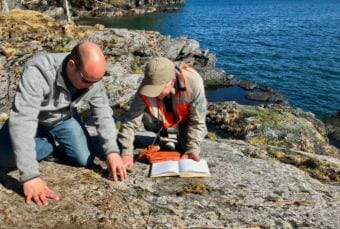
Museum archaeologist Patrick Saltonstall and helicopter pilot Keller Wattum document a petroglyph site on Afognak. (Photo courtesy Patrick Saltonstall)
Museum archaeologist Patrick Saltonstall and helicopter pilot Keller Wattum document a petroglyph site on Afognak Island. (Photo courtesy Patrick Saltonstall)

A routine assessment of  historical sites on Afognak Island by air turned into a day full of surprises.

Local researcher Patrick Saltonstall usually kayaks when he goes out to find and study archaeological sites around the Kodiak Archipelago.

Paddling can be a pretty slow way to travel. Recently Saltonstall got the chance to take to the air in a helicopter for a change.

“I don’t think I’ve ever been so ecstatic after a survey, and it was really quick! You know, it was like one day and we found all this stuff that usually takes weeks.”

Alutiiq Museum archaeology curator Saltonstall made new discoveries on the trip.

One of them being a special Alutiiq fish trap, structures constructed along shorelines to corral fish.

The structure is only the second of its kind to be found in the region. The first was only discovered last year.

“It’s another one of these traps, we found one last summer, where when the fish come in, get over these walls and then when the tide goes out there are trapped.”

The traps are an estimated 500 years old.

Saltonstall said these types of devices can found all over Southeast Alaska. He suspects more and more will be found around Kodiak.

The only reason Saltonstall was able to find the second fish trap was the high vantage point from flying in the helicopter.

“I’d actually been there on survey and had found a village there and hadn’t seen the fish trap,” he said. “When we’re in the air you look down and I was like ‘ oh my god, it’s so obvious.”

The fish trap wasn’t the only big find of the day.

Saltonstall thinks some 100-foot-tall rock spires inhabited by puffins could have been defensive sites where hundreds of years ago people would wait and watch for enemies.

It’s impressive to think about someone going out to these rock formations and climbing up so high, Saltonstall said.

“They must’ve had a rope ladder they built to get up and down and, probably, they were hoisting baskets of food up. It was kinda amazing.”

More research will have to be done on these new sites to learn more about them, but Saltonstall knows a lot more discoveries to be made around Kodiak.

He’d like to use helicopters more in the future to find them.

Energy Secretary Rick Perry visits the Kodiak Archipelago

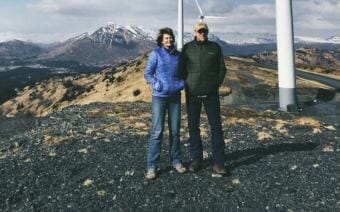
Sen. Lisa Murkowski and U.S. Secretary of Energy Rick Perry visit Kodiak’s wind turbines on their short trip to the archipelago.(Twitter photo courtesy Rick Perry)

Sen. Lisa Murkowski and the U.S. Secretary of Energy Rick Perry hopped on a plane and took a quick detour to the small community of Old Harbor.

They were on a recent day trip to Kodiak to tour the community’s electrical grid powered almost entirely by renewable energy.

Old Harbor has been developing its own renewable resources for decades, but still has a long way to go.

Rick Berns has been the mayor of Old Harbor for years, and it doesn’t seem like that long ago when the school had more than 100 students.

Old Harbor, along with other villages in the Kodiak Archipelago are having to deal with their populations dropping.

“I think I was told yesterday there was only 26. I thought we had 33, but I guess we have 33,” Berns said. “People are migrating out of the villages and looking for jobs and, you know, economic stability.”

Berns said Old Harbor has a plan to slow its out-migration.

The community wants to improve its harbor and start a fish processing plant to develop its economy and keep people in town.

The village needs access to cheap and reliable energy in order to entice a company to build a processing plant.

The community mostly relies on diesel for its power, which can be expensive and its price often fluctuates.

Berns said hydroelectricity is an answer to Old Harbors energy trouble.

Since the 1980s, he said, the community’s been working on a project to generate energy from a local river called Lagoon Creek.

“It’s a pretty much a run-of-the-river style hydro project and it has the capacity of 500 kilowatts of generation.”

Even though Old Harbor knows how it wants to incorporate hydroelectricity into its electric grid, it still hasn’t started construction on the project.

Berns said it took years and a lot of money for the village to meet all the requirements needed to move forward. The community still needs to raise about $11 million to build everything.

These challenges inspired Murkowski to bring the  Perry to Old Harbor.

They were on a trip to Kodiak to see its power grid that’s almost completely powered by hydro and wind energy.

Murkowski brought Perry to the village so he could better understand the challenges facing some of Alaska’s smaller communities.

“For him to see how innovation in a place like Kodiak has helped facilitate an economy and see how a smaller area is struggling with an economy but could have the potential to do so much more if they only they had a small renewable energy project,” Murkowski said.

Murkowski would like to see permitting reform that’d allow smaller hydroelectric projects, such as Old Harbor’s, be cleared faster and for less money.

Perry and the Department of Energy don’t control permitting for hydroelectric projects, but Murkowski still wanted him to see how places like Kodiak and Old Harbor are being creative in their efforts to reduce energy costs.

“My hope is that he goes back to Washington and he’s able to say ‘you outta see what they’re doing in Alaska and how they’re doing it. They’re taking the lead, and they’re showing the rest country and the rest of the world how to really innovate when it comes to energy,’” Murkowski said.

Berns said Murkowski and Perry were only able to stay in the village for about an hour.

But the time the community got with them — meant a lot.

“For them to actually come to our community and get to know us, to show concern, it’s humbling, and a great honor,” Berns said.

Perry seemed energized by what he had learned as he left the village, according to Berns.

Berns doesn’t expect anything will come from the visit, but he thinks it’s valuable that someone in President Donald Trump’s administration knows about Old Harbor’s situation.

After leaving Kodiak, Perry continued north.

The secretary only had two days in Alaska and spent the second one in Prudhoe Bay meeting with representatives from the oil and gas industry, according to Murkowski.

Response wraps up on Shuyak Island oil spill

Shuyak Island. (Photo courtesy Alaska Chadux Corporation)

Oil spill cleanup winds down on southern Shuyak Island, about 47 miles north of Kodiak. The area is critical habitat for marine mammals like sea otters and Steller sea lions.

A Port William dock collapsed in late February, and caused a building and a container filled with fuel to fall into the water, releasing an estimated 3,000 gallons of oil.

U.S. Coast Guard Commander James Binniker, who helps lead the $9 million cleanup, said spill responders have met the Coast Guard’s goals for the response.

“We wanted no oil left on the rocky surfaces or the pilings that we could access where oil would come off when rubbed, so we don’t want anything that’s gonna oil a bird or any marine mammal or any wildlife that gets on that beach.”

Responders used booms to contain the oil and cleaned up debris from the fallen structures and pressure washed harder surfaces.

The unified response includes contractor Alaska Chadux Corporation and the Alaska Department of Environmental Conservation.

According to the latest DEC situation report, responders have collected more than 1,800 bags of oiled absorbent material so far including from heavy oil called Bunker C fuel, in addition to oils like diesel and gasoline.

Some oil is still in the remaining two structures on the water, Binniker said. The person currently managing the site agreed to allow the responders to remove a portion of it.

But at this point it’s out of the Coast Guard’s hands, Binniker said.

“The remaining pier structures are not unlike many throughout Alaska, and it’s not our determination at this point that it poses an imminent threat of collapse and pollution.”

While the response is winding down, the state also will check out tanks held in a structure further up the property, Environmental Conservation program manager Geoff Merrell said.

DEC has an open, ongoing case related to the tanks.

According to the Coast Guard, in 2013 one of the tanks was shot, which led to oil leaking onto the property.

Merrell said that’s what they’re going to look into as part of their next steps.

“What we’re going to investigate is the impact of that leak on the ground and soils and potential contamination.”

Chugiak resident Mark Krall said he’s the effective manager of the land.

He explains he took on that role in 2012 in light of the poor health of the owner, a friend of his, and he said he was running a lodge in the area until last year.

Krall said vandalism led to the leak, and he flew to Shuyak Island to take care of it.

“There was a slight sheen, but not much of it evidently got to the water when the vandals shot it. Actually, most of it absorbed into the soil on the hill above the water.”

At the time, Krall said, it was either clean up the land or else the property owner would deal with more expensive fines from the Coast Guard.

He shipped in oil response equipment and footed the bill, which ended a little more than $40,000, a cost which he said contributed to him closing the lodge.

Krall stored the remainder of the oil from the tank in a container in one of the buildings at the docks, where it stayed until strong winds in February knocked it into the water, causing the most recent spill.

Krall was employing a caretaker for the property at the time.

The caretaker emailed him the day the container carrying the fuel fell into the water.

Krall was unclear about what he intends to do with oil still stored there. He also indicated he was trying to end his involvement with the property. Krall did not respond to further emails seeking clarification by deadline.

A representative from DEC says the state is still investigating who might be the responsible party.

Alaska Aerospace Corporation denies plans to build more launchpads at Kodiak spaceport

Alaska Aerospace Corporation launch facility in Narrow Cape. (Photo courtesy of Alaska Aerospace Corporation)

Some Kodiak residents are not happy with a seemingly harmless landscape photo recently posted online.

The reason — the picture was taken from a proposed launch pad for the space technology company Vector Launch incorporated at Kodiak’s Pacific Spaceport Complex.

Locals worry any more development at the spaceport will deface the vistas and limit access to public land.

The sky is blue and the sun is shining in the photo Vector Launch Incorporated recently posted on its Facebook and Twitter pages.

In it, you can see the Pacific Ocean, snowy mountains, and a group of people standing near a cliff.

On its surface, it’s just a pretty picture, but what caught the attention of Kodiak residents was its caption. “Vector’s proposed new launch pad at (the) Pacific Spaceport Complex (in) Kodiak, AK.”

This sparked a conversation on the community’s Facebook forum “Friends of Kodiak,” where residents worried if a new launchpad would be constructed in an area known for camping and whale watching would be negatively affected.

“I’m an Alaskan, my predecessors were not. I have a vested interest in making sure we are good stewards of our land.”

Alaska Aerospace Corporation owns and operates Kodiak’s spaceport.

President and CEO Craig Campbell said there are currently no plans for building a launchpad for Vector and that AAC is committed to keeping the public land the spaceport sits on — open. Especially, he said, Fossil Beach.

“We are very concerned always about keeping access to Fossil Beach available for the local residents and we know it’s a popular recreation area. Our intent is to always keep the access road and the beach available to the public, except for those limited times when we may have launches.”

At the moment there is no long-term agreement between the two companies.

Campbell said Alaska Aerospace Corporation is working on a deal with Vector on a potential rocket launch later this year, but nothing is set in stone.

“We are looking to bringing them up here later this year, and hopefully conduct, at least their initial launches here and hopefully a long-term relationship where they’ll do commercial launches in the future from Kodiak.”

The photo that Vector posted was taken in an area of the spaceport where there are already three small pads that could be used by Vector to launch their small liquid-fueled rockets.

Campbell said any modifications to them would be simple and if another launchpad was constructed it would be small and minimal.

“It’d just be a square of dirt and gravel fenced off with, probably, lighting and, probably, a small concrete pad where the actual engine would ignite when it launches.”

AAC is looking at increasing the number of launches it does a year, which would make the spaceport off limits to the public more often. But, Campbell says closures should only last for a few hours at a time.

The Alaska Aerospace Corporation is planning on holding a public forum in Kodiak in the next few months to give an update on its operations and to hear public input on its future plans.

Some charter companies would trade number of fish for more fishing

Chris Fiala of Kodiak Island Charters. (Photo by Kayla Desroches / KMXT)

A declining Pacific halibut stock means more restrictions for charter companies.

NOAA Fisheries released both the Pacific halibut catch limits and the charter management measures this week, just days before the season opener on March 24. Numbers are down – roughly 9 percent overall from last year.

There are some days where charter companies can’t fish halibut by regulation. And those days vary year to year.

“We never know whether it’s gonna be three days, four days, whether they’re gonna do all of ‘em,” Michael Ensley, with Happy Hooker Charters, said.

Ensley says businesses often learn about the restrictions long after the customers book their trips.

“I’ve gotta call these people and let them know, see if it’s an option to move the dates or [if they’re] willing to accept, and then turn around and have to give them some kind of special deal for the days that they can’t fish halibut,” Ensley said.

This year, charter fishermen are barred from fishing halibut all Wednesdays and six days in July and August. That’s an additional three days from last year.

And each person is limited to two fish daily, with one less than or equal to 28 inches. That’s been pretty consistent over the last few years, and Insley says he doesn’t take issue with it.

But Ensley would be willing to trade more fishing for fewer fish. He says he’d take an allotment of one fish per person in exchange for keeping all the fishing days.

“We don’t need that two halibut. Especially in Kodiak,” Ensley said.

Chris Fiala of Kodiak Island Charters agrees. He says the Kodiak area is lumped into the same regulatory district as communities along the road system like Homer and Seward.

“And the problem is that we’re significantly different than their type of demand,” Fiala said. “They have the impulsive demand from the larger areas, from Anchorage.”

Fiala says a lot of tourists fly into Kodiak for week long stays, and while his customers catch a lot of different types of fish, he calls halibut a number one draw.

“They want to be able to go out and catch halibut any day they go out,” Fiala said. “So the one fish really fits us really to a T.”

Fiala says Kodiak charter businesses have talking about a more open schedule for years, and he’s still hoping for a change sometime in the future.

Andy Mezirow is a charter operator in Seward and serves on the North Pacific Fishery Management Council.

Mezirow says it’s unlikely that Kodiak could cut off from the rest of the district with its own management measures.

“The problem is if we created a rural designation and we tried to manage them separately, it wouldn’t just be Kodiak,” Mezirow said. “It would be every rural area that wants in on it. And then there are a lot more boats and then their behavior – it’s just, it’s much more difficult to break it down by sub areas.”

Mezirow says the entire district is “feeling the pinch of a restricted harvest” and everybody would like more days and more opportunity, but there has to be a way to stay within the allocation to do that.

“And I think the better question for the Kodiak fishermen to consider is do you want to consider selling one halibut under 30 pounds or one over 200 as the option that you’re selling in order to free yourself up to do more trips? And in the rest of 3A, most fishermen have felt no,” Mezirow said.

Mezirow says they’d rather use their boat to do sightseeing or salmon fishing or other activities on those closed days and have less dependency on halibut built in their business models.

Mezirow says adapting and diversifying could be the key to attracting customers despite bag limits.

Site notifications
Update notification options
Subscribe to notifications