KMXT is our partner station in Kodiak. KTOO collaborates with partners across the state to cover important news and to share stories with our audiences.
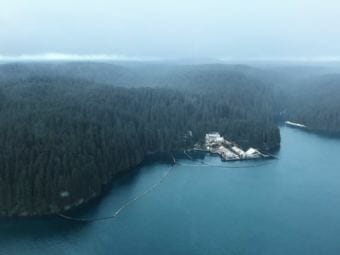
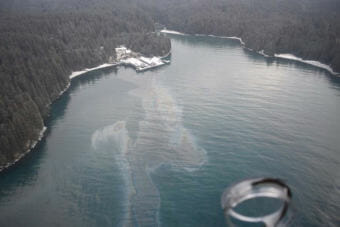
A snapshot of the spill on Shuyak Island. (Photo courtesy Alaska Department of Environmental Conservation)
Cleanup is underway on an oil spill north of the City of Kodiak.
Winds on Monday toppled a fuel bladder containing up to 3,000 gallons of oil off a dock on the south end of Shuyak Island, roughly 50 miles north of the City of Kodiak, according to a situation report from the Alaska Department of Environmental Conservation.
According to the report, gusts had reached more than 80 mph at the time.
The Coast Guard contracted with Alaska Chadux on cleanup in Shuyak Strait.
In a news release, the Coast Guard reports that winds roughly 50 to 70 mph and 8- to 12-foot seas had kept the response vessels on standby in the City of Kodiak.
A Coast Guard public information officer said three boats set out for Shuyak Island and one of them, the Sea Strike, was estimated to have landed by late Thursday afternoon.
The DEC report states the type of oil that spilled is number 6 fuel oil. The heavy oil poses a risk of coating the fur and feathers of marine mammals and birds.
Shuyak Island is almost entirely state park land and a natural habitat for sea otters and Steller sea lions in addition to a number of other animals, including seabirds.
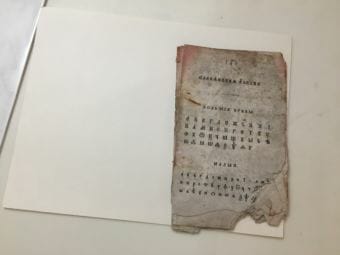
Alutiiq Primer recently discovered in the Baranov Museum achieve. (Photo by Mitch Borden/KMXT)
Treasure can come in all shapes and sizes. For some, only gold or diamonds will do.
While others prefer objects that shed light on the past. And recently, the staff at the Baranov Museum struck it big in that department.
A few old pieces of paper rediscovered in the museum’s collection are teaching local historians some interesting lessons.
As Baranov Museum executive director Sarah Harrington walks into a room full of artifacts, she takes a moment to appreciate its unique aroma.
“It’s a little bit musky maybe, like an old cologne or something like that. But not in a gross way in a good way.”
The museum is Alaska’s oldest building.
It was originally built to hold pelts for Russian fur traders when Alaska was a Russian territory. The building’s not very big and Harrington points out that it’s stuffed to its gills.
Walking down a small hallway, she opens door after door to reveal packed storerooms and it becomes clear she’s not exaggerating.
Almost every nook and cranny is used to hold the museum’s growing collection.
Objects gathered by the museum range from Xtratufs, ancient oil lamps, thousands of photographs, and file cabinets full of historical documents.
But there is a downside to having so many interesting things.
Items that deserve more attention are sometimes overlooked.
Like the museum’s most recent discovery, an Alutiiq language primer written in Cyrillic that dates back to when Alaska was ruled by Russia.
“The primer is a wonderful example of the efforts that the Russian Orthodox people took to help preserve the Alutiiq language when they didn’t have a written language,” Harrington said. “It’s written in Cyrillic, but if you are able to read Cyrillic you’d be able to read the Alutiiq words.”
The primer’s small. It’s water stained and ripped, but still beautiful.
The black Cyrillic letters stand out from the fragile brown pages as they spell out simple Alutiiq words and an Orthodox prayer.
A staff member a few months ago found the book while going through some files but didn’t realize what it was.
Then a colleague who can read Cyrillic and speak Alutiiq took a look at it.
“It’s a really hopeful thing to find because a lot of times we find ourselves or other people in our community feeling polarized about the Russian story versus the Alutiiq story.”
Harrington, who’s Alutiiq, says this discovery means a lot.
Like many indigenous groups, the history of Kodiak’s Native people is filled with the horrors of colonialism.
Harrington doesn’t think the primer erases that trauma, but it does show the complicated nature of Kodiak’s story.
“It’s one of the few things we have that shows the cooperativeness that did exist,” she said. “When so often we focus on the heart-wrenching stories of colonization.”
The Baranov Museum holds a lot of history and the primer is just one example of how much there is to learn about Kodiak, which Harrington thinks is exciting.
“You could literally spend your entire life in a place like this and not know all of the stories that this museum holds.”
As museum staff continue to research the Alutiiq primer, they’ll be reaching out to other institutions around the state to get a better understanding of the little book’s place in history.
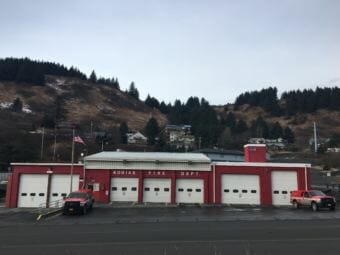
Kodiak’s fire station sits at 70 feet above sea level, which is in the city’s tsunami inundation zone. (Photo by Mitch Borden/KMXT)
An earthquake January in the Gulf of Alaska left the city of Kodiak’s fire station shaken and cracked.
It’s also stimulated the efforts to replace the building.
Kodiak’s Fire Chief Jim Mullican is standing outside Kodiak’s fire station counting the cracks in one of its walls that were left behind by January’s 7.9-magnitude earthquake.
According to the Alaska Earthquake Center, that earthquake is considered one of the strongest recorded in the last 150 years in Alaska.
It left Kodiak’s firehouse worse for the ware.
“Nine and this spiders out.”
A lot of the cracks run up the walls and cut all the way through them.
“Step cracks right here, that’s 11. Diagonal crack, that’s 12. I believe there’s another one that’s twelve brand new cracks.”
On the wall Mullican is inspecting, the small lines don’t look like much, but he says they’re serious.
The damage spans the whole building and even though the station’s considered stable, he’s still worried.
“I have these cracks that are through the wall, what happens when that next little 4.2, 5.0 earthquake what’s that going to do to this already compromised station.”
Not only is the safety of his firefighters on his mind, but another shake could potentially break the station’s garage doors and trap Kodiak’s fire engines and ambulances.
But Mullican said he’s got a plan for if that happens.
“Basically, it involves pulling out our saws and cutting these doors open to get the rigs out if it gets to that point.”
The structural damage isn’t the only problem facing the firehouse. It’s old. The newest section of the building was built in the 1970s.
Kodiak already a needed a new station before the quake.
“It’s to the point where, truly, we need to tear it down and build a new one.”
To make matters worse, the building’s located in Kodiak’s tsunami inundation zone.
When January’s earthquake shook the Gulf of Alaska it also caused a tsunami warning to be issued to many coastal communities including Kodiak.
A huge wave never appeared, but after the scare, Kodiak’s Mayor Pat Branson was called before the U.S. Senate committee on energy and natural resources to talk about the ordeal.
In her testimony, she made it clear that replacing Kodiak’s fire station is vital.
“One essential need and safety priority is our fire station. along with protecting the city of Kodiak. The Kodiak fire department provides all emergency medical services and transports on the Kodiak road system.”
Building a new firehouse will be expensive. It’s estimated the project will cost around $15 million.
While in Washington, Branson spoke with Alaska’s U.S. senators and its representative about Kodiak’s need for a new station and where to get funding for the project.
Nothings come from those conversations yet, but Branson said she’s optimistic.
Mullican said something needs to be done soon because Kodiak will get hit by another earthquake at some point
“It’s not if, it’s when because we live in the Pacific Ring of Fire. We’re going to have earthquakes.”
Right now, Branson said the city is figuring out where the new firehouse can be built where a future tsunami won’t touch it. Once that’s done the city can move on to the next step in the process of replacing the station.
Kodiak Fire Chief Mullican goes over Kodiak’s recent tsunami evacuation. (Photo by Mitch Borden/KMXT)
During the quarterly meeting of the Kodiak Island Local Emergency Planning Committee, the main topic of discussion was the 7.9-magnitude earthquake that shook the Gulf of Alaska in January.
“It was registered as the 10th largest earthquake in Alaskan recorded history,” said Kodiak’s fire chief Jim Mullican, who chaired the meeting. “It was a pretty significant earthquake.”
He went over how city residents reacted to the tsunami warning the quake triggered.
Overall, he said the community did great, especially since Kodiak hasn’t had to evacuate like this for almost 30 years.
Things didn’t go perfectly though.
Instead of heading straight for shelters like Kodiak High School or North Star Elementary, some people made unneeded pit stops.
“The sirens are going off and we had people lining up at gas stations in the inundation zone to get gas.”
More community outreach is needed to educate residents about what they should do and where they should go during events like the warning says, Mullican.
It’s wasn’t just those who gassed up that were in danger.
Mullican says everyone who rushed to Pillar Mountain instead of a shelter or other safe zones also put themselves in a precarious situation.
“There’s no help up there. You get up there, especially up in the ice and snow. That road was too blocked. If somebody had trouble up there in the parking lot we can’t get to them. We’d rather have people go to the open shelters that way they have a place to stay. They can be warm, they have bathrooms, so forth and so on. And if somebody has problems we are immediately able to help them there.”
Another thing Mullican said people need to know is what kind supplies they’ll need if a disaster hits Kodiak, and stock up.
“There’s not enough emergency services here. There’s not enough of anything here to be able to cover everybody on the road system or on the island and the archipelago. So, our citizen themselves need to ensure they have food, water, stuff at their residence so they can take care of themselves for up to seven days.”
The committee voted to use $6,000 of grant money to fund a media campaign to educate Kodiak residents about natural disaster preparedness.
Also, both the city and the Kodiak Island Borough have emergency preparedness resources on their websites such as tsunami inundation maps for communities across the archipelago.
Fishing boats in Kodiak. (Photo by James Brooks/KMXT)
A new study in Kodiak will hopefully shed some light on what Pacific cod go through when they’re young.
“We don’t know how they do in the winter. Where they are. What they are eating. What their energetic requirements are.”
One of the leaders of the project, Mike Litzow is a researcher for the University of Alaska Fairbanks based in Kodiak.
He said the recent crash in the Pacific cod population in the Gulf of Alaska was a wake-up call that there’s a lot to be learned about the early life stages of Pacific cod.
A few years ago a body of warm water settled in the gulf and it may have made it difficult for juvenile cod to survive.
“The operating hypothesis right now is that you can warm the temperatures up and they’ll survive if there’s enough food, but there wasn’t enough food to meet those requirements.”
The National Marine Fisheries Service, according to Litzow, recently found that the Pacific cod population had dropped by about 60 percent since 2015.
The North Pacific Fisheries Pacific Council reduced the amount of Pacific cod that can be caught by commercial fishermen in the Gulf of Alaska by about 80 percent because of the crash.
The decrease in cod will be hard for Kodiak fisherman because Pacific Cod is one of the bigger fisheries in the region.
Litzow thinks Kodiak will have to face the possibility that more fishery disasters could be in its future because of climate change.
“In coming years and decades for Kodiak, we have to think about there being more events like this and more unusual temperatures and more surprises like the pink salmon return in 2016 or this cod collapse.”
Litzow hopes his research will help Kodiak adapt to a changing marine environment.
Bird biologist Robin Corcoran at the Kodiak National Wildlife Refuge Headquarters at Buskin River. (Photo by Kayla Desroches/KMXT)
Kodiak is full of eagles, especially in January and February, and one rejoined the local population after a brief stay at the Eagle Inn, where the U.S. Fish and Wildlife Service keeps recuperating birds.
At the Kodiak National Wildlife Refuge Headquarters at the Buskin River, bird biologist Robin Corcoran carries a large crate out into the sunlight.
“He was a bit of a fighter, which the younger birds are,” she said.
Corcoran picked the bird up at Trident Seafoods, where many eagles hang around hoping for scraps.
He’d gotten pinned under the cannery’s tanks. She explains he was cold and wet, which can lead to its own set of problems for eagles.
“They preen a lot. They have a preen gland, and they put oil on their feathers to keep it waterproof, and if they lose that ability – if for some reason they’re coated in oil or fish guts or any substance that’s gonna mat down their feathers and cause them to lose that waterproofing, then they stand the chance of getting really wet and going hypothermic pretty quickly.”
The bird stayed at the Eagle Inn overnight to warm up and dry down.
Corcoran walks with the crate to a hill just behind the Kodiak National Wildlife Refuge Headquarters.
There, she opens the door and the eagle flies away into a nearby tree.
Corcoran does releases like this one a couple times a year, and they also fly some eagles to the Bird Treatment and Learning Center in Anchorage.
Corcoran has a lot of practice fetching birds that sustain injures or just need to be isolated.
She usually comes at them with a towel or blanket.
“You can put it over their head and then just grab their legs, and they’re not that hard. There’s a real fight or flight response, so they’ll try to get away from you first, and then once they realize they can’t, they roll over on their back and they just put their talons up, and they face you with what they’re gonna fight you with,” she said. “It’s always a little nerve-wracking. My adrenaline’s always a little bit high because each eagle capture’s a little bit different.”
Eagles love fish, and Corcoran said they run into a lot of trouble scavenging.
“We’ll get up to five or six eagle calls a week,” she said. “Most of it has to do with the canneries and the fishing boats, but there’s still issues with electrocutions. Birds get hit by cars quite a lot downtown.”
That’s one consequence of the public interacting with the eagles.
Corcoran said feeding them can lead to them into traffic.
There’s also the risk of forcing a bird to dive into the water in an attempt to escape, which could lead to its death if it’s already wet or dirty.
Close
Update notification options
Subscribe to notifications
Subscribe
Get notifications about news related to the topics you care about. You can unsubscribe anytime.