KMXT - Kodiak

KMXT is our partner station in Kodiak. KTOO collaborates with partners across the state to cover important news and to share stories with our audiences.
Three dead gray whales wash up on Kodiak Island beaches in one week

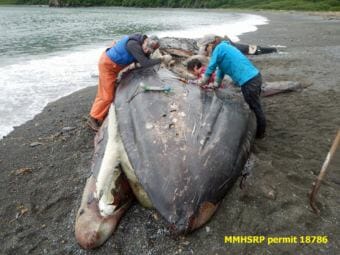
Whale carcass. (Photo courtesy Kathy Burek, Alaska Veterinary Pathology Services)

Three dead gray whales washed up on two different Kodiak Island beaches recently.

The strandings happened within the span of a week, said Mandy Migura, Alaska Marine Mammal Stranding coordinator with NOAA.

Three whales washing up in such a short span of time in the same area is concerning, Migura said. Preliminary results from necropsies should be back soon while more detailed reports will take more time.
Gray whales are on their annual migration with their young from Mexico, where they winter. They are listed under the Marine Mammals Protection Act.

Residents first reported June 25 a young gray whale lying on Pasagshak Beach, Migura said.

“It sounded like some of the local residents had been seeing it for a few weeks prior to us receiving a report. And so we were able to work with a local group who is part of our stranding network, and they were able to go out and collect some samples. There is some discussion that the tongue was missing on this young animal. And so, if that is the case, we speculate its cause of death might have been due to a killer whale attack.”

The Sun’aq Tribe of Kodiak will partner with NOAA to assess strandings on Kodiak.

The second stranding came just two days later in the same area.

“We received a second report on June 28 of an adult gray whale that was actually fairly fresh dead, that was also in Pasagshak Bay, in Kodiak, and we were able to get a veterinarian out to conduct a necropsy on this past Saturday,” Migura said.

A third whale washed up just a few days later on a different part of the island.

“On Sunday night, our local network partner sent an email saying that they had received a report of another fresh, dead gray whale near Port Lions,” Migura said. “On Monday they were going to go out for us and collect some samples.”

Migura warns that the areas where the whales washed up should be avoided as the carcasses can attract bears.

If you see a stranded whale, NOAA officials ask that you to take photos and call NOAA’s stranding hotline as soon as possible at: 1-877-925-7773.

State plans distribution of 2016 pink salmon season disaster relief funds

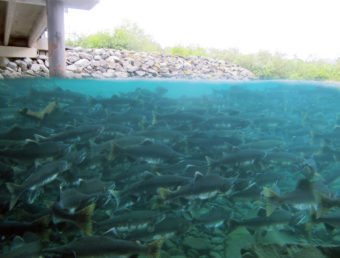
Pink (humpy) salmon migrating up Sargent Creek on Kodiak Island. (Photo courtesy USFWS/K.Mueller)
Pink salmon migrating up Sargent Creek on Kodiak Island. (Photo courtesy K.Mueller/USFWS)

The state is working on distributing roughly $56 million in relief funds to those affected by the 2016 Gulf of Alaska pink salmon season disaster.
The plan is still in its “infancy,” according to Alaska Department of Fish and Game deputy commissioner Charlie Swanton, but one projection for Kodiak is about $11.5 million. That was included in a table which Kodiak’s lobbyist sent to the Kodiak Island Borough and was then forwarded to the assembly.

Swanton said ADF&G originally calculated the Gulf’s numbers in 2016 based on previous years’ ex-vessel values and losses in the Gulf of Alaska. The data eventually made it to the desk of the Secretary of Commerce to help support whether the fishery merited a federal disaster declaration, and the 2016 pink salmon season in the Gulf was declared a disaster in 2017.

Swanton says the review committee could factor the amounts into its planning process moving forward.

“They’re useful as kind of a basic foundational basis for looking at the damages, if you will, by respective area,” Swanton said.

But Swanton says the money might be distributed differently than the table projects, and lots of elements go into that decision.

Julie Speegle, a spokesperson for the National Oceanic and Atmospheric Administration confirms that a spending plan is in the works, and representatives from the state, NOAA, and the Pacific States Marine Fisheries Commission met recently to discuss who will receive relief funds and how much.

“The spending plan can cover a range of activities in support of commercial fisheries and support industries such as processors, fish houses, or communities affected by the disaster,” Speegle said.

The table of projected allotments sent to the Kodiak Island Borough also includes roughly $32 million for Prince William Sound, $10 million for Southeast, $1.8 million for the South Alaska Peninsula, $543,000 for Chignik, $310,000 for Lower Cook Inlet and $47,000 for Yakutat.

Speegle says the review committee may settle on the spending plan in the next few months.

Wildlife get 3,000 more acres creating corridor on Afognak Island

Portage Lake, Afognak Island. (Photo courtesy Great Land Trust)

More than 3,000 acres of ecologically rich land on Afognak Island is now protected through a wildlife and recreation corridor.

“There has been some logging in the area, but it is fairly minimal,” said Ellen Kazary, executive director of Great Land Trust, a conservation non-profit.

“You are flying over these impressive lakes and streams. And I’ve seen bears just running around. When we land, it is just teaming with salmon. And the birds, you can’t even count them. It’s just jaw dropping. You feel like you are in a National Geographic special.”

Great Land Trust partnered with the Native Corporation Natives of Kodiak to conserve the land.

The Portage Lake Property includes 750 acres of wetlands, Sitka Spruce, salmon and blueberries, Kazary said.

“The Portage Lake project actually connects 180,000 acres of prime wildlife habitat on Afognak because it touches the Kodiak Island National Wildlife Refuge and Afognak Island State Park,” Kazary said. “It creates this brilliant corridor for wildlife and just increases their ability to survive and flourish.”

Natives of Kodiak CEO Jim Erickson said in a news release, “We are excited about the sale of this property because it conserves this land for future generations of Natives of Kodiak shareholders and others to enjoy.”

The U.S. Fish and Wildlife Service identifies Afognak Island among the most productive habitats in the Gulf of Alaska.

The land was purchased with funds from the Exxon Valdez Oil Spill Trust Fund and donated to the State of Alaska with a conservation easement held by the Bureau of Land Management.

Access to the land will be open to the public.

Natives of Kodiak was paid the full value of the land, benefiting its shareholders.

Alaska Aerospace Corporation schedules launch at Kodiak facility

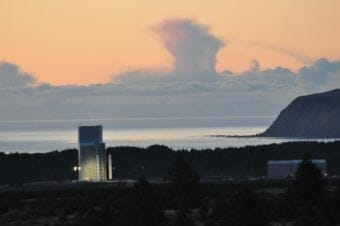
Alaska Aerospace Corporation launch facility in Narrow Cape. (Photo courtesy of Alaska Aerospace Corporation)

The Alaska Aerospace Corporation scheduled a launch next month at its Kodiak facility.

President and CEO Craig Campbell said a commercial company will conduct the launch sometime July 14-20. He says the site will be closed for certain hours during those days.

“The intention is that the rocket will launch in the first day, but if the weather’s bad, if there’s an equipment issue, it protects the next few days so that they can continue to launch the rocket within the specified window.”

Campbell said a couple of previous launch attempts this year were not completed, and he isn’t able to share anything more about the operation because of a nondisclosure agreement.

He said Alaska Aerospace Corporation, which has a contract with the Missile Defense Agency, is trying to build the number of commercial companies it contracts with.

19-year-old survives bear attack in Naknek boatyard

Stig Ure's leg had to receive 14 stitches after being bit by the bear. (Photo by Mitch Borden/KMXT) CREDIT MITCH BORDEN
Stig Ure’s leg had to receive 14 stitches after being bit by the bear. (Photo by Mitch Borden/KMXT)

Bears have been a big topic of discussion around Naknek boatyards since one young fisherman was attacked earlier this month.

Bears are known to come into town as fishermen arrive and live on their boats as they prepare for the summer salmon season.

But, even though bears are nothing new it’s been years since anyone’s been mauled.

It was dark when Stig Ure, 19, found himself walking through the Upper Lummy boat yard about 2 a.m. June 3.

He was close to his father’s salmon boat, the Coachman II, where he was staying, when his night took a turn for the worse.

He explained, “I crested the bow of the (F/V) Gabey V and all of a sudden I was five to seven feet from this brown bear.”

The bear was eating out of a dumpster when Ure surprised it.

Almost immediately, Ure reacted.

“I just kinda turned into an animal like at that point. Instinct just kicked in, and I bolted.”

Ure was only about 50 feet away from his father’s boat. He thought if he could just make it there he’d be safe. But, the bear overtook him.

“I got about halfway across the street to my dad’s boat when this bear took me down,” he said. “He first bit my right calf and I hit the ground.”

Everything slowed down for Ure at this point. He said all he could think was “this isn’t how I’m dying.”

So, he leaned into his instincts.

“I turned around as fast as I can and with as much might as I can muster, I hit the bear twice as hard as I can in the snout.”

The bear was stunned giving Ure the chance to make it to his father’s boat.

He got there, but not before the bear made one more attempt at getting him.

“He ended up nipping me in my right gluteus maximus.”

The bear ran away, and Ure wandered onto the boat and, while bleeding, sat down in the captain’s chair. He said he was in complete shock and sat there for hours.

Ure posing on the dumpster where he surprised the bear. He’s thankful he wasn’t hurt worse than he was and has a pretty good sense of humor when it comes to the incident. (Photo by Mitch Borden/KMXT)

He got up and went to bed about 6 a.m.

When he woke up an hour later, all the memories of what had happened came flooding back to him.

His father found him and took him to Naknek’s clinic, where he received 14 stitches for his leg wound. The second bite didn’t break the skin.

Looking back at his experience, Ure isn’t mad at the bear, he thinks it attacked because it felt threatened.

He was being a bit more cautious around the boatyard, but the incident hasn’t really changed his routine too much.

“(I’m) pretty comfortable walking around,” he said. “It’s all about just making noise and making sure that you know, the bears know that you’re there because usually they’ll try and steer clear of you.”

The bear may have chased him because he ran, Ure admitted, but he also believes it may have attacked if he hadn’t.

Ure isn’t second-guessing how he handled the situation.

“Acting is also what kinda saved my life.”

The Alaska Department of Fish and Game and the Alaska State Wildlife Troopers were put on alert, and two juvenile cubs were killed near the location of the attack as a result.

Fish and Game believes one of these bears was the one that attacked Ure.

Since his encounter, Ure has pretty much recuperated from the incident. Now, he’s among the thousands of fishermen out in Bristol Bay waiting for the commercial salmon season to take off.

Hand-written sign in the upper lummy yard warning anyone passing by about bears wandering the area. (Photo by Mitch Borden/KMXT)

Kodiak-based Coast Guard intercepts illegal Chinese fishing vessel

A USCGC Alex Haley boarding team boards the fishing vessel Run Da after the vessel was suspected of illegal high seas driftnet fishing in the North Pacific Ocean, 860 miles east of Hokkaido, Japan, June 16, 2018. (Photo courtesy of U.S. Coast Guard)

An illegal fishing vessel was intercepted off the coast of Japan with 80 tons of chum salmon and one ton of squid onboard.

“Legally, they can go up to about two-and-half kilometers. This vessel had almost five times the legal limit of nets,” said Captain Darran McLenon, chief of response for the 17th Coast Guard District.

He says the captain of the vessel Run Da admitted to fishing with driftnets up to 5.6 miles in length.

The crew of the Kodiak-based cutter Alex Haley detained the 164-foot Chinese-flagged fishing vessel with 29 crew onboard June 16. McLenon said they apprehended the vessel in international waters 860 miles east of Hokkaido, Japan.

He says they couldn’t have done it without help from the crew of a Kodiak-based C-130 aircraft which spotted the illegal fishing vessel.

“Because of them finding, detecting this, we were able to vector in the Coast Guard Cutter Alex Haley, which at the time was about 500 miles away and what they did was put boarding officers on board with Chinese ship riders,” McLenon said.

The joint international boarding was conducted in partnership with Chinese Coast Guard officers.

The vessel is suspected of violating the worldwide driftnet moratorium called for by the United Nations General Assembly.

The Run Da and its crew are being escorted back to China for prosecution. McLenon added that this is the first apprehension of a large-scale, high seas driftnet vessel since 2014.

Site notifications
Update notification options
Subscribe to notifications