KMXT - Kodiak

KMXT is our partner station in Kodiak. KTOO collaborates with partners across the state to cover important news and to share stories with our audiences.
Chinese delegation visits Kodiak as Trump administration issues new proposed tariffs

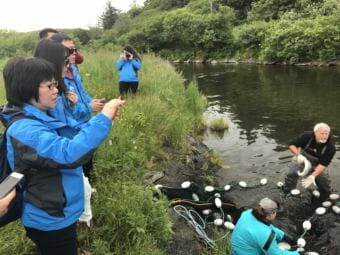
Shanghai Hollywin Frozen Food CEO Xin Lyu snaps photos July 11, 2018, at a weir on the Buskin River near Kodiak . (Photo by Daysha Eaton/KMXT)
Shanghai Hollywin Frozen Food CEO Xin Lyu snaps photos July 11, 2018, at a weir on the Buskin River near Kodiak. (Photo by Daysha Eaton/KMXT)

A delegation from China visited Kodiak Island with the Alaska Seafood Marketing Institute, touring fish processing plants in Kodiak and Larsen Bay.
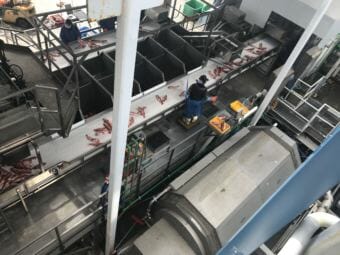
Right in the middle of the visit, President Donald Trump’s administration proposed more tariffs, which doesn’t bode well for Alaska’s seafood trade.

But that didn’t dampen the delegation’s enthusiasm for what Alaska has to offer.

The water is low, so Alaska Department of Fish and Game employees in Kodiak are seining for sockeye salmon at the Buskin River weir.

The Chinese delegation has come to learn about local fisheries management, said Tyler Polum, sport fisheries area management biologist.

“Sometimes when the water is low, we can’t get them to go into the trap at the weir, so we thought that it would be better to beach seine for these fish,” Polum said. “We’ll show them how we sample fish to get age, sex, and length from them.”

Among the delegation, Mingzhen Zhang says Kodiak is a stark contrast to her city.

“I live in Beijing, so the best impression for me is less pollution,” Zhang said.

China’s northern capital city of more than 20 million people is infamous for smog.

Zhang works for one of China’s largest media companies there.

“I work for Tencent as a video producer and we just try to understand how Alaska Seafood works and make a video about it,” Zhang said.

The group walks along a 1-foot wide wooden plank to the other side of the Buskin weir, where a net is full and the Fish and Game crew already is pulling fish out of the water.

The weir trip was just one of many outings for the delegation, which also toured Trident Seafoods, Ocean Beauty Seafoods, and Alaska Pacific Seafoods processing plants in Kodiak as well as Icicle Seafoods in Larsen Bay.

Most of the visitors work in the seafood industry in areas from purchasing to development and media.

Right in the middle of their visit, President Donald Trump proposed more tariffs on Chinese goods, including seafood reprocessed in China and exported back the United States.

Wei Zhang, works for SMH International in Shanghai, where he is also a representative for ASMI, holds up a sockeye salmon at the weir on the Buskin River near Kodiak on July 11, 2108. (Photo by Daysha Eaton/KMXT)

But that doesn’t worry Wei Zhang, who works for SMH International in Shanghai, where he is also a representative for Alaska Seafood Marketing Institute.

He says when he started working with the marketing institute 20 years ago, most Chinese consumers couldn’t find Alaska on a map.

Now, people ask for it’s seafood by name, and they can order a fillet online and have it delivered to their home within hours.

“They are willing to pay a little more higher price, but the quality is the most important,” Zhang said.

He says Chinese consumers believe Alaska seafood is one of the healthiest products available because of the virtually pollution-free environment here and strict food-safety rules.

“For the safety, they think that is more safe for them, not just for the feeding for the family, and it is good for feeding for the kids,” Zhang said.

He says Alaskan seafood has an advantage in a country where lack of environmental and workplace regulation means it isn’t always easy to ensure food is pure.

Xin Lyu has been working in the seafood industry in China for more than 20 years.

She’s impressed by Alaska’s pristine waters and efficient food safety systems at processors: huge selling points.

“I think that right now safety is almost the number one point that they focus on,” Lyu said.

She is general manager for a seafood import/export company and CEO for Shanghai Hollywin Frozen Food.

She said the news of new proposed tariffs was troubling. The Trump administration announced the tariffs overnight.

“We are really a little bit worried, but if you look for the long term I think seafood is more and more popular in China,” Lyu said.

Despite the continued tariffs, Lyu said Alaska has something special that she believes will keep its products selling in China, at least to those who can afford them.

China has a massive and growing middle class of consumers with money to spend and want sustainable and wild seafood.

ASMI and lots of Alaska seafood processors and fishermen are counting on it.

The delegation will be in the U.S through July 14, making stops in Seattle and Anchorage, but the majority of their time was spent on Kodiak.

Latest China tariffs likely to hit Alaska seafood, experts say

Trident Seafoods employees sort rock fish Saturday May 27, 2018, at a plant assembly line in Kodiak, Alaska. (Photo by Daysha Eaton/KMXT)

The Trump administration proposed Tuesday $200 billion in new tariffs on China, upsetting markets worldwide.

Some of those new tariffs could affect Alaska seafood, said Michael Kohan, who is the technical program director with Alaska Seafood Marketing Institute.

“The U.S. is going to impose 10 percent tariff on imports from China, which could include Alaska seafood product that has gone to China for reprocessing and then is being imported into the U.S. for the domestic market,” Kohan said.

Alaska seafood processors often head and gut fish, then send them to China for secondary processing. China then exports them back to the U.S. or to other countries from there.

In June, China announced it would increase tariffs on U.S. seafood products in response to those set earlier by the U.S.

China added 25 percent to the existing tariffs July 6.

After the decision, industry analysts said seafood reprocessed in China and then exported back to the U.S. would be exempt from the tariffs. The new announcement looks like it changes that, representing a major shift.

China is the largest trading partner for Alaska seafood and is a major reprocessing sector for the U.S.

Alaska Seafood Marketing Institute officials say Alaska companies export approximately $1 billion worth of Alaska seafood to China annually.

Pollock, salmon, and Pacific cod make up the bulk of Alaska fish sent to China for reprocessing, according to the institute, and they’re included on the new tariff list.

The marketing institute has been active in the Chinese market for more than 20 years, but Kohan said that could change.

“We have a large international market that we can apply our seafood to. As much as we are focusing on China right now, there are growing markets in other countries around the world,” Kohan said. “We will be trying to be able to develop markets that will enhance Alaska seafood in these markets that are growing in countries like Spain and Brazil.

Alaska Seafood Marketing Institute officials said they’ll continue to analyze what the latest tariff announcement means for Alaska seafood, and they plan to submit comments to the Office of the United States Trade Representative.

The latest proposed tariffs would go into effect in September.

Commercial company conducts rocket exercise at Kodiak launch facility

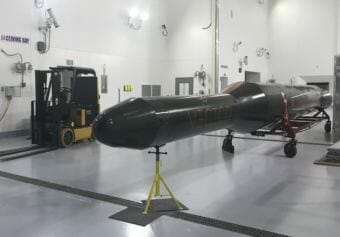
A Vector test rocket, or vehicle, housed inside the Alaska Aerospace Corporation facility. (Photo by Daysha Eaton/KMXT)

A commercial company wants to launch small payloads into the Earth’s orbit and is conducting tests for a future launch from Alaska Aerospace Corporation’s facility at Narrow Cape.

The goal is to develop a streamlined rocket or vehicle to carry small payloads.

The company employees of Vector conduct tests with a simulation rocket.

Pacific Spaceport Complex facilities director Bruce Walter enters what looks like a locker room. It’s important that no dust gets through.

“This is where you would don your white robe, if you will,” Walter said. “Booties, pants, hoods, and you’d walk through the air bath, which is just a big air Jacuzzi, gets all the dust off of you, HEPA (high-efficiency particulate air) filter’s at the bottom to take the particles out, and then you step into the clean room.”

The well-lit clean room is big: the high ceiling dwarfs anyone who enters. It’s like a cathedral, but for spaceships. Staff prepares satellites, also known as payloads, for launch in the building.

A test model — 43-feet-long and 3-and-a-half-foot-wide dark gray rocket — sits on one side of the room. “Vector” is lettered in orange along the side.

“They’re going through the steps to make sure that all of their procedures work with the real vehicle,” Walter said. “This is a mock up. If you look in the back end of it, it’s just a big, empty tube.”

The exercises this week are part of a test run, said Vector launch services president John Garvey. The company will focus on the operations, like moving the vehicle around.

“We’re just trying to establish that as the basis so that when we move up to the next level, issues like transporting it, picking it up, erecting it vertical will already have been accepted as normal so we can start working on the next level of functions,” Garvey said.

Coast Guard, partners search ferries for illegal activity, drugs

Petty Officer 1st Class Devon Waite and K9 Bingo conduct a vehicle sweep aboard the ferry vessel Tustumena in Kodiak. (Photo by Lauren Dean/U.S. Coast Guard)

U.S. Coast Guard and Alaska law enforcement agencies seized 56 grams of heroin, an ounce of methamphetamine, and almost 2 pounds of non-commercial marijuana in a large-scale search for illegal activity on ferries in Washington state and Alaska.

According to a press release, Coast Guard investigated ferries in Bellingham, Wash., Kodiak, and Ketchikan between June 24 and July 2,

Coast Guard members from across the state and the West Coast worked together with local police and Alaska State Troopers to inspect more than 1,500 passengers, 400 crew members, and 500 vehicles during that time.

Their search included the use of drug-sniffing dogs.

Lt. Cmdr. Bernie Auth, who helped coordinate the operation, said joint operations help strengthen relationships between law enforcement agencies and encourage the sharing of resources and abilities.

He adds that a major goal is to deter and detect the transportation of illegal items via the sea.

“Just with the Coast Guard being a maritime service, we know that’s one of the ways that illegal activity can be make it up to the state and throughout the state, so we want to do everything we can do eliminate that.”

This is the second operation the Coast Guard and their partners have completed together, Auth said. The last one was in March.

Alaska Aerospace Corporation launches subsidiary with focus on satellites

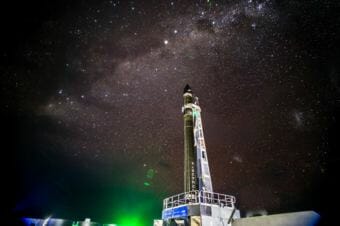
Alaska Aerospace Corporation launch facility in Narrow Cape. (Photo courtesy of Alaska Aerospace Corporation)

Alaska Aerospace Corporation created subsidiary Aurora Launch Services to focus on providing support for customers to launch vehicles with smaller satellite payloads into orbit.

And, it will also be cheaper, said corporation president and CEO Craig Campbell, because they won’t use state employees anymore, instead hiring contractors for services on demand.

“Now, you’re only paying for the launch services when you need the launch services,” Campbell said. “One of the problems we’ve had in the past, or one of the costs we’ve had in the past, has been keeping a large employee force paid on payroll, even when we had no launches. Now you’re only paying for the launch services when you have a customer that is going to launch from your facilities.”

He said the company is wholly owned by Alaska Aerospace Corporation.

After its 2014 launch failure, the corporation went two years without a launch and laid off many employees, but Campbell said business is coming back.

“The best way to now be able to address the business that we’re getting is to just pay by the drink,” said Campbell. “Bring on the people you need for the launch time that you need them and not have to pay them year-round. It also is an opportunity to provide more Alaskans jobs and specifically for people that live in Kodiak.”

Most jobs will be in launch operations or facility maintenance, says Campbell. There will be a handful of full-time employees and the number of part-time employees will be flexible and determined by contracts.

He says that the corporation hopes to continue range and telemetry services for a New Zealand launch site as well as add an equatorial launch site in Hawaii or the Mariana Islands in order to offer both polar and equatorial launches.

John Cramer will serve serve as the subsidiary’s president. He says there is no other company that will be able to do what Aurora will do.

“The subsidiary will be able to provide launch services to any customer anywhere in the world to be able to bring in a team to launch their vehicles,” said Cramer.

Cramer said that Aurora should fully operational within the year, and he adds that they could hire their first employees over the next couple of months.

GCI customers in Alaska experiencing outage

Updated | 6:44 p.m. Monday

A power source failure in Anchorage Monday morning caused service issues for GCI customers across the state. According to GCI spokesperson Heather Handyside, the outage happened between 4:30 a.m. and 5 a.m. near company headquarters.

“What we know is that services statewide that were impacted include our wireless service, our local and long distance service. We have had some reports of video service being interrupted in Southeast communities, and we have some interruptions to internet services services in the Anchorage area.”

Handyside said a backup power system failed after several hours following the outage, but kicked in again mid-morning.

In a statement, GCI said the original problem was connected to a transformer provided through Anchorage-based electric utility, Municipal Light & Power. According to ML & P, they have since replaced the transformer and are trying to determine the exact cause of the outage.

As of around 4  p.m., GCI told KMXT that they’ve restored wireless, local, and long distance service, and the majority of internet service is back statewide. They said they’re still working on returning TV access in Juneau, Kodiak, Sitka, and Valdez.

Updated | 11:59 a.m. Monday

A commercial power outage in Anchorage is causing service issues for GCI customers across the state today, according to a GCI spokesperson who wrote via email.

Some numbers were unavailable for a period of time, including the toll-free number to the Alaska Marine Highway System.

The cause of the outage and the extent of the effects are unclear, but service appeared to have returned between 11 a.m. and noon.

A GCI representative said the company can’t speak to what the current status of service is and what issues different regions are experiencing. He said GCI is working to fix the problem.

— Kayla Desroches, KMXT


Original post | 10:21 a.m. Monday

According to a Facebook post, GCI said it is experiencing an Internet and cell phone service outage affecting customers in Alaska.

A commercial power outage is to blame, according to the post.

An outage report map shows outages around Alaska, including Southeast Alaska.

Tripp J Crouse, KTOO

Site notifications
Update notification options
Subscribe to notifications