KMXT - Kodiak

KMXT is our partner station in Kodiak. KTOO collaborates with partners across the state to cover important news and to share stories with our audiences.
Kodiak biologists track climate variation’s impact on berries, bears

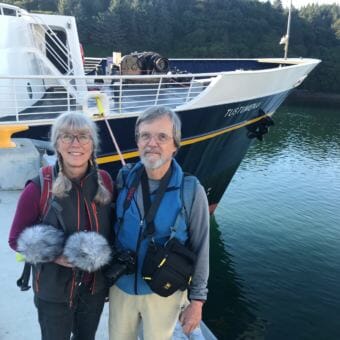
A Kodiak National Wildlife Refuge crew surveys blueberries at Abercrombie State Park in Kodiak. (Photo by Daysha Eaton/KMXT)

Kodiak National Wildlife Refuge biologists just wrapped up this season’s field work monitoring berry supply in relation to the health of bear populations.

They’ve been assessing berry patches and doing aerial surveys for bears.
The surveys lay the groundwork to create a baseline from which to measure how climate change and other factors may be affecting this particular aspect of Kodiak’s bear foraging habitat.

“We come back about the same time each year to sample the abundance of blueberry and devil’s club,” said Bill Pyle, the supervisory wildlife biologist with Kodiak National Wildlife Refuge.

Pyle walks a trail in Abercrombie State Park where he is leading a team surveying for an abundance of blueberries. They’ve already surveyed for salmonberry and elderberry.

“It is much better than it was last year where we had conditions during the winter that knocked out the production, and there wasn’t really any berries to be had for people and wildlife,” Pyle said.

Last year was a terrible year for berries.

On the north and west side of the island, there was virtually no production of three of the four species: salmonberry, elderberry, and blueberry.

Devil’s club was the one exception.

Biologists still don’t know exactly how it impacted bears and other animals here, but they are hoping to find out. Pyle said low snow cover left shrubs unprotected from the cold and exposed to browsing deer.

Vaccinium Ovalifolium, or Oval-leaf Blueberry. (Photo by Daysha Eaton/KMXT)
Vaccinium ovalifolium, or Oval-leaf Blueberry. (Photo by Daysha Eaton/KMXT)

Berries are a critical food source for bears and help them put on fat for winter.

The U.S. Fish and Wildlife Service has been doing the surveys for the past four years as part of a long-term look at climate variations’ effects on bears and bear habitat. They modeled their survey after another in the Rocky Mountains.

In the short term, they’re trying to sort out how much last season’s low berry production affected the island’s iconic bears.

Pyle and his crew divert from the path, arriving at a vast patch of the 5- to 8-foot shrubs above a pond and under a canopy of tall Sitka Spruce. The bushes are loaded.

Vaccinium ovalifolium, or oval-leaf blueberry, is not superabundant on Kodiak and, biologists say that like Sitka spruce it is still in the process of colonizing the archipelago.

This work requires sturdy boots and some bushwhacking.

Crew member Danny Hernandez stretches a long measuring tape from a metal stake in the ground to another one up the hill.

“We are going to sample blueberries along, and this is going to go out 50 meters,” said Hernandez. “And we are going to sample a 20-by-20-centimeter quadrant of blueberries at every half-meter interval and count up the berries and estimate the blueberry leaf cover that is in that frame and get an estimate how much blueberry is here.”

Catie Thow is a volunteer on the project.

“I’d traveled in Alaska before, and I just always really wanted to come back and especially in Kodiak, which is such an amazing place and, you know, it’s always famous for the Kodiak brown bear. And I heard Bill was looking for volunteers to sample bear habitat, so I figured I’d just get involved.”

Hernandez and Thow work together along the transect counting and measuring while Pyle writes down the data.

It is painstaking work, but once all the numbers are in, they’ll paint a picture about what is happening for bears and bear habitat on the island which hasn’t been available before and which may become even more important to understand as the climate changes.

Pyle says they just completed their final survey of devil’s club berry clusters.

Next, they’ll take the berry data and do some complicated math comparing it with the data gathered from bear surveys.

Pyle acknowledges there’s another species whose survival doesn’t necessarily depend on the berries, but that could benefit from the surveys: humans.

The study, Pyle adds, may also have value for local subsistence users and hunters.

As well as for the tourism industry, which, on Kodiak, is deeply connected to the health of the bear population.

Sugpiaq artist shares work, culture with Kodiak residents

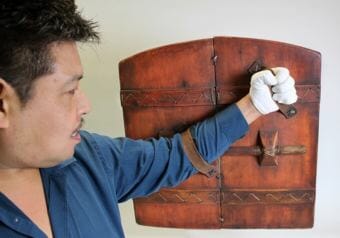
Artist, Andrew Abyo, holds his war shield which is in the permanent collection of the Alutiiq Museum and Archaeological Repository join Kodiak. (Photo courtesy the Alutiiq Museum)
Artist Andrew Abyo holds his war shield which is in the permanent collection of the Alutiiq Museum and Archaeological Repository join Kodiak. (Photo courtesy Alutiiq Museum)

Traditional Sugpiaq artist Andrew Abyo hosted an atlatl, a spear-throwing weapon, demonstration at the Alutiiq Museum and Archaeological Repository while visiting Kodiak.
“The atlatl was used by the Sugpiaq and also the Ungangax, actually all the different cultures of Alaska. And primarily it was used in the Kayak,” Abyo said of the tool used for hunting around the world. “That is actually not an Alaska Native word, it is an Aztec word and for the Sugpiaq we call it the Nug’aq. Not too many people were familiar with it and it is a good way for me to introduce our people to the culture.”

Abyo primarily carves wood, making masks, weapons and kayaks. Alutiiq Museum has a pair of Abyo’s pieces — a war shield and war club — in its permanent collection.

Originally from Pilot Point on the Alaska Peninsula, Abyo did not grow up with carving but always admired it. Then he discovered his talent through a workshop.

“My mom … paid for a workshop for me at the Alaska Native Heritage Center, and you don’t want to say no to mom,” Abyo said. “I discovered that I could carve these. It just comes right out. And it was natural, and it kinda grew from there.”

The workshop was with Abyo’s uncle, Peter Lind.

He said when he is not traveling and teaching, he can be found working on his current project: a model angyaq, an open-skin boat, similar to the umiaq, at the Alaska Native Heritage Center in Anchorage.

Abyo’s visit was supported by a museum initiative supported by the Rasmuson Foundation to incubate and test innovative approaches to create fun and engaging programming to expand its audience.

Ugashik fishermen’s patience pays off

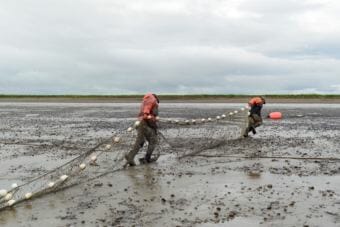
Fishermen put a net in Pilot Point before high tide. (Photo by Mitch Borden/KDLG)

Ugashik Bay fishermen are used to their sockeye showing up late in Bristol Bay’s salmon season.

This summer though was especially trying, but for some, the wait was worth it.

Conrad Day and his crew tow a net into the Ugashik River in preparation for the incoming high tide.

“Now we’ll just wait on the switch, ’cause when the water floods the fish come with it,” said Day, a college student at Texas A&M studying nuclear engineering. “It’s like a free ride upriver.”

Things are quiet out on the water tonight, but a few days ago the river would’ve been full of fellow set-netters preparing for the evening sockeye run.

Day described what fishing was like at the season’s peak.

“There’s like four boats anchored out, but earlier this week there was probably between 20 to 30 boats anchored out. Everyone had a crew of four or five people.” Day said. “It’s crazy how Pilot Point will go from a ghost town to an extra 300 people walking around and a few months later it shuts off again.”

It is the end of the season, so a lot of people have packed up and headed home, but there still are a few set netters, like Day, fishing.

Set netting has been a great summer job for Day for the last three years. Every salmon that strikes the net in front of him is little more money towards his education.

“That’s actually a lot of fish (hitting the net),” Day said. “Probably between 20 to 50.”

Even though the salmon are coming in now, for a long time things didn’t look good in Ugashik Bay. It was so bad that Catie Bursch, a set netter who’s fished in Pilot Point for over 30 years, thought the run may have failed.

“I was nervous whether they were going to come back or not,” Bursch said.

Sockeyes caught in Conrad Day’s net during the flood tide. (Photo by Mitch Borden/KDLG)

The Ugashik fishing district traditionally has one of the latest runs in Bristol Bay, but this year took it to a whole new level.

The Alaska Department of Fish and Game closed down commercial fishing because this summer’s run was so slow for so long that.

But then the fish hit and things got busy. The district was open from July 13 to about the July 23.

“We were sitting around and were like ‘can you believe we’ve only been fishing for 10 days?’” Bursch said of those pretty hectic days. “It felt like a whole entire salmon season got squeezed into 10 days.”

“We went from like 18,000 pounds to like 60-70,000 pounds in less than a week,” Traveler Terpening said of his best year ever in Pilot Point.

His crew pulled in over 125,000 pounds. The Ugashik district’s run is almost up to 4 million red salmon, about 1 million sockeyes higher than the area’s average for the last two decades.

The way Terpening sees it, a good season depends on more than the number of salmon returning.

“It doesn’t really matter if we have a huge run,” Terpening said. “It comes down to if the drifters come down, you know how did the fish come in, how do the tenders serve us.”

more than 100 fewer drift boats fished this summer in Ugashik at its peak compared with last year. Terpening says that let plenty of sockeye through to fishermen along the beach.

Plenty of set net sockeye buyers paid fishermen about $1.25 per pound, plus quality bonuses for bled and chilled salmon, a 50 cents increase from two years ago.

This year’s late run was a roller coaster ride, but Terpening said that he expects every summer to hold a lot of surprises.

“Basically our big joke is that every season we say ‘God this is a weird season,’ and then we reflect and say ‘oh we said that last year, oh we say that every year,’” Terpening said. “Every year is a weird season.”

Kodiak pays $254K to settle lawsuit filed by family of autistic man

The city of Kodiak paid $265,000 to settle a lawsuit filed in 2016 by the family of an autistic man whom a Kodiak Police officer pepper sprayed the year before.

A father-and-son pair of tourists called 911 when they saw now 30-year-old Nick Pletnikoff nearby their car and believed he was attempting to break in.

According to family attorney Josh Fitzgerald, Pletnikoff was returning home with his family’s mail.

Body cam footage captured the encounter between now 30-year-old Nick Pletnikoff and three police officers who arrived at the scene.

The footage shows officers forcing Pletnikoff to the ground and Sgt. Francis de la Fuente pepper-spraying him in the face in response to what he saw as resistance.

De la Fuente said he did not know Pletnikoff was autistic at the time.

However, one officer at the scene was acquainted with Pletnikoff, knew he had special needs and addressed Pletnikoff by name during the encounter.

Nick’s mother and guardian, Judy Pletnikoff, says she’s glad the legal battle is over, but she didn’t get what she set out for.

“Money is what we did not want. And I walked into the lawyer’s office first day saying we don’t want anything but an apology. We want to sit down with the city in good faith and have a conversation about what happened and how we can move on from here.”

City attorney Bill Ingaldson told the Kodiak Daily Mirror newspaper that the city settled partly because it was concerned a jury would not understand the police officers’ point.

Company considers Kodiak for site of second launch pad

Rocket Lab Electron on the pad at LC-1. (Photo courtesy of Rocket Lab)

A company that launches small satellites into orbit is considering Kodiak as the site of its second launch pad.

Rocket Lab has an existing relationship with the Alaska Aerospace Corporation, which has offered support services to the company’s launches in New Zealand.

An American company, Rocket Lab’s launch site would be its first on American soil.

Rocket Lab is headquartered in California and funded through venture capital firms in Silicon Valley, CEO Peter Beck said.

Their launch pad is located in New Zealand.

“There’s just a lot of stuff in America,” Beck said, referring to planes, trains, automobiles and boats.

He said every time a company launches a rocket, they have to close off large chunks of the air and sea.

“You run into a real issue with the kind of launch frequency that we’re trying to achieve by just having U.S. launch sites alone,” he said. “We’re licensed down in our launch site in New Zealand to launch every 72 hours and, when you contrast that against America as a country launching 25 times a year, you can see how that has a big effect.”

Beck started the company in 2006 to serve a growing demand for high-frequency launches for small satellites.

Now the company is expanding to a second launch pad, which it may place at the Alaska Aerospace Corporation’s Kodiak facility, but they’re also considering Cape Canaveral in Florida, Wallops Flight Facility in Virginia, and Vandenberg Air Force Base in California.

“We’ll continue to develop launch sites, but this one’s very strategic for us because it serves a real need for a U.S. government customer and also a U.S. commercial customer who may not want to launch out of New Zealand.”

He said a couple of the elements they’ll consider in their location choice is existing infrastructure, regulatory environment, and how often they can launch.

According to Rocket Lab, they’ll announce their decision next month, and hope to set the new launch pad up in 2019.

Alutiiq ancestral objects return home to Kodiak after nearly 150 years

An employee of the Alutiiq Museum and Archeological Repository in Kodiak displays a beaded dance belt and cuffs, part of the Pinart Collection on loan from the Museum Bologne-Sur-Mer on Monday, July 9, 2018. (Photo by Daysha Eaton/KMXT)
An employee of the Alutiiq Museum and Archaeological Repository in Kodiak displays a beaded dance belt and cuffs, part of the Pinart Collection on loan from the Museum Bologne-Sur-Mer on Monday, July 9, 2018. (Photo by Daysha Eaton/KMXT)

Ancestral artifacts collected in the Kodiak Archipelago nearly 150 years ago have arrived back home.

A French museum, Musee Boulogne-Sur-Mer, will loan the items to the Alutiiq Museum and Archaeological Repository in Kodiak where they will remain for five years.

A welcoming ceremony for the objects was held at the Kodiak museum on July 9.

In 1871 and 1872, then-19-year-old French anthropologist Alphonse Pinart, a linguist who visited Kodiak collected the objects.

Musee Boulogne-Sur-Mer director Elikya Kandot works for the museum that has been caring for the items all these years.

She escorted the crate to Kodiak. She told the crowd the exchange between the museums is a model for how cultural institutions can work together.

“The importance of inheriting this heritage is truly very strong here for future generations,” Kandot said in French. “Thank you for providing this example. Thank you for really, for giving it your all, to these pieces that have been protected for years, for centuries, and that will be transmitted to future generations as well.”

Kandot’s museum is part of an international movement for partnerships between European collecting institutions and indigenous peoples so that both can learn more about cultural items.

They pried open the shipping crate after a ceremony where a traditional Alutiiq oil lamp was lit.

The pieces inside are part of the Pinart Collection, which includes Kodiak Alutiiq objects that Europeans collected here in the late 19th century.

The collection includes many rare pieces of Alutiiq ceremonial gear, like masks, drums, headdresses and a feast bowl, which provide a rich record of traditional arts, ritual practices, spiritual beliefs and the Alutiiq language.

Pinart also documented vocabulary, songs, and legends along with the objects.

Inside the large crate are several smaller wooden boxes which are removed one-by-one and staged on nearly tables.

While the crowd waits for the screws to be taken out of the inner boxes, the Alutiiq Dancers sing a traditional call and response song.

A line forms for onlookers to file by the tables where the objects sit.

As the packing paper is removed, Alutiiq descendants get their first glimpse of their ancestors’ work.

At last the cultural treasures come into view: two carved wooden masks and a women’s beaded headdress set, which includes two bracelets and a dance belt.

One elder greets the items in Alutiiq, “Camai!”

Alutiiq elder Florence Matfay Pestrikoff, whose family was originally from Ahkiok, admires the headdress beads of white, green and blue.

“I’m thankful that these people preserved them for us,” Pestrikoff said.

She said she has never had a traditional headdress of her own and hopes to make one like it for herself.

Alutiiq Museum intern Dehrich Chya, 22,has been to France to see some of the objects. But he is still awed to have them here.

Today, he helped light the ceremonial lamp and pry the lid of the crate. He takes a closer look at the ancestral objects.

“I’m really particular to the mask. Just because there is so little that is written about them and it was an art that was lost on Kodiak for a long time,” Chya said.

One mask is narrow and small with black paint and red ochre paint and little white circles.

Chya’s elders have taught him that the white circles were made by dipping a stalk of a plant into paint and using it like a stamp.

“I could tell you, I could not sleep last night because I was so excited,” said elder Margaret Roberts, Alutiiq Heritage Foundation chair. She has worked to reawaken Alutiiq heritage since the 1980s.

“This has been a dream that has come true today,” Robertson said.

The objects replace two ceremonial masks, also from the Pinart Collection, scheduled to return to France.

In September, the new items will be incorporated into displays on Alutiiq spirituality.

In addition, the museum plans to assemble a group of beaders to study and recreate the regalia to share as replicas when the historic set returns to France.

Site notifications
Update notification options
Subscribe to notifications