KMXT - Kodiak

KMXT is our partner station in Kodiak. KTOO collaborates with partners across the state to cover important news and to share stories with our audiences.

There’s a new marine heatwave in the Pacific Ocean that looks a lot like ‘The Blob’

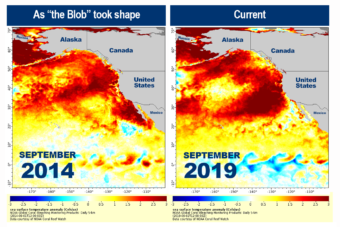
NOAA maps illustrate the similarities between the 2014 “Blob” and the 2019 heat wave event in ocean temperatures (Map courtesy NOAA).
National Oceanic and Atmospheric Administration maps illustrate the similarities between the 2014 “Blob” and the 2019 heat wave event in ocean temperatures (Map courtesy NOAA).

Scientists from the National Oceanic and Atmospheric Administration announced on Thursday that millions of square miles of water in the Pacific Ocean are heating up. They’re calling it a marine heatwave, and it’s looking pretty familiar.

This new warming trend in the Pacific, designated the Northeast Pacific Marine Heatwave of 2019, started in mid-June. Ocean surface temperatures within a giant swath of water from the West Coast to Hawaii are up 2 – 3 degrees.

“This current event that we’re seeing right now ends up being the second largest marine heatwave that we have seen since 1981,” said NOAA oceanographer Andrew Leising. The agency held a press conference on the phenomenon on Sept. 5.  “And the only thing that’s been bigger, it’s … what we call ‘The Blob’.”

“The Blob” was what people called the last marine heatwave in the Pacific, in 2014 and 2015. It wreaked havoc on the Pacific food chain, including the Gulf of Alaska, prompting multiple fishery disaster declarations.

Both “The Blob” and the current heat wave stand out as outliers according to Leising, both in size and strength. The 2019 event is already 2.5 million square miles, while “The Blob” topped out at 3 million square miles.

NOAA researcher Nathan Mantua said temperatures North Pacific waters were already above normal due to climate change. Now, this marine heatwave is making things worse, especially in places like the Bering Sea and the Arctic.

“Alaska has had its own heat wave for months,” he told KMXT in a phone interview.  “All year. It started long before this West Coast event.”

It’s too early to know what the impacts on marine ecosystems will be, but the last “Blob” provides something of a road map for what could happen, like an increase in harmful algal blooms or a repeat of disastrously low salmon returns.

“Ocean conditions can be stressful for the salmon, if the temperatures get really warm and their food supplies are very poor,” Mantua said. “That’s a tough combination for them, because their metabolic rates go up with higher temperatures, so their need for food increases and the food supply is going down at same time.”

Scientists are looking ahead to spring, when juvenile salmon start returning to the ocean, and things like algal blooms are more likely, to see the potential effects.

And they’re not just concerned about salmon. Scientists are also worried about all productivity in the food web being down — from plankton to seabirds and marine mammals.

Despite the current alarm, it’s important to note that the 2019 event is still fairly young, meaning the heat isn’t as deep in as it was during “The Blob.” It took several months to build, but researchers like Mantua still think, it’s possible that the heat wave will dissipate quickly, before having a severe effect on the ecosystem.

Kodiak whale necropsy adds to the growing body of data about 2019 gray whale deaths

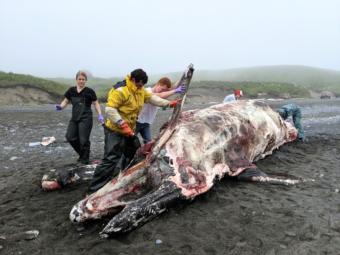
This stranded gray whale was discovered on Surfers Beach the first week of July.
This stranded gray whale was discovered on Surfers Beach the first week of July. (Photo by Kavitha George/KMXT)

Yet another gray whale washed up in Alaska this month, this time on Kodiak’s Surfers Beach. These strandings are becoming increasingly common, but scientists still don’t have a solid picture of what’s going on with the population.

Whale necropsies are a multisensory experience. Stand downwind and you’ll get the pungent smell of ocean air mixed with quickly-decomposing organs. Walk a little closer and you’ll soon see the sheer volume of blood and guts that comes out of the giant mammal.

Then, of course, there’s the squelch of blubber on the sand — and in this case, the loose-helium-balloon sound of gas escaping from a cut into the side of the whale.

“Expected, but I didn’t expect it,” veterinarian Emily Iacobucci laughed in surprise, knife still in hand. “Like, it totally makes sense, but I didn’t expect that to happen.”

Iacobucci explained that the inside of the whale was rotting, and the resulting gases have expanded the whale’s belly.

“So I just released it. That might keep happening, I’m hoping that was, like, the most explosive one,” she said.

It kept going for another two minutes straight.

Emily Iacobucci climbs on top of the gray whale to help volunteers strip blubber.
Emily Iacobucci climbs on top of the gray whale to help volunteers strip blubber. (Photo by Kavitha George/KMXT)

This gray whale is the seventh one to show up on Kodiak this year. It’s a juvenile male, nearly 30 feet long. Veterinary pathologist Kathy Burek flew down from Anchorage for the dissection. She said despite the smell, it’s the freshest specimen she’s seen this year — dead for probably less than a week.

As of July 18, 189 gray whales have washed up dead along the West Coast this year according the the National Oceanographic and Atmospheric Administration, and scientists like Burek are still trying to figure out why.

Beached gray whales used to be relatively rare, Burek said.

“Normally most years we don’t see a single gray whale,” she said. “It’s usually every couple years we might have a necropsy.”

This year, it seems gray whale necropsies are becoming almost commonplace, but each new specimen adds a little more clarity to the picture. As gray whales complete their migration to the Arctic for the summer, Burek said many whales — including this one at Surfers Beach — have been on the thin side.

“I’ve not seen one yet that I’ve been convinced was absolutely emaciated. They look thin to me,” she said. “The blubber doesn’t have a whole lot of fat in it. The profile of the animals look a bit shrunken.”

One explanation is that the whales have outgrown their food source. And with that, she said, “You have to talk about the climate change issues, because there’s been so much change in the temperatures of the waters. Pretty much we’re seeing an ecosystem-wide change right now.”

Another possibility is the spread of harmful algal blooms around southern Alaska. Toxins produced by the algae can harm and even kill marine life. And Burek said she’s not ruling out the possibility of disease among the whales either.

But this gray whale seems to have met a different fate. Burek and Iacobucci are pretty certain an orca killed it. It’s missing its tongue — that’s a pretty common sign of orca predation — and has rake marks and large bruises along its body.

Iacobucci said even if this whale’s death seems like a one-off, it doesn’t mean that the necropsy won’t deliver answers about the larger population. She said there’s always the potential that he had multiple things going on that made him easier prey.

“That’s all speculation, but it’s just the reason why you don’t go, ‘Oh his tongue’s missing, so end of story. We can all go home.’ We can learn a lot. Even if he was killed by orcas, we can learn a lot from him.”

Volunteers carve blubber off a dead gray whale on Surfers Beach in July.
Volunteers carve blubber off a dead gray whale on Surfers Beach in July. (Photo by Kavitha George/KMXT)

Back at the beach, volunteers sifted through the whale’s gooey insides to collect samples in plastic bags and small vials. For the most part, the organs looked intact. Iacobucci said some samples might be used for a chemical analysis, others to look for parasites or tissue condition.

Emily Iacobucci holds the gray whale’s eyeball cut open. Samples taken from the eye will be tested for algal bloom toxins.
Emily Iacobucci holds the gray whale’s eyeball cut open. Samples taken from the eye will be tested for algal bloom toxins. (Photo by Kavitha George/KMXT)

“The one that I was just taking (was) of the eyeball,” she said, holding two halves of a cut-open eyeball in her gloved hands. “We’re interested in (it) because it helps us look for evidence of toxic algal bloom toxicity. Certain types of tissues in the body will concentrate some chemicals, so the eyeball is a nice one.”

Gray whale populations in general are higher in number than they have been in a long time. But with strandings this year well above the 18-year average, NOAA declared an “unusual mortality event” for the animals in May.

It will probably be years before scientists can make any conclusions about the recent deaths, just taking into account the time it takes to gather a statistically significant number of samples and compile the results. Each necropsy, including this one, provides a data point that helps scientists understand the whales and their environment a little better.

In the meantime, NOAA reminds beachgoers that if you see a beached whale or other marine mammal, it’s illegal to mess with the specimen yourself. Instead, they say to call the Alaska Marine Mammal Stranding Network hotline at (877) 925-7773.

Editor’s note: Necropsy samples were collected under the MMHSRP permit #18786.

An end to school bond debt reimbursement could hike local property taxes

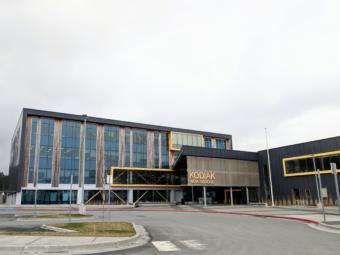
The bonds that helped pay for construction of Kodiak High School are at risk of losing state reimbursement.
The bonds that helped pay for construction of Kodiak High School are at risk of losing state reimbursement. (Photo by Kavitha George/KMXT)

The recent House Finance Committee vote to end school bond debt reimbursement could have major implications for property owners in some municipalities.

In Kodiak, the reimbursement program provides state assistance to the local borough to pay off debts associated with school building expenses. Without it, the island is looking at shouldering that outstanding debt alone.

Kodiak Island Borough currently has $89,500,000 in outstanding school bond debt. That’s split over 11 series dating back to 2004.

Each series of bonds was approved by borough voters and by the state of Alaska to fund a number of school district projects over the years, including building Kodiak High School and getting regular maintenance and repairs done.

According to the reimbursement agreements, the state signed on to cover 60%-70% of each bond series. That’s a significant chunk when you consider that a single series might be $10 million. Without the program, the state passes that expense to the borough — and in Kodiak’s case, quite likely to property owners.

If the amendment to end the reimbursement program makes it into the final state budget, the borough is looking at shouldering $5.2 million of additional debt payments for the 2019 fiscal year. That’s on top of the $2.5 million it’s already paying using borough property taxes.

“If in fact funding for that whole program is cut, there’s not particularly a whole lot of options,” said Borough Mayor Dan Rohrer. “The borough assembly would need to decide what to do, but there’s not a tremendous amount of options in front of them, given that the borough’s general fund budget is $6.7 million. ($5.2 million) is not something we can just cut out of our general fund.”

And that has Kodiak residents concerned about major property tax hikes.

“You raised something like $14 million in property taxes last year. You’re not just going to raise property taxes, what, 38% to come up with another $5 million?” longtime Kodiak resident and former assembly member Mel Stephens said at last week’s assembly meeting. “It’s a big, big deal.”

Rohrer estimates that to cover the additional $5.2 million through property taxes alone, the borough would have to raise the rate four mills, or approximately 37%. On a $300,000 house, that would translate to a $1,200 tax hike. While the decision would ultimately be up to the assembly, it’s important to note that there is no set limit to the mill rate for taxes being collected for school bond debt.

While the state did commit to paying its share when each bond series was established, it’s actually not under any kind of legal obligation to continue doing so. And that’s something that was made clear to voters when they approved each series, Rohrer said.

Alaska Gov. Bill Walker talks about the state’s budget on June 1, 2016, during a press conference in Juneau. (Photo by Rashah McChesney/KTOO)

Two years ago, he remembers, then-Gov. Bill Walker opted to cut 25% from the pool of reimbursement money.

“That year what we did was, we basically worked really, really, really hard to cut borough budget and not change the borough property tax rate at all,” he said.

But with that exception, Rohrer said voters were generally willing to go along with the reimbursement program, because the state had been consistently paying its share over the years.

“You gotta remember, historically the program has been 100% funded with the exception of the one time from Gov. Walker. So you know, I think people relied really heavily on the past actions of the Legislature to fund commitments they had made to the public.”

Assembly members at last week’s regular meeting expressed their deep concern at the prospect of paying off school bond debts without help from the state. In her comments, assembly member Julie Kavanaugh said she was concerned from the start that projects like the new high school weren’t guaranteed state funding.

“Unfortunately that’s come true. Now we’re faced with the reality of people thinking that money was gonna be there, that it was promised to us,” Kavanaugh said. “But it was only promised for a short period of time.”

Rohrer said both he and Kodiak City Mayor Pat Branson are willing to go to Juneau to argue their case for continuing the reimbursement program. With or without it, he added, the borough’s school bond debt is scheduled to be paid off by 2036.

Kodiak City Council approves new marijuana retail store application

marijuana in hand
Marijuana. (Creative Commons photo by Katheirne Hitt)

A Kodiak dispensary is one step closer to opening its doors after getting City Council approval on Thursday. For now, High Rise LLC won’t be authorized to sell edible marijuana products.

The Kodiak City Council moved to approve an application for a new marijuana dispensary in downtown Kodiak at Thursday night’s meeting. The retail store application was brought forward by High Rise LLC. Its owner, local resident Jack Schactler, assured the council that the company would be locally owned and operated during the public hearing section of the meeting.

“We will create multiple new jobs for the people of Kodiak, as well as tax income for the city,” Schactler said. “As marijuana advocates, we are excited to provide this new retail service to the people of Kodiak in the most professional way possible.”

Half an hour later, Councilman Randall Bishop proposed the council move forward with a letter of non-objection with conditions. In this case, that the dispensary be prohibited from selling edible marijuana products.

According to Forbes, other pot-friendly states like Colorado and Washington have seen edibles sales skyrocket in the last few years, especially as the smoking rate among adults declines. Bishop acknowledged that point in his closing statements, explaining the city council’s approach to the relatively new industry as cautious.

“We are definitely not opponents of edibles,” he said. “Just to clarify, I believe we decided to, maybe in a year, take a look at it and just take that conservative approach for the community to feel safe towards our youth and whatnot as this is a new industry prospering in our community. With everything that is new comes a lot of unknown variables that will get figured out.”

Schactler said Friday that he wasn’t surprised by the city’s choice to prohibit to edibles sales, adding that he hopes the regulation opens up in the future.

“It’s more of a conservative approach, which is fine,” he said. “We just need to show everyone that marijuana is just a normal business. This is strictly business, this is not anything different than the liquor store down the street.”

The motion to issue a letter of non-objection with conditions passed unanimously among the five City Council members present. Schactler says High Rise LLC will have another public hearing before the Borough Assembly on April 18, then a state board hearing, and finally a business inspection. He says he expects the company will open for business no earlier than June.

Coast Guard personnel to receive Dec. 31 paychecks despite government shutdown

USCGC Maple pulls away from Coast Guard Station Juneau. (Photo by Matt Miller/KTOO)

After some uncertainty, U.S. Coast Guard personnel and retirees should be getting this week’s pay, which is good news.

However, the system put into place that allowed the current checks to go out was a one-time only action, and future paychecks will depend on an act of Congress concerning the federal budget.

That’s according to an update posted on Coast Guard All Hands, the official blog for Coast Guard workers. The post says that meeting payroll in January “will require a fiscal 2019 appropriation, a continuing resolution, or passage of an alternative measure.”

There was some confusion last week as to whether or not Coast Guard members would get paid this week. The All Hands article said that the Coast Guard has no authority to pay its members during a lapse in appropriations.

However, because of the timing of the shutdown and the timing of the pay process, the Department of Homeland Security, which is the Coast Guard’s parent command, was able to determine that it did have the authority to execute the remainder of the December pay and allowances.

Pay or no pay, the Coast Guard will continue to do its job.

“During partial government shutdowns like this one, the Coast Guard continues operations to protect national security, life, property and the environment,” said Coast Guard spokesman Nate Littlejohn.

Littlejohn, who is based in Anchorage, said there will be some changes due to the shutdown.

“Activities like the renewals of merchant documentation and licensing and routine maintenance to aids and to navigation are typically postponed, as are some administrative functions, some training, and some maintenance to our boats, cutters and aircraft,” he said.

As for Coast Guard members, if the shutdown runs long and future paychecks don’t come, Littlejohn said there is support within the Guard.

“In the event that folks will be negatively impacted economically, we do have something called the Coast Guard Mutual Assistance program, which is basically a loan that the Coast Guard can provide to folks who are in a tight spot,” he said. “But we’re all here for each other during this difficult time.”

Cameras could replace onboard human observers for some fishing boats

How an electronic monitor sees and records fishing activities. (Photo courtesy NOAA)

Pot cod and longline vessel skippers fishing in federal waters have until Thursday to decide whether they want to sign up for electronic monitoring for 2019.

The electronic monitoring program uses cameras and recording equipment to keep track of the kinds of fish coming on board, as opposed to the more traditional way of bringing human observers on board a vessel.

Abby Turner-Franke is with the North Pacific Fisheries Association based out of Homer.

She says vessels 60 feet and under can now sign up for the program.

“So for pot cod fishing vessels you’re going to have three cameras on board that are watching the deck from different angles so that an observer that’s reviewing that video can tell what’s coming on board, how many, what species,” she said. “They work directly with the crew of the vessels to establish what the best angles are, what the best placement is for their fishing practices. It’s very customized to each vessel. So they get pretty great data.”

Turner-Franke says electronic monitors don’t get seasick, don’t get distracted, and don’t need any extra space onboard.

“I wouldn’t put it in terms of better or worse, but it’s very different,” she said. “Human observers are capable of taking biological samples that a camera can’t.  However, it also takes an extra bunk to carry a human observer, so having a camera onboard is a huge bonus, especially for vessels under 60 feet.”

Again, that deadline to sign up for electronic monitoring is Thursday, November 1.

Site notifications
Update notification options
Subscribe to notifications