KMXT - Kodiak

KMXT is our partner station in Kodiak. KTOO collaborates with partners across the state to cover important news and to share stories with our audiences.

New study links 2015 seabird die-off to food scarcity during the ‘Blob’

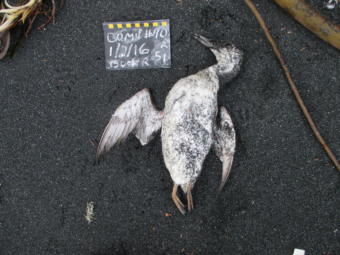
A recently dead common murre found by a citizen scientist on a routine monthly survey in January 2016. (Photo courtesy of Coastal Observation and Seabird Survey Team)

Alaskans may remember a few years ago, when huge numbers of common murres, a type of northern seabird, were washing up dead onshore. A new study from the University of Washington links the large die-off up to food scarcity during a period of extremely warm water temperatures.
In the fall of 2015, U.S. Fish & Wildlife Service biologist Robin Corcoran remembers over 100 murre carcasses lying beached in Kodiak’s Pasagshak Bay.

“Late August, early September was when we started to see a large number of birds dead on the beach and also birds just coming out of the water.” Corcoran said. “They were weak. Their plumage was pretty shabby. They were no longer waterproof. They were just starving to death.”

And that’s because with warming ocean temperatures, murres were losing their food source.

When the last “Blob” hit the Pacific, an area of the ocean larger than Canada experienced surface ocean temperatures rise as much as 7 degrees, completely altering the marine ecosystem for more than two years. The result was havoc in the food chain.

“It didn’t extinct anything but it just changed the rules of who was a winner and who was a loser,” said Julia Parrish, a professor of marine sciences at the University of Washington.

She said the ecosystem shift started with phytoplankton. Nutrient-rich cold-water phytoplankton began dying off, replaced by new, warm-water phytoplankton.

“The new species were smaller and not as energy dense. So less like a Clif bar, more like a rice cake. And all of that meant that the predators had to eat more to get enough to eat.”

Without a reliable source of phytoplankton, forage fish started to dwindle. And with fewer forage fish to eat, murres began to starve. In the span of about a year, Parrish estimates one million birds died from California to Alaska.

“I would say a million is a round number. I would also say it’s probably a conservative one,” she said. “It’s highly likely that more than a million birds died.”

In January 2016, 6,540 common murre carcasses were found washed ashore
near Whitter, Alaska, translating into about 8,000 bodies per mile of shoreline — one of the highest beaching rates recorded during the mass mortality event. (Photo courtesy of David B. Irons)

For climate scientists, murres are an excellent indicator of how some other marine species, like cod, are doing. And that’s simply because murres and cod eat the same forage fish. It’s no surprise then that Pacific cod have also experienced a sharp decline in the same Blob-affected areas that murres did.

NOAA fisheries biologist Steve Barbeaux has studied the cod crash for years. With another marine heat wave looming, he says murres are something to watch for this winter.

“If we see — like we did during the first heat wave — huge die off in murres, that would not be good for the cod population,” he said. “If the murres are starving to death, that means there’s not enough forage out there. And unfortunately, with the cod metabolism being so high, they could quickly end up in the same boat that we were at during the last heat wave.”

As far as recovery goes, Parrish says the outlook for murres is murky.

“I think that the warming ocean poses an uncertain future for murres,” she said. “I don’t believe that they are going to go extinct. But I believe the size of the populations that the marine environment can support will be lower.”

Parrish and Corcoran are among the authors of the new murre die-off study, released in the journal PLOS ONE on Jan. 15, 2020.

M/V Tustumena makes its last run before winter ferry service gap

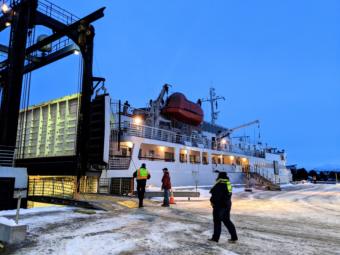
M/V Tustumena crew finish last preparations before they push off on Saturday, Jan. 11, 2020. (Photo by Kavitha George/KMXT)

Kodiak Island’s last ferry of the season pulled away from the dock on Saturday, Jan. 11, and there won’t be one returning until April. Aging vessels in need of repairs and cuts to the Alaska Marine Highway System budget have extended the service gap this year, making life for village residents more difficult in the meantime.
It’s Saturday afternoon, and Ouzinkie resident Fred Shanagin is sitting in a line of idling trucks waiting off to one side of the Kodiak pier. Everyone in this line lives in the remote villages of Ouzinkie and Port Lions, and they’re waiting to load up for the M/V Tustumena’s last run of the season.

“Just gotta make sure you have a lot of canned goods and like, paper towels, toilet paper, that kind of thing,” he says.

Shanagin’s truck bed is piled high with suitcases, cardboard boxes, even a bulk package of paper towels. With no ferry service for more than three months, he says he’ll still be able to make shopping trips to town, but it’ll be more expensive.

A little further down the line, Port Lions resident Melvin Squartsoff is bringing his boat back to the village after getting it fixed up in town. In winters like these, when frozen bays make boating over impossible, ferry travel is the safest way for people in Port Lions to get into town.

“It’s actually really terrible with no service over there in Port Lions for that long, makes it extremely hard in the winter months, especially when Anton [Larsen Bay] is frozen up, can’t come by boat,” he said. “And it’s expensive to have to fly over and take groceries and goods.”

When its running Squartsoff says he uses the ferry two to three times a month to get into Kodiak. That’s not uncommon. A lot of village residents will schedule their lives around ferry sailings, making trips for groceries and car repairs, collecting building supplies, or bringing an elder who isn’t comfortable flying into town for a doctor’s appointment.

Squartsoff says most people in Port Lions have a similar feeling about the winter service gap.

“Like we’re all getting the short end of the stick out of this deal somehow,” he says. “There’s got to be other solutions to this, you know, to be able to rectify the situation.”

Village residents are used to unpredictable ferry schedules — due to weather cancellations, delays, vessel repairs, etc. Winter service gaps are common too, but at more than three months, this year’s gap is particularly long.

Part of the reason for the gap is that both the vessels that service the island, the Tustumena and the Kennicott, are scheduled to be in overhaul for repairs at the same time this year. Department of Transportation and Public Facilities spokesperson Meadow Bailey said in September that overhauls happen every year, but repairs for the 22-year-old Kennicott and the 56-year-old Tustumena are more extensive this year.

A nearly one-third cut to the Alaska Marine Highway System budget last year has also resulted in a significantly pared-down sailing schedule.

Gov. Mike Dunleavy’s proposed budget for next fiscal year includes slightly more money for AMHS than this year’s budget, but DOT is already warning that coastal Alaska residents will continue to see long service gaps.

Sen. Gary Stevens, who represents many Gulf communities including Kodiak, says the proposed allocation isn’t good enough.

“We need to put more money into it. And we also need to address the fact that vessels are getting older. We need to replace the Tustumena,” he said. “If you’ve noticed that at this point, over half the fleet has been tied up for various reasons.”

Stopping in at the ticketing office, Tustumena Captain John Mayer says for the next few months he’ll miss stopping in Kodiak and seeing his usual passengers, many of whom he knows by name.

“Trusty Tusty” stickers for sale in the Kodiak ferry office. (Photo by Kavitha George/KMXT)

“They bring us food, smoked salmon… we’re part of the family,” he says. Asked how his passengers feel about the break in service, he replies “They’re very patient people. They put up with it. They don’t like it. People in Kodiak don’t like it, but we have no choice at this time.”

Half an hour later, with all the vehicles loaded up, the crew folds up the gangway and Captain Mayer yells a goodbye down to the ferry office staff.

“Keep our spot warm!” he shouts. “This is our spot, don’t give it away!”

“Okay, nobody can moor here while you’re gone!” staffer Camilla Jordan shouts back.

And just as they push off, Mayer honks out a Morse code letter “K” on the Tustumena’s whistle.

“Bye Kodiak! We’ll be back!” he says in farewell.

The next ferry to stop in Kodiak will be the Kennicott on April 25.

The M/V Tustumena pulls away from Kodiak on Jan. 11, 2020, beginning a ferry service gap of more than three months. (Photo by Kavitha George/KMXT)

DEC budget proposal puts small shellfish farming operations at risk

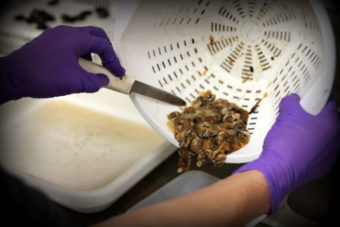
Sitka Tribe of Alaska fisheries biologist Jen Hamblen empties blue mussel meat into a blender.
Sitka Tribe of Alaska fisheries biologist Jen Hamblen empties blue mussel meat into a blender. The Sitka Tribe tests subsistence shellfish, but the only FDA and National Shellfish Sanitation Program-approved lab for commercially-grown shellfish in the state is in Anchorage. A budget item proposed in late 2019 would move the cost of paying for that testing from the state to the shellfish farmers. (Photo by Emily Russell/KCAW)

Margo Reveil and her husband have owned and operated Jakolof Oyster Co. in Homer’s Kachemak Bay for seven years.

“It’s primarily oysters,” she said. “We do a little bit of mussels and scallops, but they’re sort of a bycatch for us. Primarily oysters. I would say 99 percent.”

Reveil regularly sends samples of her oysters to a lab in Anchorage run by the state’s Department of Environmental Conservation (DEC) to make sure they’re healthy to sell. She spends around $100 to ship each sample — once a week in the summer and once a month in the winter.

The testing itself is paid for by the state. DEC Commissioner Jason Brune estimates it’s about $500 to $700 per test.

But Brune’s looking to shift some of that cost back to the industry, proposing that farms start paying half the testing costs. Eventually, he says, he’d like to see 100 percent of the testing fee fall to farmers.

“You know, for many industries the testing is paid for 100% by their industry,” he said.

The DEC lab in Anchorage is the only FDA and National Shellfish Sanitation Program-approved lab in Alaska, so it’s the only place in-state to get commercially grown shellfish tested. Brune says shellfish farms have had about a decade of completely subsidized testing, and now it’s time to start pulling back.

“We want to foster diversification of our economy,” he said, “but we also have to make sure that we’re paying attention to what should be funded and what shouldn’t be funded from the limited state resources that we have.”

Shellfish farmers in Alaska face unique challenges. It’s expensive to operate, and they’re often shipping product from far-flung areas, with unpredictable weather. Farmers like Reveil say it’s impossible to try to help the growing industry while taking away that state support.

“We can’t just raise [our] prices because we already have the competition of outside Alaska oysters, even Mexican oysters that we have to compete with,” Reveil said. “If the state wants to support this industry and see it grow into something viable, then there should be some state participation starting out.”

Oyster farming is a big commitment, according to Reveil, requiring at least 5-7 years of permitting and growing the oysters before farmers see a profit. The proposal, which would kick in in a matter of months if it passes, came as a shock. If it does pass, Reveil says they probably won’t be able to support selling oysters to Homer’s summer crowd anymore.

“It would probably push us into harvesting more in the fall, spring, winter months when we have fewer tests required,” she said. “But that’s also the more dangerous season to be over [at the farm] and harvesting, so it makes it all more stressful.”

And if they end up having to cover the full testing fee?

“At that point, it would just shut us down,” she said. “I just don’t see how a small farm can can manage that.”

The budget proposal is also a threat to farms trying to get off the ground. Erik O’Brien is in the permitting process for his oyster farm in the remote village of Larsen Bay, on Kodiak Island.

“There’s a thought that this can be an industry to diversify,” he said. “But if we throw up walls right now, I think that you’d see a lot more businesses change their perspective, go out of business and exit the industry.”

For O’Brien, shipping samples from Larsen Bay to Anchorage can cost $200 or more. That’s on top of already high fixed costs of shipping the oysters from the village to market. Add to that several hundred dollars in testing fees, and O’Brien says it’s going to limit the kind of sales he can make.

“If my fixed costs increase due to tissue samples of $700 then I have to sell 1400 oysters, just to cover fixed costs,” he said. “So now my minimum sale is couple of thousand. And that really reduces the number of people that will be able to buy that product.”

This budget item is still a proposal, subject to consideration by the legislature, which convenes next month. Brune says if it does pass, they’ll be looking to get industry comments to determine how quickly to shift testing fees to farmers.

Sand Point’s fish plant closed for the winter because there’s not enough cod

Wind turbines over the Sand Point harbor. This year is the first that Sand Point’s fish plant won’t be processing cod. (Photo by Zoë Sobel / KUCB)

The precipitous drop in Gulf of Alaska cod recently closed the federal fishery for the upcoming season. Its effects are also being felt by processors who rely on the fish for their winter workload. The Trident Seafoods plant in Sand Point closed last month for the winter, leaving a gaping hole in the city’s budget, and sowing uncertainty about the future.

The city of Sand Point was founded on cod. Settled less than 150 years ago, it’s had a processing plant in some form for nearly a century. This year is the first that the plant, now owned by Trident Seafoods, won’t be processing cod — and that’s because of climate change.

“It’s no fault of the plant at Sand Point, however, there’s not enough fish to process. So for the first time in my life, it’s closed,” Paul Gronholdt, an Aleutians East Borough assembly member testified at the North Pacific Fisheries Management Council meeting earlier this month. “That’s going to be pretty devastating to Sand Point and it’ll hurt the other communities in our region too.”

A massive marine heat wave known as “The Blob” began decimating Gulf cod stocks five years ago, and this year saw the lowest cod numbers on record.

With so few fish to process, Trident closed the processing line on November 8 and notified the city in an email the same day, according to city administrator Jordan Keeler. Trident declined a request for an interview.

“This was not expected at all. This is the first time in recent memory — or long memory actually — that it’s happened,” Keeler said.

In a fishing town of just under a 1,000, a large employer industry forced to close for six months is a huge blow. At peak seasons, the plant employs as many as 400 people. Keeler says many of them are out-of town seasonal workers, however, so the biggest impact might not be unemployment, but rather the loss to the city’s tax base.

“We’re looking at a significant loss of raw fish tax, as well as a loss of sales tax revenue because the fleet isn’t buying fuel, gear, paying for repairs of their boats,” said Keeler.

In the months the plant is closed, Keeler estimates they’ll lose half of their $600,000 sales tax budget and another $160,000 out of a $400,000 raw fish tax budget. Keeler says the city has a cash reserve it can use to fill in those holes, and they’ll reevaluate in the spring.

But he says the community will feel the loss regardless.

“We expect to see you know, a reduction in purchases at the store. That’s for sure,” he said. “How it impacts people buying airline tickets, or buying consumer goods — if there’s less money, there’s less money to spend.”

The Trident plant processes salmon, halibut, and sablefish at various times of the year, but winters are mainly cod and pollock, brought in from Sand Point’s own fishing fleet as well as boats as far away as Kodiak.

For now, Keeler expects Sand Point will just have to ride out storm and hope for better conditions next year.

Akhiok’s new power system opens the door to renewable energy, and reduces costs

Akhiok Mayor Dan McCoy, left, talks with former Kodiak Island Borough Mayor Dan Rohrer inside the existing powerhouse in August 2018. (Photo courtesy of Tyler Kornelis)

The Kodiak village of Akhiok’s power grid supports 73 people: about 25 homes, a school, a clinic and the tribal and city offices. Like many remote villages in Alaska, it runs on a diesel generator and an aging power grid buried underground.

“It’s failing,” said Akhiok mayor Dan McCoy. “The infrastructure is just is so old. And the grid, the wires that are in the ground are just basically rotten.”

McCoy doubles as the village’s electrician. He’s been working to get the system replaced for 10 years.

Right now Akhiok’s electricity rate is the highest on the island. At 80 cents per kilowatt-hour, it’s more than five times the city of Kodiak’s rate. One reason it’s so expensive, according to McCoy, is that Akhiok’s worn down grid loses about 25 percent of the electricity it generates to line loss — basically, leaking into the ground instead of traveling through the wires.

On top of that, he said, the whole village experiences about two power outages a week.

“I might not be able to get it back on for a week to certain sections of the village, depending on how long it takes me to find the dead short in the ground,” he said.

With grants from the Denali Commission, the state of Alaska and the United States Department of Agriculture, the entire grid plus the power generator are slated to be replaced by 2021. The new system comes with estimates of a 15 to 20 percent improvement in energy efficiency, and with it, lowered electricity bills for Akhiok residents.

It will also integrate a heat recovery system, taking heat from the new powerhouse’s exhaust and using it to heat the school building, effectively cutting the school’s heating bill in half. And it’s set up to be compatible with alternative energy sources, like solar panels.

“As soon as they get the new power plant, we can start applying for funding,” McCoy said. “Right at the moment we don’t have the capability to introduce solar or wind into our grid. But in a year we will have, when the new power plant is complete.”

Kodiak Area Native Association project manager Tyler Kornelis has been working with McCoy on the process. They’re working on a feasibility study to determine what kinds of renewable energy would work best for the village. He says Akhiok could serve as a model for other villages looking toward efficient, and potentially renewable, energy systems.

“I think if we could develop a community scale solar project in a remote micro-grid community like Akhiok, it would be great to share with other communities so that we can replicate that,” he said.

The surveying and conceptual design phase of the project is done. McCoy and Kornelis expect the bidding process for construction to open up after Christmas, and are hoping for construction to begin this summer.

Increase in observer fees has people in the fishing industry questioning how their dollars are being spent

Jake Everich looks up at one of the electronic monitoring cameras installed on the winch of his trawler, the Alaskan. (Photo by Kavitha George/Alaska’s Energy Desk)

In Kodiak’s Dog Bay Harbor, Jake Everich is puttering around the galley of his trawler, the Alaskan. He bought his boat in March to fish for rockfish and pollock around the Gulf of Alaska. It’s just under 75 feet — a relatively small operation.

Everich is among the fishermen affected by a recent decision from the North Pacific Fishery Management Council to increase observer fees from 1.25% to 1.65% of their catch value. When he sits down at the little galley table with his cup of coffee, he doesn’t seem worried the fee hike will put him under.

“I would say for my own business, no, it’s not that tight that,” he said. “You know, 0.4% isn’t gonna put me into bankruptcy.”

He’s clear that he doesn’t speak for all vessel owners when he says that. In an average season Everich’s gross is about half a million dollars, so the bump to observer fees means an extra $2,000 out of his profit margin.

Jake Everich’s trawler, the Alaskan, docked in Kodiak’s Dog Bay Harbor. (Photo by Kavitha George/Alaska’s Energy Desk)

It’s not great, but it’s not unmanageable, he says. For Everich, the bigger issue is how that money is going to be used. He says the data observers collect, and sometimes observers themselves, can be unreliable.

“When the program first started, yes, there was large emphasis on using that data strictly for management, better understanding of the fisheries resource, but I feel that at this point it has devolved into something that we pay for, but it doesn’t do anything.” he said.

Observers are neutral data-collectors who go along on fishing trips. They watch to make sure everyone is following regulations, but they also collect biological data and information about bycatch.

Trawl boats like Everich’s, along with some other gear types, are in what’s called the partial coverage sector. That means that they only have to carry observers some of the time. Processors and boats in the partial coverage sector pay into a pool that’s used to pay for observers. The amount each boat pays is a percentage of whatever their catch is worth. Depending on funding, observers cover one in every six fishing trips, but it’s random — you might get assigned an observer three trips in a row, or not at all.

Historically, the federal government has helped to fund the program, but that money is likely going away, says Bill Tweit, Vice-Chair on the North Pacific Fishery Management Council. And without guaranteed federal money, the council has to look to the fleet for funding.

Tweit says the council doesn’t take increasing operating costs on fishermen lightly.

“We think there’s some ways of beginning to interject some cost containment in that and that’s the sort of thing we’re going to be working on over the next couple years,” he said.

The big cost-saving measure is electronic monitoring, or EM. EM systems use cameras and GPS systems, instead of a person, to collect data on board a vessel. They’re a lot more expensive up front when you consider installation and equipment, but Tweit estimates the daily cost of an EM system is roughly half that of a human observer.

“Electronic monitoring, as it moves from the developmental stage to fairly wide use — and you know, we’re at the point where it’s a well accepted, institutionalized program — we really see costs beginning to drop there as well,” he said.

EM systems are still quite new to the industry, and only in use on certain types of boats. Everich is part of a pilot program to test out the systems on trawl vessels.

Jake Everich stands in the engine room of his trawler, the Alaskan. The equipment to his right is part of the electronic monitoring system that collects data in place of a human observer. (Photo by Kavitha George/Alaska’s Energy Desk)

Down in the engine room, he points out how the system is rigged to monitor the boat. For Everich, EM eliminates the downsides of a human observer— the electronics won’t get seasick for instance. And he thinks, EM can provide better fishery management data.

“I think cameras would do a better job,” he said. “You know, I don’t have any issue with that. I just wish that we could return to better management of the fishery.”

EM developers still have to work out some kinks before they system is as prevalent as Everich would like, but he’s already looking forward to a fully electronic observer system. In the meantime, the observer fee hike doesn’t kick in until 2021.

Correction: An earlier version of this story incorrectly reported the observer fee hike costing Everich approximately $20,000 extra in an average year. The actual difference is approximately $2,000 extra.

Site notifications
Update notification options
Subscribe to notifications