KMXT - Kodiak

KMXT is our partner station in Kodiak. KTOO collaborates with partners across the state to cover important news and to share stories with our audiences.

Remembering Natayla Isatchenko: Kodiak’s walking contradiction

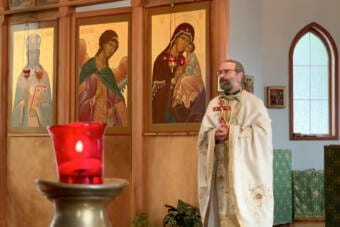
Natalya Isatchenko was remembered at the Kodiak Russian Orthodox Cathedral on Sunday, Aug. 23. (video still/Rhonda McBride)

Who was Natalya Isatchenko? She was a woman almost everyone in Kodiak knew — but really didn’t know. Everywhere and nowhere. Homeless but always at home, wherever she was. She was often seen walking the roadsides, as she did the morning of Aug. 19, when she was killed by a hit-and-run driver on West Rezanof Road near Pier III.
In many ways she was a fixture in town, but also invisible. She moved about, mostly unnoticed, except by those like Roman Carlson who occasionally interacted with her.

Carlson works at the library, where she was one of the regulars.

Roman Carlson, standing by a painting at the Kodiak library. The library worker says it was the fisherman in this painting that Natalya Isatchenko would talk to. (courtesy Roman Carlson)

“We have a picture on the wall she would come and talk to,” Carlson said. “I always had the impression it looked like somebody she had known in the past.”

Carlson hadn’t seen her much after the library cut back its hours due to the coronavirus, so the news of her death hit him hard.

“It really made me sad, just because she died on the road with nobody there,” Carlson said. “It’s how she lived. Her life was pretty solitary. I don’t think that’s any way that somebody should leave this world is alone.”

Carlson said he didn’t try to engage her in conversation. He sensed she wouldn’t welcome it, even though she was always talking.

At Big Ray’s outdoor clothing store, she would occasionally sit at a table at the entrance, and the staff would bring her coffee.

Erik Berggren says he was always careful to warn new staffers about Isatchenko’s visits.

Eric Berggren describes how Natalya Isatchenko would come into Big Ray’s with pieces of fruit and leave them on the railing for the bear. (Rhonda McBride/KMXT)

“Don’t worry. Don’t worry. She won’t hurt anything,” he would tell them. “She won’t steal anything. She doesn’t break stuff. She just talks to people we can’t see.”

She also talked to the towering wooden bear carving that sits outside the store. And when she came inside, she carried on a conversation with a stuffed brown bear.

“She’d feed the one out front, like cheeseburgers. She’d leave this one pieces of fruit sometimes,” he said pointing to the stuffed bear behind a railing Berggren calls “the cage.”

He said she would try to show the bear her offerings, then lay them on the cage. Staffers would wait to clear them away until after she left. Now they won’t have to do that anymore, and that makes Berggren sad.

“We’re all going to miss her to a certain extent,” said Berggren, who said his staff came to enjoy her random visits. “It’s something we’ve become accustomed to, and it’s not there now.”

Natalya Isatchenko (Rhonda McBride)

If anything, the town had become accustomed to living with the mystery of Natalya Isatchenko. Her story is not known to the public at large, not even to Mike Rostad, a longtime Kodiak newspaper columnist who met her years ago when he worked at the Arc and Spark store and welding shop, where a toy dragon sat on the counter.

“And her eyes just lit up,” Rostad said. “And in a very soft, sweet voice and a very nice tone, she started speaking to this dragon in Russian.”

Those in Kodiak’s social service network said she sometimes would talk about the desire to go home to Kazakhstan, a former Soviet Republic in Central Asia.

Maybe that’s why she frequented the grounds of the Russian Orthodox Church along Mission Road.

Chris Dresdow, the pastor’s wife, tried to get to know her.

“Usually, if you went to offer her something, she would say ‘No. No. No. No. I’m fine. I have everything. I have everything,’” said Dresdow.

Even though her overtures were met with rejection, that didn’t stop Dresdow from trying. And one day not too long ago, she had a breakthrough when she tried to give Isatchenko some cake she had made, part of an experiment to prepare for her daughter’s wedding.

“Please help me. Please take some cake. I have so much cake. I don’t even know what to do with it,” Dresdow remembers telling Isatchenko.

“And then she said yes. And she turned. We look at each other and that was just kind of the beginning.”

Dresdow and her husband, Daniel, known to the Russian Orthodox worshipers in Kodiak as Father Innocent, had heard the speculation around town that her mental illness stemmed from a past trauma.

Father Innocent said he believed something must have happened, just from watching her.

Father Innocent points to the picket fence where Natalya Isatchenko would stand and pray. (Rhonda McBride/KMXT)

Occasionally he would see her standing next to a white picket fence near the wooden chapel at the church’s seminary. One time he watched her for about 20 minutes.

“She would make the sign of the cross repetitively, looking up at the cupolas and the crosses at the top of the church. It was one of those moments, even watching from 100 yards away, you could feel the grace and sacredness of the moment,” Father Innocent said.

He remembers the last time he saw her very vividly.

“Pouring rain. Pouring rain,” he said. “And she just stood out there in that same stance. Praying hands together, crossing herself, gazing up in the rain. She was past this earthly life in that sense. It was grace, true grace.”

Father Innocent says he will never forget her gaze.

“My blue eyes to her blues eyes. They seemed to look right through you,” he said. “It was sobering.”

In fact, there was something familiar about her face and her posture in prayer.

“Many times I saw her, I thought of St. Mary,” Father Innocent said, speaking of St. Mary of Egypt, who wandered the desert alone to atone for her sins. On church icons, she’s skeleton-thin, with gray hair, ragged and closely cut, just like Natalya — also a wanderer in search of what, we can only wonder.

“There’s hope that can be found even in these horrific circumstances of her loss, and part of that hope can be found in recognizing that she survived,” Father Innocent said.

Many in Kodiak wondered how. They, like Chris Dresdow, tried to offer food or comfort, but usually these attempts to reach out would drive her away, like a bird when you get too close.

But just a few weeks before she died, Natayla told Chris her story of heartbreak. It’s one Chris says she will never share because it’s the only gift she can give to Natayla now, her privacy.


Epilogue

Natalya Isatchenko was remembered at the Kodiak Russian Orthodox Cathedral on Sunday.

The bells rang as a choir sang an ancient hymn, Memories Eternal.

Father Innocent also shared some of her story, as relayed to him by her ex-husband, a retired professor who called him a few days ago from his home in Florida.

He told the priest they met in the 1990’s and were married in St. Petersburg, Russia. Later, they moved to the United States, where Isatchenko worked in a pharmacy and raised a son.

They visited Anchorage in 2004, about the time their marriage began to break down under the strain of her long struggle with mental illness.

For reasons unknown, mental breakdowns happen,” the priest told his congregation.

“In my speaking with her husband, it was very, very clear that he still loves her tremendously,” Father Innocent said, “and he was hesitant to contact me, because his experiences with the church, up until this time, were not very supportive of her struggle.”

In fact, he said, they made things worse.

“Natalya, over the years, was subject to every form of treatment that could be imagined by mankind. But still she was tortured by these voices,” Father Innocent said. “So, by the time that she came here to Kodiak, she left her husband for good, thinking he was one of the devils.”

Isatchenko died on August 19, two days after she had turned 62. That day not only marked her death but is also a Russian Orthodox holy day, known as the Feast of Transfiguration, the day that Christ took his inner circle of disciples to a mountain and his face and his clothes became bright with light.

“It took the wind out of me,” Father Innocent said of his reaction to hearing the news of Isatchenko’s death. “She died on one of the major feasts of the church.”

“When one is received by God on a feast day of the church, it is considered a great grace, a great gift of god’s love.”

The priest told the congregation that although Natalya Isatchenko chose to live in the community’s orbit and was often hard to reach, Kodiak accepted her for who she was — and that her life and death are a reminder — that except for the love of God and family, there is no greater love than the love of our neighbors.

Kodiak spaceport asks for longer window after canceled launches

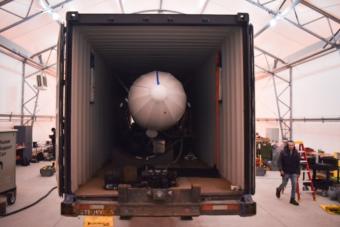
The nose of Astra’s Rocket, named “One of Three,” pokes out of a shipping container at the Pacific Spaceport Complex on February 21, 2020. (Photo by Kavitha George/KMXT)

The Alaska Aerospace Corporation says the windows for recent launch attempts at Kodiak Pacific Spaceport were too narrow. Astra, a California-based company, tried to send its 3.1 rocket into space on four different days, each within a two-hour window.

The president of Alaska Aerospace, Mark Lester, says it’s not unusual to have launches called-off during the testing phase, but a bigger window might improve the success rate.

“We’re negotiating with the FAA, the Coast Guard and others to determine if two hours is most appropriate or if we can negotiate a slightly longer window,” Lester said.

The FAA and Coast Guard must sign off on launch windows and consider the impacts to trans-Pacific flights and the fishing fleet. Lester says Alaska Aerospace hopes to expand the window by an hour, or at least by 30 minutes, which might have made some of the recent canceled launches possible.

The Sunday, Aug. 2 launch was scrubbed after a boat wandered into the safety zone.

“For public safety, we closed the launch opportunity,” Lester said. “That’s unfortunate, because the speed of the boats takes a couple of hours to get through the closure areas.”

They had to call off three more launches that week, all for different reasons: delays in loading rocket propellant, a problem with the rocket’s drainage system and strong winds in the upper atmosphere.

The new launch schedule starts on August 30 and ends on September 3. For now, the FAA has only approved a two-hour window for each launch attempt.

Astra hopes its 3.1 rocket can drive down the costs of sending rockets into space. It’s smaller in size — compact enough to fit into a shipping container and be towed by a truck — but capable of sending a satellite into low orbit.

Lester says the rocket, if it’s successful, could open up a lot of economic opportunity for Alaska. He says launch vehicles like the Astra 3.1 are needed for telecommunications and monitoring the earth as well as for military and government ventures.

In Kodiak, 26 new fisheries-related cases of COVID-19

Workers processing fish at a salmon processing plant.
Workers at a Kodiak Island seafood plant. (Eric Keto/Alaska’s Energy Desk)

The recent rash of COVID-19 outbreaks in the seafood industry has spread to the Kodiak Island Borough.

The community had 26 non-resident cases “in a remote area of the borough,”the Kodiak Area Emergency Services Organization said Wednesday. They did not name the area.

All of the people who tested positive are nonresidents and work in the seafood industry.

Public health officials say the new cases have been successfully isolated and have not spread to nearby communities, so the threat level for the Kodiak region is still low, or in “green” status.

The new cases bring the count for the Kodiak region to 58. Currently, 42 of those cases are considered active. Since August 1, the number of cases has more than doubled.

Out of the 58 cases, only four have been classified as community spread.

Kodiak man recovering after bear attack on Pillar Mountain

A Kodiak brown bear. In the attack, Don Zimmerman suffered a broken forearm and bites to his thigh and calf. (Steve Hillebrand/USFWS)

Don Zimmerman is a legend in Kodiak. At 71, with a Willie Nelson-like mane of hair, he races up and down Pillar Mountain with the energy of someone decades younger. And now the legend continues. He survived a bear attack Sunday near a gravel pit on Pillar Mountain, on the outskirts of Kodiak.

Zimmerman, the owner of Sutliff’s Ace Hardware in downtown Kodiak, managed to use his cell phone to call for help. Kodiak police say his call came in at 11:35 a.m., and officers were on scene in about 15 minutes. More help continued to arrive — a state trooper, wildlife officials and medics. They had their work cut out for them.

The rescue team hiked about a half mile from the road, working their way down a steep incline to reach Zimmerman and carry him out on a gurney, which was eventually hoisted with a rope to the ambulance.

At first, police thought his injuries could be life-threatening.

Zimmerman’s son, Dave, said it might have looked that way because his father was covered in blood. But, he said, while his father remains hospitalized, his condition is improving. He expects him to make a full recovery.

Zimmerman suffered a bite to his thigh, a puncture wound in his calf and a fractured forearm.

Zimmerman said his father told him he didn’t have time to be afraid. The bear came out of nowhere, attacked in a matter of seconds, retreated and then returned. He said his father was able to keep the animal away with bear spray.

“He’s been running that same trail for 40 years,” Zimmerman said about his father. “And he’s never seen a bear. He’s probably run that trail 5,000 times.”

Wildlife officials searched for the bear without success. Volunteers flew the area with drones. Shots were fired to flush it out.

Investigators called the attack a mystery. They don’t know whether the bear lashed out because it was surprised or whether it was protecting a deer carcass or some other food. But the search did not turn up any evidence of that.

In the meantime, warning signs have been placed in the area, and Kodiak Police Lt. Francis de la Fuente urged people to take precautions in the backcountry.

A wayward boat scuttled Astra’s launch attempt Sunday. They’ll try again Tuesday.

Astra rocket “One of Three” is set up to mount at Launch Pad B on February 24, 2020. (Photo courtesy DARPA).

Astra’s first launch attempt from the Pacific Spaceport Complex was scrubbed Sunday evening.

The launch seemed like a go, with only a slight delay for winds. But about 15 minutes from launch, a boat had wandered into the waterway hazard zone, an area south of Narrow Cape that must be clear for the launch.

According to Alaska Aerospace, which manages the launch complex, they hire a boat to position near Ugak Island and communicate with nearby vessels about the hazard zone when a launch is scheduled. With about ten minutes to launch, they could not clear the wandering boat before the launch window closed, so the launch was scrubbed.

Due to weather conditions, Astra will not attempt a launch today, but they’ll try again Tuesday.

Astra, a California-based aerospace company, is attempting to test launch Rocket 3.1, a small rocket capable of delivering small satellites to low orbit.

“We believe in achieving scale by making a relatively small launch vehicle that is very inexpensive to produce,” said Astro CEO and founder Chris Kemp. “Our objective is daily space delivery.”

Kemp says the small rocket has its advantages.

“We are keeping the rocket small so that we can focus on the small satellites,” he said. “At the very largest scale, we intend to be able to deliver one communications satellite to one of these mega-constellations that are being developed.”

The rocket itself is 38 feet long and designed to hold 55 pounds of payload, but no payload will be on the test flight.

Mega-constellation is the term used for a huge assortment of satellites in low orbit that work together to provide internet access all over the world. This is an alternative to terrestrial broadband and may be more reliable and faster for rural populations, including remote Alaska, according to the Department of Defense.

But a concern among local rocket launch critics is emissions, especially emissions that get into ocean waters.

Astra Chief Technical Officer Adam London says the emission footprint for this rocket is relatively small.

“Most of the rockets, in fact all of the rockets, launched before ours in Kodiak are solid propellants,” London said. “So they have in their exhaust aluminum and various other things. Our exhaust is primarily water, some carbon dioxide and various small chemicals. From an emission perspective, we are quite a bit more benign than other rockets that have traditionally been launched from Kodiak.”

Kemp compared the rocket’s emissions to an airplane’s.

“If a 737 flies over, the exhaust from jet engines typically contribute more hydrocarbons to the atmosphere than our rocket,” he said. “The rocket stays over Alaska for a short period of time before it heads down range. We like to say, if you planted a tree during every one of our launches, you would offset the CO2 from our launch.”

Astra’s objective is to achieve first-stage separation so that the rocket can reach orbit and release a payload. But they are also here to learn.

“Pretty much everything we learn is the additional upside,” Kemp said. “We’ll be delighted if that upper stage lights, and teaches us something so that our next flight can be more successful.”

Earlier this year, Astra attempted a launch as part of the defense department’s Defense Advanced Research Projects Agency challenge. The launch failed, but Astra said they made some hardware and software changes, including valves that had failed due to overpressurization.

Fixing those problems during COVID-19 was a challenge. They had to furlough employees and faced disruptions to their supply chain of over 1,000 vendors.

Astra brought a smaller crew to Kodiak than usual. For previous launches, they had up to 30 launch staff. This time they have six.

Alaska Aerospace CEO Mark Lester explained that for past launches, 75% of staff were from out of state. As launches are increasing, Lester says 75% of the launch staff is now from Kodiak, and 90% is from Alaska.

Staff brought to the island for the launch have all tested negative for COVID-19. As part of their mitigation plan with the state, staff are wearing masks, implementing social distancing and increasing cleaning procedures.

Tuesday’s launch window is from 6:30 pm – 8:30 pm.

Astra will not be providing a live stream of the launch, but you can follow them on Twitter for live updates.

Tsunami warning reveals COVID-era oversight: masks

Kodiak residents gather after a tsunami warning on July 21, 2020 (Rhonda McBride/KMXT)

This week’s late night tsunami warning prompted many residents of Kodiak to load up their emergency supplies and seek higher ground.

The Kodiak emergency operations center keeps a list on its website of emergency supplies recommended by the Federal Emergency Management Agency. It includes items like prescription medications, first aid kits, sleeping bags and even books and games for kids.

But with this emergency occurring during a global pandemic, one thing was not on the list: masks.

“From the hospital standpoint, we had individuals in our parking lot and I saw a lot of people without masks. But at least there was a breeze blowing, and you’re outside, so that’s a positive factor. But it was also concerning that I’m not seeing as many people as I’d like wearing a mask,” said Dr. Steve Smith, an emergency room doctor with Providence Kodiak Island Medical Center.

He says now is a good time for people to update their emergency supply kits.

“Things you have to think about in your emergency preparedness kit now is maybe add a mask in,” he said.

With hundreds of people gathering at evacuation points such as Kodiak High School, Dr. Evan Jones of the Kodiak Area Native Association is concerned with social distancing during an evacuation.

“If we were to have a natural disaster where people, suddenly we’re having to house people, we’d have to rethink the way we were planning how we do things and figure out how to distribute those people a little more, and spread them out into family groups rather than congregating in one place.”

And while evacuating a family to high ground can be stressful, Smith warned that COVID-19 might enjoy such spontaneous large gatherings.

“It would be really advantageous for the coronavirus, but not us, if everyone was together.”

The tsunami warning was triggered by a magnitude 7.8 earthquake south of Chignik Tuesday night. The warning lasted for about two hours, with no damage reported in Kodiak.

Site notifications
Update notification options
Subscribe to notifications