KMXT is our partner station in Kodiak. KTOO collaborates with partners across the state to cover important news and to share stories with our audiences.
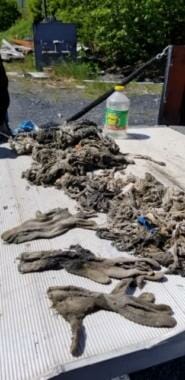
Masks and gloves found in Kodiak area sewers (Photo from Kodiak EOC Facebook)
Kodiak city manager Mike Tvenge has one request.
“If you use a disposable mask, please place it in the trash when it’s no longer effective,” he said. “Rather than disposing down the toilet.”
During a community COVID-19 briefing, Tvenge praised residents for taking precautions against the coronavirus. But he says improperly discarded gloves and masks have wreaked havoc on the city sewer system. Workers have also found disinfecting wipes plugging up pumps in the sewage lift stations.
A city spokesman said most of the clogged sewers are in Kodiak’s Cannery Row area.
The city recently posted a photo on its Facebook page showing a tangled mess of gloves, masks and wipes retrieved from the sewer. The post asks people to flush only toilet paper and human bodily wastes — and that even if the packaging for these products says they are “disposable” or “flushable,” they can still clog up the system.
Since April, Kodiak has had 16 cases of COVID-19. Most are travel-related. Health officials believe the weekly broadcasts from the Kodiak Emergency Operations Center and other community efforts have helped to curb the spread of the virus. So far, there have been no hospitalizations.
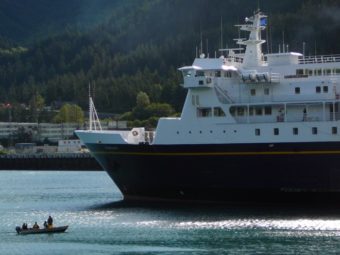
The mainline ferry Kennicott pulls out of Whittier as fishermen watch in 2011. (Photo by Ed Schoenfeld/CoastAlaska)
A passenger traveling on the Kennicott ferry has tested positive for COVID-19. The Alaska Marine Highway system says the traveler tested negative before boarding the Kennicott in Bellingham on June 27.
After extensive contact tracing, the State Health and Social Services Department says the passenger only had close contact with one person on the journey – a traveling companion who shared private sleeping quarters. It says the two wore face coverings when outside their cabin and kept six feet away from others while onboard.
The department says it doesn’t know when the passenger became infected or became contagious. The two travelers stayed on board until arriving in Whittier, then re-boarded the Kennicott on July 3 for a new sailing to Cordova, where the passenger tested positive for COVID-19.
The passenger had mild “allergy-like” symptoms and did not think they were caused by COVID.
The infected passenger is not a resident of Alaska. Both travelers have been isolated and are not having physical contact with anyone else.
It says this recent case is a good example of why it’s important to wear a mask and practice social distancing, because people can have a full range of symptoms — from being asymptomatic, to having only mild reactions.
Kari Millstein, Elinore Millstein and Linda Jackson hold signs in support of the Black Lives Matter movement in downtown on Sunday in Kodiak. (Photo by Kavitha George/KMXT)
Global protests continue as communities rally against the police killing of George Floyd — and countless other black Americans before him.
In Anchorage, Fairbanks and Juneau last weekend, hundreds of Alaskans turned out in solidarity with the Black Lives Matter movement, peacefully protesting against institutional racism and injustice. Kodiak joined in on Sunday with a small gathering of five community members.
When Kari Millstein woke up on Sunday, she says she just had to do something. She had been following the protests in Minneapolis, and decided that despite being on a remote island thousands of miles away, she needed to speak out against the “unchecked violence” against black people in America.
Elinore Millstein holds a sign reading “I stand for all” at the intersection of Rezanof Dr. and Mill Bay Rd. on Sunday. (Photo by Kavitha George/KMXT)
She says in Kodiak, it can be easy for people to look the other way.
“I think it’s easy for people to stay home. And no matter what they believe, just kind of keep it to themselves and not really make it known because they feel like this community is so isolated from the rest of the country that it doesn’t really matter what we say.”
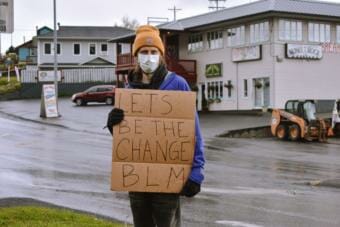
Millstein gathered a small group of friends and headed out to the main intersection in downtown Kodiak Sunday afternoon, holding a sign that said “End our silence / Stop the violence.” The response was mostly positive — drivers honked and waved in support. But a handful of passerby shook their heads in disagreement, and a few gave the middle finger.
Ron Jackson, a tattoo artist in Kodiak says the small negative response is frustrating.
“Because there’s nothing negative on any of our signs,” he said. “They’re literally saying that obviously, Black Lives Matter, that human lives matter. How can you argue with that, that these people are human beings that deserve the utmost love and respect. And to argue against that, it’s just so confusing to me.”
Jackson says it can be difficult to see the impacts of systemic police violence in a town where officers generally have a good relationship with the community.
“It’s the constant interaction. I tattoo the police officers, I’ve tattooed the police chief, I’ve tattooed the last police chief, like, you’re gonna see them in Safeway, you know. So no matter what job you have, you’re gonna encounter them on a personal level. And that’s something that we benefit from here, but does also kind of hinder our worldview.”
Ron Jackson holds a sign in support of the Black Lives Matter movement in downtown Kodiak. (Photo by Kavitha George/KMXT)
Kodiak has had experience with police brutality in the past. In 2018, the city of Kodiak settled a lawsuit with the family of an autistic Alaska Native man after police forcibly detained and pepper sprayed the man at close range.
Jackson says he would like to see police held more accountable in incidents like these. Former Minneapolis police officer Derek Chauvin was filmed pressing his knee into George Floyd’s neck on May 25 until the unarmed, handcuffed man suffocated. It took four days for Chauvin to be charged with murder and arrested.
“If either of us had done what just happened, we would have been taken into custody immediately, not four days later,” Jackson said. “He did not get taken into custody right away, which is insane.”
Scientists suspect heat stress killed a large number of summer chum salmon migrating through the Koyukuk River, a tributary of the Yukon. The carcasses held underdeveloped eggs and sperm, indicating that the salmon were far from their spawning grounds, where salmon usually die. (Photo by Stephanie Quinn-Davidson/Yukon River Inter-Tribal Fish Commission)
Over the last decade, two massive marine heatwaves, better known as “blobs” swept the North Pacific Ocean, raising surface temperatures more than 5 degrees Fahrenheit causing blooms of toxic algae and major die-offs in the ecosystem. A new study from the University of British Columbia reports that as these heatwaves continue, they may have far more devastating implications to fisheries than previously predicted.
Climate scientists have known for years that global warming would have devastating long-term impacts on marine species. Already, fast-melting Bering Sea ice is threatening spotted seals and other marine mammals. Warming Gulf of Alaska waters wiped out cod eggs in 2019, causing a crash in cod stocks. Record warm waters in the Yukon River last summer killed thousands of migrating salmon with heat stress.
While climate change is steadily warming oceans all over the world, marine heatwaves, like the two North Pacific “blobs,” are causing more dramatic swings in surface temperatures. In 2014 and again in 2019, ocean temperatures in Alaska rose as much as 5 degrees Fahrenheit.
A NOAA map illustrates the similarities between the 2014 “Blob” and the 2019 heat wave event in ocean temperatures (Map courtesy NOAA).
William Cheung, a professor at the University of British Columbia’s Institute for the Oceans and Fisheries said marine heatwaves will be frequent and that will double the damage to northeast Pacific fisheries.
“The normal now is cooler than the normal in the future, 50 or even 100 years later,” said Cheung. “Then on top of that, we add an additional few degrees Celsius. And so that would create additional challenges to fish stocks and fisheries.”
Cheung co-authored a report analyzing the impacts of marine heatwaves on Northeast Pacific fisheries. The study teased out the impacts of high-intensity heatwaves from the average effects of a warming climate over time.
The findings show that by 2050, marine heatwaves will double the impact to important fishery species like pollock, cod and salmon over previous predictions that only took into account the effects of climate change.
It’s an alarming forecast for Alaska, where seafood is a $5.6 billion industry and the state’s largest export, after oil and natural gas. Fisheries are the primary economic driver for coastal Alaskan communities, and carry a globally recognized reputation for healthy management, even as climate change threatens the futures of many essential stocks. According to Alaska Sea Grant, more than 100,000 Alaska Natives and non-natives in rural communities rely on healthy fish stocks for subsistence living.
“It will lead to a variety of impacts on fish stocks, like a decrease in biomass, decrease in potential catches, changes in the distribution from where they are living now,” said Cheung.
The study says previous research “greatly underestimated” the risk to fish stocks in a warming ocean. For instance, prior studies suggested sockeye salmon stocks in the Gulf of Alaska would fall 10 to 20 percent in the next 50 years due to climate change. Cheung’s team estimates the drop is more like 20 to 40 percent when you take heatwaves into account.
Cheung said the compounded impact of heatwaves will affect the entire ecosystem, including marine mammals and seabirds that rely on fish for food. The effects may already be present, he said, in the sweeping seabird die-offs that left almost a million birds starved to death along the West Coast in 2015 during the first “Blob”.
Cheung said there is still a lot of research to be done on the impacts to humans who rely on those fish too.
“We [will] also look at the implications for the dependent human communities, particularly on fisheries that are dependent on these species,” he said. “We are trying to quantify the economics as well as the social impacts associated with … marine heatwave[s].”
The new study models ocean changes on a macro scale. Anne Hollowed, who studies fish stocks for the Alaska Fisheries Science Center said predictions about precisely how and when commercial fish stocks will be impacted is an ongoing field of work.
“How fish move and their availability to coastal communities to harvest them is quite an important issue. To model the very near shore ocean practices requires a finer scale resolution model than the models that William [Cheung] was using,” she said. “You actually need to downscale the global ocean conditions to look at the processes that really govern coastal fish distribution and abundance in areas where coastal communities might be trying to access those fish.”
Hollowed said it’s still too soon to tell how marine heatwaves will impact the future of commercial fisheries, and regulatory agencies are already adopting protocols to use research from Cheung and other scientists to adapt management plans.
A package of frozen fish fillets sold at a Whole Foods Market carries the Marine Stewardship Council blue label. (Photo courtesy Marine Stewardship Council)
After 10 years of certification, Gulf of Alaska cod will have its blue-sticker sustainability label suspended starting April 5, 2020.
After a climate change-caused crash pushed Gulf cod to near-overfished status last year, the suspension of the Marine Stewardship Council (MSC) blue label did not come as a surprise to the industry.
The MSC is a leading standard-bearer for sustainable fisheries around the world. And right now, impacts of losing MSC certification are still unclear. With no federal cod fishery this season and only a small state fishery, there isn’t a lot of Gulf cod to sell this year, anyway.
An independent audit of the fishery this winter essentially found that not enough young cod were entering the fishery — that’s what triggered the suspension.
The auditor was clear, however, that the suspension is not a result of poor management. Rather, it blames the 2013-2016 marine heatwave that decimated cod stocks in the Gulf.
“GOA Pacific cod stock and fishery continue to be extremely well managed and monitored,” the report read.
Right now, the MSC does not distinguish between climate-caused suspensions and management-caused suspensions, something industry players criticized when it became clear Gulf cod was close to suspension.
“We believe that responsible management should be rewarded and hope this unfortunate situation will be a catalyst for the MSC program to make changes to address future scenarios such as this,” Alaska Fisheries Development Foundation executive director Julie Decker said in a statement on Friday.
In January, an MSC spokesperson told Alaska’s Energy Desk that distinguishing climate change-caused fishery suspensions is worth taking another look at, though no actions have been taken yet.
Gulf cod makes up less than ten percent of Alaska’s cod market following the crash, according to the Alaska Fisheries Development Foundation. The majority of the state’s cod comes out of the Bering Sea and Aleutian Islands fisheries, both of which remain MSC-certified.
The combined KFC/Taco Bell located on Mill Bay Road in Kodiak. (Photo by Kavitha George/KMXT)
Debbie Rohrer, owner and manager of the combination KFC/Taco Bell on Mill Bay Road in Kodiak, announced on Facebook late last week that the restaurant would be “permanently closing its doors.”
“We are saddened and disappointed it has come to this,” she wrote.
According to her post, she and her brother Dan Rohrer, who is the former mayor if Kodiak, were unable to comment further about the reasons for closing the business, due to “potential future legal action.” The restaurant will continue serving food until they run out of supplies, she wrote, which she expects will be within the next two weeks.
Reached by phone shortly before the announcement, Debbie Rohrer said she had no comment.
The community’s response to the news was strong. In 12 hours, Debbie Rohrer’s post had more than 500 reactions and 150 comments. Almost all of the replies were despondent about the loss of a local fast food fixture.
“I got a lot of calls and text messages from people after I posted and there’s been a ton of support via Facebook,” Debbie Rohrer said on Monday, adding, “Our community is amazing, and I hate that this happening.”
Jason Waggoner is a stay-at-home parent who worked on the Coast Guard Base back in 2008 when the restaurant opened. He remembers making the 20 minute drive from the base into town on his one-hour lunch break, just to order a double-decker taco.
“Of course the whole building was packed. The whole waiting area was elbow to elbow with people,” he said.
Despite placing his order right away, Waggoner said servers told him it would be an hour before his food was ready.
“All the people in there knew they had to wait, but it wasn’t like an airport security line where everyone’s in a hurry to get somewhere and everyone’s upset,” he said. “You know, people were excited to be part of the experience.”
Waggoner said he saw more than 100 people waiting to get their food that day. For someone who had moved to Kodiak from the Lower 48, he said it was nice to be able to get the exact same food he remembered from home.
“People in Kodiak, we want to have this wild, natural life, but then we also kind of miss those bits of civilization, such as chain restaurants,” he said.
“You get in there, and you finally get the taco and it’s exactly like the one you had down in Arizona, or the one you had in Vermont. And there’s something nice to that,” he said, adding, “Of course, that’s why we’re all gonna miss it a little bit when it’s gone.”
KFC/Taco Bell is a major sponsor of many community activities, from Arts Council events to high school sports teams. Trisha Bartel, performing arts director for the Arts Council says the closure is devastating news.
“Here is a prime example of how small businesses, they make big differences in our community. When businesses like Taco Bell/KFC, when they step forward as sponsors, they support enriching our daily lives. Make us appreciate and value living in a small community. This is a pretty heavy loss for for all of us.”
Bartel noted that KFC/Taco Bell has supported a number of performing arts events, including this past December’s production of The Nutcracker, last year’s Jig Jam and many other community theater and touring artist performances.
“It’s one less business in the community to sponsor those types of things, which is a challenge as various businesses in the community shut down for lots of different reasons,” said Dan Rohrer, who first opened the combination store in 2008 before selling the business to his sister six years later.
He still owns the KFC/Taco Bell building and both Kodiak Subway restaurants, which continue to sponsor a variety of community activities.
“It just is one less business that can help cover those costs,” he said.
The Kodiak KFC/Taco Bell is the only Yum Brands combination store of its kind to have opened in Alaska.
This story has been updated.
Close
Update notification options
Subscribe to notifications
Subscribe
Get notifications about news related to the topics you care about. You can unsubscribe anytime.