KMXT - Kodiak

KMXT is our partner station in Kodiak. KTOO collaborates with partners across the state to cover important news and to share stories with our audiences.
Al Gross and Sen. Dan Sullivan face off on fisheries in U.S. Senate debate

https://www.facebook.com/780377792051872/videos/691042638191733

The Kodiak Chamber of Commerce’s U.S. Senate debate is the only Alaska political forum of its kind devoted exclusively to fisheries. Saturday night’s showdown between Sen.Dan Sullivan and his challenger, Al Gross, had some heated exchanges.
“If this was a Nascar race, you would have corporate sponsor patches all over your jacket,” said Gross, who accused his Republican opponent of being beholden to special interests and rattled off a long list.

“The plastics industry. Big pharma. Big oil on your hat, and I’d save this spot right here in the middle for Pebble mine,” Gross said.

“The Pebble Mine is dead, and I’m going to keep it that way,” Sullivan fired back.

Gross referred to a secretly recorded video, in which the head of Pebble Mine claims Sullivan silently supports the mine.

U.S. Senate candidates Al Gross and Sen. Dan Sullivan in a virtual debate on Saturday, Oct. 10, 2020. (Source: Facebook / ComFish Alaska)

Dan, you’re hiding in the corner on Pebble Mine. I think you need to come out of the closet on this,” Gross said.

Sullivan said he only supported the permitting process, not the mine itself.

“So, look Al, you know you can keep saying what you want on Pebble,” Sullivan said. “I came out opposed to it on Aug. 24, after the process ran. That’s the facts.”

Sullivan says there’s a bigger issue that’s more important — control of the Senate. He said that if Gross were to win, it would put Democrats like Chuck Schumer in the driver’s seat.

“If you look at their national agenda, it is an agenda that is anti-Alaska,” Sullivan said. “It’s anti-resource development. It’s anti-Second Amendment.”

Sullivan also said the loss of his Senate seat might give Washington Sen. Maria Cantwell the chairmanship of the Commerce Committee, which would put Seattle’s interests ahead of Alaska’s.

Although Gross had emphasized earlier in the debate that he’s a strong supporter of Second Amendment rights, Sullivan argued that he would have to cave into Democrats, who advocate for gun control.

But Gross said, as an Independent, he is free to represent Alaska interests while it is Sullivan who is beholden to his own Republican party. He also criticized Sullivan’s staunch support of President Donald Trump.

The debate ran for almost an hour-and-a-half on Zoom. Sullivan had a campaign setting for a backdrop. Gross was outdoors, wearing a camouflage jacket. The two sparred over a variety of issues — from COVID-19 economic relief for fishermen to climate change’s impact on fisheries, as well as Arctic policies and seafood tariffs.

Al Gross is scheduled to visit Kodiak on Monday evening. His campaign will hold a meet-and-greet at the downtown harbor gazebo, across from Oscar’s Dock on the spit at 6:00 p.m. Organizers of the rally are asking attendees to follow all COVID-19 safety guidelines. Masks will be required.

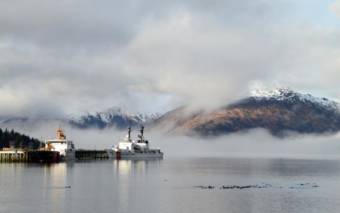
Kodiak Coast Guard base reports COVID-19 cases

The Kodiak Coast Guard Air Base (Chief Petty Officer Charly Hengen / U.S. Coast Guard)

The Coast Guard says it’s moving quickly to contain a COVID-19 outbreak at Air Station Kodiak this week. Six cases have been reported. Two include children.

Petty Officer 1st Class Ali Blackburn, a spokesperson for the Coast Guard, said the children are dependents of Coast Guard members.

“Of the recent two, one child tested positive,” Blackburn said. “And one is exhibiting symptoms that keeps testing negative.”

Blackburn said one of the children exposed to the virus attended an afternoon daycare center at the base, known as the Child Development Center Annex. The Coast Guard closed the facility and has asked those families with children who were also in the program to quarantine for fourteen days and report any symptoms of the virus.

“We also have on-base care teams to assist those families if they need groceries, medicine or anything,” Blackburn said.

The base has taken other steps to prevent the spread of the virus. The commissary and exchange have been closed. Also, all air station personnel are being tested for COVID-19.

“I just want to stress that our base command and personnel are cognizant of the COVID threat, and we’re doing our best to protect our community and fellow Kodiak members,” Blackburn said.

A school near the base, Peterson Elementary, closed on Wednesday after the Kodiak Island Borough School District was notified that a student had tested positive. The child is one of the six cases reported at the Coast Guard base.

The school underwent deep cleaning and disinfection on Thursday and is scheduled to reopen on Friday, although close contacts of the child exposed to the virus must remain at home under a two-week quarantine period and take classes remotely.

Blackburn says at least four crew members were involved in recent operations that took them off Kodiak Island, but none of these cases involve personal travel.

Until now, there have been no cases of COVID-19 reported at the Kodiak Coast Guard base. Since April, there have been 80 positive tests in the Kodiak region.

Kodiak’s decades-old Tsunami siren system gets a new song

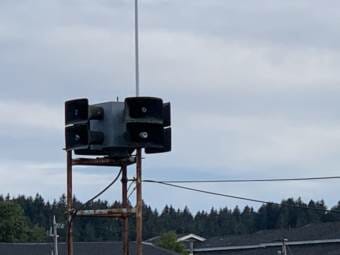
The Kodiak tsunami siren photographed with the sky above it and a tree line below
The tsunami siren behind the Kodiak post office (Rhonda McBride / KMXT)

Kodiak has heard the wail of sirens every Wednesday at 2:00 p.m. for decades.

They sound like something out of an old, World War II movie — a weekly test of a warning system to signal households in Kodiak’s low-lying areas to move to higher ground, should an earthquake trigger a tsunami.

The problem, said Kodiak Mayor Pat Branson, is that the system is getting old.

“I don’t want to be swallowed up by a 34-foot tsunami wave,” Branson said. “I want to be able to evacuate. We’re very vulnerable here.”

The first new tsunami siren to be installed went up behind the downtown Kodiak Fire Station.

Branson is relieved that work is underway to retire 21 tsunami warning sirens on Kodiak Island, which have worked hard for more than 30 years.

The new ones will be installed one by one until they’re all replaced — sirens that will not only be more reliable but with some new capabilities.

In recent years, the city council has had complaints that some of the sirens don’t work anymore. But Kodiak Police Chief Tim Putney said they’re not easy to fix.

“It’s getting difficult to find components,” said Putney. “It’s expensive. It’s older technology. A lot of times you’re getting used components.”

The original sirens were installed in the mid-1980s. A few were added in the early 1990s, that run on a computer operating system that most people are glad to see gone.

Kodiak Police Chief Tim Putney and Fire Chief Jim Mullican are about the same height as the new speakers, which are still in their shipping crates. 

“They can only be programmed through DOS which is obsolete, so it would be very difficult, if the need arose, to reprogram those,” Putney said.

West Shore Services, a Michigan company, is in Kodiak installing new sirens. The company does most of the installations in Alaska.

Jeff DuPilka, the owner, says the biggest challenge is not the work itself but the logistics involved. He brought rigs with a crane and a drill to Kodiak, along with 50-foot steel pipes and crates of siren speakers, which look like little white UFO spaceships stacked on top of each other.

“It’s not a big deal,” he said. “Just takes a lot of extra planning time.”

Most of the equipment to install the sirens as well as the components arrived on the state ferry, the Tustumena. DuPilka said he was expecting to use Tustumena to get his equipment back to Anchorage, but since the ferry’s winter service schedule was cut back, getting his equipment back to the road system will be more challenging and expensive.

For now, he’s focused on the job and says the biggest challenge, one that’s unique to Kodiak, is drilling holes for the poles. DuPilka says it takes about a day to install a siren.

“We put these poles in the ground ten feet, so the hurdles will be if we had some rock that we can drill,” said DuPilka, who laughed when he was told Kodiak’s nickname for itself was “The Rock.”

“It fits,” he said.

Not only do the sirens look different but will sound different as well. Fire Chief Jim Mullican says the added height of the new poles will help project the sound.

“Once this system is complete, when the system is hit, you will hear it a lot louder,” Mullican said.

The new system has a lot of other advantages. It can send out different tones. There is one for a tsunami alert, which will sound off every Wednesday at 2:00 p.m. once the system is installed.

The new system can also play recorded messages in English, as well as Spanish and Tagalog — languages you hear a lot in Kodiak. These messages will provide updates on what’s going on, which Chief Mullican says will help to prevent the emergency dispatch center from getting flooded with calls.

“Having all the pre-recorded messages really helps out dispatch,” Mullican said. “They’re also answering hundreds and hundreds of phone calls.

Mullican said automated messages will free up emergency dispatchers to respond to citizen needs during an emergency.

The sirens can also be used selectively. For example, there’s a tone for a chemical spill that could be played only in affected neighborhoods.

This new system also talks to the dispatch center. During tests, each siren can signal back that it is functioning properly.

Public safety officials can also use the system to broadcast messages live if need be.

But what the new system won’t do is eliminate the need for human involvement. The sounds are not quite loud enough to be heard indoors in some homes, especially those with thick walls and a lot of insulation.

So, expect to see police and other emergency workers go door-to-door during tsunami alerts to make sure neighborhoods are completely evacuated.

It may be a few weeks yet before Kodiak gets to hear the new sirens. Before the new system can be hooked up to the city’s emergency dispatch center, a new console must be installed.

Funding for the siren installation within the city of Kodiak comes to about $553,376, mostly federal money with a city match. Beyond city limits, a combination of federal and Borough funds will be used. The cost amounts to $513,241.

And even though the new system produces different sounds, one thing will remain the same: the need to be prepared. Although the new sirens can be tested without sounding off, Kodiak’s emergency responders say it’s still important to carry on the tradition of Wednesday’s 2:00 p.m. drill, lest we forget the 1964 tsunami that washed away Kodiak’s downtown waterfront in one giant wave.

Kodiak rocket launch ends in fiery explosion

The Astra rocket launch in Kodiak Alaska on Sept. 11, 2020.
The Astra rocket launch in Kodiak Alaska on Sept. 11, 2020. (Courtesy of John Kraus / Astra)

Friday evening was clear and crisp in Kodiak when Astra’s 3.1 rocket lifted off just after 7:00 p.m. from the Pacific Spaceport Complex. Mark Van Dongen and his son, Eric, had been out deer hunting nearby and decided to watch the launch.

They drove to a pull-out on the road to the launch complex. Eric narrated as he shot video with his cell phone.

“Rocket launch in Kodiak, Alaska. Pretty cool,” he said, as the rocket roared straight up into the sky and quickly disappeared against a cloudy backdrop.

About 20 seconds later, the noise of the rocket’s engines abruptly stopped. Then it tumbled downwards.

The video captured Van Dongen’s reaction, after it hit the ground in a loud, fiery explosion.

“Holy Mackerel, that’s unbelievable,” he could be heard saying in the background. “I’m glad it didn’t throw any shrapnel this way.” Van Donren noted that the rocket exploded in the area where they had been hunting.

They had left their hunting grounds in the afternoon, to avoid a widespread closure of the area surrounding the spaceport, which routinely takes place before a launch attempt.

Explosion from failed Astra rocket launch in Kodiak Alaska on Sept. 11 2020. (Courtesy Eric Van Dongen)

Mark Lester, president of Alaska Aerospace Corporation, was in Kodiak for the launch of Astra’s rocket. He said no one was hurt and crews responded quickly to put out the fire.

“The launch was terminated early, which is part of our safety process,” Lester said. “We are prepared for these things.The key is public safety, and everything we did to keep the air, waterways and land free from the public is exactly why we do that in conditions like this.”

Lester said it’s too early to tell what caused the crash, which occurred on state land.

He called the launch itself a success, even though it didn’t get past its first-stage burn.

“Every test gives you new data,” Lester said. “It gives you new information.”

And that’s what Astra said in its blog, posted by the company’s founders, Chris Kemp and Adam London. They said despite the failed launch, they’re still happy with the result.

“We’re excited to have our first orbital attempt under our belt,” they wrote. “Tonight, we saw a beautiful launch! Preliminary data review indicates the rocket performed very well. Early in the flight, our guidance system appears to have introduced some slight oscillation into the flight, causing the vehicle to drift from its planned trajectory.”

The blog said this led to a “commanded shutdown of the engines by the flight safety system.”

“We didn’t meet all of our objectives, but we did gain valuable experience, plus even more valuable flight data.”

The blog said Friday’s launch sets the company on a path to reaching orbit within two additional flights.

Astra, which is based in Almeda, California, has been working to develop smaller, more cost-effective rockets to send telecommunications satellites to space. Last month, it made several attempts to send its 3.1 rocket into space but was hampered by weather, technical problems and in one case, a fishing boat that strayed into the safety zone.

Kemp and London said in their post that their 3.2 rocket is already built and ready to take the next step towards orbit.

“Stay tuned for updates over the next few weeks,” they wrote. “We’ll be back to the pad before you know it!”

On the company’s Twitter page, Elon Musk, the founder of SpaceX, offered a message of encouragement after Astra announced its launch had not made it past the first stage.

“Sorry to hear that,” Musk wrote. “I’m sure you’ll figure it out though. Took us four launches to reach orbit. Rockets are hard.”

Lester says the fact that Musk took the time to comment speaks to the difficulties of rocket development.

He said there are more than a hundred companies that want to make rockets, with only about 40 close to the testing phase.

“And then you have a very few, just a handful, if that, who are at the stage Astra is at,” Lester said.

Lester said a number of the team members involved in Friday’s launch are Alaskans.

“And this is what Alaskans do,” he said. “We face adversity. We overcome it. We get after it. We learn from it, and then we grow from it.”

As for the Van Dongens, they had planned to go back to the area where the rocket crashed. They had spotted a buck they wanted to pursue, but now they are left with emotional aftershocks from the explosion — feeling waves of sadness and wonder at the same time.

“I’ve never seen a missile failure like that, even on TV. When a rocket explodes, it usually explodes over the ocean or in the air,” said Mark Van Dongen. “And then to have it land right in the area that we were hunting in that morning. What are the odds that that was going to happen?

Van Dongen’s son, Eric, says he keeps studying his video, to try and understand exactly what it was he saw.

“It was a pretty crazy experience to watch,” said Eric, who said the shock wave that followed was even stranger. “It almost felt like you’re holding your breath for a couple of seconds and lightly pushed you back.”

“To witness something like that is pretty amazing, despite the fact the fact that a lot of money was lost, and time and effort,” he said. “A little boy was crying beside us. He wasn’t crying because of the explosion. He was crying because he wanted to see it launched in space.”

Maybe Astra’s next 3.2 rocket will make it into orbit, but a lot depends on how Astra’s team will be able to turn Friday’s failure into tomorrow’s success.

3 Yellowstone bison arrive at their new home near Old Harbor, Alaska

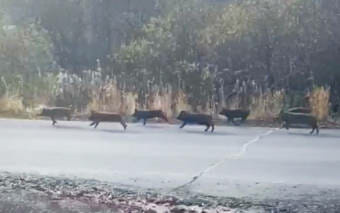
Bison in Montana. (Photo courtesy of the Old Harbor Alliance)

It was a journey that took three bison thousands of miles from a remote Montana Indian reservation. They traveled by land, by air, and then by sea to reach their new home near Old Harbor on Kodiak Island. They finally arrived Thursday night.

The buffalo left Montana for Alaska on Monday — three hardy bulls, which weigh about a thousand pounds each. They had to be loaded in specially-built shipping containers and trucked to Seattle — then flown to Alaska on a FedEx plane, which landed in Anchorage. And from there, they were driven to Homer, where they set out for Kodiak Island on a 60-foot landing craft.

Their final destination: tiny Sitkadilak Island, right across from Old Harbor.

Melissa Berns-Svoboda stands in front of one of the shipping containers the bulls traveled in. She checked on them regularly throughout their journey to Alaska and said them seemed to handle the ride OK. (Photo courtesy of the Old Harbor Alliance)
Melissa Berns-Svoboda stands in front of one of the shipping containers the bulls traveled in. She checked on them regularly throughout their journey to Alaska and said they seemed to handle the ride OK. (Photo courtesy of the Old Harbor Alliance)

Melissa Berns-Svoboda manages the herd and kept a watchful eye on the bison from start to finish.

“There was really no signs of stress,” she said. “They clearly wanted to know, like, ‘What are we doing in this container?’”

Berns-Svoboda said they seemed to make the trip just fine.

“They were very calm, laying down and doing what they should have been doing, which was eating and drinking,” Berns-Svobda said. 

These are bulls from Yellowstone National Park, brought to Alaska by the Old Harbor Alliance – a group which includes Old Harbor’s Alutiiq Tribe, its Native corporation, and other organizations.

They are to join a herd of about 70 animals, to help improve their health and genetic diversity. When the Sitkalidak herd had its DNA tested, traces of an aggressive gene were found. Three bulls in the current herd will be culled, to allow the new bulls to bring new blood to the group. Researchers say genetic diversity helps the herd adapt to changing conditions and improves survival.

Berns-Svoboda says the move from Montana probably cost about $9,000 per bull, but the money is an investment in Old Harbor’s future — because the buffalo will help feed the community, a place so isolated that groceries have to be flown in, which makes them expensive.

Some of the buffalo have already been harvested — and the meat shared in the community of about 200. One day, the Alliance would like to sell the meat, as well as hunting permits, to bring some income to this cash-poor community. The bulls are key to those dreams.

When the landing craft arrived on the shores of Sitkadilak Island, it dropped its bow and opened the containers. The bison were free to cross the deck and head down a ramp to the beach, but they had to be coaxed to get off the boat.

But eventually, Berns-Svoboda says, they scrambled across a rocky beach, slippery with kelp, and headed right towards a valley, where their new herd was grazing.

“The valley was full of just green, green grasses,” Berns-Svoboda said. “There were alders. It was just beautiful.”

The bison will join a herd that was originally brought to Kodiak Island by a rancher, tired of losing his cattle to Kodiak brown bears. Their genetics have been traced to animals in Wyoming, so they are essentially kin the new bulls, but many generations removed.

The Old Harbor Alliance bought a small part of that herd three years ago – and so far, they’re holding their own against the bears.

“There is really no conflict. They were kind of doing their own thing. They have their own respective areas. It was really neat to see,” Berns-Svoboda said.

Sitkalidak Island, save for a cabin, is virtually uninhabited, so the bears and the buffalo have the island all to themselves. In the spring, they both enjoy eating the green shoots of plants, that in the summer turn the island to emerald green.

Fed Ex flew the specially-made shipping containers from Seattle to Anchorage. One bull road alone. Two others shared a container. (Photo courtesy of the Old Harbor Alliance)

The InterTribal Buffalo Council helped Old Harbor move the bison from Montana to Seattle. Members from the Blackfeet Nation were hired to assist – and Berns-Svoboda says that created a special bond.

“We built relationships that are lifelong relationships,” she said. “We’re going to have them come down here. They’re going to help us work our animals, then help us get to know them.”

Berns-Svoboda says both the Blackfeet and the Old Harbor Alutiiq see the bison as more than just a source of food. She says the Blackfeet will also teach them how to fully appreciate the role the bison play in tribal culture – how they bring the community together through sharing. Berns-Svoboda says she has also seen how the buffalo can help bridge generation gaps and promote spiritual connectedness.

It took a web of connections from Montana to Alaska to bring the bison here. Some federal COVID-19 money to improve food security was used to pay for their trip. Many community organizations helped to make the move possible.

Lynell Bullshoe, a member of the Blackfeet Nation, had this post on the Sitkadilak Island Herd’s Facebook page, where you can also find short video clips of the bisons’ journey to Alaska.

“So very emotional watching them being loaded,” she wrote, “thinking of history being made and the people/generations that will be positively impacted by this.”

Lois J. Red Elk-Reed, a member of the Fort Peck Sioux, wrote, “What a journey for these Tatanka. There are telling us a story. They are educating us once again, and they will continue blessing us.”

Marine highway communities say: Along with passengers, the future rides on the ferry

The Aurora, a 235-foot Alaska state ferry, approaches the dock in Whittier, its departure point for its trip across Prince William Sound to Cordova. (Photo by Nat Herz/Alaska's Energy Desk)
The Aurora, a 235-foot Alaska state ferry, approaches the dock in Whittier, its departure point for its trip across Prince William Sound to Cordova. (Photo by Nat Herz/Alaska’s Energy Desk)

The Alaska Marine Highway System is at a critical crossroads, as the first round of hearings on restructuring the ferry system began this week.

A nine-member working group is reviewing a $250,000 study commissioned by Gov. Mike Dunleavy’s administration, one that has already ruled out privatizing the state ferry fleet because it doesn’t pencil out.

Now they will hear what the public has to say about the future of the ferry system. They are taking testimony on September 2.

These hearings come as many coastal communities brace for long gaps in service. The Department of Transportation proposed deep cuts to its winter ferry schedule, which the working group will not address in its current series of hearings.

Department of Transportation officials said the cuts are necessary to keep the ferry system afloat, after COVID-19 hit ridership hard and caused huge losses.

During a 5-day comment period on the proposed schedule earlier this month, more than 200 people weighed in on how the reduced service will hurt them, including those who depend on the aging Tustumena, one of two certified ocean class ferries in the fleet.

The Tustumena rides the waves from Homer to Seldovia, and from Kodiak out to the Aleutian chain, where she’s known as the “Trusty Tusty.” But between mechanical problems and COVID-19, which infected the crew and kept the ferry out of service for about a month, it has been a challenge to live up to that name.

When the Tustumena resumed service to Kodiak in July, her loud bellow to clear the channel was a welcome sound, a sign that life was on its way back to normal – that passengers, cars, groceries and other goods were on the move again. But now, with the proposed cutbacks, some communities could lose service entirely.

John Mayer, one of two captains who pilots the Tustumena, understands what it means to the communities on the route. He compares it to ordering dinner in a restaurant and all you can afford is a bowl of soup.

“And who gets the soup?” he said. “We’re all getting a bowl of soup with five spoons in it. All these communities need something.”

Here’s more from Capt. John Mayer’s interview:

But in the proposed winter schedule, there are no spoons for Ouzinkie or Port Lions, no longer on the route to Kodiak, which will see some service through the winter from the Kennicott.

The mayor of Port Lions, Dorinda Kewan, said her community has no store – and its airport runway is small, too small for airplanes big enough for cargo like lumber and other big-ticket items.

“We’re back in the same boat as we were last year, with no Tustumena service, starting October 1,” Kewan said. “And no real guess at when it’ll come back because the maintenance always takes much longer than originally estimated on the Tustumena.”

Kewan has been working with the Marine Highway’s ferry scheduler in hopes to make a change in the proposed winter schedule – to allow the Kennicott to make some stops in Port Lions. Kewan said it’s frustrating to know that the Kennicott, when it makes stops at nearby Kodiak, will bypass Port Lions – after the community used state money in 2014 to build a new ferry dock to accommodate the Kennicott.

Port Lions in 2004. (Photo Credit: Department of Commerce, Community and Economic Development; Division of Community and Regional Affairs’ Community Photo Library.)

Kewan said Port Lions’ elders will suffer the most without ferry service because they use it to get to medical appointments in Kodiak.

She said the ferry system has allowed elders to continue to live in Port Lions as long as possible. And if the elders have to move for care, so will their families.

“Yet flying is difficult for elders to get in and out of planes – and our bad weather means the ferry is the first choice for getting to their appointments,” Kewan said.

Kewan is upset that the public was given less than a week to weigh in on the winter schedule. And so is Representative Louise Stutes, a Kodiak Republican.

Rep. Louise Stutes, R-Kodiak, participates in a House Majority press availability in the Alaska State Capitol on April 3, 2018. The conversation centered on House Bill 286, the state operating budget passed by the House or Representatives the day before. (Photo by Skip Gray/360 North)
Rep. Louise Stutes, R-Kodiak.

“Give me a break, you know. Come on. Obviously, they’re not too concerned with public comment,” Stutes said.

John MacKinnon, the commissioner of the Department of Transportation and Public Facilities, said the main reason for the 5-day comment period was to get the winter schedule set as soon as possible, to give people time to make travel plans.

He said cutbacks to the winter schedule are unavoidable, because passenger revenues are only 40% of normal, due to COVID-19 and mechanical breakdowns.

MacKinnon said he’s hopeful that the Alaska Marine Highway Reshaping Work Group can come up with some long-term solutions.

When Gov. Dunleavy first took office, he made drastic budget cuts and moved money set aside for the Tustumena’s replacement process to the state’s federal highway matching program. The legislature restored some of those funds and Dunleavy created the working group.

Stutes, who is part of the group, said the key to its success is to get the ferry system out of competition with the road system for its funding. Though she believes the Marine Highway deserves a fair share of state transportation funds.

“We don’t have to pave our road,” Stutes said. “We don’t have to fill potholes on our roads. What do you think the cost was to build the road between Fairbanks and Anchorage?”

Stutes would like to see the ferry system forward-funded for five years.

Here’s more from Rep. Louise Stutes’ interview:

Another ferry advocate, Shirley Marquardt, said a dependable source of revenue is critical in making sound decisions for the ferries. She heads up an economic development group called the Southwest Alaska Municipal Conference.  She was Marine Highway’s top administrator until the Dunleavy administration eliminated her job in a budget cut.

Marquardt hopes the legislature will get behind the efforts of the ferry reshaping work group.

“I’m worried without that kind of push from the legislature, that we won’t see this,” said Marquardt, who said many Alaskans on the road system, think the answer is simply to starve the ferry system and let it die.

Marquardt said it’s easy for those who don’t understand the importance of ferries to coastal communities to said, “People will be unhappy for a little bit, but they’ll get over it,” she said. “You don’t get over not being able to move back and forth between your communities.”

Marquardt believes the answer may be to set up an entity similar to the Alaska Railroad. It would be removed from the annual politically-charged funding battles, where support for the system varies from administration to administration, as well as an understanding of how the ferry system works and why it’s important.

Marquardt recently boarded the Tustumena on a trip from Kodiak to Unalaska, a nearly three-day journey, which passes by Chignik, Cold Bay, False Pass, Sand Point, King Cove, Akutan, and Unalaska.

“The scenery along the way, the volcanoes, the bays, the whales,” Marquardt said, “It’s just what 99.9 percent of the population on this planet will never see.”

Here’s more from Shirley Marquardt’s interview:

Captain John Mayers has steered the Tustumena across the Aleutian chain for many, many years. He said it’s a route that requires a specialized crew. He worries about the impact of the winter schedule cuts on crew members, who will be out of work from October to April.

“The crew right now is very nervous about where they’re going to find work,” Mayer said. “You can’t feed your family on no work, so they’re going to find other jobs.”

Without an experienced crew, Mayer worries the system could become even more unreliable — and those fighting for the ferry system, like Dorinda Kewan, say it’s doomed to fail without dependable service.

“So if you don’t have people using the ferry, then that’s going to give the governor even more fuel to say, ‘Well, they don’t need it. They don’t want it. They’re not using it,’” Kewan said. “It’s a lose-lose proposition.”

Kewan worries that the work of the ferry reshaping group won’t come in time to save the system – that not only passengers ride on the ferry, but also the future of many communities who depend on the Marine Highway.

Site notifications
Update notification options
Subscribe to notifications