KMXT - Kodiak

KMXT is our partner station in Kodiak. KTOO collaborates with partners across the state to cover important news and to share stories with our audiences.
Watch: In August, scientists saw rare right whales twice in Alaska waters

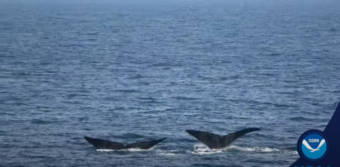
Right whales are so named because they were the “right” whale to hunt. They’re known for being slow-moving, and they float on the surface after being killed.

“It’s estimated that between 26,000 and 37,000 animals were taken in only a handful of decades,” said Jessica Crance, a Research Biologist at the Marine Mammal Lab at the Alaska Fisheries Science Center. “And then they became the target of illegal Soviet whaling in the 1960s. And that decimated what was left of the population and brought them down to what we think are their current numbers.”

According to National Oceanic and Atmospheric Administration scientists, there are about 30 members of the Eastern Group of North Pacific right whales left in the wild. They live in Alaska waters, and there are only a handful of sightings in a decade. But last month, survey vessels encountered two different groups of right whales, each with two different individuals. That may not sound like much, but those four whales make up over 10% of Alaska’s right whale population.

Both sightings occurred near Kodiak Island, with the first sighting being on the morning of Aug. 21 around the Barnabas Trough west of Kodiak Island. The second sighting was on the Aug. 24, near the Trinity Islands on the west end of Kodiak.

Crance witnessed both sightings personally, and is among a handful of living people who have seen one of this population of right whales up close since the species was devastated by commercial whaling.
According to her, NOAA biologists found the whales when they went looking for them.

“We had marine mammal observers that were looking for marine mammals from two different platforms. And the purpose of the survey was to get distribution density and abundance estimation for large whale species in the area. And so it was during the survey that we had two different sightings of North Pacific right whales,” she said.

She says right whales are easy to identify.

“When you’re looking at a right whale, they have a very pronounced V-shaped blow. So if you happen to see a distinctive V in the blow pattern, there’s a good chance you’re looking at a right whale,” she said.

While infrequent sightings make it difficult to gauge population trends, there is some good news. Two of the four whales spotted were completely new individuals, that until then had never been logged by researchers. The other two animals are known to biologists — one was seen nearby in 2006 and the other had been seen earlier this year off the coast of British Columbia.

Advisory for Kodiak ends after winds stir up ash from 1912 eruption

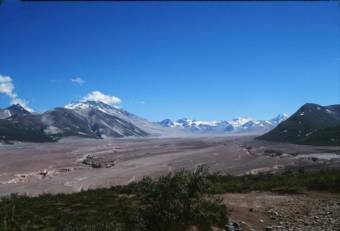
View of the Valley of Ten Thousand Smokes from the Overlook Cabin in Katmai National Park and Preserve, Alaska in July, 1990. The valley has been filled with up to 660 feet of ash-flow deposits from the 1912 eruption of Novarupta volcano. The rim of Katmai Caldera is on the skyline at center-right. (Game McGimsey/USGS)

It’s been a big year for volcanoes in Alaska, with up to three erupting at once across the Aleutian Range.

But last weekend, worries focused on volcanic ash that rained down a hundred years ago — ash left behind by Novarupta’s 1912 eruption, which buried parts of Alaska like a heavy snowfall.

Some of that ash came back to haunt Kodiak last weekend. Pam Szatanek, who is based with the National Weather Service in Anchorage, says meteorologists call it “re-suspended ash.”

“What’s been unique about this summer for the Alaska Peninsula and the Aleutians is we’ve had five active volcanoes that we’ve had to put products out for, and then we had two different volcanoes that we had to do re-suspended ash products for. And Novarupta is, of course, the one that we tend to see the most re-suspended ash from,” Szatanek said.

A National Weather Service ash advisory for Novarupta expired over the weekend without too much disruption to the enjoyment of unusually fair weather for Alaska’s emerald isle.

Ash covering a home in Katmai Village, after the 1912 eruption of Novarupta. (G.C. Martin/USGS)

Szatanek says volcanoes are typically the realm of geologists, but when they affect the weather – that’s when meteorologists like her step into the picture.

“A lot of people don’t realize that when it comes to volcanoes, meteorologists handle the volcanic ash and geologists handle all the seismic stuff. So anything dealing with volcanoes is a tag team event,” Szatanek said.

Ash advisories aren’t issued too often — a few times a year at most. But when it’s swept into the air, the ash can wreak havoc for people with respiratory problems. It’s also dangerous when it’s sucked into airplane engines. That’s why it’s important for meteorologists to track these volcanic particles, even if they’re from a century ago.
“That particular event, we could see it on satellite imagery, and we could also see it on webcam. The FAA and also the Alaska Volcano Observatory — they have a series of webcams across the area and we can click and see what’s going on. That particular event with the re-suspended ash from Novarupta, we could see on satellite imagery and with the web camera,” Szatanek said.

Kodiak fisherman gets $1M fine, 6-month sentence for falsifying fishing records

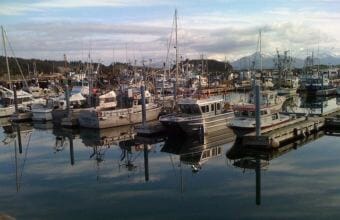
Fishing boats in Kodiak. (Photo by James Brooks/KMXT)
Fishing boats in Kodiak. (James Brooks/KMXT)

A U.S. District Court judge sentenced commercial fisherman James Aaron Stevens of Kodiak to six months in federal prison and a $1 million fine last week for falsely labeling fish in violation of the Lacey Act.

Stevens pleaded guilty to the charges in November 2020 after an investigation by NOAA’s Office of Law Enforcement.

Stevens owned and operated the F/V Alaskan Star and F/V Southern Seas. He admitted in a plea agreement that he lied on individual fishing quota landing reports and log books about where he harvested over 900,000 pounds of halibut and sablefish between 2014 and 2017. Stevens sold the falsely labeled fish, which had a market value of over $13 million, violating the Lacey Act.

The Lacey Act, passed in 1990, is a federal law that makes it illegal to sell fish that were harvested in violation of U.S. law.

Stevens’ attorney had asked for a sentence of a year of home confinement to be served intermittently so Stevens could still participate in commercial fishing openers. That request was denied.

Family members, friends and fellow fishermen wrote letters in support of Stevens. Some asked for the fine to be reduced. A letter written by Janiese Stevens, James’s wife, said the halibut and sablefish individual fishing quota program put economic strains on fishermen.

As part of his sentencing, Stevens must also create a public service announcement acknowledging his crime and serve 80 hours of community service.

Investigation into Scandies Rose sinking points to faulty stability instructions

The F/V Scandies Rose sank west of Kodiak on Dec. 31, 2019. (Photo courtesy of Bret Newbaker)

The National Transportation Safety Board’s investigation into the Scandies Rose sinking has found no fault with the captain or crew but pointed to inaccurate vessel stability instructions that could have led to dangerous ice accumulation.

Included in the NTSB report, which was released on Tuesday, were a series of findings voted on and accepted by the board. Among them was the finding that there were no issues with the conduct of captain or crew or problems with the vessel itself. The hearing looked closely at a series of welds made on the Scandies Rose, but the NTSB found they did not contribute to the sinking, either.

The NTSB also found that the ice accumulation on the F/V Scandies Rose likely would have been between 6 and 15 inches on the wind-facing side. This would have raised the boat’s center of gravity and lowered its stability, contributing to the capsizing.

The report says that while the crew followed stability instructions while loading the vessel, the instructions were inaccurate and left the Scandies Rose outside of regulatory stability requirements.

The board also called for an oversight program to audit stability instructions for uninspected commercial fishing vessels that are not required to carry a load line certificate. For now, that’s just a recommendation to the Coast Guard.

The report also stated “the National Weather Service cannot accurately forecast the more extreme localized wind and sea conditions for the area, which can lead to vessels encountering conditions that are worse than expected.”

The NTSB also recommended that NOAA increase surface observation resources for the Sutwik Island and Chignik Bay region.

Coast Guard says masks will no longer be required while outdoors on boats, ferries

An Alaska Marine Highway ferry docked in Skagway. (Photo by Emily Files/KHNS)

The Coast Guard announced Friday that it received permission from the Centers for Disease Control and Prevention to no longer enforce the mandate that requires anyone traveling on commercial maritime vessels, including ferries, to wear a mask in outdoor areas.

The requirement for most people to wear masks indoors for the duration of travel, including boarding and disembarking the vessel, is still in place. Exceptions for eating and drinking, identity verification and for speaking to someone hard of hearing are still allowed.

Masking up in outdoor areas on the vessel or at the dock or port, though, will no longer be required.

It will take some time for the CDC to formally revise the executive order and its mandates that initially required masking up outdoors on maritime vessels. Until then, the CDC said that they will not compel the Coast Guard and vessel operators to enforce outdoor masking requirements.

Coast Guard rescues friends adrift in giant inflatable flamingo near Kodiak

Nation Sega (center) and friends pose with USCG crew after being rescued in Monashka Bay. (USCG)

Being rescued by the Coast Guard while out on the water or a hike is not entirely unusual in Kodiak. But it is if you’re being dragged out to sea on a giant inflatable flamingo.

It was a picturesque summer Saturday last weekend in Kodiak. Nation Sega, his sister, her roommate and dogs were enjoying the sunny skies and warm temperatures out in Monashka Bay, about five miles from the city of Kodiak.

It’s a common spot for recreators to fish, swim surf, and kayak. But Sega and his friends brought something different: A pink inflatable flamingo.

“We usually do it in a lake, where we’re usually more cautious,” Sega said. “But Saturday we were just having too much fun and not paying attention.”

They weren’t worried at first, but by afternoon, the winds had picked up and pulled the flamingo riders out across the bay.

“Then we were in the middle of nowhere at one point, but we just called 911, and were ‘Okay, we don’t have any paddles or lifejackets. Can you send someone out here?’ We were hanging out waiting for someone to show up,” Sega said.

As they waited for rescue, the flamingo drifted toward some offshore rocks until they finally ran aground.

About an hour later, an MH-60 Jayhawk helicopter from Coast Guard Air Station Kodiak came to their rescue, hoisting them up.

“Alaska State Troopers and the USCG worked together to determine that due to the treacherous circumstances, a helicopter hoist was the best option to bring these folks and their animals back to shore, safe and sound!” the Coast Guard said on Facebook.

Alaska State Troopers recovered the flamingo but have not yet returned it to its owners. Sega said he intends to get it back. He and his fellow flamingo riders plan to ride it out again — but next time, they say they’ll be more prepared.

KMXT’s Dylan Simard also contributed to this story.

Site notifications
Update notification options
Subscribe to notifications