KMXT is our partner station in Kodiak. KTOO collaborates with partners across the state to cover important news and to share stories with our audiences.
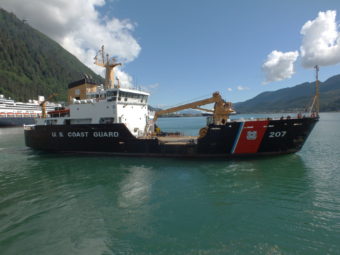
Alaska Aerospace Corporation launch facility in Narrow Cape. (Photo courtesy of Alaska Aerospace Corporation)
A rocket launch scheduled for Friday afternoon at the Narrow Cape Pacific Spaceport Complex is the second launch for the company whose rocket was destroyed in July. The launch window for the flight is between noon and 4:00 p.m.
Craig Campbell is the Chief Executive Officer for Alaska Aerospace Corporation. He said a non-disclosure agreement with the business that owns the rocket prevents releasing the company’s name, but it is a test flight.
“It’s a commercial launch, it’s not a government launch,” he said. “It’s the second launch from the same company. This is the company that launched back in July. And it’s another test of their commercial vehicle to get ready to be a commercial company and launch commercial satellites.”
Campbell explained that the test launch is necessary in order for the rocket company to get certification by the Federal Aviation Administration. He says it is similar to what an airplane company must do before it is allowed to use a new plane:
Before the plane can be certified to carry passengers it has to be tested. They have to fly it. Do all the stuff that an airplane does and then they say, ‘OK, now it’s safe to carry passengers.’
It’s the same with a rocket. You have to launch a rocket a number of times to demonstrate that the rocket motors work, the avionics work, that the telemetry works, all the components work right. So that’s what they are under right now the certification process.
Because ultimately the rocket will be certified by the FAA as a rocket capable of doing commercial launches for paying customers.”
The launch window for the flight is noon to 4 p.m. Friday with back-up dates running from Saturday to Tuesday.
Pasagshak Road and the Narrow Cape area will be closed during the launch window on Friday and on other days if launch day is pushed back.
Lepani Nadori stands in th doorway of a greenhouse in Old Harbor on August, 7 2018. (Photo by Daysha Eaton/KMXT)
This summer, the community of Old Harbor on Kodiak Island harvested vegetables and fruit from their farm in significant quantities for the first time.
The agricultural experiment provided enough produce to sell at the local store.
One employee and some seasonal helpers have overseen Nuniaq Farm for the past three years. It was funded through a federal grant, which runs out soon. But Old Harbor hopes to keep the farm going with volunteers.
For now, it is managed by one man: Lepani Nadori, who works for the Alutiiq Tribe of Old Harbor. Among other things, he oversees Nuniaq Farm, which consists of two large hoop houses and a chicken coop on the edge of the village.
“Nuniaq is actually the Alutiiq name for Old Harbor and pretty much as it being our first farm, we figured it would be complimentary to have the Alutiiq name,” said Nadori.
Two hoop houses at the farm in Old Harbor on August 7, 2018. (Photo by Daysha Eaton/KMXT)
Nadori moved to Old Harbor from Anchorage and is originally from American Samoa. He’s raising his two young daughters in the village, where their mother is from.
This is the first summer they’ve had the garden fully established in Old Harbor. It even includes fruit trees – cherries and apples. And some kiwis.
Chickens cluck in the background as Nadori continues the tour over to the chicken coop.
“I am not familiar with the chicken breeds per se,” he said, “but we definitely got 35 hens and one rooster.”
The chickens produce about two dozen eggs a day, give or take. When they stop producing eggs, they are butchered and sold for meat.
The idea is to keep the prices low and affordable for community members. All the money goes back into the farm.
The project is funded through a 3-year grant which runs out at the end of September.
The City of Old Harbor is willing to support the program when the grant funding ends, but there will not be any more funding to pay for a staff member to manage it. So, they are turning it into a community garden to be run by volunteers during the transition. Eventually, they hope a community member will take on the farm as a business.
Nadori says the Nuniaq Food Market, where the food is sold, takes a small cut from the proceeds.
As Nadori opens the fridge inside the village store, he explains what’s inside: “Once we clean off the eggs they go into these 12 dozen containers, and they are sold pretty much for $4.44, a dozen.”
They also sell bundles of kale, bok choy and lettuce for $3.49 each.
Those prices are the same or cheaper than those paid for the same type of foods in Kodiak. Plus, they didn’t have to endure a barge trip or a flight, and they’re fresh.
The Kodiak Archipelago Leadership Institute or KALI, helped secure the federal grant for Old Harbor through the Administration for Native Americans.
The grant also helped start farms in Port Lions, Ouzinkie and Larsen Bay.
They’re working on wrapping up business plans for the farms with the villages this September, before the grant ends on September 30.
Ryan Gabor (left) and Pearson Brodie (right) prepare and eat crawdads following their snorkeling trip to the Buskin. (Photo by Kayla Desroches / KMXT)
An informal sport fishery has popped up in Kodiak. For crawdads.
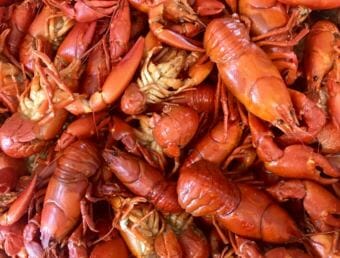
They’re crustaceans that look like little lobsters, and they’re native to the Pacific Northwest, but not Alaska. In 2002, they were found scuttling along the bottom of a popular fishing area near Kodiak, in the Buskin River watershed, mainly in the lake.
Now, a local tribal organization is studying their movement, distribution, and diet.
They are concerned the crawdads could be snacking on salmon and disrupting their natural environment.
In a parking lot next to Buskin Lake, four guys pull on neoprene wetsuits and snorkeling masks. They’re gearing up for the hunt.
“Man, I’m ready to slay some frickin’ crawdad right now.”
That’s Ryan Gabor. He and some friends have put aside the day to snorkel for the mud-colored crustaceans.
They’re called a variety of names throughout the world including: crawfish, crawdads, and crayfish.
Kelly Krueger, tribal biologist with the Sun’aq Tribe, calls them by their proper name: Signal Crayfish. She says they’re not certain how the crawdads came to Kodiak, but she says people started catching them as early as 2015.
“And I think it was because the Kodiak Soil and Water Conservation District and Blythe Brown, she was putting up signs that if you know of anything let us know, and then people just started looking for them and once people found out that they were in that southeast corner of the lake, then it kinda just exploded, and people have been snorkeling for ‘em, setting traps, and even scuba diving for ‘em.”
The more people removing the crayfish from the Buskin, the better, Krueger says.
Day trips to snorkel for crawdads are fun in the Kodiak summer, but the Sun’aq Tribe is concerned about the long term effects on salmon and their habitat.
In 2016, the Sun’aq Tribe and the Kodiak Soil and Water Conservation District teamed up to determine just how much of a presence crawdads have in the Buskin River. The Sun’aq Tribe has since taken the lead on the project, which is funded with a grant from the U.S. Fish and Wildlife Service.
Krueger says the Buskin is a popular subsistence salmon fishing stream along the road system.
“So, on a year like this year where the salmon runs are really low, the tribal members are really concerned about it. And so the main question is how are the crayfish impacting the salmon resources? Are they are eating the eggs? Are they eating the carcasses? Are they eating the smolts? We don’t know.”
Hypothetically, Krueger says, people could have shipped them up for a crawdad boil or as pets and then released them.
One female can bear hundreds of babies in her lifetime.
The Sun’aq Tribe is turning to locals to get a sense of the problem.
Staff posted a sign up by Buskin Lake asking for people to report the number of crawdads they catch and how many females with eggs they capture.
It would be hard to make a dent in the population, according to one crawdad hunter, Miguel Zarate.
“I don’t know. Every time I go there, I get a lot and then I go back to the same spots and I see still a ton of them.”
Zarate was in a local store, Scuba Do, when Ryan Gabor and his friend dropped by to rent their gear. While there, the gang also picked up a plastic raft. Motorized boats are not allowed on the lake because the Buskin is on Coast Guard land, and it’s also the source of drinking water for Base Kodiak.
The raft carries the cooler and serves as a tender where the snorkelers can dump their stash of crawdads.
Out on Buskin Lake, the gang dives down with bags made from nets and cinched at both ends. Once they filled the bags with crayfish, they pop back up to the surface and empty the crayfish into the cooler.
“See ya later.”
The crayfish are fast. They’ll use their tails to propel away if they can. But Pearson Brodie says he’s having success.
“I started to find ‘em quite a bit once I started flipping over all these rocks. You try to get ‘em as soon as the mud stirs up and everything.”
They’re only out there for a couple of hours before they have a large cooler full of crayfish. Brodie swims over to the raft and lifts the cooler lid.
“Wow. We got a lot.”
He sees hundreds of crayfish writhing around inside.
The group meets Kelly Krueger with the Sun’aq Tribe and some of their local partners back in the parking lot. They also take a look.
Krueger says in September, the Sun’aq Tribe will look at whether crayfish have also spread into deeper areas of the lake, trying to learn more about them in order to find a long-term solution.
In the meantime, Kruegar says, they can use all the help they can get from people like Ryan Gabor and his friends.
Later that day, the guys gather at Brodie’s house, where they set up a pot of boiling water and drop the crayfish in by hand.
They break out the cocktail sauce, and Gabor cracks a bright orange crayfish shell open with his fingers over a baking sheet. He says he aims for the tail, one of the fleshiest bits:
“Kind of tastes like crab to be honest. Like a real small version of crab.”
Clarification: We’ve clarified a reference in the second paragraph to note that while they are native to the Pacific Northwest, they are not native to Alaska.
Trident Seafoods employees sort rock fish Saturday May 27, 2018, at a plant assembly line in Kodiak, Alaska.
Alaska Seafood Marketing Institute recently received clarification about tariff changes, which went into effect on July 6, for Alaska seafood products going into the Chinese domestic market, an organization spokesperson said.
The public-private marketing organization promotes Alaska’s seafood industry.
“We previously thought that fish meal would not be included and we now know that fish meal products will be included in those proposed tariff increases from China,” communications director Jeremy Woodrow said.
Woodrow says $69 million in fish meal products — mostly used in animal feed — were exported to China last year.
Woodrow said one of the largest generators of fishmeal is the Alaska pollock industry.
The fishmeal market is important to Alaska because it ensures full utilization of seafood and helps generate revenue.
“The more that you can get out of the fish, the more everybody benefits,” Woodrow said. “That’s right down to the fishermen, to the processors, as well as the communities.”
Many fishing communities rely on a variety of fish taxes.
For example, Kodiak Island Borough received more than $2 million in 2017 through three types of fish taxes:
$1.6 million dollars in severance tax (a direct production value tax on fish crossing the dock);
$14,000 through a landing tax via the state of Alaska; and
$1.1 million via the state through a fisheries business tax.
Woodrow said the tariff excludes some fresh fish and fish oil.
He adds that ASMI is asking its members to comment on the latest round of proposed tariffs on goods, including seafood from China, which includes seafood from Alaska that is reprocessed in China then imported back to the U.S.
Those tariffs were introduced July 10. The Office of the U.S. Trade Representative proposed increasing the tariffs last month from 10 to 25 percent.
The deadline to submit written comment was originally Aug. 17. The deadline was recently extended to Sept. 6.
The seafood industry creates $2 billion in income, the second largest private industry in the state after oil and gas, and directly employs more Alaskans than any other industry, according to ASMI.
Documentarians Lucy Peckham and Michael Sakarias, pictured here in front of the Alaska Marine Highway System’s ferry Tustumena in Kodiak on Wednesday, are collecting stories about the ship. (Photo by Daysha Eaton/KMXT)
Two documentarians are riding the Tustumena from Homer to Unalaska this week, making stops along the way to collect stories about the ferry.
Kodiak was the first stop along the ferry’s western route for Lucy Peckham, of Anchorage, and Michael Sakarias, of Juneau. Sakarias was a longtime KTOO employee.
On Wednesday, they explained their project from the deck of the Tustumena near the car lift.
As the lift rattled, squeaked and strained under a load of several cars it was moving to the dock near the visitor’s center in Kodiak, Lucy Peckham pointed out what is special about it.
“The car lift, the turntable, the crane. This is the only ferry in the Alaska Marine Highway System that has something like this that is able to pull up to any dock at any height of tide and offload vehicles or onload vehicles. And it is because of this vehicle lift and crane system that was designed for her specific to allow communities that don’t have ferry ramps to utilize ferry service,” said Peckham.
She boarded the M/V Tustumena in Homer on Tuesday with fellow documentarian, Michael Sakarias.
“A couple years ago we decided that we wanted to or needed to document some of the stories that came from the Tustumena. Its 50-plus years of service in Southwestern Alaska,” said Sakarias.
They are going round trip to Unalaska and back, with the goal of documenting stories of the Tustumena. Or, as it is known by most Alaskans, the Tusty.
Peckham said the project has a name: “The M/V Tustumena Oral History Project otherwise known as the Tusty story project.”
Sakarias said the duo is hoping to preserve the history before it is gone.
“The M/V Tustumena is going to be retired soon at some point, soon as a replacement is built. It has been in operation for 54 years and counting,” said Sakarias. “It serves a part of Alaska that is unknown to even most Alaskans. And the project is trying to capture some of the memories and history of the boat in oral form to go to the to the University of Alaska Fairbanks oral history collection.”
A new HC130-J will replace the HC-130H at Coast Guard Air Station Kodiak. The fixed-wing aircraft will help drop survival gear and other duties. (Photo by Kayla Desroches/KMXT)
Coast Guard Air Station Kodiak just received the first of five newer, more technologically advanced aircraft.
The HC-130J replaces the HC-130H that the Coast Guard base Kodiak has been operating since the 1980s.
Each model J costs $85 million dollars, and the fixed-wing aircraft assists in dropping survival equipment and enforcing maritime law, among its other duties.
A crowd of air station members – some with their families – have gathered to watch a welcoming ceremony.
The new model J taxis down to Hangar 1 through streams of water from two fire engines on either side of the runway.
Air Station Commanding Officer Capt. Brian Daley said pilots will transition between flying the older model and the J.
“The pilots can fly one, can’t fly the other. It’s totally different when you walk inside. And Alaska’s a very unforgiving environment,” Daley said. “Teaching the guys to fly up here is a challenge, and so for this next year, we’re focusing on getting our pilot and aircrew proficient in the aircraft.”
The new model J looks pretty similar to its predecessor, the model H. But it’s apparently a lot quieter.
Lt. Cmdr. Hunter Atherton is stationed in Elizabeth City, North Carolina, and one of the pilots to fly the J into Kodiak.
“Some people really like the roar of the H model and this one doesn’t quite have that, but it is a lot more efficient overall.. they’re both good. I’ll definitely miss flying Hs now that I’m flying Js.”
Atherton said the model J may look the same as the model H from the outside, but it comes with a few improvements: a more powerful engine, more automation and a better navigation system.
He said the plane’s extra features could help cut through challenges pilots face landing in Alaska.
“Having access to a plane that’s gonna have GPS based approaches in the near future, which the J model will have hopefully in the next couple of years. That’s huge. That’ll be huge for Kodiak to be able to have access to airplanes with that capability.”
Atherton said Kodiak is the only other station where the J is being used. According to the Coast Guard, Kodiak’s four other aircraft should arrive by fall 2019 and the program aims to have 22 nationwide.
Close
Update notification options
Subscribe to notifications
Subscribe
Get notifications about news related to the topics you care about. You can unsubscribe anytime.