KMXT - Kodiak

KMXT is our partner station in Kodiak. KTOO collaborates with partners across the state to cover important news and to share stories with our audiences.
Whale collides with ferry Tustumena

The ferry Tustumena passengers traveling to Kodiak watched a whale collide with the vessel Wednesday morning.
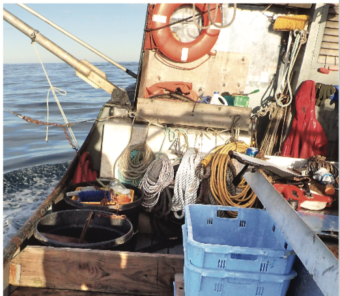
A photo taken on board the Tustumena. and shared with DOT officials. (Photo courtesy Alaska Department of Transportation)

NOAA received a report of the incident from the Alaska Marine Highway System, according to NOAA Fisheries Alaska region spokeswoman Julie Speegle.

Eyewitnesses say a whale breached into the side of the ferry, Speegle said.

“Afterwards, the whale was seen swimming abnormally and then it sank out of sight,” she said. “From the force of the breach, it is likely that this whale suffered mortal injuries.”

The whale struck the ferry’s starboard stabilization fin.

“Divers took a look at the stabilizer, and it was able to be retracted,” DOT public information officer Aurah Landau said. “The vessel can run safely as is without that one stabilizer, and so we don’t anticipate needing repairs at this point.”

The ferry schedule will not be affected, Landau said.

Speegle said NOAA may be able to learn more, such as the whale’s species, if its body floats to the surface.

NOAA law enforcement researches sexual harassment, assault among fisheries observers

(Photo courtesy NOAA)

Women are harassed and fear for their safety much more than men when they work as fishery observers.

National Oceanic Atmospheric Administration’s office of law enforcement officials presented a report about sexual harassment of observers to a meeting of the North Pacific Fisheries Management Council in Kodiak.
The report shared preliminary data from an ongoing survey and although the sample size is small, just 21 women and 31 men responded from the 2016 cohort and 21 females and 26 males from the 2017 cohort, the survey reveals stark differences between the experiences of female and male observers.

Jaclyn Smith, a special agent for the NOAA office of law enforcement in Anchorage, presented some of the data compiled through an anonymous survey sent out to observers deployed in Alaska in 2016 and 2017.

About 400 observers are employed in Alaska in any given year.

“There were 20 questions that were asked about either safety or harassment. I phrased it in ways that didn’t come up with conclusions,” Smith said. “I didn’t ask them if they were sexually harassed rather I asked them  if they ever received unwanted, unwelcome comments of a sexual nature or I asked them if they ever feared for their physical safety.”

North Pacific Groundfish and Halibut Fisheries observers are expected to accurately record sampling data, write reports, make observations of violations and report suspected violations.

Observers make sure boats are following required regulations while at sea. They live aboard fishing boats with their crews, and a strong rapport with the fishermen they work alongside can really help observers do their job.

But, for women working as observers, the isolated environment can lead to uncomfortable or dangerous situations, according to the Observer program’s annual report.

Almost half of all observers in Alaska are women.

The survey’s goal was to narrow down what observers were experiencing while working said Smith.

“(In) 2016, and these are all the positive responses that we got. Nineteen percent of the females who responded were made to fear for their physical safety in 2016 and 14 (percent) in 2017,” Smith said. “Offensive comments made regarding age, sex, sexual orientation, religion or race/ethnicity: 43 percent and 10 percent in 2016 as opposed to 38 (percent) and four percent in 2017.”

The fact that some observers feared for their safety is distressing, but Smith also pointed out that this kind of work environment doesn’t allow women to do their jobs well.

“There have been times where the observer is trying to do their sampling and a crew member might stand directly in front of them. Or there might be a bunch of things that are put onto the observer sampling station when the crew knows that the observer is about to conduct their sample that prevents them from accessing it,” Smith said. “A lot of times it is a person actually standing in front of the observer preventing them from going where they need to go.”

The body acknowledged that male and female observers have very different experiences when out with crews and expressed support for more research into sexual harassment among observers.

NOAA has seen a significant drop in reports of sexual harassment in 2017.

There were 14 reports in 2016 and just seven in 2017, which could indicate law enforcement and industry efforts to educate and prevent sexual harassment could be working.

Smith acknowledged that because victims can lose trust in the government, their employers and law enforcement, they may not report experiences such as sexual harassment to authorities.

One of the goals of the survey is to find out what the barriers are to reporting such incidents.

The results of the survey are preliminary and NOAA law enforcement plans to continue conducting it for several more months.

The final report is scheduled to be released during the December meeting of the North Pacific Fisheries Management Council.

Salmon are beginning to show up around Bristol Bay

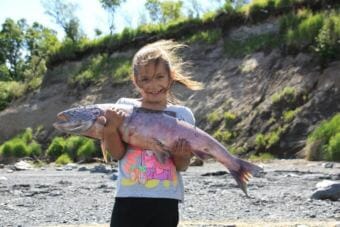
A young fisher-woman displays a King caught on Kanakanak Beach in 2017. (Photo courtesy Sarah Grace Durrance)

Salmon are beginning to hit the nets of subsistence fishermen around Bristol Bay.

Eddie Clark was fishing at coffee point near Egegik last week when he got his first salmon.

“Put the net out and got a dog on May 23,” he said. “We usually put the net out for a little bit every tide. Then around May 25, got one red.”

Clark also said he had heard that at least one king had been caught around Egegik last week since a friend in the village got to sit down to a meal of chinook.

“He enjoyed a king steak on the 25th, but he did not catch it,” Clark said. “They did get a King in Egegik on May 25, and we’ve been fishing one tide a day since then, but nothing.”

On the west side of the bay, fishermen in Clarks Point are beginning to have some luck as well.

Robert Wassily said his season didn’t start off with a bang, but, recently, he pulled in his first king of the season.

“Mine was pretty slow, but I got one, probably, 15 (or) 20 pounder, so far,” he said. “And, a couple other nets caught a couple more.”

It’ll take at least four more kings, Wassily said , for him to feel satisfied. He, also, says other than some chinook, there’s also been talk of one red salmon, a chum, and some trout being caught near Clarks Point.

Bobbie McCarr caught two kings near Dillingham, and there are reports of at least one king caught in Koliganek.

The Alaska Department of Fish and Game office in King Salmon, on the other hand, says things are pretty quiet at this point on the East side of the bay.

Researchers try to understand why Pacific cod stocks are crashing in Gulf of Alaska

Marine scientists Alisa Abookire, left, and Mike Litzow clear kelp out of their seine. (Photo by Mitch Borden/KMXT)

On an island about 4 miles off of Kodiak, marine scientists working with the University of Alaska are trying to figure out why Pacific cod stocks are crashing in the Gulf of Alaska.

And, how climate change may be affecting the fish when they’re young.

Mike Litzow and, his wife, Alisa Abookire, try to pull in a beach seine on a soggy gray day on Long Island. But, they catch more seaweed than fish as they slowly sink deeper into the shore’s mud.

“We have to get some kelp out, Liz,” Litzow said. “Oh no, it’s the freaking motherload. This will be our day right here if we aren’t careful.”

This isn’t a normal fishing trip.

The marine scientists are collaborating on a study for the University of Alaska Fairbanks to figure out why Pacific cod stocks are declining in the Gulf of Alaska and how warming waters may be affecting the species when they’re young.

But to do that, they need cod to study, which is why they’re currently struggling to pull in a net. When the seine’s finally on shore, Litzow begins counting up the catch.

There aren’t any cod among the small flopping fish, but every specimen is still inspected and recorded before they’re tossed back into the water.

Litzow isn’t surprised they’re not catching any cod today because it’s probably too early for them to come into shore.

As it becomes warmer though, more and more fish will begin to appear, including the small cod they’re looking for.

“Over the winter and we’d set five sets and get like at the low point, 15 fish. And then in the summer, if you hit a big school fish you can get like 15,000 in one set.”

Once juvenile cod begin to show up in their net, Litzow and Abookire will measure them; examine the fish to figure out what they’re eating; and collect the small ear bones, or the otoliths, of the cod, which will be used to determine the temperature of the water the fish grew up in.

“There’s all kinds of information you can get over time once you catch the fish.”

The reason it’s important to collect this data is the Gulf of Alaska has been unusually warm for the past few years. In that time, cod populations have crashed.

Cod is an important commercial fishery in the gulf and the quota was recently cut by about 80 percent for 2018.

The unusually warm water in the gulf is connected to climate change,  Litzow said.

He believes, the reason the cod population declined so quickly is that juvenile cod couldn’t find enough food to sustain themselves in these warmer temperatures.

That’s only a hypothesis right now, which is why Litzow and Abookire are trying to collect as much information that will help explain the collapse.

“As you get a number of years together you can start to understand something about how environmental changes are affecting the population,” he said. “That’s the ultimate goal, but it does take a few years to get enough data to be able to answer questions like that.”

Litzow and Abookire will be taking a lot more trips to cast their net to see what more they can learn about how cod are being affected by the changing climate in the Gulf of Alaska.

Alaska National Guard hopes to increase number of Alaska Native soldiers

Then-Lt. Col. Wayne Don of the Alaska Army National Guard, photographed on Feb. 27, 2015, in his office, holds a photo of his uncle, Sam Herman, who served with the Alaska Territorial Guard during World War II. Herman is pictured during his subsequent service with the Alaska Army National Guard. A statuette of an ATG scout keeps vigil on Wayne's desk.
Then-Lt. Col. Wayne Don of the Alaska Army National Guard holds a photo of his uncle, Sam Herman, who served with the Alaska Territorial Guard during World War II in his office on Feb. 27, 2015. Herman is pictured during his subsequent service with the Alaska Army National Guard. A statuette of an ATG scout keeps vigil on Wayne’s desk. (Photo by David Bedard/U.S. Air Force)

The Alaska National Guard is trying to recruit more Alaska Native soldiers.

Col. Wayne Don was in Kodiak last week along with other members of the National Guard in order to reach out to locals.

The National Guard said it already has an armory and 17 soldiers in Kodiak, but they’re working towards a number of Alaska Native participants that are more representative of the state population.

Don said about 8.5 percent of the entire Army Guard and 3 to 4 percent in the Air Guard is Alaska Native.

“Over a period of time, since the end of the Cold War, the participation of Alaska Natives has diminished and, with that, a lot of the able-bodied young men who would otherwise provide assistance during local emergencies and state emergencies,” Don said. “So, we lack a presence out in some of our communities there.”

Don said the Rural Guard Initiative, which they established a few years ago, is focused on bringing in Alaska Native soldiers, especially to the Army Guard.

“As is going on in the rest of the country, there are entrance barriers for a lot of young men and women in terms of medical and academic or entrance scores, and so with our initiative, we’re able to waive some of those initial entry requirements to increase the number of participants,” Don said.

He said ideally, they’d like soldiers stationed in every community, but they just don’t have enough qualified people to serve yet. He said they hope to build to at least 50 members in these first few years.

Mallott views growth in energy sector as Alaska’s future

Meeting of Governor Walker's Climate Action Leadership team, chaired by Lieutenant Governor Byron Mallott, on the University of Alaska Fairbanks Campus, in Fairbanks, Alaska, April 12, 2018. (Photo by David Lienemann/Office of Governor Bill Walker)
Alaska Lt. Gov. Byron Mallott chairs a meeting April 12, 2018, of Gov. Bill Walker’s Climate Action Leadership team on the University of Alaska Fairbanks Campus, in Fairbanks, Alaska. (Photo by David Lienemann/Office of Governor Bill Walker)

Alaska’s lieutenant governor sees a future for renewable energy.

Alaska needs to focus on transitioning from a fossil-fuel based economy to more renewable resources, like hydro and wind power, Lt. Gov. Byron Mallott said.

It could take a while to make that switch, he said last week during a visit to Kodiak for a fundraising event.

“I expect that it will be a combination of the market place for such fuels and public policy that will drive that timing, and that has really not come into focus yet, certainly at the national level.”

Branching out is vital to the state’s economy to diversify its industries and, within those industries, he said. The same for energy.

“The imperative for Alaska is certainly one of doing its part to reduce emissions globally, but it is also an opportunity that we view economically that investing in new forms of energy, reducing the cost of energy across our state, makes us more competitive as a state.”

Mallott said Alaska needs to take steps to plan ahead.

In an effort to do that, Mallott is chairing the Climate Action for Alaska Leadership Team, which was established last year and is made up of citizen representatives from across the state.

The group has drafted a climate change policy that’s up for public review and the governor’s office is in the process of prioritizing those items and figuring out how to act on them.

Site notifications
Update notification options
Subscribe to notifications