KMXT - Kodiak

KMXT is our partner station in Kodiak. KTOO collaborates with partners across the state to cover important news and to share stories with our audiences.

Alaska Legislature sends $300K in salmon donations to Ukraine

""
Pink salmon swim in the Tongass National Forest. (Photo by Joe Serio/U.S. Forest Service)

More than a year into the war in Ukraine, Alaska’s government is doing its part by sending aid in the form of seafood from the Last Frontier. The Alaska Seafood Marketing Institute is handling the state’s food distribution.

Bruce Schactler, the institute’s food aid program and development director, said ASMI doesn’t own any of the seafood but has helped manage the state’s aid programs.

That includes sending over $300,000 worth of Alaskan seafood, or about 3,600 cases of canned pink salmon, to Ukraine.
“We do things on behalf of the Legislature, the State of Alaska,” he said. “Most recently, at the request of the Legislature, we sent three containers of canned salmon over to Ukraine.”

When the state government decides to send aid, it sets a budget and ASMI solicits bids from companies across Alaska. Companies then bid on the sale and offer stock at competitive rates to ensure a maximized amount of product.

The state has aided in several disasters over the years. Through ASMI, it has sent food to the Philippines after devastating typhoons and areas suffering food insecurity in Africa and the Middle East as well.

Schactler says ASMI has a history of running the state’s aid programs.

“ASMI’s been facilitating humanitarian aid for (the) last 20 years,” he said.

The institute was asked about domestic food insecurity at a recent presentation to the state House Fisheries Special Committee. The issue has been particularly acute, as the state has been slow to send food stamps or process applications since August.

Schactler said ASMI would be interested in sending food to those in need across the state, but needs funding and approval from the Legislature first.

“I’ve discussed it with the State Department and I’ve discussed it with a few members of Congress in Washington, D.C., but I have not been contacted or heard anything further than that,” he said.

If the state decides to purchase domestic seafood for Alaskans in this year’s supplemental budget, aid could be sent to food banks as soon as next week. But if aid isn’t included until the 2024 regular budget, folks would have to wait at least until July.

Kodiak crab strike ends after 2 weeks

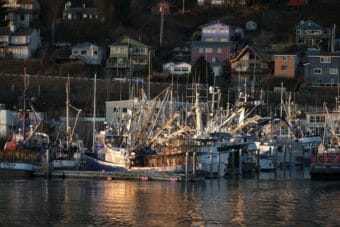
Boats stacked with empty crab pots sit in Kodiak’s St. Paul Harbor. (Brian Venua/KMXT)

After two weeks of staying at the dock, Kodiak’s tanner crab fleet is finally going fishing. Crabbers agreed to a price with the island’s processors on Saturday.

Each of Kodiak’s four canneries offered slightly different deals — Alaska Pacific Seafoods agreed to $3.35 per pound plus a retro payment — which can boost the final payout to fishermen after the season. Pacific Seafood also agreed to $3.35 per pound with a possible retro to fishermen. OBI settled with crabbers for $3.25 plus profit sharing, and Trident Seafoods stayed at $3.25 per pound.

It wasn’t exactly the deal Kodiak crabbers were hoping for, and some boats from Kodiak may still take their crab out west where processors are offering slightly more per pound. But ultimately, 80% of those in attendance at Saturday’s meeting agreed — it was time to go fishing.

“We stuck together, we’re gonna roll this thing out together, and we’re looking at it as a victory,” said Kevin Abena, the secretary and treasurer for the Kodiak Crab Alliance Cooperative, which represents the fishery’s permit holders.

Crabbers were initially offered $2.50 per pound ahead of the season, which started Sunday, Jan. 15. And at one point, nearly 200 vessels up and down the Aleutian Chain said they weren’t going fishing unless they were offered a better price.

Crabbers in Chignik and the South Peninsula started fishing last week after coming to an agreement with canneries in King Cove. But as of Friday, about 130 vessels from Kodiak still weren’t fishing. Alaska’s Department of Fish and Game also confirmed it hadn’t received any harvest reports or landings in that time.

“It’s important for these processors to know that we can stick together and organize and and honestly get a more fair deal on the table,” said Abena.

With a deal in place, crabbers will now set their gear at noon on Monday, Jan. 30 for the start of Kodiak’s tanner crab season.

Fishing can go fast in Kodiak’s tanner crab fishery — last year, the fishery closed after just about a week. This year’s quota is much larger, at 5.8 million pounds; that’s more than five times the size of last year’s harvest level. Abena said they’re expecting a bottleneck at local canneries, and some vessels might be stuck waiting to unload their harvest.

But despite all that, he says the fleet is more than ready.

“For a fisherman, he’s worried about when he’s going fishing and how long he’s going to be out fishing,” he said. “And now we have that first piece of that puzzle – we have when we’re leaving –  that’s huge.”

Abena is also the skipper of the fishing vessel Big Blue. He said after the last two weeks, he’ll feel a sense of relief when he pulls out of the harbor.

Kodiak fishermen sit out opener as dispute over crab prices continues

Boats stacked with empty crab pots sit in Kodiak’s St. Paul Harbor. (Brian Venua/KMXT)

Fishermen should have been setting their gear on Sunday morning for the opening of Kodiak’s biggest tanner crab fishery since 1986. But the harbor was almost full, with dozens of boats stacked high with empty crab pots. At the coffee shop near the docks downtown, fishermen lined up for free coffee instead.

Frank Miles owns the Sumner Strait — it’s a 58-foot limit seiner — and has fished commercially for nearly 50 years. His first tanner season around Kodiak was in the early 80s, when he chopped bait for a local boat.

“I’ve parlayed it into a very good livelihood,” he said. “I’ve raised three kids in this town on the back of fishing income, and it’s been a beautiful thing.”

Miles normally fishes pot cod and longlines for halibut and black cod. He also tenders salmon. He sat out the beginning of this cod season so he could go out for tanners instead. He didn’t think prices would be quite as high as last year’s record of more than $8 per pound.

“But I never in my wildest dreams thought that we’re gonna get offered $2.50. It really is a slap in the face,” Miles said.

That’s how much all of Kodiak’s processors offered ahead of the scheduled opener for the tanner crab fishery.

Miles says he understands that processors’ expenses have gone up, but so have his. Fuel and bait costs have increased, it’s more expensive to replace or repair crab pots, and he’s losing money staying tied up. Miles said it costs $63,000 to insure his boat — which is one of two that he owns — plus $15,000 in moorage fees for the Sumner Strait alone.

Skippers and crew from Kodiak, Chignik and the South Peninsula have been holding out for better price before they go fishing (Brian Venua/KMXT)

Kodiak’s entire fleet sat out the season opener on Sunday, and they aren’t planning on fishing anytime soon. That includes fishermen in Chignik and the South Peninsula.

“Nobody’s pulling any pots as far as we know,” said Kevin Abena, the secretary and treasurer for the Kodiak Crab Alliance Cooperative, which represents about 120 permit holders in the fishery.

It’s a diverse group that includes 32-foot gillnetters to 118-foot crabbers.

He said they’re still negotiating with the canneries in town, but so far, the best offers are coming from processors out the Aleutian Chain.

“We are actively finding tenders right now, working with the processors out west to formulate a plan to move all this crab out west,” Abena said.

As of Monday, that decision wasn’t final, but it’s a serious option. Abena said the cooperative is in talks with Peter Pan in King Cove to process crab from Kodiak.

Canneries to the west are offering close to $4 per pound for Bering Sea tanners. But Kodiak tanner crabs are about an inch bigger. That’s another sticking point for local fishermen, who say the crab around Kodiak is more valuable than what’s currently on the market.

Abena said both the community and fishermen from other parts of the state have reached out to express their support of the stand-down. At this point, he says the soonest the fleet would go fishing is Wednesday, Jan. 18.

“The amount that we stand to gain, everybody understands it is much greater than what we’re losing right now for standing down for a day, two, three, four – a week – whatever it takes,” he said.

Fisherman Frank Miles said whenever they get a fair deal, he’ll be ready.

“I can’t wait to go fishing, man, I think everybody’s ready to go,” he said. “I’ve never seen a fleet so ready.”

In the meantime, he and the others will continue to wait.

As of Monday morning, processors in Kodiak either could not be reached by phone or had no comment.

Brian Venua contributed to this reporting.

Kodiak fishermen stand down to protest low tanner crab prices

Kodiak’s commercial fishing fleet has been preparing for the area’s biggest tanner crab season since 1986. (Brian Venua/KMXT)

Kodiak’s biggest tanner crab fishery in nearly 40 years is set to open on Sunday, but the fleet is standing down. Fishermen say they won’t go fishing for the prices offered by local canneries. It’s the latest wrinkle on a winter fishing season already impacted by closures and strikes.

Processors in Kodiak offered $2.50 per pound for tanners when negotiations started earlier this month. Kevin Abena is the secretary and treasurer for the Kodiak Crab Alliance Cooperative, which represents about 120 permit holders in the fishery. He said since then, all of Kodiak’s canneries haven’t budged from their initial price.

“We haven’t been given anything to consider. $2.50 isn’t the number that we’ll consider,” Abena said.

Last year, fishermen were paid a record of more than $8 per pound. The tanner crab fishery was closed in 2021, but back in 2020, prices still were more than $4.

This year’s harvest levels for the Kodiak fishery are the biggest they’ve been since 1986, at 5.8 million pounds. That’s more than five times the size of last year’s quota. Combined with the fisheries in Chignik and the South Peninsula, 7.3 million pounds total of tanners are up for grabs in the Westward Region.

Last year, the state Department of Fish and Game estimates the Kodiak region alone was worth over $10.1 million.

The big quota this year also means more boats are participating. Last year, 87 vessels fished for tanners. This year, 109 were registered as of Friday morning. That includes some Bering Sea crabbers, whose seasons have been canceled because of crashing snow crab and king crab populations.

Abena says some processors out west have been offering around $4 per pound for tanner crabs. That doesn’t help the local fleet though, most of whom can’t make the trip out the chain. And it doesn’t help the community, which collects municipal taxes off of seafood landings.

“This is a community deal,” he said. “Everybody in the fleet has spent a lot of money on getting ready to do this fishery, everybody has invested money.”

Abena declined to call it a strike, but the action is similar to a strike in another fishery earlier this year. Bering Sea fishermen successfully pushed up the price per pound for Pacific cod after striking.

Abena says the entire fleet – including fishermen in Chignik and the South District — is holding out until local processors offer better prices.

“The feeling of unity is really strong, and it’s pretty special,” he said. “It’s hard to get a diverse group like we have here on board, everybody has things that they want to move on to after crab. Some boats go cod fishing, some boats go dragging for pollock. Some guys will be going right into black cod or halibut fishing.”

When reached by phone Friday morning, Pacific Seafoods had no comment. Other processors, including Trident, Ocean Beauty and Alaska Pacific Seafoods, could not be reached.

The cooperative’s next meeting with permit holders is Saturday. Abena said if they get the right price, the soonest they’d go fishing is Monday, Jan. 16 – a day after the scheduled opener.

Correction: A previous version of this story said the Kodiak area fishery was worth $1.2 million. Fish and Game estimates it was worth over $10.1 million. 

Kodiak rocket crashes at spaceport after launch

A black plume was visible from the city of Kodiak shortly after ABL’s launch attempt on Jan. 10, 2023. (Photo by Brian Venua/KMXT)

A rocket launched from Kodiak’s spaceport Tuesday afternoon crashed shortly after ignition, with damage at the spaceport confirmed by the rocket’s creator.

ABL Space Systems confirmed that its RS-1 rocket experienced an anomaly during liftoff from the Kodiak Pacific Spaceport. All nine of the rocket’s engines shut down prematurely and it did not reach orbit. The rocket then “impacted the pad and was destroyed,” the company said on Twitter.

A black plume of smoke was visible from the city of Kodiak, rising from the area near the spaceport complex on Narrow Cape around 2:30 p.m. Tuesday, shortly after the rocket’s planned takeoff time of 2:27 p.m.

A spokesperson for ABL said via email that all personnel on the ground at the complex were safe, although there is damage to the launch facility. As of 9 p.m. Tuesday, the company said via Twitter that “fires have subsided” at the complex.

The company also tweeted, “This is not the outcome we were hoping for today, but one that we prepared for. We’ll revert with additional information when available. Thanks to all for the support.”

ABL said it was going through its anomaly response procedures in coordination with the Pacific Spaceport Complex and the Federal Aviation Administration.

This would have been ABL’s first successful launch of its RS-1 rocket – the company has been trying to launch from the Kodiak Pacific Spaceport Complex since the fall.

Nearly 3 years after deadly sinking, debris from the Scandies Rose finds its way to a family in Kodiak

A photo of the Scandies Rose, taken from another boat.
Debris from the F/V Scandies Rose, which sunk on Dec. 31, 2019, recently was found by a fisherman from Chignik. (Photo courtesy Gerry Cobban Knagin)

Seven men were on board the F/V Scandies Rose when it went down during stormy weather in the waters off Sutwik Island – near Chignik – on New Year’s Eve, 2019.

Two survivors were plucked from the water in the hours after the vessel sank by Coast Guard rescue crews. But five crew members were never found and presumed dead. Those included the ship’s captain, Gary Cobban Jr. and his son David Cobban, both from Kodiak.

Gerry Cobban Knagin is Gary Cobban Jr.’s sister. She said in the years since, the family sent a remote operated vehicle down to the seafloor to survey the wreckage.

“I have a whole video of the boat on the bottom with the pots and the buoys popped up out of the pots and made like a kelp forest of buoys,” she said.

The ship, a 130-foot crabbing boat, was enroute from Kodiak to fishing grounds in the Bering Sea and stacked with 198 crab pots when it sank.

Now, nearly three years later, those buoys and other pieces of the ship have started washing ashore, bringing closure to Knagin and some of the other family members of the crew members lost.

Knagin said her family was contacted earlier this month by a fisherman from Chignik, who found two buoys and a bait tow. He flew them back to the family in Kodiak.

“That was just such a heartfelt moment to know that this fisherman, he recognized them for what they were and then he didn’t have Facebook, so he used somebody else’s Facebook page to get in touch with me,” said Knagin. “And then I met them here in Kodiak and picked them up and that’s just like, thank you. I can’t thank him enough for that.”

Knagin said they’ve received some of her brother’s personal belongings from storage yards in Kodiak and Dutch Harbor over the years, but finding something from the ship was different.

“When I touched those buoys it was like getting a hug from my brother. It was a pretty emotional moment,” said Knagin.

report from the National Transportation Safety Board later concluded that inaccurate stacking instructions – particularly in icing conditions – for the ship’s crab pots and more extreme weather than predicted likely caused the Scandies Rose’s sinking. The NTSB made a series of recommendations to multiple agencies, including the Coast Guard, National Oceanic and Atmospheric Administration, National Weather Service and the North Pacific Fishing Vessel Owners’ Association based on its findings.

Just last week, members of the Coast Guard’s Marine Safety Detachment were walking the docks in Kodiak to make sure boats heading out for the upcoming tanner crab fishery were loading pots correctly. Knagin said weather forecasting has also gotten better in the area where her brother’s ship went down. Education and outreach to fishermen has also improved; there’s an upcoming Alaska Marine Safety Education Association course in Kodiak on vessel stability and emergency procedures.

Knagin said she plans to reunite washed-up items from the sunken vessel with the family members of the other men who went down with the ship.

Her brother was color blind, so the big buoys from the Scandies Rose are lime green for him to pick them out on the sea. They have the letters “SR” written on them in black with the ship’s Fish and Game number, 35318. There’s also smaller buoys with the Fish and Game number on them that may float to the surface.

“Some of those are trailer buoys, some of those are red and some of those are white,” she said.

She said anyone who finds something they think is from the ship can find her on Facebook and send her a message, or contact her via email, that’s gdknagin@gmail.com.

Site notifications
Update notification options
Subscribe to notifications