KMXT is our partner station in Kodiak. KTOO collaborates with partners across the state to cover important news and to share stories with our audiences.
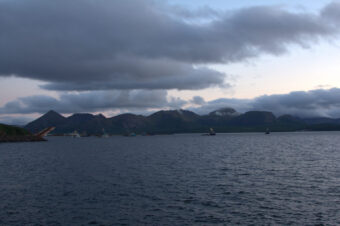
A U.S. Coast Guard MH-60 Jayhawk helicopter. (Mikko Wilson/KTOO)
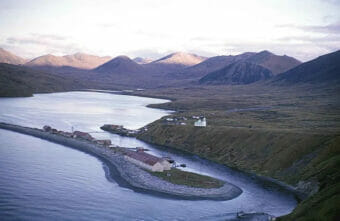
A small plane crashed near the village of Old Harbor – on the southeast side of Kodiak Island – on Sunday afternoon. The Piper Cherokee crashed just 6 minutes into its flight; it was reported at 3:30 p.m.
Five people were aboard when it went down about three miles north of Old Harbor on Sunday, according to the Coast Guard.
Two people are reported to be dead. Three survivors were found at the crash site. One person was in critical condition and taken by helicopter to Providence Kodiak Island Medical Center. Two others were injured but in stable condition. Survivors were transported by a good Samaritan Cessna to awaiting medical personnel. Alaska State Troopers also assisted in the call.
A Coast Guard spokesperson said they were unable to provide any additional information about the survivors or deceased on Monday morning.
Clint Johnson is the Alaska region chief for the National Transportation Safety Board, which is leading the investigation into the crash.
“Preliminary information would indicate that they were on their way back from a lodge in Old Harbor, back to Kodiak. As far as the flight, we don’t know exactly what it was,” he said.
During investigations, the NTSB looks for possible causes categorized as human performance, mechanical issues, or environment and weather.
The plane was operated by Kodiak-based Vertigo Air Taxi. The company declined to comment on Monday.
Johnson said it’s too early to speculate the cause of the crash.
“It’s a process of elimination – nothing has been eliminated at this point right now,” he said.
NTSB meteorologists are already looking into weather patterns in the area at the time of the crash. Johnson said they will also question survivors and the pilot as part of the investigation. Preliminary reports will be published on the board’s website in the next two weeks.
This post has been updated. Brian Venua contributed reporting.
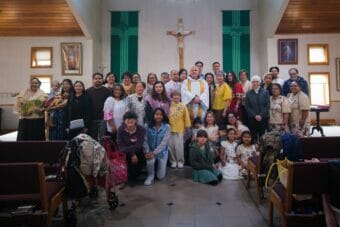
After Mass, community members and attendees gathered for a group photo in front of the altar, June 11, 2023. (Brian Venua/KMXT)
This week marks the 125th anniversary of the Philippines’ Declaration of Independence. That was when the island nation officially began a revolution from its colonizers.
Festivities take place across the country each year, and this year, celebrations even took place in Kodiak.
St. Mary’s Parish, Kodiak’s Catholic church, dedicated a Mass to the archipelago’s Filipino community on Sunday. After Mass, a celebration was held in the church’s community center across the parking lot.
Some helped serve food as they talked with friends, June 11, 2023. (Brian Venua/KMXT)
“The first time that the Philippine flag was raised was in Kawit, Cavite by the late president (and) general, Emilio Aguinaldo,” he said. “That’s the first time that we as the Filipino [sic], we are free from bondage, we are freed from slavery. ” This is one of the first events Kodiak Filipino American Association has had in a while. Mark Anthony Vizcocho is the association’s president. The United States didn’t officially recognize the Philippines until after World War II, but Vizcocho said most Filipinos recognize the original declaration from June 12,1898.
Some folks even wore traditional Filipino formal clothes for Sunday’s celebration in Kodiak.
Barong tagalogs are usually worn by men and look kind of like a western button up shirt. Filipinianas are usually worn by women and can look like a short jacket or similar to a shawl. Both are usually white or off-white and transparent, but worn with a similar color shirt or dress underneath. They’re traditionally made from pineapple fibers, and adorned with patterns near the collar and chest areas.
Vizcocho said he wants to hold more events like this to bring together the Filipino community and spread awareness about the association’s efforts.
“Let’s bring this back online so that everyone can see that we are here,” he said. “We are proud of who we are and we want to share that celebration with everybody in the community, so this is just a start on just giving back to the community.”
City Mayor Pat Branson also attended the celebration. The Kodiak City Council proclaimed June as Filipino Heritage Month at its meeting last week in honor of the independence day. She said it’s important to acknowledge the historic presence of Filipinos on the island and the impact they’ve had over the years.The small room was lined with tables filled with foods like pancit, a rice noodle dish with chicken and vegetables, and kaldereta which is like a stew. There were also desserts like puto, a steamed rice cake. The room was filled to the brim and attendees spoke both in English and Tagalog, the main dialect of the Philippines.
Four women, just outside the filled room, June 11, 2023. (Brian Venua/KMXT)
Vizcocho said they hope to host a basketball or volleyball tournament next year as well to get more young people involved. “(The) Filipino Community’s been here since the 1800s, a major part of our community, volunteering, working hard,” said Branson. “And celebrating – The FilAm Association knows how to celebrate with great food and laughter – you can hear that going on inside! So, it’s joyous day.”
“Anything that we try to do to get the youth involved,” he said. “That’s one of our main projects, towards the youth.”
The Kodiak Island Borough Assembly will also proclaim June as Filipino Heritage Month in their meeting on Thursday. Vizcocho says this past weekend’s festivities are just the beginning, and is already planning to host more events soon.
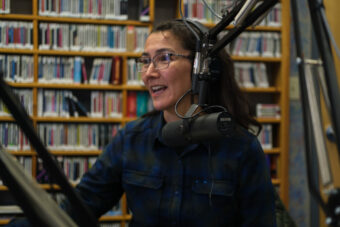
Rep. Mary Peltola in the KMXT studio on May 27, 2023. (Brian Venua/KMXT)
The U.S. House will vote Wednesday on an agreement to raise the nation’s debt ceiling, and Alaska Congresswoman Mary Peltola supports the deal, a spokesman said Tuesday.
For other Democrats, the worst parts of the agreement the White House and House Speaker Kevin McCarthy struck Sunday are in a 25-page section called “Permitting Reform.” They include changes to the National Environmental Policy Act that are aimed at speeding permits for everything from highways to oil drilling.
But Peltola likes that section.
“I have been expressing to my caucus the importance of permitting reform. And if that’s one of the elements of this deal, I think that would be very good for Alaska and America,” she said in an interview with KMXT Saturday in Kodiak, where she was attending the island’s annual Crab Fest.
Peltola’s position highlights her willingness to step outside of party lines. In particular, it puts her at odds with fellow Democrats on the House Natural Resources Committee, who’ve issued detailed statements denouncing the permitting reform section. They say the changes would gut environmental protection and benefit Big Oil.
Peltola said a faster permitting process wouldn’t just benefit the fossil fuel industry.
“It’s just cumbersome to permit a renewable energy project as it is a petroleum project. And we cannot afford to wait five years or 10 years to transition,” she said.
It’s not clear yet how many Democratic votes House Speaker Kevin McCarthy will need to lift the debt ceiling. He may need several dozen, depending on how many Republicans join right-wing members of his caucus who are rejecting the bill.
Peltola said the deal is preferable to a government shutdown, though she aligns with most Democrats against the imposition of new work requirements for government assistance, like federal nutrition programs.
“It would not be my preference to be cutting programs to the poorest of the poor and actually nutrition programs taking food literally out of peoples’ mouths,” she said.
The deal puts stricter work requirements on adults under 55 without dependents for the Supplemental Nutrition Assistance Program, also known as SNAP or food stamps, and welfare payments. Current work requirements for SNAP benefits apply for adults 49 and younger without dependents.
But the deal also expands SNAP benefits for other groups, including homeless individuals and veterans.
Peltola said there’s already an exhaustive process for vetting SNAP recipients, and work requirements are hard to apply in the state, particularly in rural areas.
“That’s much more complicated in Alaska when you’re talking about very small communities that may not have many jobs,” Peltola said.
The congresswoman was not part of the negotiations. She said she kept up with developments over the weekend through a text chain with other House Democrats.
Marine debris collected on Gore Point. (Aaron Bolton/KBBI)
Plastic, wood, fishing nets and buoys are just some of the waste that washes up on even the most remote parts of Alaska’s coastline. Now, programs aimed at cleaning up that marine debris are getting a funding boost from the National Oceanic and Atmospheric Administration – thanks to an influx of grant money from the Bipartisan Infrastructure Law.
Nearly $14 million in federal funding is earmarked for two separate programs aimed at cleaning up marine debris in the state. The money is distributed through NOAA’s Marine Debris Program and funded by the Bipartisan Infrastructure Law that was passed in 2021.
Peter Murphy is Alaska’s regional debris coordinator with NOAA. He said the new programs go beyond just cleaning up existing debris.
“But also prevention, finding ways to reduce how much is getting into the ocean, because at the end of the day, we’re not going to be able to clean our way out of the problem,” he said.
Of that money, $5.85 million will go to the University of Alaska Fairbanks to establish a Center for Marine Debris based in Kodiak, that will serve as a kind of a regional headquarters for marine debris removal projects across the state. The center will eventually be able to process and recycle debris that is shipped there.
Partner organizations on the project include Alaska Sea Grant, the Aleut Community of St. Paul Island, Douglas Indian Association, Matson, the Native Village of Port Heiden and the Ocean Plastics Recovery Project.
The other project is focused on removing abandoned fishing gear from Chesapeake Bay on the East Coast, and $8 million will go to that project, which is spearheaded by the Virginia Institute of Marine Science. But it will also include a grant program that organizations in Alaska can tap into.
Murphy said abandoned gear is a problem across the country — and it has a big impact on fisheries. For instance, a study in Southeast Alaska showed that abandoned crab pots were still catching crabs and other marine animals years after they were lost.
“Fishing gear is a specifically impactful type of marine debris, because once it gets lost or abandoned in the marine environment, it does what it was intended to do. It continues to catch animals but it does so indiscriminately,” he said.
Money for both programs is included in Bipartisan Infrastructure Law for this year, and both the marine debris and fishing gear cleanup programs are set to start this summer.
An oil tanker docked at the Valdez Marine Terminal in April. (Photo by Elizabeth Harball/Alaska’s Energy Desk)
The Valdez terminal of the Trans-Alaska Pipeline System is at “risk of a serious accident or incident in the near future.” That’s a main takeaway of a sweeping 180-page report that was published in April, detailing wide-ranging safety concerns at the Valdez Marine Terminal, where North Slope crude is loaded onto ocean tankers.
The Alyeska Pipeline Service Company says it’s taking the report seriously, but coastal communities say time is of the essence.
Early last year, an Alyeska employee working at the Valdez Marine Terminal — which is the southern end of the trans-Alaska pipeline — reported smelling fumes. Heavy snow had damaged oil storage tanks at the facility — venting petroleum vapors into the atmosphere.
“It was noticed by an employee at Alyeska that was walking around, happened to smell toxic fumes coming out of the tanks,” said Wayne Donaldson, the city of Kodiak’s representative on the Prince William Sound Regional Citizens’ Advisory Council, or PWSRCAC.
The advisory council is one of two federally mandated oil spill prevention groups formed in response to the 1989 Exxon Valdez spill, which saturated more than a thousand miles of Alaska’s coastline – including Kodiak Island’s shores – in oil.
Donaldson is one of 19 members of the group and has served on the council for eight years. The federal Oil Pollution Act of 1990, which was passed after the Exxon Valdez oil spill, also led to the formation of the Cook Inlet Regional Citizens Advisory Council.
He said after the incident at the terminal last year, more Alyeska employees started contacting the group.
“And as time went on, more people started coming to us giving safety concerns, as well as retired people from Alyeska,” Donaldson said.
The advisory council commissioned a review of safety practices at the terminal last summer in light of the complaints. And a final report was published last month.
It encompasses nearly 200 pages of major safety concerns at the Valdez Marine Terminal: equipment the report calls “aging and obsolete;” a work culture that includes retaliation among employees, mismanagement and turnover; and shrinking federal and state budgets that have decreased regulatory oversight.
In response to the report, the advisory council sent letters to lawmakers – including Gov. Mike Dunleavy and Alaska’s congressional delegation – citing the need for federal audits of the terminal by the Government Accountability Office and the Occupational Safety and Health Administration.
The report was prepared by corporate safety consultant Billie Garde, who has worked both with Alyeska and BP in the past. Harvest Alaska, a Hilcorp subsidiary, ConocoPhillips and ExxonMobil all own portions of Alyeska Pipeline, which operates the terminal.
“We don’t agree with everything in the report, but we do take it as an opportunity to improve,” said Michelle Egan, Alyeska’s chief communications officer.
Egan is also from Kodiak, and she says she – like many others at Alyeska – is acutely aware of what an oil spill does to coastal communities. She said Alyeska has formed a management team to work on an action plan in response to the report.
Much of the report, however, comes directly from Alyeska staff — many of whom said they think a “serious incident is imminent.”
Brooke Taylor is the director of communications for the Prince William Sound Regional Citizens’ Advisory Council. She said the internal knowledge of problems at the terminal is one of the biggest weaknesses identified in the report.
“There wasn’t any substantive information in the report regarding safety or process safety issues that wasn’t already available to Alyeska,” said Taylor.
About 4% of the nation’s crude oil departs from the Valdez Marine Terminal, a percentage that could swell in the coming years as oil from the recently approved Willow project makes its way down the pipeline.
Taylor said an incident at the Valdez Marine Terminal has the potential to be environmentally devastating, and it threatens one of the state’s main sources of revenue.
“For us, it’s not pro or con industry, it’s — if oil is going to be transported through our region, we want it done as safely as possible,” she said.
Alyeska hired a new chief executive officer the same month the report came out, former BP executive John Kurz. Egan said he’s met with members of the group several times since then.
“He wants to work with [PWS]RCAC and with our employees to make this the safest environment we can possibly have,” she said. “So, I think that commitment has been clear. He’s communicated that repeatedly to our workforce, and to all of our stakeholders.”
The advisory council’s Taylor agrees that Alyeska has responded quickly to the report, and understands changes at the terminal won’t happen overnight.
“Time will tell on what actions are done. So, we know our biggest successes have always happened when industry regulation and citizen groups work together. And so we are hoping this will be another example of that,” Taylor said.
Wayne Donaldson said he’s also encouraged by Alyeska’s initial response to the report. But it’s been more than 30 years since the Exxon Valdez oil spill – he worries that the biggest challenge now is time and complacency.
Dave Jackson in his greenhouse at his home in Bell’s Flats. Jackson grows carrots indoor and outdoors, along with other vegetables. (Kirsten Dobroth/KMXT)
Kodiak Island is home to a burgeoning local food movement — one that could get a whole lot bigger this summer, thanks to one gardener’s ambitious plan to plant half a million carrots across the archipelago.
You could say Dave Jackson is Kodiak’s carrot kingpin.
Jackson’s got a thriving garden at his house on the sunny side of Bell’s Flats, just past Kodiak’s Coast Guard base. There are onions and asparagus and rhubarb and beds of greens, but carrots are the main attraction.
“Three out of these four beds right in front here is where I’m going to grow carrots,” Jackson said. “And I grow quite a few carrots. I give a lot away. I probably put 2,000 seeds in there.”
That might seem like a lot of carrots. But it pales in comparison to Jackson’s bigger goal for this summer: to distribute 1,000 growing kits — each containing hundreds of carrot seeds — to gardeners across the island.
“The goal is to put half a million seeds out there and try to get people to plant them,” he said.
But Jackson said the plan started off much smaller. One of his friend’s asked if he could put together a carrot planting packet to give to the neighborhood kids, who kept eating carrots out of his garden.
So, he posted on Facebook to ask if other people wanted their own packets, too.
“And it got like 150 hits right off the bat,” said Jackson. “And I went, ‘Whoa.’ Next day, I ordered this bucket of seeds.”
That bucket, which contains 500,000 seeds and other materials, cost about $1,800 altogether, according to Jackson. The local 4-H club, Kodiak Harvest Food Cooperative and some friends pitched in money for him to upscale the project.
Jackson worked as a fisherman and then for Alaska’s Department of Fish and Game for three decades. He said carrots are perfect for commercial fishing communities like Kodiak. You can leave them for weeks at a time – which is especially convenient with salmon season on the horizon.
“I learned how to do these carrots, high intensity, low maintenance, I do no thinning and no weeding,” said Jackson. “And so once I get the carrots up a couple of inches, I can go away and go fishing or whatever. And come back in six weeks and start eating carrots.”
Jackson’s carrot kits come with 500 seeds, solar mulch and instructions. (Kirsten Dobroth/KMXT)
Each carrot kit comes with an envelope filled with 500 seeds and everything you need to plant them. Jackson said the kits are perfect for aspiring or established gardeners, and they’re available for free at locations around Kodiak, including the Little Store in Bell’s Flats and Kodiak Harvest’s Food Co-Op.
He’s not shipping the kits outside Kodiak, but they have made it to other parts of the state, including Homer and the Aleutian Chain.
He said he doesn’t have a long term goal for the project — just that at least this summer, it means more locally grown food will end up on people’s plates.
“I really don’t have a way to judge how effective we are, you know, scientifically or anything, but I’m expecting there’s going to be lots of carrots,” he said.
Jackson’s advice is to plant by mid-May to have carrots in time for fall.
Close
Update notification options
Subscribe to notifications
Subscribe
Get notifications about news related to the topics you care about. You can unsubscribe anytime.