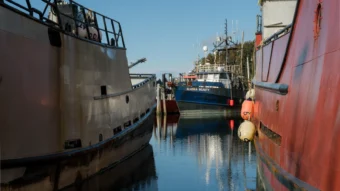
KMXT is our partner station in Kodiak. KTOO collaborates with partners across the state to cover important news and to share stories with our audiences.
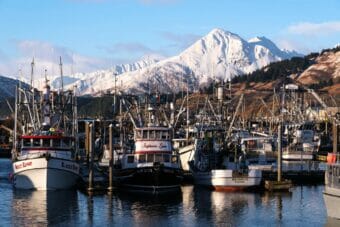
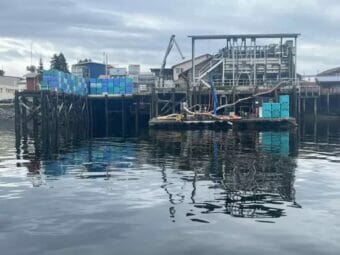
Commercial fishing vessels docked in the St. Paul Harbor in Kodiak; Feb. 6, 2023 (Brian Venua/KMXT)
Russia will no longer be able to sell seafood to U.S. markets after processing products through other countries, according to an executive order President Joe Biden signed earlier Friday to close a loophole.
Alaska lawmakers, especially those in fishing communities like Kodiak and Homer, heralded the news.
“I’m glad it seems to be resolved here,” state Senate President Gary Stevens said. “It just really has an impact on everyone in Kodiak, both the processors, and the fishermen, and the workers and the plants and all that. It’ll make up a level field that we can all fairly deal with.”
Fisheries have been struggling this year, and marketing executives and processors alike have blamed Russia for flooding markets with its seafood as a major reason for low prices offered to Alaska fishermen.
The initial ban on Russian seafood was enacted after the country invaded Ukraine. While Russian seafood processors have been unable to directly export products to the United States since then, they have gotten around the ban by having fish processed or “significantly modified” in other countries like China.
U.S. Senator Dan Sullivan said he’d been working on closing the loophole since the initial ban on Russian seafood.
“It’s a long overdue win for Alaskan fishermen, American fishermen, for sustainable and environmentally sound fisheries, and the numerous coastal communities in Alaska that support our fishing fleet,” Sullivan said.
Closing the loophole will open a huge market for domestic seafood producers to fill demand and hopes it will help raise prices for Alaska fishermen, Sullivan said.
“We have plenty of fish in Alaska that can source any of these products that you’d need,” he said.
Sullivan also touted Alaska’s standards for environmental protection and labor reputation when compared to its Russian and Chinese counterparts.
Starting Friday, Sullivan said, no new contracts can be signed to import Russian seafood from other countries. Any existing contracts must also be fulfilled or surrendered within the next 60 days, he said.
The Trident Seafoods processing plant in Petersburg. (Hannah Flor/KFSK)
Trident Seafoods, one of the biggest seafood processors in the country, announced Tuesday that it’s selling a third of its Alaska plants. Four of Trident’s processing plants in Alaska are now for sale – in Kodiak, Ketchikan, Petersburg, and False Pass.
The company also announced a significantly scaled-back winter season for its year-round plant in Kodiak. The historic Diamond NN Cannery in South Naknek and the company’s support facilities in Chignik will either be retired or sold as well, according to a company statement.
Multiple fishers contacted by KMXT said the move was a huge surprise.
Trident spokesperson Alexis Telfer, declined to comment, saying they’re focusing on their employees and fishing fleets at this time.
There’s a storm of issues in seafood markets right now – processors have offered fishers some of the lowest prices for their harvest in years, sparking standdowns and protests across the state. The Alaska Seafood Marketing Institute’s conference in November pointed to declining demand for seafood, huge harvests, and foreign competition as some of the key problems.
In a press release, Trident blamed similar reasons for its move to sell and claimed the plants for sale in Southeast Alaska and on the Alaska Peninsula better aligned with other operators’ strategies for the state. The seafood processor also announced it would delay building a processing plant in Unalaska earlier this year.
The company’s cost-cutting efforts also include laying off about a tenth of its corporate staff.
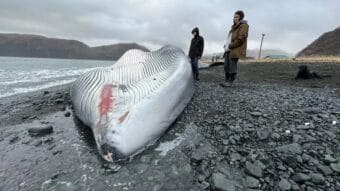
The fin whale washed up on her own without needing to be dragged higher onto the beach. (Courtesy Matt Van Daele/Sun’aq Tribe)
A fin whale washed up in the Pasagshak State Recreation Area, near the end of Kodiak Island’s road system, late last month. It’s unclear how it died, but the whale was in remarkably poor health.
Fin whales are the second largest whale species in the world after blue whales and are usually pretty rare around Kodiak.
Matt Van Daele is the natural resources director for the Sun’aq Tribe in Kodiak. Fin whales can live up to 90 years in the wild but Van Daele said this one was between 10 and 14 years old.
“She was extremely emaciated,” he said. “She was basically like a 53-foot-long snake and that was very sad to see.”
He said when they found the lone whale, she had several bruises all along her body.
“It’s possible that she may have stranded while she was still alive and then died during the night before anyone found her,” he said.
In all, about 40 people including volunteers, veterinary staff, and staff from the Sun’aq Tribe came to help with the necropsy last week.
Van Daele said whales dying near town used to be pretty rare for the island but now this is the second severely unhealthy whale they’ve done a necropsy for this year. The Sun’aq Tribe organized a necropsy for a humpback whale in September.
There isn’t enough data for biologists to declare a trend yet, but these whales are being found on the heels of an unusual mortality event for gray whales in the Pacific Ocean. Van Daele said these two starved whales in a single year doesn’t bode well for populations near the Kodiak Archipelago.
“I personally and scientifically am concerned about what we’re going to be seeing in the next couple of years with our local whales, if these things actually do turn into trends,” he said.
For now, all biologists can do is monitor populations and wait for their samples to get their lab results. Van Daele said the fin whale’s corpse is still on the beach for now, but they plan to bury it in the hopes they can save the skeleton to assemble and display in town.
“Nowhere in Alaska actually has a fin whale skeleton and we’d really like to have this be a community landmark,” he said. “That’d be pretty neat for our fin whale to stay home here so that we can enjoy it.”
The ground in the area is frozen after several days of freezing temperatures, but once it’s buried it will take a few years for it to decay to just a skeleton. Van Daele said while the whale might have had a sad death, they hope displaying it can be a source of pride for the community.
Staff said the building needed some maintenance before reopening like changing locks as well as converting it to a suitable dwelling. (KMXT photo)
The Native Village of Karluk on Kodiak Island went viral this summer for an ad offering cost-free living in an effort to reopen its school. But just a month after classes started, that school is closing again. The school’s student enrollment is back down to just two kids after both families chosen to move there left the village.
The decision to close the Karluk school was unanimous at an emergency school board meeting on Oct. 24.
“It’s a sad day when you have to close a school,” said Cyndy Mika, the Kodiak Island Borough School District superintendent. “And it’s not anything that I ever wanted to do in my tenure – it’s nothing that I want to ever repeat again. It weighs heavy on your heart when you have to close a school.”
Reopening the school was a huge effort for all the parties involved.
Karluk had just a few dozen year-round residents, with only two of them being school-age kids. The village advertised free living expenses for two families to move there over the summer. The state requires 10 students to be enrolled in order to receive funding.
The ad worked; two families with eight kids between them moved to Karluk in September, and the district’s board of education voted to reopen the facility.
But as of Monday, both of the new families had left Karluk.
Alicia Andrew, a Tribal Chief for the Tribal Council, said in an email Tuesday that it was a blow to the community.
“It’s so disappointing, we thought we picked the right families,” she wrote.
The Wilkinsons were one of the families chosen to fly to the village. When reached via social media, they said they were back in Kentucky but had no comment at this time. The other family could not be reached for comment.
Mika said the district will still support the kids still in Karluk, even though the school is closing.
“We’ll be transitioning those students and providing them education via our AK Teach homeschool and correspondence program,” she said.
She said part of that support will be to offer counseling as needed and provide some internet connection as well.
October is when the Alaska Department of Education and Early Development does a headcount of students for funding. But since the families left before the count was finished, Mika said it’s unlikely the district will be able to recuperate the investment the district made to open the school.
“We didn’t make it through the count and that’s predominantly the reason why — that is the really, solely, the only reason why we are closing.”
Between renovating the school building so a teacher could live there and getting curriculum and tech supplies to the village, and now, getting those supplies back, the district is out about $80,000 in an already tight budget.
District staff are currently making plans to retrieve appliances like a refrigerator, a freezer, and a starlink satellite dish as well as student tech like iPads and computers. Mika said they will probably need three or four chartered Cessna Caravans to get everything back to Kodiak.
The district is currently working with the state to try to get prorated funding for serving the 10 students for the weeks they stayed in the village, but otherwise that money will come out of the district’s fund balance, or savings account.
While it didn’t work out, Mika said she still stands by her recommendation and the Board of Education’s decision to reopen the school in the first place.
“We knew it was in the best interest of the students to open the school as a learning site and I think we did the right thing,” she said. “It was a risk – it didn’t pay off. But we did our best while we had the school open.”
The representative for the Karluk Tribal Council said in an email they may look for other families to try again. If they do find new families, the school board would have to vote to open the school again, even if they had enough students again.
Legally, the district had to notify parents 10 days ahead of a school closing, so the building will officially close on Nov. 2, exactly one month after it opened.
Mika said the school district’s next steps will be to give the Karluk facility back to the borough.
Toni Wilkinson and her kids have been exploring the town since they arrived a few weeks ago. (Courtesy of Toni Wilkinson)
Karluk, a remote village of just 24 residents, will have a school for the first time in five years starting next month.
Until recently, just two of those residents were kids. But schools need at least 10 students to qualify for state funding. In an effort to reopen the school, the Karluk Tribal Council posted an ad offering to pay a year of living expenses for two families to move there.
One of those families is the Wilkinsons. Toni and her five children took four flights over 28 hours to get to Karluk from Lexington, Kentucky.
“When we landed in Karluk, there were several people on the airstrip to kind of greet us and show us around and load up all of our luggage and bring us and show us our house and one of the ladies had cooked breakfast for us and so it was very welcoming,” she said.
The family arrived in early September and have been adjusting to life on an island and exploring the beaches. Wilkinson’s spouse as well as their two adult children stayed in Kentucky.
“They put a lot of thought into getting things for us and making us feel comfortable and everybody’s just been so welcoming and kind,” she said.
Between the Wilkinsons and another family on the way, the village has brought in enough students for the Kodiak Island Borough School District Board of Education to agree at its meeting Monday night to reopen the school.
Kathryn Reft is the Karluk Tribal Council’s secretary and treasurer. She says the council sifted through thousands of inquiries to find the right families to move to the island. She said another family with three more children are on their way.
“Well, we’re just all so grateful that we were able to pull this off,” she said. “And it was looking pretty iffy there for a minute, but we can actually now breathe.”
Reft said they hoped to find families with more rural Alaska experience, but with only two available houses right now, they had to prioritize families with enough kids.
“It was kind of like, ‘Oh this one don’t [sic] have enough kids,’” she said. “We were really concerned about a single parent coming in also, but it came down to the amount of kids and how we can work that out.”
But getting enough kids to the village was just the first step. The Kodiak Island Borough School District hasn’t had a school in the community in five years. The district’s board of education voted to open the school with just a few days’ notice. Now staff have limited time to sort all of their paperwork, and figure out what’s next.
“I’ve got to reach out to the borough and see what we need to do to take back over that building as a school site,” said district superintendent Cyndy Mika. “I have to file paperwork with the Commissioner of Education at the Department of Education to request for us to open that school because they’re the ones that ultimately will give us permission.”
That’s just the tip of the iceberg – Mika also needs to certify all of the schools by the end of September and even with the state funding of $371,000 for the school, the district anticipates needing $412,000 to operate the facility and pay staff. That means they need to make up about $50,000 to operate the Karluk school in an already tight budget.
District staff toured the building this summer and said it needs some maintenance but the facility is overall is in good condition. (Courtesy of Toni Wilkinson)
During its meeting on Monday, the school board said its biggest obstacle though is finding and housing a teacher for the Karluk school. The district had a hard time finding staff for rural schools last year. Mika said the Tribal Council renovated two houses for the incoming families, but there isn’t a third home that’s ready for a teacher.
“Not only are we scrambling to find a teacher, we’re scrambling to stand up one of those classrooms in the building as the teacher dwelling and so that’s a hard sell,” she said.
That means a teacher would have a private bedroom and living room, but would have to share the kitchen, bathroom, and laundry rooms that the students use during the day.
Mika said communities around Kodiak have housed teachers in school buildings in the past, but she’s concerned that it will affect the teacher’s work-life balance. For now, the district is planning to send rotating staff to teach in the community for a few weeks at a time.
Despite all of the work though, Mika said it’s worth it.
“Ultimately we do have 10 students in Karluk and we do need to educate them and it’s the right thing to do to open the school,” she said. “It would have been nice if we had a year to plan for the opening instead of rushing it, but now the real work happens.”
Wilkinson, the mother of five who recently moved to Karluk, said the family has loved getting to know the community, seeing bears, and exploring the island.
“It’s just beautiful! I mean Kentucky’s beautiful too, just in a different way,” she said. “So we’re enjoying that and we’re enjoying and looking forward to hopefully the school getting up and going.
The other family headed to the village is coming from California and will arrive in late September.
The Okeanos Explorer live streams a lot of their expeditions. (Courtesy of Okeanos Explorer crew)
The Okeanos Explorer, an exploratory vessel operated by the National Oceanic and Atmospheric Administration, discovered an unidentifiable golden orb deep in the Gulf of Alaska late last month. The orb ended up making national headlines for stumping the ship’s scientists.
The attention came as a surprise, said expedition coordinator Sam Candio.
“I’m not even sure that that was the most interesting thing on that dive,” he said. “We, aboard, pretty much forgot about it. And then once it started getting all the media attention, it was just like, ‘Oh, that’s what everybody’s focused on.’”
Researchers still haven’t been able to identify the golden orb.
“We don’t know what it is, and I haven’t gotten any compelling ideas from people ashore. But a lot of theories right now are kind of the same ones that we had when we first came across it,” he said. “It could be some sort of sponge, maybe a coral, I’m kind of on the egg-case train.”
It was found about about 2 miles under the ocean’s surface during the ship’s work along Alaska’s coastline.
Underwater, the orb was a bit more circular and had kind of a golden shine, but when their drone brought a sample to the surface, it was a matte brown and had a flaky texture with a hard center.
Scientists used an aquatic drone to bring it to the surface for testing. (Courtesy of Okeanos Explorer crew)
Scientists aboard the ship took several photos and ran tests. Candio said the crew will have to send the orb along with a myriad of other potential new species to the Smithsonian National Museum of Natural History in Washington, D.C., for further analysis.
“We got a lot of things that are new to science, which is really exciting,” he said. We’re processing them, making sure that we get them all packed away safely.”
He said while the orb intrigued the crew, they were more fascinated on this particular dive by seeing octopi tending to eggs – that’s previously been a rare sight. In their time in Alaska, the scientists found several octopi tending to eggs, with 10 mothers off the coast of Kodiak Island.
The Okeanos Explorer is about to complete its work in Alaska. The ship’s last stop is in Seward, and then the crew will head to San Francisco for the winter. Candio said he was glad to visit so many places around the state.
“Just seeing how incredible all the life and the landscapes and the geology and how diverse and beautiful it was with crazy coral forests and chemosynthetic communities, and pretty much everything you could hope to see,” he said. “It’s amazing to see that both on land and at sea.”
The boat is scheduled to begin mapping waters around Hawaii next year.
Close
Update notification options
Subscribe to notifications
Subscribe
Get notifications about news related to the topics you care about. You can unsubscribe anytime.